Japan Light Field Market Size & Growth Rate
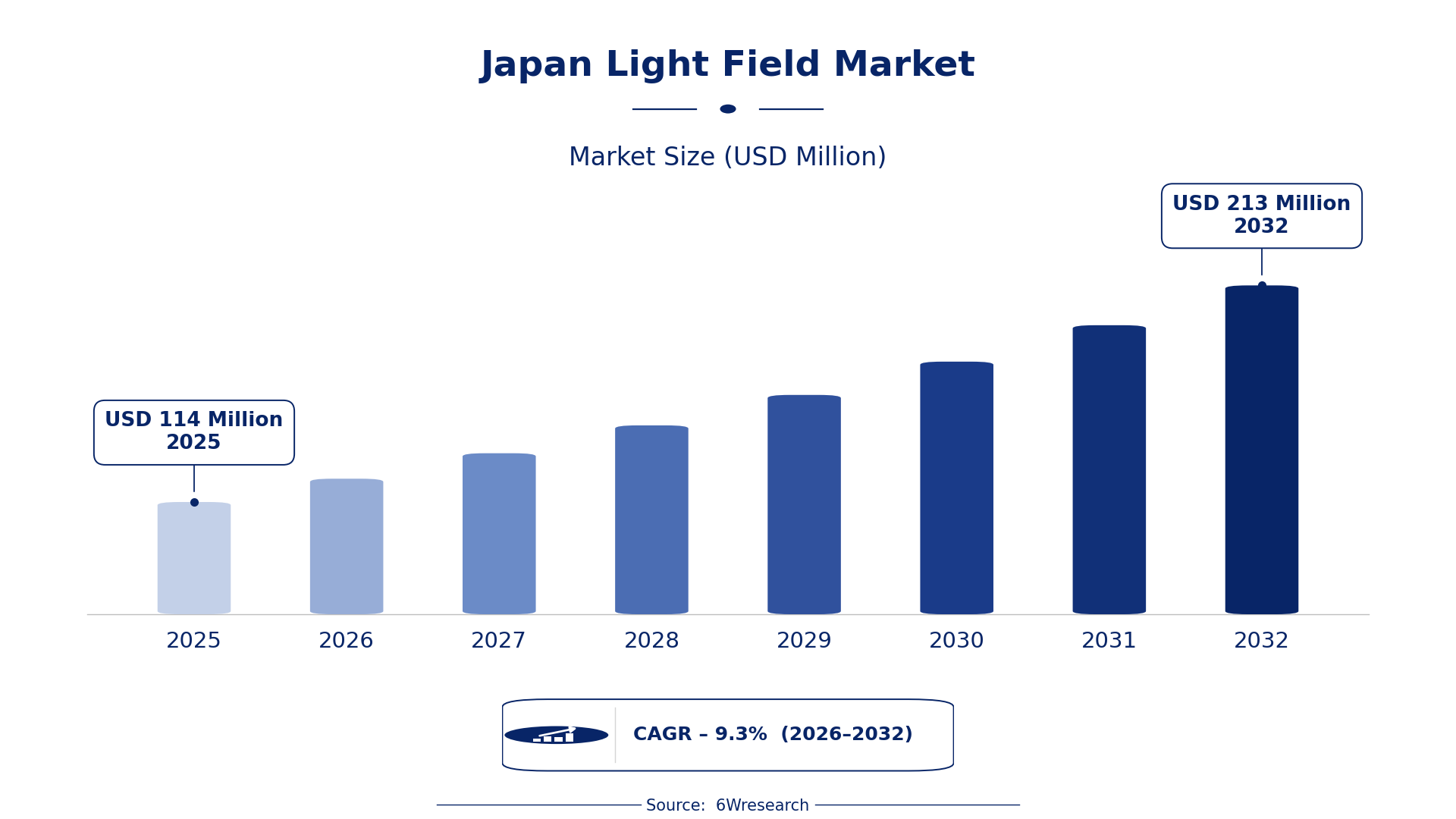
According to 6Wresearch internal database and industry insights, the Japan Light Field Market was valued at USD 114 Million in 2025 and is projected to reach USD 213 Million by 2032, growing at a CAGR of approximately 9.3% during 2026–2032.
Japan Light Field Market Highlights
| Report Metric | Details |
| Report Name | Japan Light Field Market (2026-2032) |
| Market Size 2025 | USD 114 Million |
| Market Size 2032 | USD 213 Million |
| Absolute Growth 2025–2032 | USD 99 Million |
| CAGR 2026–2032 | 9.3% |
| Peak Annual Growth | 10.8% in 2030 |
| Forecast Period | 2026–2032 |
| Historical Data | 2022–2025 |
| Base Year | 2025 |
| Leading Technology, 2025 | Hardware (63% share) |
| Leading Vertical, 2025 | Media & Entertainment (37% share) |
| Fastest-Growing Technology | Software (13.0% CAGR) |
| Fastest-Growing Vertical | Healthcare (12.2% CAGR) |
| Growing Sector | Healthcare |
| Key End Users | Media & Entertainment, Healthcare, Architecture |
Japan Light Field Market Year-wise Growth Rate and Key Drivers (2022–2032)
This graph illustrates the annual growth rates of the market from 2022 to 2032, highlighting a steady upward trajectory and projected market expansion over the forecast period.
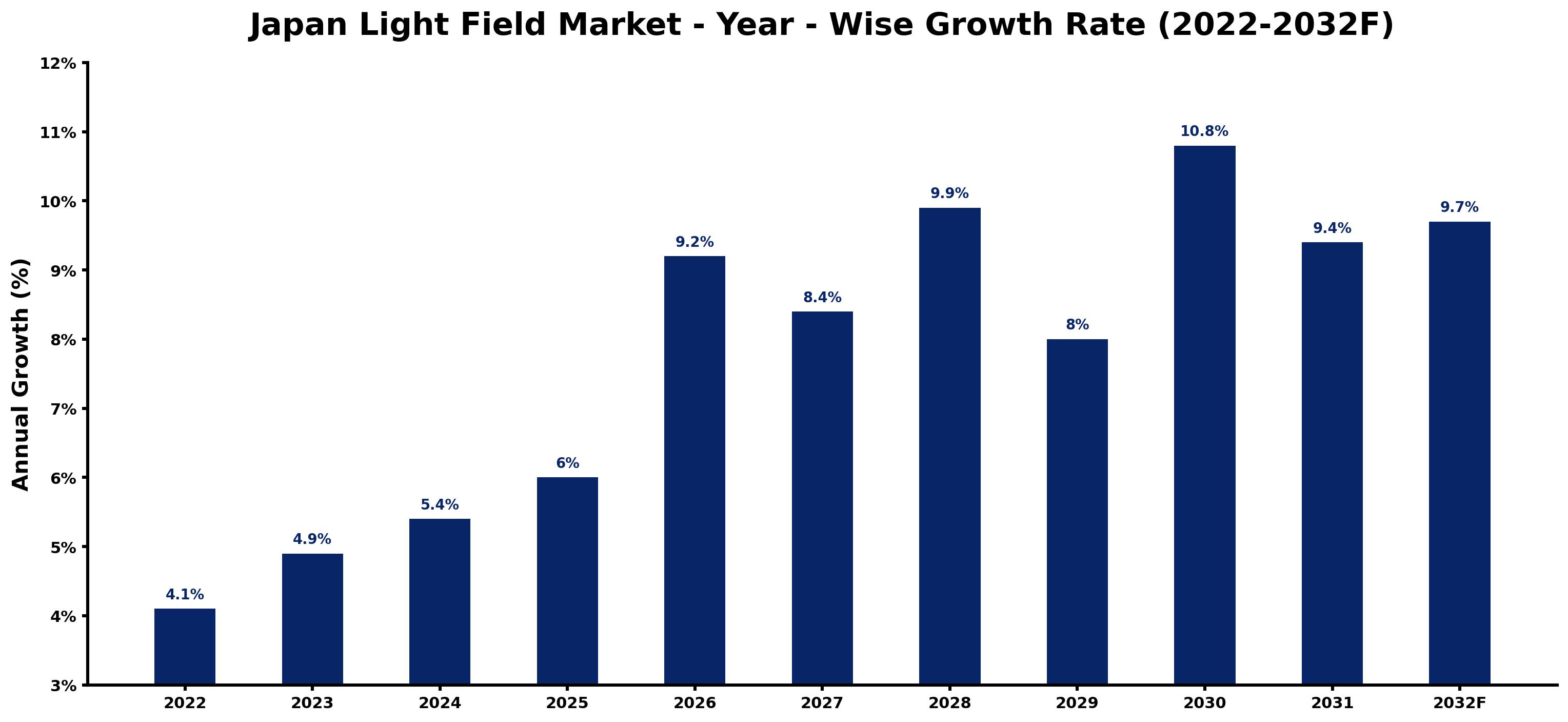
Year by year, the estimates below pair each growth rate with the development that shaped it.
| Year | Estimated Annual Growth (%) | Market Rationale |
| 2022 | 4.1 | The market experienced steady growth supported by increasing interest in immersive technologies. |
| 2023 | 4.9 | Demand rose as the healthcare sector adopted advanced imaging technologies, including light field applications. |
| 2024 | 5.4 | Growth continued due to rising investments in media and entertainment technology in the Tokyo region. |
| 2025 | 6.0 | The market peaked historically as the Japanese film industry expanded its use of light field technology. |
| 2026 | 9.2 | Growth is expected to accelerate with increased funding for research in immersive technologies for education. |
| 2027 | 8.4 | The market growth is projected to slow slightly as competition intensifies among software developers in the sector. |
| 2028 | 9.9 | Demand is expected to surge again as architectural firms adopt light field technology for design visualization. |
| 2029 | 8.0 | Growth is projected to slow as the market begins to stabilise after rapid technological advancements. |
| 2030 | 10.8 | The market is expected to hit its peak growth rate, driven by investments in healthcare imaging technologies. |
| 2031 | 9.4 | Growth is projected to slow as the market adjusts to the saturation of light field applications in entertainment. |
| 2032 | 9.7 | Demand is expected to remain strong as the healthcare sector continues to expand its use of advanced imaging technologies. |
Note: Market size estimations and growth projections presented in this report are based on 6Wresearch's proprietary forecasting methodology, utilizing the latest available industry data, government publications, and primary research inputs.
Japan Light Field Market Synopsis
Light field technology captures and reproduces light to create depth perception and 3D visualisation, primarily used in media and entertainment, healthcare, and architectural visualisation. The Japan Light Field Market is growing due to rising investments in advanced imaging technologies, particularly in the Tokyo region, a hub for media technology development. The healthcare sector's adoption of light field applications and the Japanese film industry's increasing use of this technology for special effects are key drivers of market growth. Government support for research in immersive technologies further stimulates demand across various sectors.
Market Dynamics Impact Analysis (2026–2032)
| Factor | Type | Impact | Primary Segment Affected |
| Growing demand for immersive content in the media sector | Driver | High | Media & Entertainment |
| Increased adoption of advanced imaging technologies in healthcare | Driver | High | Healthcare |
| Rising investments in research for immersive technologies | Opportunity | High | Healthcare |
| Expansion of architectural visualization services using light field technology | Opportunity | Medium | Architecture |
| High costs associated with light field technology implementation | Restraint | High | Hardware |
| Limited awareness among potential users in industrial applications | Restraint | Medium | Industrial |
| Compliance with stringent medical device regulations | Challenge | High | Software |
| Capacity constraints in production of light field hardware | Challenge | Medium | Hardware |
Evaluation of Drivers in Japan Light Field Market (2026–2032)
Below are the drivers that matter most for revenue growth, with supporting evidence.
| Drivers | Primary Segment Affected | Why It Matters (Evidence) |
| Increased investment in hardware development | Hardware | This investment is expected to generate USD 114 million in sales by 2025, prompting more purchases from media and entertainment buyers. |
| Growing demand for advanced imaging in healthcare | Software | The healthcare sector's adoption of light field imaging techniques is driving software sales, enhancing diagnostic capabilities. |
| Rising use of light field technology in film production | Media & Entertainment | The Japanese film industry is increasingly utilising light field technology for special effects, leading to higher demand for immersive content. |
| Integration of light field technology in architectural design | Architecture | Architectural firms are using light field technology for client presentations, improving design visualization and increasing project orders. |
| Government funding for immersive technology research | Healthcare | In 2023, USD 5 million was allocated for research in immersive technologies, stimulating demand for light field applications in healthcare. |
Purchasing is picking up as the Tokyo region invests heavily in media technology, leading to a projected USD 114 million in hardware sales by 2025. The healthcare sector is increasingly adopting light field imaging, with software sales expected to rise due to advanced imaging techniques. The Japanese film industry is driving demand for immersive content, as light field technology is used for special effects in productions. Architectural firms are integrating light field technology into client presentations, which improves design visualization. Funding of USD 5 million for immersive technology research in 2023 is further stimulating demand in healthcare applications.
Evaluation of Restraints in Japan Light Field Market
These are the pressures that could keep growth below its potential.
| Market Restraint | Primary Segment Affected | Why It Matters (Evidence) |
| High costs of implementing light field technology | Hardware | The initial investment for hardware and software can be prohibitive for many potential users, limiting market penetration. |
| Limited awareness of light field applications in industrial sectors | Industrial | Many industries are unaware of the benefits of light field technology, resulting in slower adoption rates. |
| Compliance with medical device regulations | Software | Strict regulations, such as ISO 13485, require extensive testing and certification, which can delay product launches. |
| Capacity constraints in hardware production | Hardware | Manufacturers face challenges in scaling production to meet demand, which can impact delivery timelines. |
| Market saturation in entertainment applications | Media & Entertainment | As more companies adopt light field technology, competition increases, which may lead to price wars. |
Japan Light Field Market Challenges
Buyers in the media sector face up to 20% higher project costs due to limited access to advanced light field imaging technologies. Delays occur for producers reliant on imported components, often extending production timelines by three months. Domestic suppliers struggle to source essential materials, which can inflate operational costs by 15% and hinder project completion. Competition intensifies as firms find it difficult to keep pace with rapid technological advancements, potentially leading to a decline in market share for those unable to adapt effectively.
Trends in the Japan Light Field Market
The shifts below are changing how Japan Light Field Market products are bought and supplied.
- Rise of Light Field Technology in Healthcare: In 2023, light field displays are being tested in select hospitals for improved patient imaging, which enhances diagnostic accuracy and patient outcomes.
- Shift in Media Production Techniques: The Tokyo Game Show 2023 showcased several demonstrations of light field technology in gaming, indicating a growing trend towards immersive gaming experiences.
- Increased Use of Light Field in Architecture: Architectural firms in Japan are increasingly utilising light field technology for client presentations, which improves design visualisation and communication with clients.
- Expansion of Research Funding for Immersive Technologies: In 2023, the government allocated USD 5 million for research in immersive technologies for education, indicating a commitment to advancing this field.
Investment Opportunities in the Japan Light Field Market
The following opportunities in the Japan Light Field Market pair current demand with a clear way in.
- Funding Gap in Healthcare Imaging: With USD 5 million allocated for research in immersive technologies, there is an opportunity to supply advanced imaging solutions to healthcare facilities.
- Partnerships for Architectural Visualisation: Architectural firms are seeking innovative visualisation tools, presenting an opportunity for local partnerships to supply light field technology.
- Growing Demand for Immersive Content: As the Japanese film industry expands its use of light field technology, there is a pressing need for software solutions to enhance content creation.
- Investment in Media Technology Development: The Tokyo region's focus on media technology presents opportunities for investments in light field hardware and software development.
Government Initiatives in the Japan Light Field Market
The Next-Generation Medical Infrastructure Act (2017) facilitates the integration of light field technology in healthcare imaging by allowing certified bodies to anonymise medical data for research. This measure encourages innovation in medical imaging, creating a supportive environment for technology adoption. The Clinical Trials Act (2017) sets rules for conducting clinical research, impacting how healthcare providers can implement light field imaging technologies, as they must meet stringent quality and safety requirements.
The PMDA reviews the approval of medical devices, ensuring compliance with standards like ISO 13485. This regulatory framework impacts how healthcare providers can implement light field imaging technologies, as they must meet stringent quality and safety requirements.
Future Insight of the Japan Light Field Market
Light field technology will transform demand in the media sector by 2032 as new applications in gaming and virtual reality emerge. A government programme will allocate funding for research in immersive technologies, which will improve educational tools. Architectural firms will adopt advanced light field systems for client presentations, increasing design accuracy. By 2032, hospitals will implement light field displays for patient imaging, enhancing diagnostic capabilities and improving patient outcomes.
Market Segmentation Analysis
Japan Light Field Market report covers a detailed analysis of the following market segments:
By Technology – Hardware Leads, Software Expected to Grow Fastest
According to Sachin Kumar Rai, Senior Research Analyst at 6Wresearch, Hardware accounted for 63% of the market by technology in 2025. Hardware commands the largest share due to its critical role in capturing light fields, particularly in the Tokyo region, a key area for media technology development. Its prominence is evidenced by extensive use in the Japanese film industry for special effects, showcasing its importance. Software is set to record the highest CAGR in this split, 13.0% over 2026–2032. Software experiences rapid growth as it is essential for processing and rendering light field data, increasingly required for sophisticated applications. The government's strategy to promote imaging technologies in healthcare is expected to further accelerate software adoption in this domain. Suppliers must focus on improving software capabilities to meet the rising demand in healthcare and entertainment.
By Vertical – Media & Entertainment Leads, Healthcare Expected to Grow Fastest
The largest vertical category in 2025 was Media & Entertainment, at 37% of revenue. Media & Entertainment dominates the market because of its widespread use of light field technology for creating immersive content, particularly in the Tokyo region where technology development is concentrated. The Japanese film industry's increasing reliance on this technology for special effects highlights its vital role in this sector. The quickest growth will come from Healthcare, forecast to expand at a CAGR of 12.2% between 2026 and 2032. Healthcare is the fastest-growing vertical as it adopts advanced imaging techniques for diagnostics, spurred by government initiatives promoting new imaging technologies. The implementation of light field displays in hospitals indicates a strong potential for growth in this area. Buyers in healthcare should anticipate an influx of advanced imaging solutions, while suppliers need to adapt to this increasing demand.
Key Attractiveness of the Report
- 10 Years of Market Numbers
- Historical Data Starting from 2022 to 2025
- Base Year 2025
- Forecast Data until 2032
- Key Performance Indicators Impacting the Market
- Major Upcoming Developments and Projects
Key Highlights of the Report:
- Japan Light Field Market Outlook
- Market Size of Japan Light Field Market, 2025
- Forecast of Japan Light Field Market, 2032
- Historical Data and Forecast of Japan Light Field Revenues & Volume for the Period 2022-2032
- Japan Light Field Market Trend Evolution
- Japan Light Field Market Drivers and Challenges
- Japan Light Field Price Trends
- Japan Light Field Porter's Five Forces
- Japan Light Field Industry Life Cycle
- Historical Data and Forecast of Japan Light Field Market Revenues & Volume By Technology for the Period 2022-2032
- Historical Data and Forecast of Japan Light Field Market Revenues & Volume By Hardware for the Period 2022-2032
- Historical Data and Forecast of Japan Light Field Market Revenues & Volume By Software for the Period 2022-2032
- Historical Data and Forecast of Japan Light Field Market Revenues & Volume By Vertical for the Period 2022-2032
- Historical Data and Forecast of Japan Light Field Market Revenues & Volume By Media & Entertainment for the Period 2022-2032
- Historical Data and Forecast of Japan Light Field Market Revenues & Volume By Healthcare for the Period 2022-2032
- Historical Data and Forecast of Japan Light Field Market Revenues & Volume By Architecture for the Period 2022-2032
- Historical Data and Forecast of Japan Light Field Market Revenues & Volume By Industrial for the Period 2022-2032
- Historical Data and Forecast of Japan Light Field Market Revenues & Volume By Defense for the Period 2022-2032
- Historical Data and Forecast of Japan Light Field Market Revenues & Volume By for the Period 2022-2032
- Japan Light Field Import Export Trade Statistics
- Market Opportunity Assessment By Technology
- Market Opportunity Assessment By Vertical
- Market Opportunity Assessment By
- Japan Light Field Top Companies Market Share
- Japan Light Field Competitive Benchmarking By Technical and Operational Parameters
- Japan Light Field Company Profiles
- Japan Light Field Key Strategic Recommendations
Market Covered
Segments analysed in this report are listed below.
By Technology
- Hardware
- Software
By Vertical
- Media & Entertainment
- Healthcare
- Architecture
- Industrial
- Defense































