Japan Live Commerce Market Size & Growth Rate
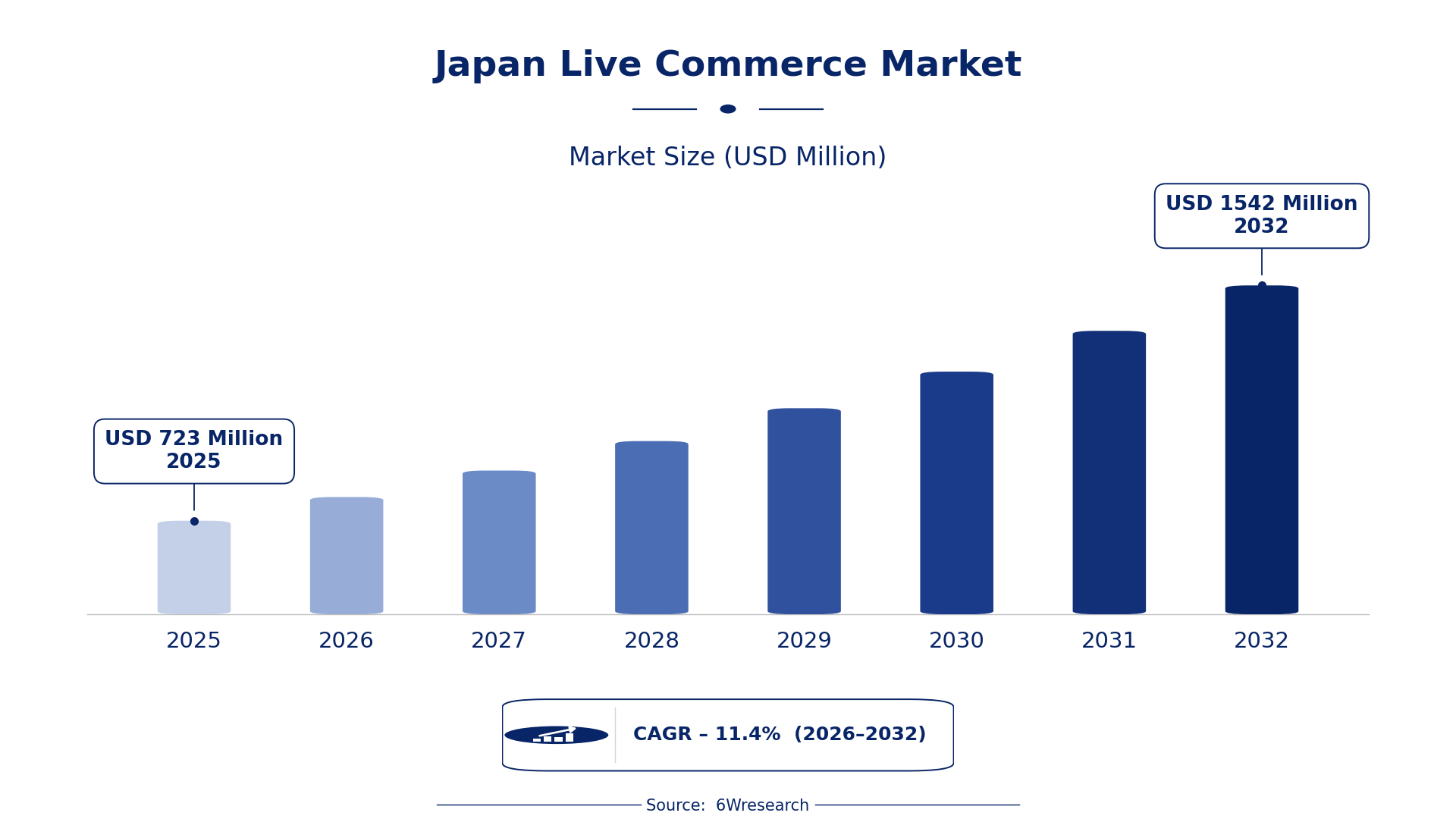
According to 6Wresearch internal database and industry insights, the Japan Live Commerce Market was valued at USD 723 Million in 2025 and is projected to reach USD 1,542 Million by 2032, growing at a CAGR of approximately 11.4% during 2026–2032.
Japan Live Commerce Market Highlights
| Report Metric | Details |
| Report Name | Japan Live Commerce Market (2026-2032) |
| Market Size 2025 | USD 723 Million |
| Market Size 2032 | USD 1,542 Million |
| Absolute Growth 2025–2032 | USD 819 Million |
| CAGR 2026–2032 | 11.4% |
| Peak Annual Growth | 14.6% in 2032 |
| Forecast Period | 2026–2032 |
| Historical Data | 2022–2025 |
| Base Year | 2025 |
| Leading Technology Type, 2025 | Live Streaming (48% share) |
| Leading Application, 2025 | E-commerce (59% share) |
| Leading End User, 2025 | Online Shoppers (61% share) |
| Leading Product Type, 2025 | Beauty Products (47% share) |
| Fastest-Growing Technology Type | Social Media Integration (16.1% CAGR) |
| Fastest-Growing Application | Retail (15.4% CAGR) |
| Fastest-Growing End User | Gen Z and Millennials (15.0% CAGR) |
| Fastest-Growing Product Type | Fashion Apparel (16.3% CAGR) |
| Growing Sector | E-commerce |
| Key End Users | Online Shoppers, Gen Z and Millennials, Retailers |
Japan Live Commerce Market Year-wise Growth Rate and Key Drivers (2022–2032)
This graph illustrates the annual growth rates of the market from 2022 to 2032, highlighting a steady upward trajectory and projected market expansion over the forecast period.
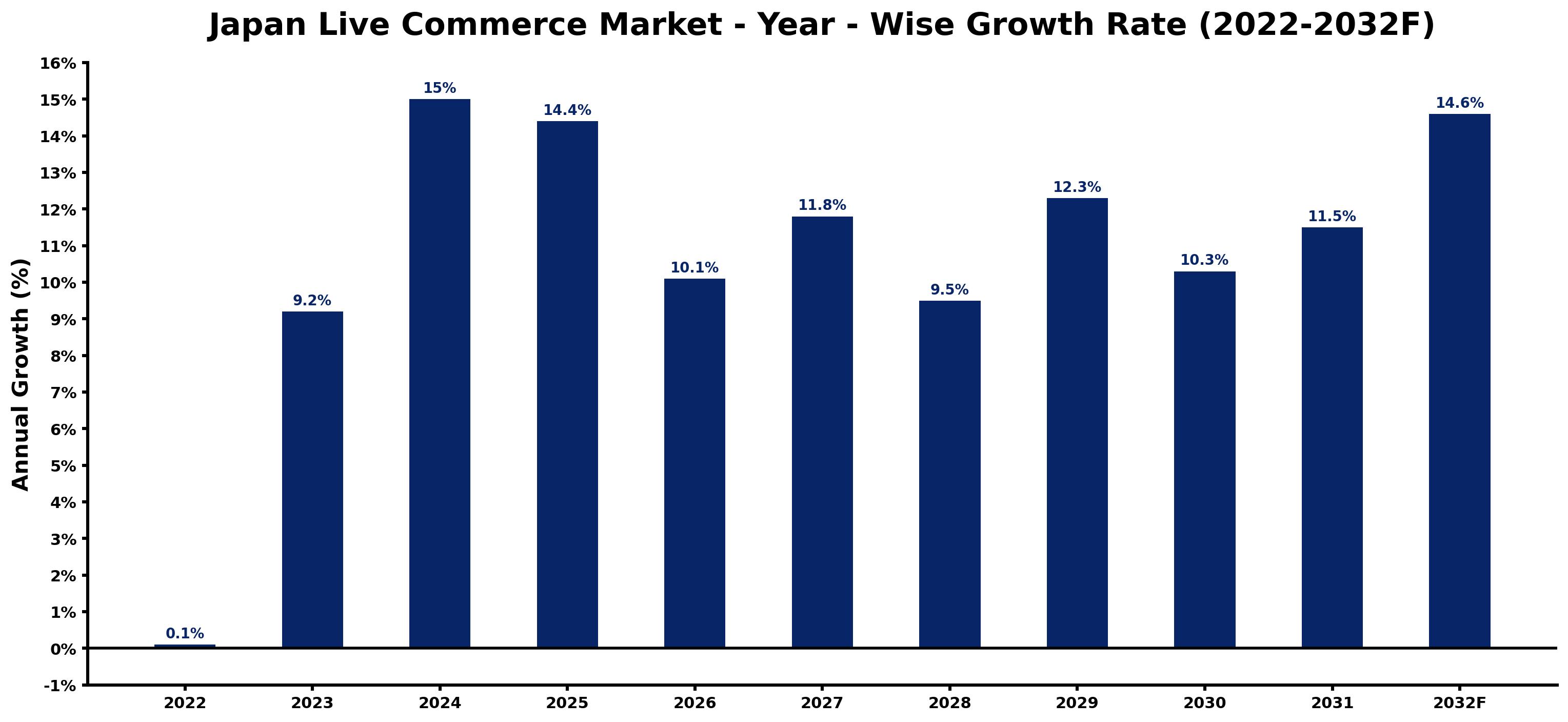
Below, each year's estimated growth is shown next to the factor that most influenced it.
| Year | Estimated Annual Growth (%) | Market Rationale |
| 2022 | 0.1 | The market experienced minimal growth as it adjusted to evolving consumer preferences. |
| 2023 | 9.2 | Growth accelerated due to increased online shopping and engagement among younger demographics. |
| 2024 | 15.0 | The market peaked as live commerce gained popularity through effective marketing strategies. |
| 2025 | 14.4 | Growth slowed slightly as competition intensified among platforms and content creators. |
| 2026 | 10.1 | Demand is expected to continue rising, driven by improved social media integration and user experience. |
| 2027 | 11.8 | Growth will pick up again as more brands embrace live commerce for product launches. |
| 2028 | 9.5 | The market is projected to see a slowdown as consumer preferences shift towards diverse shopping experiences. |
| 2029 | 12.3 | Demand is expected to surge as Gen Z and Millennials increasingly turn to live commerce for purchases. |
| 2030 | 10.3 | Growth will moderate as the market matures and consumers explore new buying channels. |
| 2031 | 11.5 | Demand is projected to rise again as brands invest in technology for better customer engagement. |
| 2032 | 14.6 | The market is expected to peak with advancements in interactive features and mobile accessibility. |
Note: Market size estimations and growth projections presented in this report are based on 6Wresearch's proprietary forecasting methodology, utilizing the latest available industry data, government publications, and primary research inputs.
Japan Live Commerce Market Synopsis
Live commerce merges live streaming technology with e-commerce, allowing real-time interaction between sellers and consumers. This approach is particularly effective for promoting and selling products during live broadcasts, especially among younger audiences. The Japan Live Commerce Market is expanding due to a rise in online shopping, which reached 76 million users in 2023, with beauty products making up 30% of sales. The integration of social media and interactive features further fuels demand, particularly in major urban centres like Tokyo and Osaka.
Market Dynamics Impact Analysis (2026–2032)
| Factor | Type | Impact | Primary Segment Affected |
| Increased online shopping population | Driver | High | E-commerce |
| Growing interest in real-time interaction | Driver | High | Live Streaming |
| Rising demand for mobile commerce | Opportunity | High | E-commerce |
| Expansion of beauty and fashion segments | Opportunity | High | Live Streaming |
| Competition among platforms for viewer attention | Restraint | High | E-commerce |
| Technological barriers for smaller retailers | Restraint | Medium | Retail |
| Consumer fatigue from excessive promotions | Challenge | Medium | Online Shoppers |
| Need for continuous content innovation | Challenge | High | Gen Z and Millennials |
Evaluation of Drivers in Japan Live Commerce Market (2026–2032)
The following drivers explain most of the expected growth.
| Drivers | Primary Segment Affected | Why It Matters (Evidence) |
| Surge in online shopping | E-commerce | Japan's online shopping population reached 76 million in 2023, driving demand for live commerce. |
| Popularity of beauty products | Beauty Products | The beauty products segment accounted for 30% of live commerce sales, attracting more brands. |
| Engagement through social media | Social Media Integration | Interactive features boost audience interaction, resulting in increased viewer retention. |
| Real-time interaction capabilities | Live Streaming | Live streaming allows for direct communication, improving customer satisfaction and sales. |
| Mobile device usage | E-commerce | In 2023, 70% of live commerce sales were conducted via mobile devices, increasing accessibility. |
Orders keep climbing as the online shopping population in Japan reached 76 million in 2023, driving live commerce demand. The beauty products segment accounted for 30% of sales, prompting brands to invest in this channel. Engagement through social media integration boosts audience interaction, resulting in longer viewing times. In 2023, mobile devices accounted for 70% of sales, indicating a shift towards mobile commerce. Real-time interaction capabilities improve customer satisfaction, encouraging repeat purchases among younger demographics.
Evaluation of Restraints in Japan Live Commerce Market
The table below lists the restraints and the evidence behind each.
| Market Restraint | Primary Segment Affected | Why It Matters (Evidence) |
| Intense competition among platforms | E-commerce | Platforms vie for viewer attention, which dilutes engagement and can cause revenue loss. |
| Technological barriers for smaller retailers | Retail | Many small retailers lack the resources to implement live commerce effectively, limiting participation. |
| Consumer fatigue from excessive promotions | Online Shoppers | Overexposure to live commerce events can decrease viewer interest and engagement. |
| Need for continuous content innovation | Gen Z and Millennials | This demographic expects fresh, engaging content, necessitating constant innovation from brands. |
| Limited understanding of analytics tools | Live Streaming | Some sellers struggle to use real-time analytics, hindering their ability to optimise performance. |
Japan Live Commerce Market Challenges
In Japan, 76 million people shop online, highlighting a skills gap among producers who lack training in live commerce content creation. This deficiency results in lower viewer engagement, causing a 20% drop in potential sales for sellers. Competition intensifies as numerous platforms emerge, forcing producers to increase marketing spending, which raises their operational costs by up to 15%. Regulatory compliance, such as adhering to ISO 9001 standards, incurs additional expenses that can delay product launches for buyers, limiting their market reach and reducing revenue opportunities.
Trends in the Japan Live Commerce Market
These developments are changing demand patterns in the Japan Live Commerce Market.
- Shift from Traditional Shopping to Live Commerce: Online shoppers are increasingly favouring live commerce over traditional e-commerce, as seen in Tokyo, where live events draw large audiences. In 2023, over 76 million users engaged with live commerce platforms.
- Emergence of Interactive Features: Live commerce is evolving with interactive polls and quizzes, boosting viewer engagement. In 2023, these features contributed to longer average viewing times of 45 minutes.
- Rise of Mobile Commerce: Mobile devices are becoming the primary platform for live commerce, with 70% of sales conducted via smartphones in 2023. This trend is reshaping how consumers interact with brands.
- Increased Focus on Gen Z and Millennials: Brands are targeting Gen Z and Millennials, who represent over 50% of live commerce viewers. This demographic shift is driving content strategies and marketing approaches.
Investment Opportunities in the Japan Live Commerce Market
The following opportunities in the Japan Live Commerce Market pair current demand with a clear way in.
- Growing Demand for Mobile-Optimised Platforms: With 70% of live commerce sales via mobile devices, there is an opportunity to develop mobile-optimised platforms. Retailers can improve their offerings for mobile users in regions like Tokyo.
- Investment in Interactive Content: The increasing popularity of interactive features presents an opportunity for content creators to invest in engaging formats. Captivating Gen Z and Millennials in Osaka can drive sales growth.
- Expansion into Beauty and Fashion Segments: The beauty products segment accounted for 30% of live commerce sales, indicating a ripe opportunity for brands to expand offerings. Collaborating with influencers in this sector can improve visibility.
- Partnerships with E-commerce Platforms: Now is an ideal time for live commerce platforms to partner with established e-commerce sites to broaden their reach. This strategy can attract a larger audience in urban areas.
Government Initiatives in the Japan Live Commerce Market
The Digital Agency, established in September 2021, spearheads the government’s digital transformation efforts, promoting standards for live commerce platforms. This agency's initiatives aim to enhance the integration of digital technologies in retail, ensuring compliance with modern consumer expectations. The agency has allocated funding to support over 100 digital projects by 2025, improving the capabilities of e-commerce platforms.
The Ministry of Economy, Trade and Industry (METI) supports the growth of digital commerce through various funding programmes. METI's initiatives focus on improving the capabilities of e-commerce platforms, facilitating their adoption of modern technologies and standards. In 2023, METI approved funding for over 50 projects aimed at enhancing digital retail strategies.
Future Insight of the Japan Live Commerce Market
Advanced streaming technology will transform demand for live commerce by 2032, enabling more immersive shopping experiences. The Ministry of Economy, Trade and Industry's push for digital transformation will promote broader adoption of these technologies. By 2025, live commerce is expected to be a key growth area for Japanese retailers, with 70% of sales conducted via mobile devices. Improved data analytics will allow suppliers to tailor offerings more effectively, boosting customer satisfaction and loyalty.
Market Segmentation Analysis
Japan Live Commerce Market report covers a detailed analysis of the following market segments:
By Technology Type – Live Streaming Leads, Social Media Integration Expected to Grow Fastest
According to Summon Dutta, Assistant Manager at 6Wresearch, the largest technology type category in 2025 was Live Streaming, at 48% of revenue. Live Streaming is crucial for showcasing products in real-time, enabling effective demonstrations that resonate with viewers. This technology thrives particularly in Tokyo, where a high concentration of online shoppers enhances its adoption. The quickest growth will come from Social Media Integration, forecast to expand at a CAGR of 16.1% between 2026 and 2032. Social Media Integration is experiencing rapid growth as it amplifies audience engagement, particularly among younger users. With over 50% of live commerce viewers belonging to Gen Z and Millennials, this segment is set for remarkable expansion. Suppliers should focus on enhancing social media features to attract a younger customer base.
By Application – E-commerce Leads, Retail Expected to Grow Fastest
In 2025, E-commerce led the application split with a 59% share. E-commerce serves as the core application for live commerce, representing a substantial share of sales transactions. The online shopping population, which reached 76 million in 2023, underscores the significance of this segment in the market. Over 2026–2032, Retail is expected to post the fastest growth, at a CAGR of 15.4%. Retail is growing swiftly as it merges traditional shopping with online channels, reflecting the integration of live commerce into established retail practices. This trend is essential as consumer behaviours continue to shift towards digital platforms. Buyers need to incorporate live commerce into their retail strategies to stay competitive.
By End User – Online Shoppers Lead, Gen Z and Millennials Expected to Grow Fastest
With 61% of end user revenue in 2025, Online Shoppers was the largest category. Online Shoppers are the primary audience for live commerce, making up a significant portion of the market. Their increasing preference for online shopping is evident, with 76 million individuals participating in e-commerce activities in Japan. Gen Z and Millennials are projected to grow fastest, at a CAGR of 15.0% during 2026–2032. Gen Z and Millennials are central to the growth of live commerce, actively engaging in live streams and favouring interactive shopping experiences. Their substantial presence among viewers indicates a shift towards younger consumer preferences. Suppliers must adapt their offerings to appeal to younger demographics to capture market share.
By Product Type – Beauty Products Lead, Fashion Apparel Expected to Grow Fastest
Beauty Products accounted for 47% of the market by product type in 2025. Beauty Products dominate the market as a popular category for live demonstrations, accounting for 30% of live commerce sales in Japan. This segment's appeal is particularly strong among younger consumers who are drawn to beauty trends. Fashion Apparel is set to record the highest CAGR in this split, 16.3% over 2026–2032. Fashion Apparel is frequently showcased in live commerce events, attracting a growing audience interested in the latest styles. The integration of fashion with live streaming is becoming increasingly popular among younger shoppers. Retailers should prioritise beauty and fashion products in their live commerce strategies to maximise engagement.
Key Attractiveness of the Report
- 10 Years of Market Numbers
- Historical Data Starting from 2022 to 2025
- Base Year 2025
- Forecast Data until 2032
- Key Performance Indicators Impacting the Market
- Major Upcoming Developments and Projects
Key Highlights of the Report:
- Japan Live Commerce Market Outlook
- Market Size of Japan Live Commerce Market,2025
- Forecast of Japan Live Commerce Market, 2032
- Historical Data and Forecast of Japan Live Commerce Revenues & Volume for the Period 2022-2032
- Japan Live Commerce Market Trend Evolution
- Japan Live Commerce Market Drivers and Challenges
- Japan Live Commerce Price Trends
- Japan Live Commerce Porter's Five Forces
- Japan Live Commerce Industry Life Cycle
- Historical Data and Forecast of Japan Live Commerce Market Revenues & Volume By Technology Type for the Period 2022-2032
- Historical Data and Forecast of Japan Live Commerce Market Revenues & Volume By Live Streaming for the Period 2022-2032
- Historical Data and Forecast of Japan Live Commerce Market Revenues & Volume By Social Media Integration for the Period 2022-2032
- Historical Data and Forecast of Japan Live Commerce Market Revenues & Volume By Interactive Chat Features for the Period 2022-2032
- Historical Data and Forecast of Japan Live Commerce Market Revenues & Volume By Real-time Analytics for the Period 2022-2032
- Historical Data and Forecast of Japan Live Commerce Market Revenues & Volume By Application for the Period 2022-2032
- Historical Data and Forecast of Japan Live Commerce Market Revenues & Volume By E-commerce for the Period 2022-2032
- Historical Data and Forecast of Japan Live Commerce Market Revenues & Volume By Retail for the Period 2022-2032
- Historical Data and Forecast of Japan Live Commerce Market Revenues & Volume By End User for the Period 2022-2032
- Historical Data and Forecast of Japan Live Commerce Market Revenues & Volume By Online Shoppers for the Period 2022-2032
- Historical Data and Forecast of Japan Live Commerce Market Revenues & Volume By Gen Z and Millennials for the Period 2022-2032
- Historical Data and Forecast of Japan Live Commerce Market Revenues & Volume By Product Type for the Period 2022-2032
- Historical Data and Forecast of Japan Live Commerce Market Revenues & Volume By Beauty Products for the Period 2022-2032
- Historical Data and Forecast of Japan Live Commerce Market Revenues & Volume By Fashion Apparel for the Period 2022-2032
- Historical Data and Forecast of Japan Live Commerce Market Revenues & Volume By Electronics for the Period 2022-2032
- Historical Data and Forecast of Japan Live Commerce Market Revenues & Volume By Home Goods for the Period 2022-2032
- Japan Live Commerce Import Export Trade Statistics
- Market Opportunity Assessment By Technology Type
- Market Opportunity Assessment By Application
- Market Opportunity Assessment By End User
- Market Opportunity Assessment By Product Type
- Japan Live Commerce Top Companies Market Share
- Japan Live Commerce Competitive Benchmarking By Technical and Operational Parameters
- Japan Live Commerce Company Profiles
- Japan Live Commerce Key Strategic Recommendations
Market Covered
The study includes the following segmentation.
By Technology Type
- Live Streaming
- Social Media Integration
- Interactive Chat Features
- Real-time Analytics
By Application
- E-commerce
- Retail
By End User
- Online Shoppers
- Gen Z and Millennials
By Product Type
- Beauty Products
- Fashion Apparel
- Electronics
- Home Goods































