Japan Location Based Virtual Reality Market Size & Growth Rate
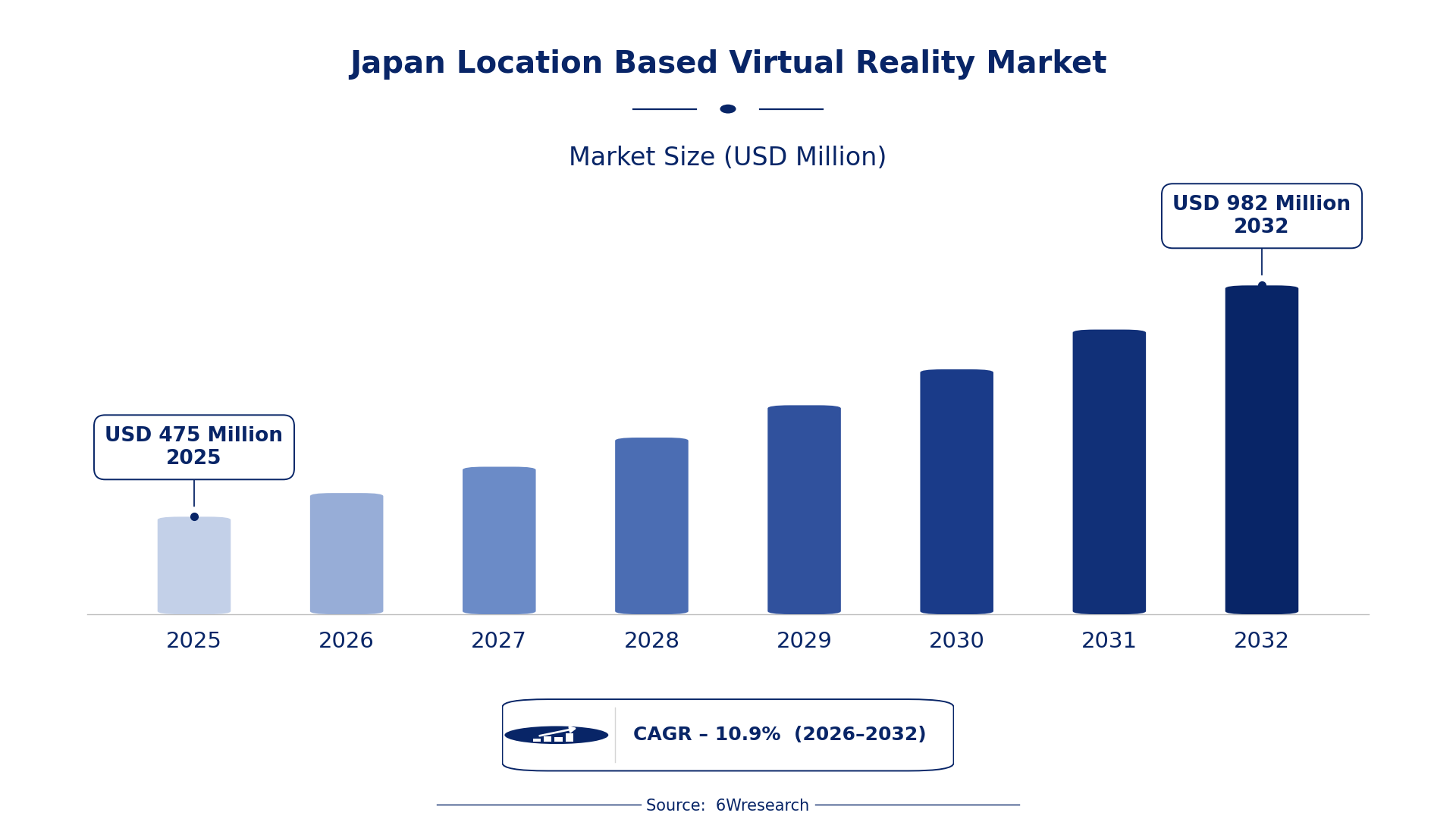
According to 6Wresearch internal database and industry insights, the Japan Location Based Virtual Reality Market was valued at USD 475 Million in 2025 and is projected to reach USD 982 Million by 2032, growing at a CAGR of approximately 10.9% during 2026–2032.
Japan Location Based Virtual Reality Market Highlights
| Report Metric | Details |
| Report Name | Japan Location Based Virtual Reality Market (2026-2032) |
| Market Size 2025 | USD 475 Million |
| Market Size 2032 | USD 982 Million |
| Absolute Growth 2025–2032 | USD 507 Million |
| CAGR 2026–2032 | 10.9% |
| Peak Annual Growth | 11.7% in 2026 |
| Forecast Period | 2026–2032 |
| Historical Data | 2022–2025 |
| Base Year | 2025 |
| Leading Device Type, 2025 | Head-Mounted Displays (61% share) |
| Leading Application, 2025 | Gaming (68% share) |
| Leading Content Formatting, 2025 | 360-Degree Videos (54% share) |
| Leading End user, 2025 | Consumer (54% share) |
| Leading Deployment Model, 2025 | On-Premises (63% share) |
| Fastest-Growing Device Type | Handheld Devices (14.3% CAGR) |
| Fastest-Growing Application | Entertainment (13.6% CAGR) |
| Fastest-Growing End user | Enterprise (13.1% CAGR) |
| Fastest-Growing Deployment Model | Cloud-Based (15.1% CAGR) |
| Growing Sector | entertainment |
| Key End Users | gaming venues, educational institutions, entertainment centres, individual consumers |
Japan Location Based Virtual Reality Market Year-wise Growth Rate and Key Drivers (2022–2032)
This graph illustrates the annual growth rates of the market from 2022 to 2032, highlighting a steady upward trajectory and projected market expansion over the forecast period.
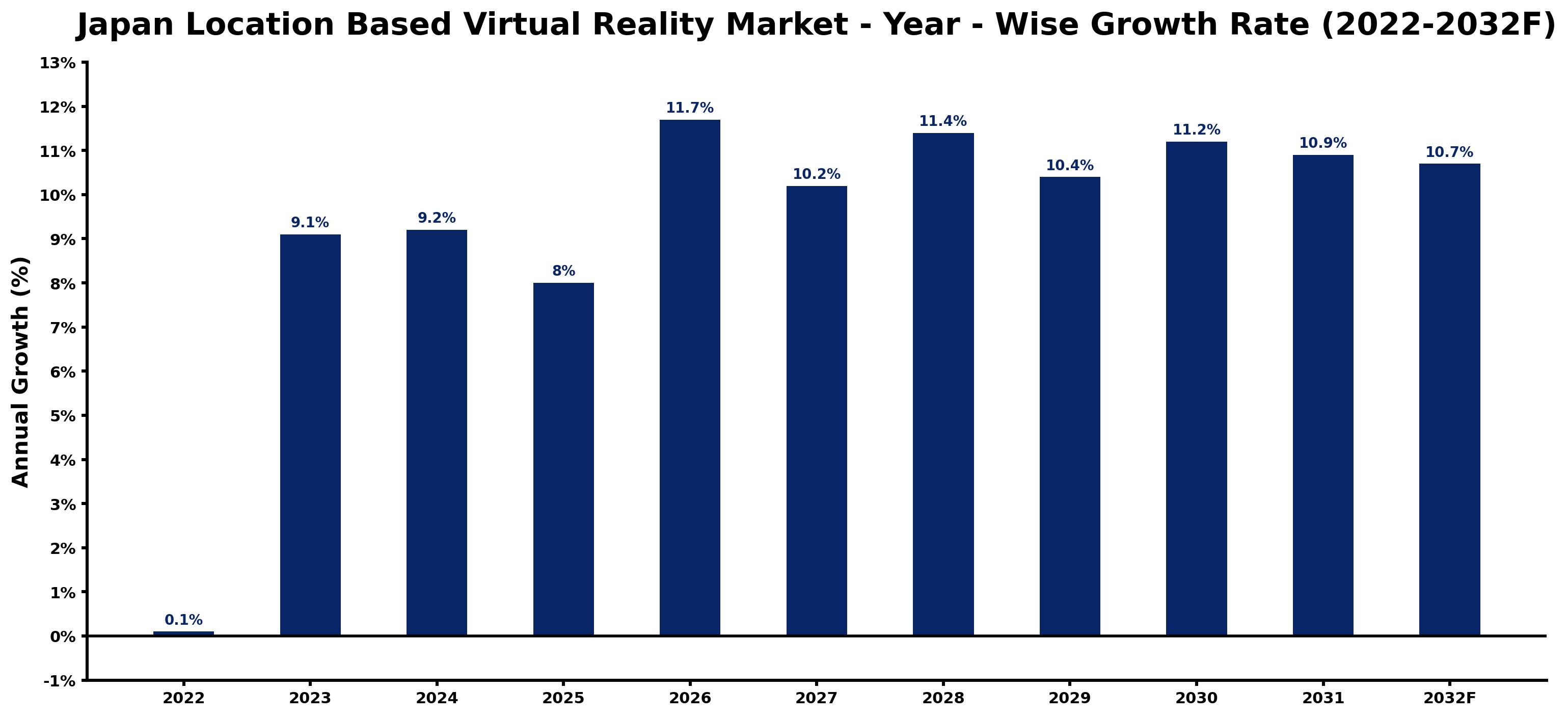
Year by year, the estimates below pair each growth rate with the development that shaped it.
| Year | Estimated Annual Growth (%) | Market Rationale |
| 2022 | 0.1 | The market showed minimal activity with only slight growth observed. |
| 2023 | 9.1 | Growth accelerated as more entertainment venues adopted LBVR technology. |
| 2024 | 9.2 | The introduction of new immersive experiences drove further growth in the market. |
| 2025 | 8.0 | Growth slowed as the market began to stabilise after rapid expansion. |
| 2026 | 11.7 | The peak growth year saw increased investment in LBVR installations across Japan. |
| 2027 | 10.2 | Growth slowed slightly as the market adjusted to new consumer preferences. |
| 2028 | 11.4 | Demand rose again as engaging content attracted more users to LBVR. |
| 2029 | 10.4 | The market experienced another slowdown as competition intensified among venues. |
| 2030 | 11.2 | Growth picked up as new gaming experiences were introduced to consumers. |
| 2031 | 10.9 | The market continued to grow, but at a slower pace due to market saturation. |
| 2032 | 10.7 | Growth moderated as the market matured, with a focus on quality experiences. |
Note: Market size estimations and growth projections presented in this report are based on 6Wresearch's proprietary forecasting methodology, utilizing the latest available industry data, government publications, and primary research inputs.
Japan Location Based Virtual Reality Market Synopsis
Location Based Virtual Reality (LBVR) creates immersive experiences through advanced hardware and interactive software. In Japan, the market thrives with approximately 67 million gamers and over 500 VR arcade locations. Demand is driven by the popularity of gaming and entertainment venues, supported by the 'Cool Japan' programme, which promotes VR content creation. The market is set to expand as technology and user engagement evolve, with growth expected in the coming years.
Market Dynamics Impact Analysis (2026–2032)
| Factor | Type | Impact | Primary Segment Affected |
| Growing gaming population | Driver | High | Gaming |
| Increasing investment in VR technology | Driver | High | Entertainment |
| Expansion of VR arcade locations | Opportunity | High | On-Premises |
| Rising demand for educational VR content | Opportunity | Medium | Consumer |
| High costs of advanced VR equipment | Restraint | High | Head-Mounted Displays |
| Limited availability of high-quality content | Restraint | Medium | 360-Degree Videos |
| Competition from alternative entertainment options | Challenge | High | Gaming |
| Technological limitations in VR experiences | Challenge | Medium | Entertainment |
Evaluation of Drivers in Japan Location Based Virtual Reality Market (2026–2032)
The table below links each growth driver to the segment it affects and the evidence for it.
| Drivers | Primary Segment Affected | Why It Matters (Evidence) |
| Growing interest in immersive gaming experiences | Gaming | Japan's gaming population is approximately 67 million, leading to increased demand for LBVR installations. |
| Investment in entertainment technology | Entertainment | The VR market in Japan was valued at around 200 billion yen in 2022, prompting more venues to adopt LBVR. |
| Support from government initiatives | On-Premises | The Ministry of Economy, Trade and Industry supports VR technology development, encouraging more arcade openings. |
| Increased adoption of VR in education | Consumer | VR content for education is increasingly adopted in Japanese schools, expanding the user base. |
| Popularity of events like Tokyo Game Show | 360-Degree Videos | The Tokyo Game Show features VR gaming annually, showcasing new content and driving consumer interest. |
What keeps demand rising is the growing interest in immersive gaming experiences, with Japan's gaming population at approximately 67 million. This large user base fuels demand for LBVR installations in entertainment venues. Investment in entertainment technology remains strong, as the VR market was valued at around 200 billion yen in 2022. The increasing adoption of VR in education broadens the user base, while events like the Tokyo Game Show showcase new content, generating consumer interest.
Evaluation of Restraints in Japan Location Based Virtual Reality Market
Several factors work against faster growth; the main ones are summarised below.
| Market Restraint | Primary Segment Affected | Why It Matters (Evidence) |
| High costs of advanced VR equipment | Head-Mounted Displays | The average cost of head-mounted displays can be prohibitive for smaller venues, limiting market growth. |
| Limited availability of high-quality content | 360-Degree Videos | A lack of engaging and diverse content hampers user experience and retention in LBVR. |
| Competition from alternative entertainment options | Gaming | With numerous gaming options available, LBVR must compete for consumer attention and spending. |
| Technological limitations in VR experiences | Entertainment | Latency issues in cloud-based models can detract from the immersive experience, affecting user satisfaction. |
| Market saturation in urban areas | On-Premises | The concentration of VR arcades in major cities leads to fierce competition and potential overcapacity. |
Japan Location Based Virtual Reality Market Challenges
Japan's VR arcade locations exceed 500, yet many operators face inconsistent supply of advanced VR equipment, delaying new installations and limiting their competitive edge. Buyers encounter high costs as the VR market was valued at around 200 billion yen in 2022, restricting access for smaller entertainment venues and reducing their market participation. Competition intensifies as international players enter the market, forcing local suppliers to lower prices, which can shrink profit margins for producers. Regulatory hurdles arise, as compliance with JIS X 0129 standards can postpone product launches, affecting revenue for suppliers and limiting choices for buyers.
Trends in the Japan Location Based Virtual Reality Market
Several trends are reshaping the Japan Location Based Virtual Reality Market; the most important are set out below.
- Shift from Traditional to Immersive Gaming Experiences: Consumers are increasingly favouring immersive gaming experiences over traditional formats, as seen in Tokyo's VR arcades, which have proliferated to over 500 locations in 2023.
- Transition from On-Premises to Cloud-Based Models: The market is experiencing a gradual shift towards cloud-based VR solutions, with a projected CAGR of 15.1% for this deployment model, driven by technological advancements.
- Emergence of Educational VR Content: Since 2022, educational institutions have begun integrating VR content into curricula, reflecting a growing trend towards immersive learning experiences in Japan's schools.
- Prioritisation of User Engagement in Content Creation: The Japan VR Association promotes standards for engaging content creation, encouraging developers to focus on user interaction, which is essential for market growth.
Investment Opportunities in the Japan Location Based Virtual Reality Market
The opportunities below stand out in the Japan Location Based Virtual Reality Market for new entrants and existing suppliers.
- Partnerships with Local Venues: With over 500 VR arcade locations, forming partnerships with local venues can help suppliers tap into a growing market, valued at approximately 200 billion yen.
- Investment in 360-Degree Video Production: The demand for 360-degree videos is rising, with a 54% share in 2025, offering opportunities for content creators to supply engaging experiences.
- Expansion into Educational Institutions: The increasing adoption of VR content in schools presents a strong opportunity, focusing on developing educational experiences for students.
- Utilising Government Support Initiatives: The Japanese government allocated 10 billion yen for digital innovation in 2023, providing funding opportunities for projects in the LBVR sector.
Government Initiatives in the Japan Location Based Virtual Reality Market
The PMD Act, established in 1960 and renamed in 2014, regulates the approval and quality of medical devices, impacting VR producers by ensuring safety standards are met. Additionally, the Digital Agency, established in September 2021, leads government digital transformation and common system standards, promoting the use of VR technology in various sectors.
The Japan VR Association oversees funding for VR technology development, approving projects that support the industry. The agency also plays a role in promoting industry standards and practices, ensuring producers adhere to quality guidelines.
Future Insight of the Japan Location Based Virtual Reality Market
New VR arcade facilities will emerge, driven by the government's 10 billion yen allocation for digital innovation in 2023. By 2032, advancements in VR content for education will enhance learning experiences in Japanese schools, creating new opportunities for suppliers. The Tokyo Game Show will continue to showcase VR technology, increasing interest and investment in the sector. Initiatives like 'Cool Japan' will support VR content creation, leading to a more vibrant market for buyers and suppliers.
Market Segmentation Analysis
Japan Location Based Virtual Reality Market report covers a detailed analysis of the following market segments:
By Device Type – Head-Mounted Displays Lead, Handheld Devices Expected to Grow Fastest
According to Uttkarsh, Research Associate at 6Wresearch, Head-Mounted Displays accounted for 61% of the market by device type in 2025. Head-Mounted Displays hold the largest share due to their essential role in providing immersive experiences in gaming and entertainment. With over 500 VR arcade locations in Japan, these devices are key to attracting users seeking virtual engagement. Handheld Devices are projected to grow fastest, at a CAGR of 14.3% during 2026–2032. Handheld Devices are experiencing rapid growth as users seek portable solutions that complement traditional setups. Their increasing popularity is driven by the demand for supplementary experiences in various entertainment contexts. Suppliers should focus on developing handheld solutions to meet the rising interest in portable VR experiences.
By Application – Gaming Leads, Entertainment Expected to Grow Fastest
Gaming took 68% of application revenue in 2025, more than any other category. Gaming is the leading application for LBVR, drawing in a large audience of approximately 67 million gamers in Japan. Events like the Tokyo Game Show, which has featured VR gaming since 1996, underscore the strong demand for immersive gaming experiences. The quickest growth will come from Entertainment, forecast to expand at a CAGR of 13.6% between 2026 and 2032. Entertainment is the fastest-growing segment as immersive experiences become more prevalent in public spaces to attract visitors. Initiatives such as 'Cool Japan' are enhancing this trend by supporting diverse VR content creation. Buyers should explore partnerships with entertainment venues to capitalise on the increasing demand for immersive experiences.
By Content Formatting – 360-Degree Videos Lead and Record the Fastest Growth
The largest content formatting category in 2025 was 360-Degree Videos, at 54% of revenue. 360-Degree Videos dominate the market as they are crucial for creating immersive content in LBVR, providing users with fully interactive experiences. This format is widely utilised across various applications, solidifying its market leadership. 360-Degree Videos are also forecast to expand faster than any other category, at a CAGR of 13.6% over 2026–2032. 360-Degree Videos are also the fastest-growing segment, as their versatility allows for a wide range of immersive applications. Continuous advancements in VR technology ensure this format remains vital for content creation. Suppliers must prioritise the enhancement of 360-Degree Video capabilities to satisfy the growing demand for immersive content.
By End user – Consumer Leads, Enterprise Expected to Grow Fastest
With 54% of end user revenue in 2025, Consumer was the largest category. The Consumer segment leads the market as individual users are the primary audience engaging in LBVR experiences across various venues. This widespread consumer interest is reflected in the numerous VR arcade locations available throughout Japan. Over 2026–2032, Enterprise is expected to post the fastest growth, at a CAGR of 13.1%. Enterprise is the fastest-growing segment, driven by the increasing adoption of VR for training and simulations in professional settings. As more businesses recognise the value of immersive training, this segment is set to expand rapidly. Suppliers should consider targeting enterprise clients to capitalise on the growing demand for VR training solutions.
By Deployment Model – On-Premises Lead, Cloud-Based Expected to Grow Fastest
In 2025, On-Premises led the deployment model split with a 63% share. On-Premises deployment is the predominant model, especially in arcades and entertainment centres where immersive experiences are delivered directly to users. This approach effectively meets the high demand for immediate access to VR technology. Cloud-Based is projected to grow fastest, at a CAGR of 15.1% during 2026–2032. Cloud-Based deployment is experiencing rapid growth as technological advancements mitigate latency issues, making remote access to VR experiences more viable. This shift indicates a trend towards more flexible deployment options in the future. Buyers should assess cloud-based solutions to improve accessibility and scalability of their VR offerings.
Key Attractiveness of the Report
- 10 Years of Market Numbers
- Historical Data Starting from 2022 to 2025
- Base Year 2025
- Forecast Data until 2032
- Key Performance Indicators Impacting the Market
- Major Upcoming Developments and Projects
Key Highlights of the Report:
- Japan Location Based Virtual Reality Market Outlook
- Market Size of Japan Location Based Virtual Reality Market,2025
- Forecast of Japan Location Based Virtual Reality Market, 2032
- Historical Data and Forecast of Japan Location Based Virtual Reality Revenues & Volume for the Period 2022-2032
- Japan Location Based Virtual Reality Market Trend Evolution
- Japan Location Based Virtual Reality Market Drivers and Challenges
- Japan Location Based Virtual Reality Price Trends
- Japan Location Based Virtual Reality Porter's Five Forces
- Japan Location Based Virtual Reality Industry Life Cycle
- Historical Data and Forecast of Japan Location Based Virtual Reality Market Revenues & Volume By Device Type for the Period 2022-2032
- Historical Data and Forecast of Japan Location Based Virtual Reality Market Revenues & Volume By Head-Mounted Displays for the Period 2022-2032
- Historical Data and Forecast of Japan Location Based Virtual Reality Market Revenues & Volume By Handheld Devices for the Period 2022-2032
- Historical Data and Forecast of Japan Location Based Virtual Reality Market Revenues & Volume By Application for the Period 2022-2032
- Historical Data and Forecast of Japan Location Based Virtual Reality Market Revenues & Volume By Gaming for the Period 2022-2032
- Historical Data and Forecast of Japan Location Based Virtual Reality Market Revenues & Volume By Entertainment for the Period 2022-2032
- Historical Data and Forecast of Japan Location Based Virtual Reality Market Revenues & Volume By Content Formatting for the Period 2022-2032
- Historical Data and Forecast of Japan Location Based Virtual Reality Market Revenues & Volume By 360-Degree Videos for the Period 2022-2032
- Historical Data and Forecast of Japan Location Based Virtual Reality Market Revenues & Volume By 360-Degree Images for the Period 2022-2032
- Historical Data and Forecast of Japan Location Based Virtual Reality Market Revenues & Volume By End user for the Period 2022-2032
- Historical Data and Forecast of Japan Location Based Virtual Reality Market Revenues & Volume By Consumer for the Period 2022-2032
- Historical Data and Forecast of Japan Location Based Virtual Reality Market Revenues & Volume By Enterprise for the Period 2022-2032
- Historical Data and Forecast of Japan Location Based Virtual Reality Market Revenues & Volume By Deployment Model for the Period 2022-2032
- Historical Data and Forecast of Japan Location Based Virtual Reality Market Revenues & Volume By On-Premises for the Period 2022-2032
- Historical Data and Forecast of Japan Location Based Virtual Reality Market Revenues & Volume By Cloud-Based for the Period 2022-2032
- Japan Location Based Virtual Reality Import Export Trade Statistics
- Market Opportunity Assessment By Device Type
- Market Opportunity Assessment By Application
- Market Opportunity Assessment By Content Formatting
- Market Opportunity Assessment By End user
- Market Opportunity Assessment By Deployment Model
- Japan Location Based Virtual Reality Top Companies Market Share
- Japan Location Based Virtual Reality Competitive Benchmarking By Technical and Operational Parameters
- Japan Location Based Virtual Reality Company Profiles
- Japan Location Based Virtual Reality Key Strategic Recommendations
Market Covered
The report covers the following segments.
By Device Type
- Head-Mounted Displays
- Handheld Devices
By Application
- Gaming
- Entertainment
By Content Formatting
- 360-Degree Videos
- 360-Degree Images
By End user
- Consumer
- Enterprise
By Deployment Model
- On-Premises
- Cloud-Based































