Japan Metaverse Market Size & Growth Rate
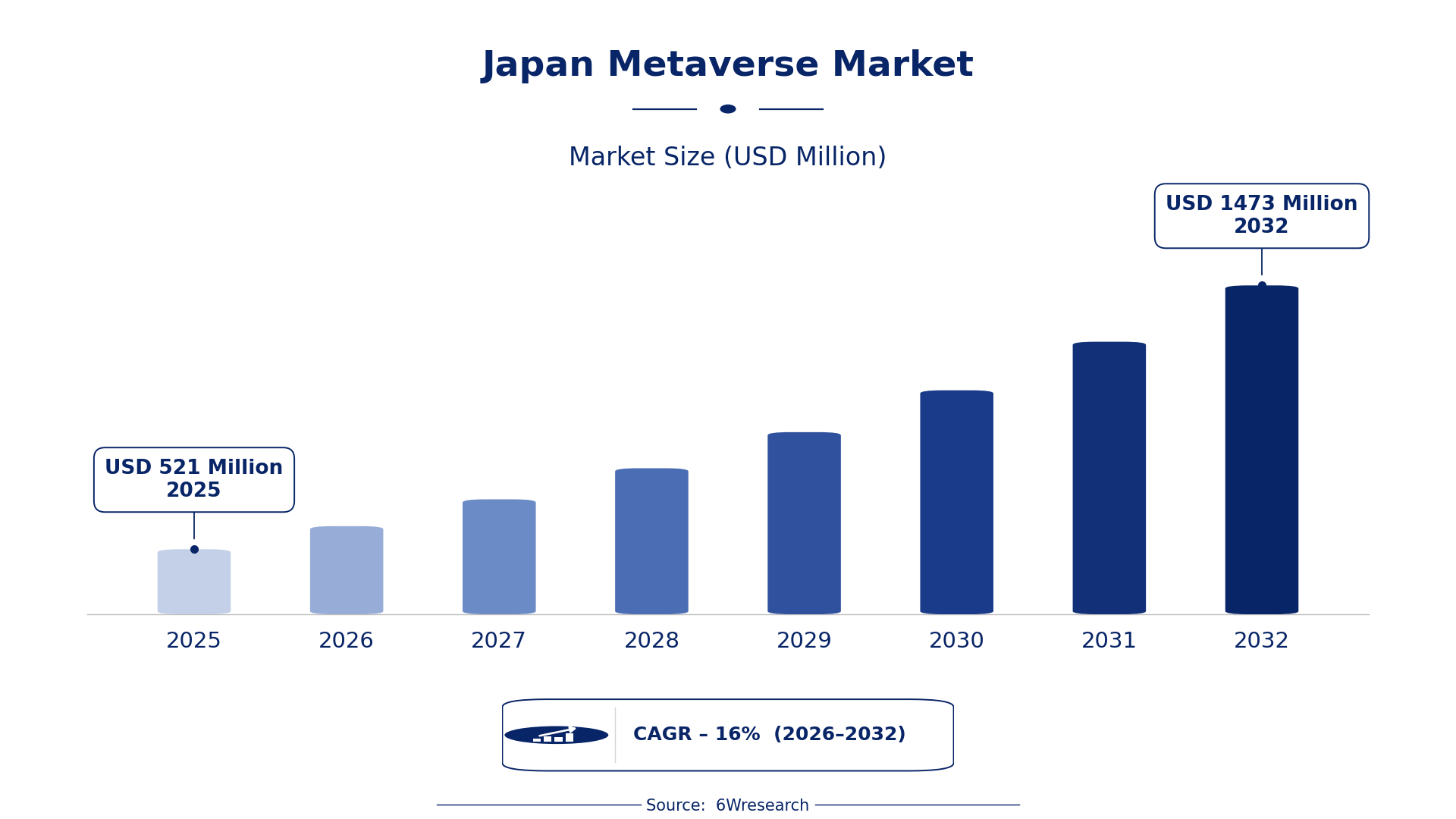
According to 6Wresearch internal database and industry insights, the Japan Metaverse Market was valued at USD 521 Million in 2025 and is projected to reach USD 1,473 Million by 2032, growing at a CAGR of approximately 16% during 2026–2032.
Japan Metaverse Market Highlights
| Report Metric | Details |
| Report Name | Japan Metaverse Market (2026-2032) |
| Market Size 2025 | USD 521 Million |
| Market Size 2032 | USD 1,473 Million |
| Absolute Growth 2025–2032 | USD 952 Million |
| CAGR 2026–2032 | 16% |
| Peak Annual Growth | 18.2% in 2026 |
| Forecast Period | 2026–2032 |
| Historical Data | 2022–2025 |
| Base Year | 2025 |
| Leading Products, 2025 | Software (58% share) |
| Leading Technology, 2025 | Virtual Reality VR (100% share) |
| Leading Augmented Reality, 2025 | AR (100% share) |
| Fastest-Growing Products | Hardware (17.2% CAGR) |
| Growing Sector | Gaming and Entertainment |
| Key End Users | Gaming developers, educational institutions, retail businesses, technology startups |
Japan Metaverse Market Year-wise Growth Rate and Key Drivers (2022–2032)
This graph illustrates the annual growth rates of the market from 2022 to 2032, highlighting a steady upward trajectory and projected market expansion over the forecast period.
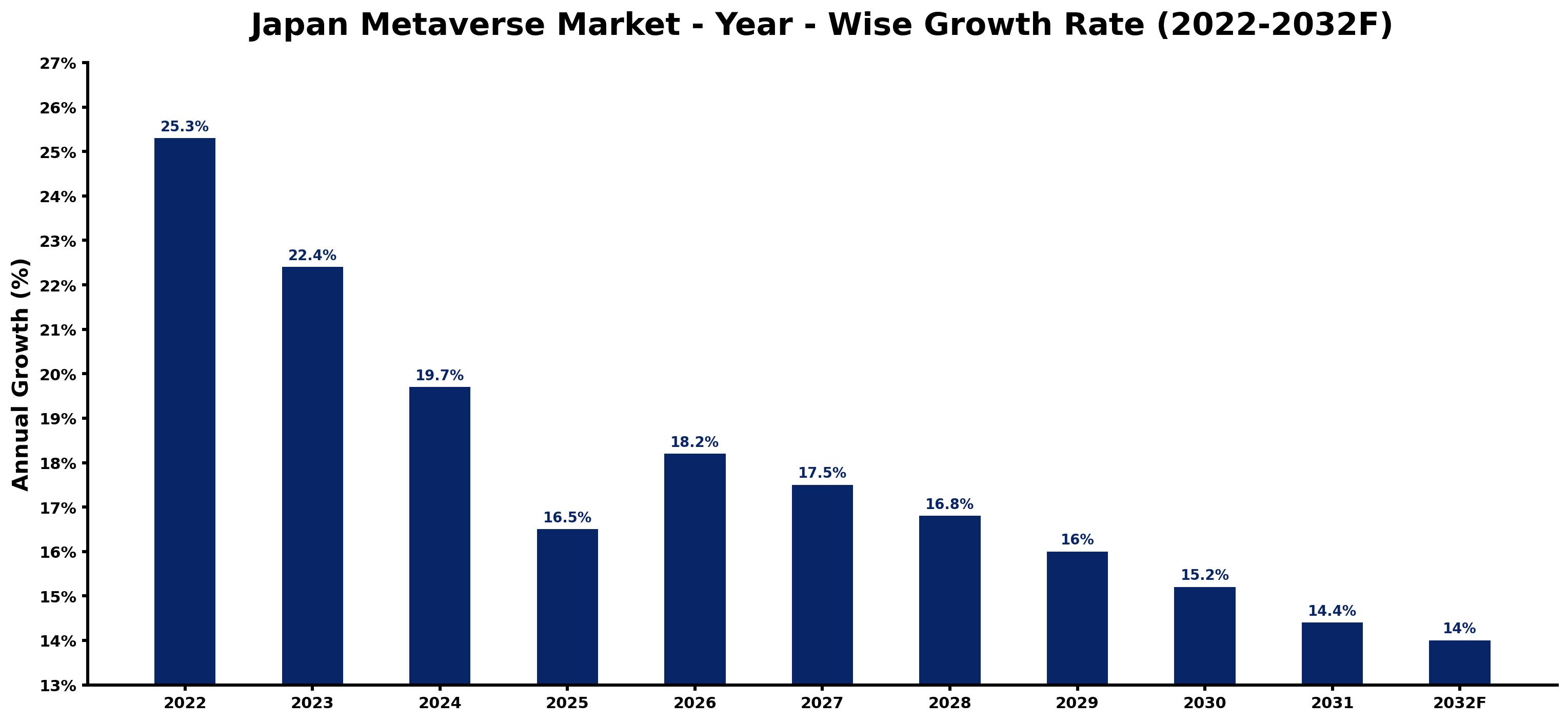
Year by year, the estimates below pair each growth rate with the development that shaped it.
| Year | Estimated Annual Growth (%) | Market Rationale |
| 2022 | 25.3 | The market experienced high demand due to advancements in technology and gaming. |
| 2023 | 22.4 | Growth slowed as the market adjusted to increased competition and market saturation. |
| 2024 | 19.7 | Demand continued to grow, but at a reduced pace as new entrants emerged. |
| 2025 | 16.5 | The market maintained steady growth driven by ongoing digital transformation initiatives. |
| 2026 | 18.2 | Growth is expected to accelerate as new virtual reality applications gain traction in various sectors. |
| 2027 | 17.5 | Demand growth will slow slightly due to market maturity and increased competition. |
| 2028 | 16.8 | The market is projected to continue expanding, supported by rising user engagement in gaming. |
| 2029 | 16.0 | Growth is expected to slow as the market faces challenges from emerging technologies and trends. |
| 2030 | 15.2 | Demand growth will decelerate as the market reaches a more stable phase. |
| 2031 | 14.4 | The market will continue to grow, albeit at a slower rate due to saturation effects. |
| 2032 | 14.0 | Growth is projected to stabilise as the market matures and competition intensifies. |
Note: Market size estimations and growth projections presented in this report are based on 6Wresearch's proprietary forecasting methodology, utilizing the latest available industry data, government publications, and primary research inputs.
Japan Metaverse Market Synopsis
The Metaverse represents a collective virtual shared space that combines physical reality with persistent virtual environments, primarily through advanced software and hardware technologies. In Japan, the gaming industry generated over 2 trillion yen in 2023, driving demand for Metaverse applications. A user base of 126 million, ongoing technological advancements, and government initiatives to promote digital transformation are propelling growth in the Japan Metaverse Market. The Tokyo Game Show in 2023 showcased numerous innovations, reflecting the rising investment and interest in Metaverse applications across various sectors.
Market Dynamics Impact Analysis (2026–2032)
| Factor | Type | Impact | Primary Segment Affected |
| Technological advancements in VR and AR | Driver | High | Virtual Reality VR |
| Increasing user engagement in gaming and education | Driver | High | Software |
| Growing interest in virtual commerce | Opportunity | High | Software |
| Expansion of AR applications in retail | Opportunity | Medium | AR |
| Competition from emerging technologies | Restraint | High | Software |
| Market saturation limiting growth potential | Restraint | Medium | Hardware |
| High development costs for VR content | Challenge | High | Virtual Reality VR |
| Regulatory compliance and standards adherence | Challenge | Medium | Software |
Evaluation of Drivers in Japan Metaverse Market (2026–2032)
Below are the drivers that matter most for revenue growth, with supporting evidence.
| Drivers | Primary Segment Affected | Why It Matters (Evidence) |
| Increased investment in gaming technologies | Software | In 2023, Japan's gaming industry generated over 2 trillion yen, driving demand for advanced software solutions. |
| Rising user engagement in virtual environments | Virtual Reality VR | With approximately 5 million VR headset users in 2022, demand for immersive experiences is growing. |
| Government initiatives promoting digital transformation | Software | The Ministry of Internal Affairs and Communications launched a program in 2023 to enhance digital capabilities across industries. |
| Expansion of educational applications for AR and VR | AR | The government aims to increase AR and VR adoption in education by 30% by 2025, boosting demand. |
| Technological advancements in hardware | Hardware | The expected 50% increase in the VR gaming user base by 2025 will drive hardware demand. |
Buyers are adding capacity as Japan's gaming industry generated over 2 trillion yen in 2023, boosting demand for advanced software solutions. Approximately 5 million VR headset users in 2022 are driving the need for immersive experiences, leading to increased investment in virtual environments. With a target of 30% increased AR and VR use in education by 2025, educational institutions are seeking new solutions. The anticipated 50% growth in the VR gaming user base by 2025 will further stimulate hardware demand, prompting manufacturers to expand their offerings.
Evaluation of Restraints in Japan Metaverse Market
The main factors holding the market back are set out below.
| Market Restraint | Primary Segment Affected | Why It Matters (Evidence) |
| High development costs for VR content production | Virtual Reality VR | Content creation costs can exceed 100 million yen, limiting smaller developers' ability to compete. |
| Market saturation limiting growth potential | Hardware | As the market matures, growth is constrained by a limited number of new users entering the market. |
| Regulatory compliance and standards adherence | Software | Compliance with ISO/IEC 30170:2020 can increase operational costs for software developers. |
| Intense competition from emerging technologies | Software | New technologies may divert investment away from traditional Metaverse applications, impacting growth. |
| Consumer reluctance to adopt new technologies | AR | Some consumers remain hesitant to engage with AR applications, limiting market expansion. |
Japan Metaverse Market Challenges
Producers encounter intense competition from global gaming firms, which pressures prices and squeezes profit margins. Distributors face regulatory challenges that impede the rapid development of virtual environments, resulting in project delays for tech startups in Tokyo. Rising costs of advanced technologies, particularly VR hardware, burden distributors, forcing them to raise prices for consumers. Skills shortages in immersive technology hinder producers from recruiting qualified talent, leading to delayed project rollouts and reduced market responsiveness.
Trends in the Japan Metaverse Market
Buyers and suppliers in the Japan Metaverse Market are adjusting to the following trends.
- Shift from Traditional Gaming to Immersive Experiences: Since 2023, the focus has shifted towards immersive gaming experiences, with the Tokyo Game Show showcasing multiple Metaverse innovations. The trend is evidenced by the gaming industry's 2 trillion yen revenue, indicating a strong market demand.
- Transition from Physical to Virtual Commerce: In recent years, retailers have increasingly adopted AR applications to improve customer engagement. A projected 40% increase in user engagement by 2025 highlights the growing importance of virtual commerce in Japan.
- Augmented Reality Gaining Traction in Education: Starting in 2023, educational institutions are increasingly integrating AR technologies into their curricula. The government's aim to boost AR adoption by 30% by 2025 reflects this trend's significance for educators.
- Emergence of Collaborative Virtual Environments: Beginning in 2023, collaborative virtual environments are becoming more prevalent in various sectors. The Japan VR Association's promotion of VR technology supports this shift, improving user interaction and engagement.
Investment Opportunities in the Japan Metaverse Market
Several openings in the Japan Metaverse Market merit attention from investors.
- Gaming Developers Seeking Advanced Software Solutions: With Japan's gaming industry generating over 2 trillion yen in 2023, developers are in search of advanced software solutions. Collaborating with local tech startups in Tokyo can facilitate entry into this expanding market.
- Retailers Adopting AR Technologies: As AR applications in retail are expected to grow, suppliers can offer engaging solutions. Retailers in urban centres like Tokyo are keen to enhance customer experiences through immersive technologies.
- Educational Institutions Expanding VR and AR Use: The government's goal to increase AR and VR adoption by 30% by 2025 presents a notable opportunity. Suppliers can partner with educational institutions to create tailored solutions.
- Investment in VR Content Creation: With a projected 50% increase in VR gaming users by 2025, there is a rising demand for high-quality content. Content creators can invest in developing immersive experiences to attract this growing audience.
Government Initiatives in the Japan Metaverse Market
The Digital Agency leads the government's digital transformation initiatives, including the promotion of the Metaverse. The agency allocated 10 billion yen in 2023 to support research and development in immersive technologies, benefiting producers and developers in the sector.
The Ministry of Internal Affairs and Communications launched a program in 2023 to encourage digital transformation across various industries, including the Metaverse. This initiative enables buyers to access funding and resources for adopting new technologies, improving their competitive edge.
Future Insight of the Japan Metaverse Market
The launch of new digital transformation programmes will improve infrastructure for Metaverse applications, benefiting both buyers and suppliers. By 2025, a 50% increase in the virtual reality gaming user base will compel suppliers to diversify their offerings. The government’s commitment to boost AR and VR adoption in education will create fresh opportunities for content creators. Investment in immersive technology research will lead to advancements that broaden the Metaverse's applications across various sectors.
Market Segmentation Analysis
Japan Metaverse Market report covers a detailed analysis of the following market segments:
By Products – Software Leads, Hardware Expected to Grow Fastest
According to Dhaval Chaurasia, Assistant Manager at 6Wresearch, Software held 58% of the Japan Metaverse Market by products in 2025. Software holds the largest share in Japan's Metaverse market due to its essential role in creating and maintaining virtual environments. The gaming sector, which generated over 2 trillion yen in 2023, relies heavily on software to deliver immersive experiences. Hardware is projected to grow fastest, at a CAGR of 17.2% during 2026–2032. Hardware is experiencing rapid growth as the demand for devices that enable access to the Metaverse increases. With a projected 50% rise in the virtual reality gaming user base by 2025, hardware sales are expected to surge significantly alongside this trend. Suppliers should prioritise enhancements in hardware offerings to meet the growing demand from the gaming industry.
By Technology – Virtual Reality VR Leads and Records the Fastest Growth
Virtual Reality VR accounted for 100% of the market by technology in 2025. Virtual Reality VR leads the market as it is the core technology that enables immersive experiences within the Metaverse. The Tokyo Game Show in 2023 showcased numerous VR innovations, highlighting its crucial role in driving user engagement. Its lead should widen, with a projected CAGR of 16.0% during 2026–2032, the highest in this split. The growth of Virtual Reality VR is set to continue as it remains central to the Metaverse experience, attracting more users and applications. This sustained interest will likely widen its lead over other technologies in the market. Buyers should invest in VR technologies to ensure they remain competitive in the advancing Metaverse landscape.
By Augmented Reality – AR Leads and Records the Fastest Growth
The largest augmented reality category in 2025 was AR, at 100% of revenue. AR commands the largest share in Japan's Metaverse market as it is increasingly applied across various sectors, particularly in retail. The expected 40% growth in user engagement for AR applications by 2025 underscores its importance in enhancing customer experiences. AR is also forecast to expand faster than any other category, at a CAGR of 16.0% over 2026–2032. AR is also the fastest-growing segment, driven by its expanding applications in education and retail. The government's target to increase AR adoption in education by 30% by 2025 will further accelerate its growth. Suppliers need to adapt their strategies to leverage the increasing demand for AR applications across multiple industries.
Key Attractiveness of the Report
- 10 Years of Market Numbers
- Historical Data Starting from 2022 to 2025
- Base Year 2025
- Forecast Data until 2032
- Key Performance Indicators Impacting the Market
- Major Upcoming Developments and Projects
Key Highlights of the Report:
- Japan Metaverse Market Outlook
- Market Size of Japan Metaverse Market, 2025
- Forecast of Japan Metaverse Market, 2032
- Historical Data and Forecast of Japan Metaverse Revenues & Volume for the Period 2022-2032
- Japan Metaverse Market Trend Evolution
- Japan Metaverse Market Drivers and Challenges
- Japan Metaverse Price Trends
- Japan Metaverse Porter's Five Forces
- Japan Metaverse Industry Life Cycle
- Historical Data and Forecast of Japan Metaverse Market Revenues & Volume By Products for the Period 2022-2032
- Historical Data and Forecast of Japan Metaverse Market Revenues & Volume By Software for the Period 2022-2032
- Historical Data and Forecast of Japan Metaverse Market Revenues & Volume By Hardware for the Period 2022-2032
- Historical Data and Forecast of Japan Metaverse Market Revenues & Volume By Technology for the Period 2022-2032
- Historical Data and Forecast of Japan Metaverse Market Revenues & Volume By Virtual Reality VR for the Period 2022-2032
- Historical Data and Forecast of Japan Metaverse Market Revenues & Volume By Augmented Reality for the Period 2022-2032
- Historical Data and Forecast of Japan Metaverse Market Revenues & Volume By AR for the Period 2022-2032
- Japan Metaverse Import Export Trade Statistics
- Market Opportunity Assessment By Products
- Market Opportunity Assessment By Technology
- Market Opportunity Assessment By Augmented Reality
- Japan Metaverse Top Companies Market Share
- Japan Metaverse Competitive Benchmarking By Technical and Operational Parameters
- Japan Metaverse Company Profiles
- Japan Metaverse Key Strategic Recommendations
Market Covered
This report examines the market across the segments below.
By Products
- Software
- Hardware
By Technology
- Virtual Reality VR
By Augmented Reality
- AR































