Japan Mobile Augmented Reality Market Size & Growth Rate
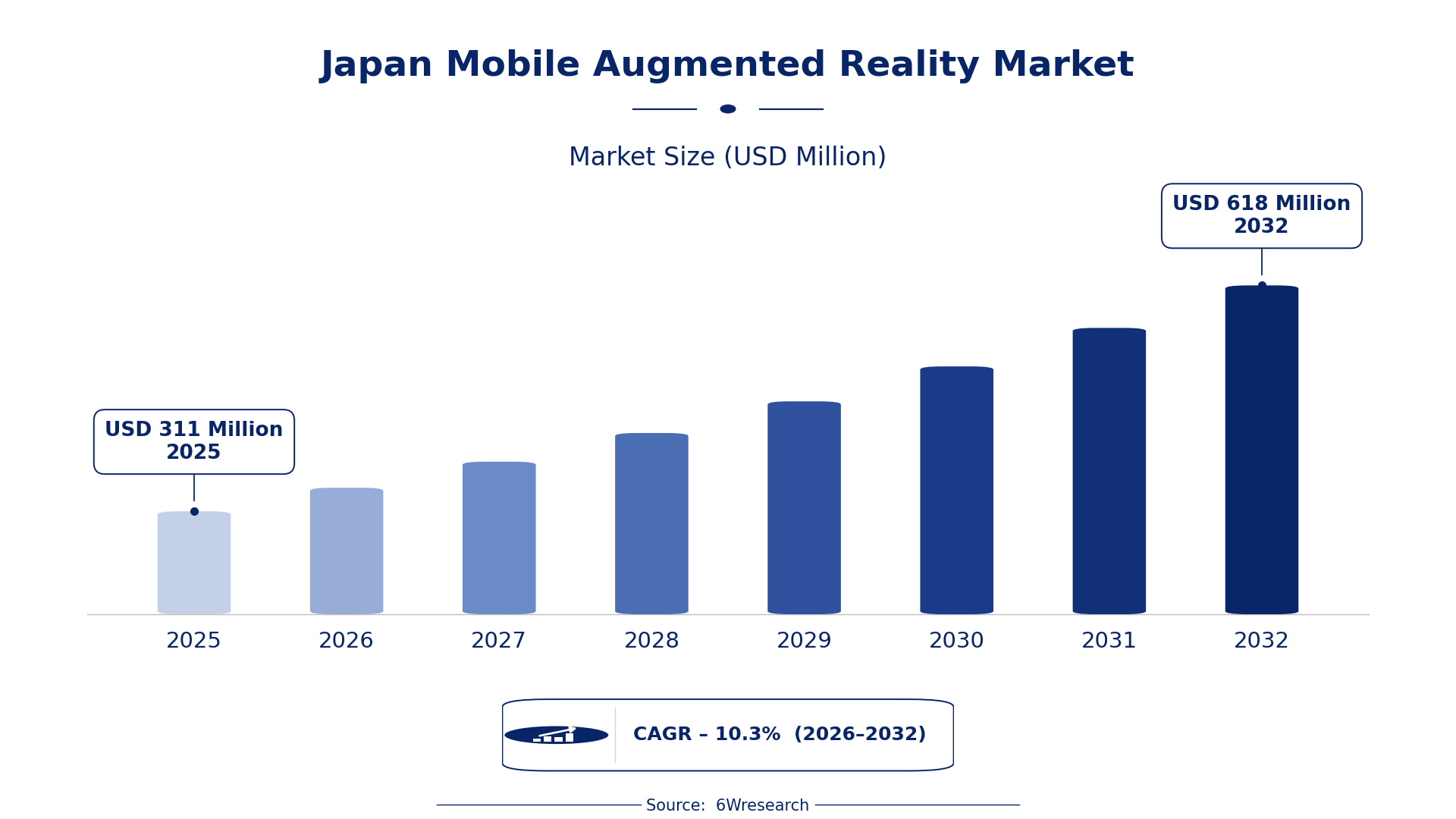
According to 6Wresearch internal database and industry insights, the Japan Mobile Augmented Reality Market was valued at USD 311 Million in 2025 and is projected to reach USD 618 Million by 2032, growing at a CAGR of approximately 10.3% during 2026–2032.
Japan Mobile Augmented Reality Market Highlights
| Report Metric | Details |
| Report Name | Japan Mobile Augmented Reality Market (2026-2032) |
| Market Size 2025 | USD 311 Million |
| Market Size 2032 | USD 618 Million |
| Absolute Growth 2025–2032 | USD 307 Million |
| CAGR 2026–2032 | 10.3% |
| Peak Annual Growth | 12.4% in 2032 |
| Forecast Period | 2026–2032 |
| Historical Data | 2022–2025 |
| Base Year | 2025 |
| Leading Device Type, 2025 | Smartphones (56% share) |
| Leading Offering, 2025 | Software (55% share) |
| Leading Application, 2025 | Consumer (34% share) |
| Fastest-Growing Device Type | Tablets (14.7% CAGR) |
| Fastest-Growing Offering | Services (12.7% CAGR) |
| Fastest-Growing Application | Healthcare (13.9% CAGR) |
| Growing Sector | Healthcare |
| Key End Users | Consumers, Educational Institutions, Enterprises, Healthcare Providers |
Japan Mobile Augmented Reality Market Year-wise Growth Rate and Key Drivers (2022–2032)
This graph illustrates the annual growth rates of the market from 2022 to 2032, highlighting a steady upward trajectory and projected market expansion over the forecast period.
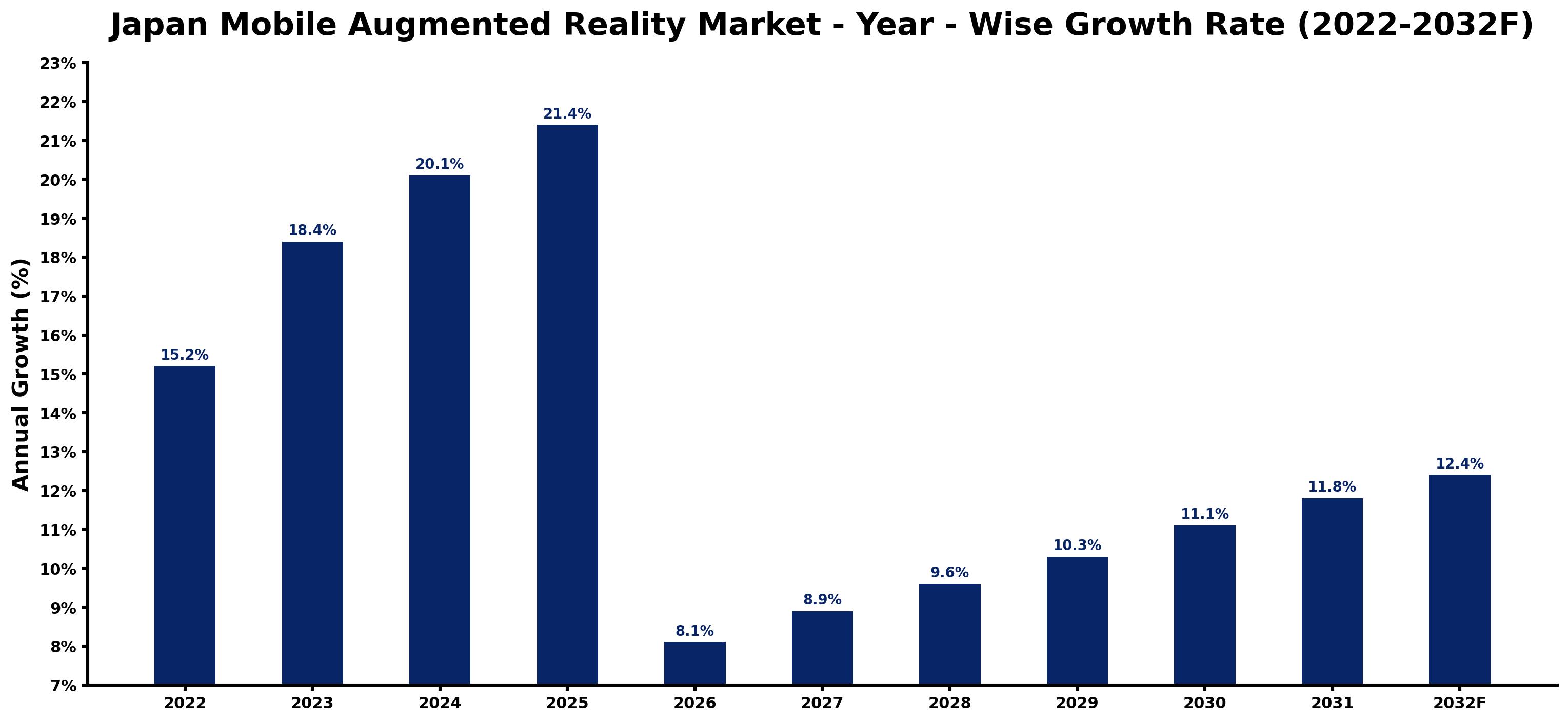
Each row of the following table gives one year's estimated growth and the event or demand shift that explains it.
| Year | Estimated Annual Growth (%) | Market Rationale |
| 2022 | 15.2 | The market experienced steady growth due to increasing smartphone penetration and AR application availability. |
| 2023 | 18.4 | Growth accelerated as consumer interest in mobile AR applications surged, particularly in gaming and education. |
| 2024 | 20.1 | Continued advancements in smartphone technology and software development drove further growth in mobile AR usage. |
| 2025 | 21.4 | The Tokyo Game Show showcased AR gaming, contributing to peak growth in the market. |
| 2026 | 8.1 | Growth is expected to slow as the market begins to stabilise after the peak, yet demand for AR applications will remain strong. |
| 2027 | 8.9 | An uptick in enterprise adoption of AR solutions is projected to contribute to a slight recovery in growth rates. |
| 2028 | 9.6 | Consumer engagement with AR applications will continue to rise, supporting steady growth. |
| 2029 | 10.3 | Increased investment in AR technologies by various sectors is expected to lead to a further boost in market demand. |
| 2030 | 11.1 | The integration of AR in educational curricula across multiple prefectures will enhance market growth. |
| 2031 | 11.8 | Continued advancements in AR technology and applications will keep the growth momentum strong. |
| 2032 | 12.4 | The market is projected to peak as consumer and enterprise adoption of AR technologies reaches new heights. |
Note: Market size estimations and growth projections presented in this report are based on 6Wresearch's proprietary forecasting methodology, utilizing the latest available industry data, government publications, and primary research inputs.
Japan Mobile Augmented Reality Market Synopsis
Mobile Augmented Reality (AR) technology overlays digital information onto the real world through mobile devices, primarily using software that integrates computer vision and depth tracking. The Japan Mobile Augmented Reality Market is growing due to high smartphone penetration, with approximately 80% of the population using these devices. The Tokyo metropolitan area serves as a hub for AR development, while consumer applications account for 60% of mobile AR usage. The increasing adoption of AR in sectors like healthcare and enterprise training further drives market growth as investments in AR technologies rise.
Market Dynamics Impact Analysis (2026–2032)
| Factor | Type | Impact | Primary Segment Affected |
| High smartphone penetration and increasing AR applications drive demand for mobile AR solutions. | Driver | High | Smartphones |
| The rise of AR in enterprise training and operations creates new opportunities for service providers. | Opportunity | High | Services |
| Limited awareness of AR technology among potential users restrains broader adoption. | Restraint | Medium | Consumer |
| The high cost of developing AR applications can deter smaller companies from entering the market. | Restraint | Medium | Software |
| The growing interest in AR applications in healthcare presents a significant opportunity for growth. | Opportunity | High | Healthcare |
| Integration challenges with existing systems can hinder the adoption of AR solutions in enterprises. | Challenge | Medium | Enterprise |
| The need for continuous software updates and maintenance can strain resources for AR developers. | Challenge | Medium | Software |
| The increasing number of AR applications available enhances competition among developers. | Driver | High | Software |
Evaluation of Drivers in Japan Mobile Augmented Reality Market (2026–2032)
Demand rests on the following drivers, each shown with the segment it touches most.
| Drivers | Primary Segment Affected | Why It Matters (Evidence) |
| High smartphone penetration rates drive AR application usage. | Smartphones | In 2023, approximately 80% of Japan's population used smartphones, increasing the potential user base for AR applications. |
| Growing consumer interest in AR gaming drives demand for applications. | Consumer | The Tokyo Game Show 2023 featured multiple AR gaming innovations, attracting significant consumer attention. |
| Increased investment in AR technologies supports development and deployment. | Services | The Japanese government allocated funds for AR research and development through the New Energy and Industrial Technology Development Organization. |
| Healthcare sector's adoption of AR for training enhances market growth. | Healthcare | Japan's healthcare expenditure was approximately 42 trillion yen in 2023, with AR applications gaining traction. |
| Integration of AR into educational curricula boosts demand for AR applications. | Smartphones | AR applications in education are being integrated into curricula across multiple prefectures, enhancing learning experiences. |
Spending rises because of the high smartphone penetration rate, with approximately 80% of Japan's population using these devices. Consumer interest in AR applications is growing, particularly in gaming, as evidenced by the Tokyo Game Show 2023 showcasing multiple AR innovations. Investment in AR technologies is increasing, supported by funding for research and development, which improves the deployment of AR solutions. The healthcare sector, with an expenditure of around 42 trillion yen in 2023, is adopting AR for training, further boosting market growth. The integration of AR into educational curricula across prefectures is creating new opportunities for AR applications.
Evaluation of Restraints in Japan Mobile Augmented Reality Market
The key brakes on demand, and where they bite hardest, are shown below.
| Market Restraint | Primary Segment Affected | Why It Matters (Evidence) |
| Limited awareness of AR technology among potential users restricts market growth. | Consumer | Many consumers are unaware of the benefits of AR applications, hindering widespread adoption. |
| High development costs deter smaller companies from entering the AR market. | Software | The investment required for AR application development can limit participation from smaller developers. |
| Integration challenges with existing systems hinder enterprise adoption of AR solutions. | Enterprise | Many enterprises face difficulties in integrating AR technologies with their current operations, slowing down adoption. |
| Regulatory hurdles can delay the deployment of AR applications in certain sectors. | Healthcare | Healthcare regulations may require extensive testing and validation, slowing the introduction of AR solutions. |
| Competition among developers leads to market saturation, making it harder for new entrants. | Software | The increasing number of AR applications available can overwhelm consumers, making it difficult for new products to gain traction. |
Japan Mobile Augmented Reality Market Challenges
High development costs for mobile AR applications strain producers, forcing them to delay product launches. In Japan, the average cost to develop an AR app is around 10 million yen, which limits market entry for smaller firms. A lack of skilled AR developers hampers suppliers' ability to meet demand, leading to extended project timelines for producers. Disruptions in sourcing AR components can lengthen lead times, frustrating clinics that rely on timely delivery. Heightened competition among AR developers can spark price wars, risking quality and innovation for end-users.
Trends in the Japan Mobile Augmented Reality Market
The following changes are redrawing the Japan Mobile Augmented Reality Market.
- Shift from Consumer to Enterprise Applications: Enterprise applications are becoming more prevalent as businesses recognise the benefits of AR for training and operations. In 2023, the adoption rate of AR in enterprise solutions was estimated at 30%, indicating a growing market segment.
- Transition from Gaming to Education: Educational institutions are increasingly integrating AR applications into curricula, improving learning experiences. In 2023, AR applications in education were adopted across multiple prefectures, demonstrating a shift in focus.
- Healthcare AR Solutions Gaining Traction: The healthcare sector is increasingly adopting AR for surgical training and visualisation. In 2023, AR applications gained traction within Japan's healthcare expenditure of approximately 42 trillion yen.
- Rise of AR Standards and Frameworks: The establishment of ISO/IEC 30170:2019 is promoting consistency in AR technologies. This standard is expected to improve the development and deployment of AR applications across various sectors.
Investment Opportunities in the Japan Mobile Augmented Reality Market
Several openings in the Japan Mobile Augmented Reality Market merit attention from investors.
- Healthcare Sector Adoption: The healthcare sector is increasingly adopting AR for training and visualisation, with AR applications gaining traction. With Japan's healthcare expenditure around 42 trillion yen in 2023, this presents an investment opportunity for developers.
- Educational Institutions Seeking AR Solutions: Educational institutions are looking for AR solutions to improve learning experiences. The integration of AR into curricula across multiple prefectures highlights the demand for educational tools.
- Growth in Enterprise Training Solutions: The enterprise sector is seeking AR solutions for training and operations, with an estimated adoption rate of 30% in 2023. This presents opportunities for service providers to develop tailored solutions.
- Digital Transformation Initiatives: The Japanese government's digital transformation programme launched in 2023 aims to improve AR technologies. This initiative opens avenues for partnerships with local firms to develop AR solutions.
Government Initiatives in the Japan Mobile Augmented Reality Market
The AI Promotion Act (2025) provides a structured approach to AI integration, complementing existing laws such as the Digital Agency's initiatives. This new measure supports AR technologies by establishing a national framework for research and development, which is vital for AR applications.
The Digital Agency, established in September 2021, leads government digital transformation efforts. It supports AR technology development through funding and initiatives, enabling buyers to access effective AR solutions and boosting overall market growth.
Future Insight of the Japan Mobile Augmented Reality Market
The introduction of digital transformation programmes will advance AR technologies in various sectors by 2032. Integration of AR into educational curricula will provide new learning experiences for students. The establishment of standards like ISO/IEC 30170:2019 will ensure application consistency and reliability. With over 50 million AR-enabled devices in 2023, the user base will likely expand, offering suppliers opportunities to create tailored solutions for diverse applications.
Market Segmentation Analysis
Japan Mobile Augmented Reality Market report covers a detailed analysis of the following market segments:
By Device Type – Smartphones Lead, Tablets Expected to Grow Fastest
According to Shubham Padhi, Research Analyst at 6Wresearch, Smartphones held 56% of the Japan Mobile Augmented Reality Market by device type in 2025. Smartphones dominate the mobile AR market due to their widespread adoption, with around 80% of the population using these devices. The Tokyo metropolitan area serves as a significant hub for mobile AR development, further solidifying smartphones' leading position. The quickest growth will come from Tablets, forecast to expand at a CAGR of 14.7% between 2026 and 2032. Tablets are experiencing rapid growth as they become more popular for educational AR applications. The increasing integration of AR in curricula across multiple prefectures supports this trend, indicating a shift in device preference. Suppliers need to focus on developing applications that are optimised for both smartphones and tablets to capture a broader audience.
By Offering – Software Leads, Services Expected to Grow Fastest
In 2025, Software led the offering split with a 55% share. Software holds the largest share in the market as it is crucial for the development and functionality of AR applications. The availability of over 10,000 AR applications in Japan highlights the indispensable role of software in this sector. Services are set to record the highest CAGR in this split, 12.7% over 2026–2032. Services are growing quickly as they are necessary for the deployment and maintenance of AR solutions. The government's investment in AR research and development is likely to drive further demand for these services. Buyers will benefit from robust service offerings that enhance the performance and longevity of their AR systems.
By Application – Consumer Leads, Healthcare Expected to Grow Fastest
Consumer accounted for 34% of the market by application in 2025. Consumer applications lead the market as they account for the majority of mobile AR usage, driven by gaming and entertainment. Events like the Tokyo Game Show 2023 showcased numerous AR gaming innovations, reflecting consumer interest. Healthcare is projected to grow fastest, at a CAGR of 13.9% during 2026–2032. Healthcare applications are growing rapidly as the sector increasingly adopts AR for surgical training and visualization. With Japan's healthcare expenditure around 42 trillion yen in 2023, the integration of AR into training programmes is expected to expand. Suppliers should consider tailoring their offerings to meet the specific needs of the healthcare sector to capitalise on this growth.
Key Attractiveness of the Report
- 10 Years of Market Numbers
- Historical Data Starting from 2022 to 2025
- Base Year 2025
- Forecast Data until 2032
- Key Performance Indicators Impacting the Market
- Major Upcoming Developments and Projects
Key Highlights of the Report:
- Japan Mobile Augmented Reality Market Outlook
- Market Size of Japan Mobile Augmented Reality Market, 2025
- Forecast of Japan Mobile Augmented Reality Market, 2032
- Historical Data and Forecast of Japan Mobile Augmented Reality Revenues & Volume for the Period 2022-2032
- Japan Mobile Augmented Reality Market Trend Evolution
- Japan Mobile Augmented Reality Market Drivers and Challenges
- Japan Mobile Augmented Reality Price Trends
- Japan Mobile Augmented Reality Porter's Five Forces
- Japan Mobile Augmented Reality Industry Life Cycle
- Historical Data and Forecast of Japan Mobile Augmented Reality Market Revenues & Volume By Device Type for the Period 2022-2032
- Historical Data and Forecast of Japan Mobile Augmented Reality Market Revenues & Volume By Smartphones for the Period 2022-2032
- Historical Data and Forecast of Japan Mobile Augmented Reality Market Revenues & Volume By Tablets for the Period 2022-2032
- Historical Data and Forecast of Japan Mobile Augmented Reality Market Revenues & Volume By PDAs for the Period 2022-2032
- Historical Data and Forecast of Japan Mobile Augmented Reality Market Revenues & Volume By Offering for the Period 2022-2032
- Historical Data and Forecast of Japan Mobile Augmented Reality Market Revenues & Volume By Software for the Period 2022-2032
- Historical Data and Forecast of Japan Mobile Augmented Reality Market Revenues & Volume By Services for the Period 2022-2032
- Historical Data and Forecast of Japan Mobile Augmented Reality Market Revenues & Volume By Application for the Period 2022-2032
- Historical Data and Forecast of Japan Mobile Augmented Reality Market Revenues & Volume By Consumer for the Period 2022-2032
- Historical Data and Forecast of Japan Mobile Augmented Reality Market Revenues & Volume By Healthcare for the Period 2022-2032
- Historical Data and Forecast of Japan Mobile Augmented Reality Market Revenues & Volume By Enterprise for the Period 2022-2032
- Historical Data and Forecast of Japan Mobile Augmented Reality Market Revenues & Volume By Commercial for the Period 2022-2032
- Japan Mobile Augmented Reality Import Export Trade Statistics
- Market Opportunity Assessment By Device Type
- Market Opportunity Assessment By Offering
- Market Opportunity Assessment By Application
- Japan Mobile Augmented Reality Top Companies Market Share
- Japan Mobile Augmented Reality Competitive Benchmarking By Technical and Operational Parameters
- Japan Mobile Augmented Reality Company Profiles
- Japan Mobile Augmented Reality Key Strategic Recommendations
Market Covered
Segments analysed in this report are listed below.
By Device Type
- Smartphones
- Tablets
- PDAs
By Offering
- Software
- Services
By Application
- Consumer
- Healthcare
- Enterprise
- Commercial































