Japan Molded Pulp Packaging Market Size, Share & Growth Rate
The Japan Molded Pulp Packaging Market was estimated at USD 210 Million in 2025 and is projected to reach USD 226 Million by 2032, growing at a CAGR of 1.1% from 2026 to 2032. This growth trajectory is largely driven by increasing consumer awareness regarding environmental sustainability and stringent government regulations aimed at reducing plastic waste. Additionally, the ongoing innovation in molded pulp technology is enabling manufacturers to create more durable and aesthetically pleasing packaging solutions, further propelling market demand.
Japan Molded Pulp Packaging Market Year-wise Growth Rate and Key Drivers
This graph highlights how the Japan Molded Pulp Packaging Market has steadily grown over the years, supported by major growth factors.
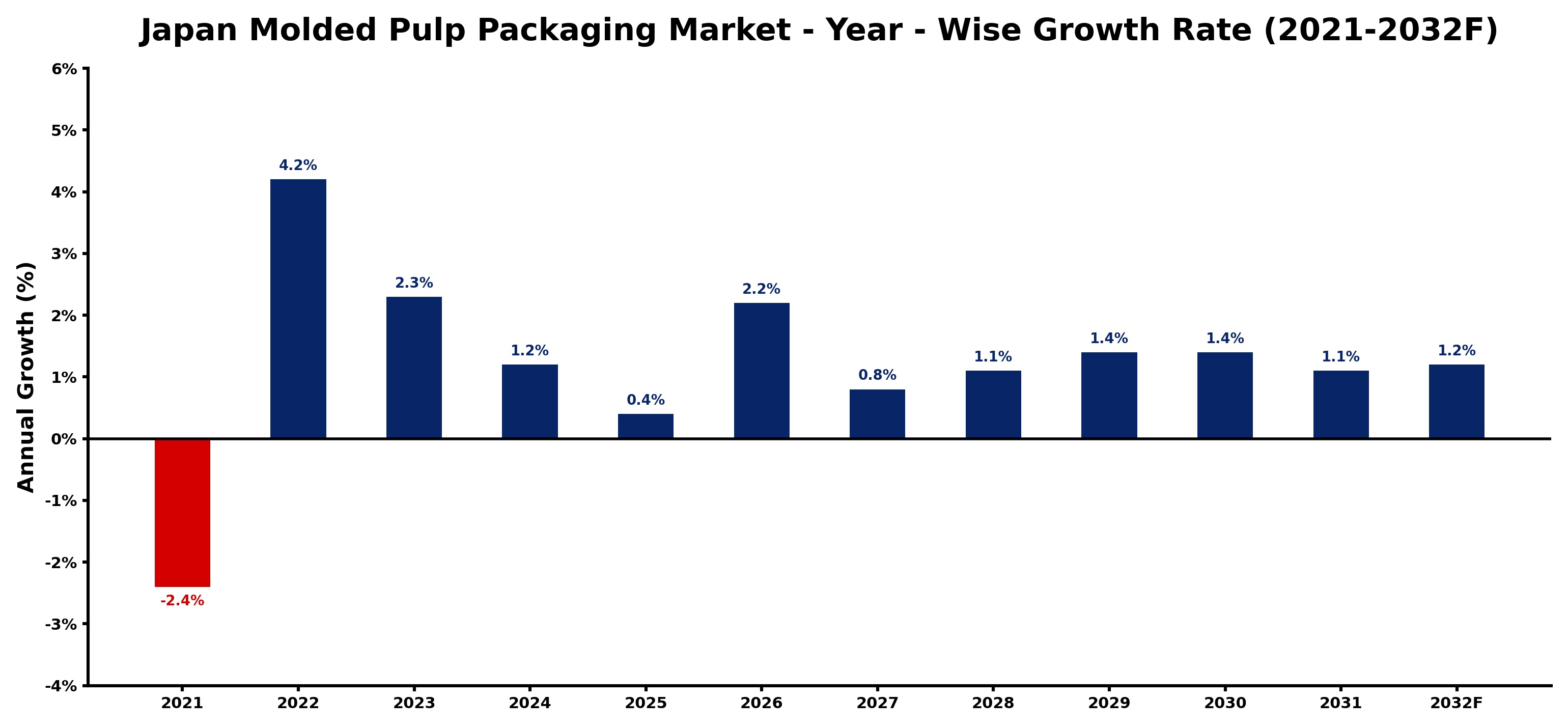
The table below presents the year‑wise growth rates along with the key drivers influencing the market
| Year | Growth Rate | Major Drivers |
| 2021 | -2.4% | Growing urbanization and commercial development |
| 2022 | 4.2% | Growing renewable energy integration projects |
| 2023 | 2.3% | Rising electricity demand across industries |
| 2024 | 1.2% | Growing renewable energy integration projects |
| 2025 | 0.4% | Expansion of manufacturing activities |
| 2026 | 2.2% | Increasing smart city development projects |
| 2027 | 0.8% | Growing renewable energy integration projects |
| 2028 | 1.1% | Growing urbanization and commercial development |
| 2029 | 1.4% | Rising electricity demand across industries |
| 2030 | 1.4% | Rapid growth in telecom and data center sectors |
| 2031 | 1.1% | Growing renewable energy integration projects |
| 2032 | 1.2% | Rapid growth in telecom and data center sectors |
Note - Market size estimations and growth projections presented in this report are based on 6Wresearch’s advanced forecasting approach, validated with industry datasets as of June 2026.
Japan Molded Pulp Packaging Market Synopsis
While the Japan Molded Pulp Packaging Market has been steadily growing, propelled by rising sustainability concerns, it is set to evolve further in the coming years. The shift from traditional plastic packaging to eco-friendly options indicates a promising outlook for molded pulp alternatives, especially in sectors like food and electronics.
In the short term, the market momentum is likely to be influenced by government initiatives promoting recycling and eco-conscious practices among businesses. Looking ahead, as consumer behavior continues to shift towards greener options, the demand for molded pulp packaging is expected to solidify its role as a mainstream solution.
Japan Molded Pulp Packaging Market Key Takeaways
- Strong growth driven by the shift towards sustainable packaging solutions.
- Innovation in product designs enhances durability and appeal.
- Government regulations are fostering an environment conducive to eco-friendly packaging adoption.
- Collaboration between industries and packaging manufacturers is on the rise.
- Increased consumer awareness about environmental issues supports market growth.
Evaluation of Restraints in Japan Molded Pulp Packaging Market
Despite its growth potential, the Japan Molded Pulp Packaging Market faces notable challenges. One significant restraint is the limited availability of raw materials such as recycled paper and cardboard, which are crucial for producing molded pulp products. This scarcity may lead to elevated production costs and potential disruptions in the supply chain. Furthermore, a general lack of awareness among consumers regarding the benefits of molded pulp packaging can impede broader adoption, as can the strong competition from established plastic and foam packaging alternatives. Addressing these challenges will be essential for sustained growth.
Japan Molded Pulp Packaging Market Trends
A trend towards increased customization is emerging, with companies focusing on tailored molded pulp solutions for various industries. As consumer preferences shift, the demand for biodegradable trays and cushioning materials is growing. Moreover, manufacturers are utilizing advanced technologies to enhance the efficiency and capabilities of molded pulp production, making it a more attractive option compared to traditional packaging methods.
Japan Molded Pulp Packaging Market Opportunities
The market presents significant investment opportunities, particularly for companies innovating in molded pulp technologies. Targeting sectors with heightened demand for sustainable packaging, such as food and beverage, electronics, and cosmetics, can yield substantial returns. Strategic partnerships with industry stakeholders will be crucial for enhancing distribution and gaining market penetration.
Government Initiatives in the Japan Molded Pulp Packaging Market
The Japanese government is actively endorsing sustainable packaging practices, including molded pulp solutions, to mitigate plastic waste and fulfill environmental objectives. Policies such as the Plastic Resource Recycling Strategy are aimed at increasing recycling rates and promoting eco-friendly packaging materials. Regulatory frameworks and financial incentives are supporting businesses that adopt sustainable packaging, creating a favorable landscape for the molded pulp packaging market.
Future Insights of the Japan Molded Pulp Packaging Market
The future of the Japan Molded Pulp Packaging Market looks promising, with steady growth anticipated from 2026 to 2032. As sustainability becomes an increasingly critical priority for both consumers and businesses, molded pulp packaging will likely gain traction across various sectors. The expansion of e-commerce and food delivery services will further drive demand, creating more opportunities for molded pulp packaging solutions. Companies will need to innovate continuously, focusing on design and efficiency to stay competitive in this evolving landscape.
Japan Molded Pulp Packaging Market Latest Developments (May 2025 - June 2026)
Recent developments in the Japan Molded Pulp Packaging Market indicate a surge in collaborative efforts between packaging manufacturers and product-centric companies. There is a noticeable increase in the introduction of customized molded pulp solutions tailored for specific applications. Additionally, advancements in production technologies are enhancing the efficiency and quality of molded pulp products, marking a significant trend towards more sophisticated and versatile offerings in the market.
Japan Molded Pulp Packaging Market - Key Attractiveness of the Report
- 10 Years of Market Numbers
- Historical Data Starting from 2022 to 2025
- Base Year: 2025
- Forecast Data until 2032
- Key Performance Indicators Impacting the Market
- Major Upcoming Developments and Projects
Key Highlights of the Report:
- Japan Molded Pulp Packaging Market Outlook
- Market Size of Japan Molded Pulp Packaging Market, 2025
- Forecast of Japan Molded Pulp Packaging Market, 2032
- Historical Data and Forecast of Japan Molded Pulp Packaging Revenues & Volume for the Period 2022-2032F
- Japan Molded Pulp Packaging Market Trend Evolution
- Japan Molded Pulp Packaging Market Drivers and Challenges
- Japan Molded Pulp Packaging Price Trends
- Japan Molded Pulp Packaging Porter's Five Forces
- Japan Molded Pulp Packaging Industry Life Cycle
- Historical Data and Forecast of Japan Molded Pulp Packaging Market Revenues & Volume By Source for the Period 2022-2032F
- Historical Data and Forecast of Japan Molded Pulp Packaging Market Revenues & Volume By Wood Pulp for the Period 2022-2032F
- Historical Data and Forecast of Japan Molded Pulp Packaging Market Revenues & Volume By Non-wood Pulp for the Period 2022-2032F
- Historical Data and Forecast of Japan Molded Pulp Packaging Market Revenues & Volume By Molded Type for the Period 2022-2032F
- Historical Data and Forecast of Japan Molded Pulp Packaging Market Revenues & Volume By Thick Wall for the Period 2022-2032F
- Historical Data and Forecast of Japan Molded Pulp Packaging Market Revenues & Volume By Transfer for the Period 2022-2032F
- Historical Data and Forecast of Japan Molded Pulp Packaging Market Revenues & Volume By Thermoformed for the Period 2022-2032F
- Historical Data and Forecast of Japan Molded Pulp Packaging Market Revenues & Volume By Processed for the Period 2022-2032F
- Historical Data and Forecast of Japan Molded Pulp Packaging Market Revenues & Volume By Product for the Period 2022-2032F
- Historical Data and Forecast of Japan Molded Pulp Packaging Market Revenues & Volume By Trays for the Period 2022-2032F
- Historical Data and Forecast of Japan Molded Pulp Packaging Market Revenues & Volume By End Caps for the Period 2022-2032F
- Historical Data and Forecast of Japan Molded Pulp Packaging Market Revenues & Volume By Bowls & Cups for the Period 2022-2032F
- Historical Data and Forecast of Japan Molded Pulp Packaging Market Revenues & Volume By Clamshells for the Period 2022-2032F
- Historical Data and Forecast of Japan Molded Pulp Packaging Market Revenues & Volume By Plates for the Period 2022-2032F
- Historical Data and Forecast of Japan Molded Pulp Packaging Market Revenues & Volume By Others for the Period 2022-2032F
- Japan Molded Pulp Packaging Import Export Trade Statistics
- Market Opportunity Assessment By Source
- Market Opportunity Assessment By Molded Type
- Market Opportunity Assessment By Product
- Japan Molded Pulp Packaging Top Companies Market Share
- Japan Molded Pulp Packaging Competitive Benchmarking By Technical and Operational Parameters
- Japan Molded Pulp Packaging Company Profiles
- Japan Molded Pulp Packaging Key Strategic Recommendations






































