Topics Covered in Japan Paint Remover Market Report
Japan Paint Remover Market Report thoroughly covers the market by type, by application, by end user and by distribution channel. Japan Paint Remover Market Outlook report provides an unbiased and detailed analysis of the ongoing Japan Paint Remover Market trends, opportunities/high growth areas, and market drivers. This would help stakeholders devise and align their market strategies according to the current and future market dynamics.
Japan Paint Remover Market Synopsis
The Japan Paint Remover Market witnessed growth during 2022–2025, supported by an aging vehicle parc, sustained automotive aftermarket activity, industrial equipment refurbishment, and renovation across residential, commercial, and government properties. Japan’s non-residential building renovation and renewal order value increased, creating sustained opportunities for paint removal across buildings and infrastructure. Japan’s four-wheeler parc increased in 2024, while used four-wheeler sales also increased, strengthening aftermarket demand for body repair, refinishing, and refurbishment. The country’s resilient base of certified automotive maintenance businesses further supported recurring repair and paint-removal requirements.
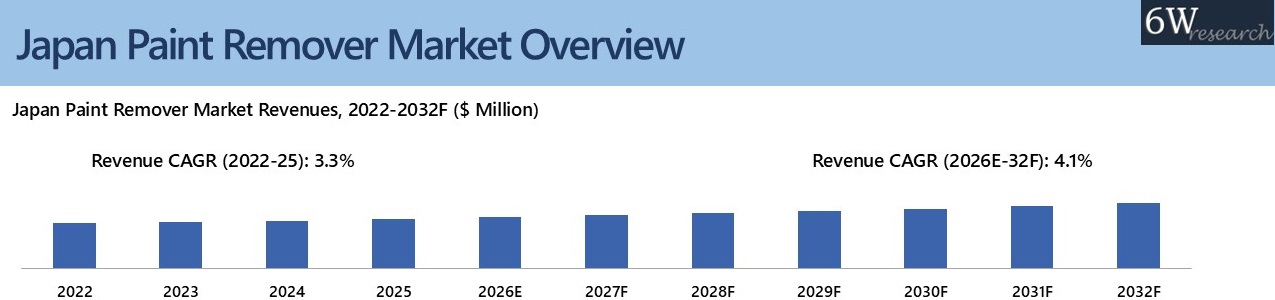
According to 6Wresearch, Japan paint remover market revenue size is projected to grow at a CAGR of 4.1% during 2026-2032F, driven by vehicle aging, automotive accident repairs, industrial refurbishment, and infrastructure maintenance. In FY2025, MLIT allocated a specific amount for renovations of aging government facilities, supporting paint-removal demand during surface preparation and recoating. Additionally, under Japan’s FY2026 First Medium-Term Plan for National Resilience (FY2026–FY2030), the government is strengthening strategic infrastructure maintenance, including development and improvement of port-related buildings across various ports.
Looking ahead, planned dock expansion during 2029–2031 and investments in expanded facilities and large-scale equipment during 2032–2034 are expected to create additional opportunities through maintenance, refurbishment, and protective-coating renewal. Furthermore, demand is supported by Japan’s large vehicle parc, long vehicle usage periods, established maintenance and collision-repair network, alongside renovation activities and ongoing industrial equipment and building refurbishment.
Trends in the Japan Paint Remover Market
Below are some important trends of the market, which include:
Past Trends: The Japan paint remover market initially developed around solvent-based and caustic-based formulations, with consumption driven by automotive refinishing, industrial equipment maintenance, and metal surface preparation. Demand remained concentrated on high-performance chemical removers capable of efficiently stripping multiple coating layers.
From the late 2010s onward, stricter workplace safety and environmental considerations gradually influenced product development, encouraging manufacturers to improve formulations while maintaining effective paint removal performance across industrial applications
Present Trends: From 2016–2025, the Japan paint remover market has shifted toward safer, low-VOC, and environmentally compliant solutions, supported by increasing adoption of bio-based and water-based removers across industrial and consumer applications. Demand has expanded beyond traditional uses into renovation, maintenance, and DIY activities.
The market is witnessing greater preference for specialized solutions offering faster removal, reduced surface damage, and compatibility with advanced coatings used in automotive, machinery, and infrastructure applications.
Future Trends: Going forward, the Japan paint remover market is expected to emphasize eco-friendly formulations, improved chemical safety, and high-efficiency stripping technologies as industries focus on sustainability and regulatory compliance. Manufacturers are likely to invest in alternatives to conventional chemical removers.
Automotive refurbishment, industrial maintenance, and building renovation activities are expected to support future demand, while product innovation will focus on multi-surface compatibility, reduced processing time, and user-friendly application methods
Market Segmentation By Type
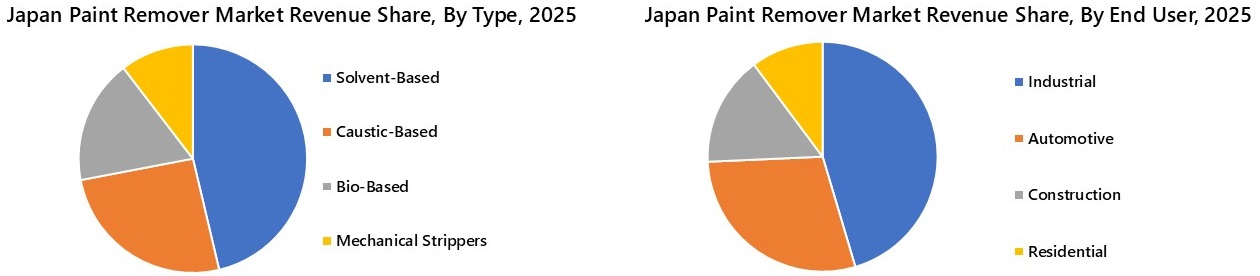
Bio-based paint removers are expected to witness the fastest growth during the 2026E–2032F period, driven by stricter environmental regulations, growing demand for low-toxicity formulations, increasing workplace safety awareness, and manufacturers’ shift toward sustainable alternatives with reduced volatile organic compound emissions and environmental impact.
Market Segmentation By Application
Industrial coatings stripping is expected to witness the fastest growth during the 2026E–2032F period in Japan’s paint remover market, driven by infrastructure renewal, industrial equipment refurbishment, increasing maintenance requirements, and demand for efficient removal of high-performance protective coatings across manufacturing and industrial facilities.
Market Segmentation By End user
Construction is expected to witness the fastest growth during the 2026E–2032F period in Japan’s paint remover market, driven by rising renovation and refurbishment activity, aging buildings and infrastructure, government facility upgrades, and increasing demand for efficient surface preparation during maintenance and renewal projects.
Market Segmentation By Distribution Channel
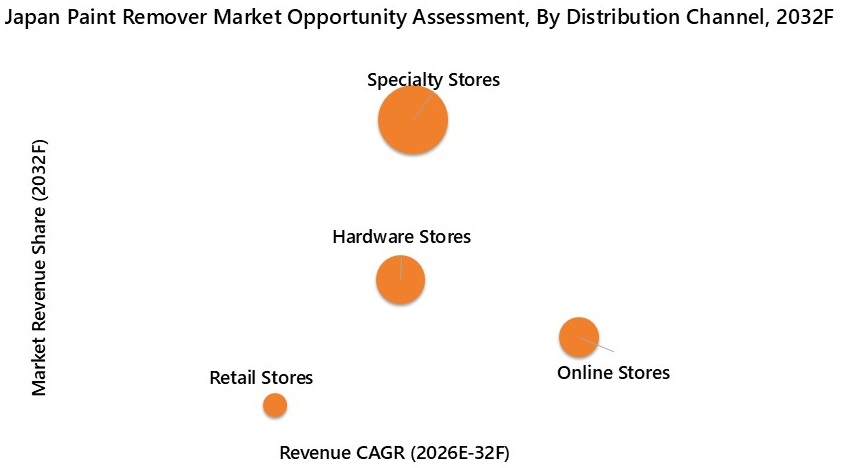
Online stores are expected to witness the fastest growth during the 2026E–2032F period in Japan’s paint remover market, supported by increasing digital purchasing, broader product selection, convenient home delivery, easy price comparison, and growing adoption among DIY users and small-scale professional buyers.
Key Attractiveness of the Report
- 10 Years Market Numbers.
- Historical Data Starting from 2022 to 2025
- Base Year: 2025
- Forecast Data until 2032
- Key Performance Indicators Impacting the Market.
- Major Upcoming Developments and Projects.
Key Highlights of the Report:
- Japan Paint Remover Market Overview
- Japan Paint Remover Market Outlook
- Japan Paint Remover Market Forecast
- Historical Data and Forecast of Japan Paint Remover Market Revenues for the Period 2022-2032F
- Historical Data and Forecast of Japan Paint Remover Market Revenues, By Type, for the Period 2022-2032F
- Historical Data and Forecast of Japan Paint Remover Market Revenues, By Application, for the Period 2022-2032F
- Historical Data and Forecast of Japan Paint Remover Market Revenues, By End User, for the Period 2022-2032F
- Historical Data and Forecast of Japan Paint Remover Market Revenues, By Distribution Channel, for the Period 2022-2032F
- Industry Life Cycle
- Porter’s Five Force Analysis
- Japan Paint Remover Market Drivers and Restraints
- Japan Paint Remover Market Trends & Evolution
- Market Opportunity Assessment
- Japan Paint Remover Market Revenue Ranking, By Top 3 Companies
- Competitive Benchmarking
- Company Profiles
- Key Strategic Recommendations
Market Scope and Segmentation
The report provides a detailed analysis of the following market segments:
By Type
- Solvent-Based
- Caustic-Based
- Bio-Based
- Mechanical Strippers
By Application
- Automotive Paint Removal
- Industrial Coatings Stripping
- Home & DIY Projects
- Metal Paint Removal
By End User
- Automotive
- Industrial
- Residential
- Construction
By Distribution Channel
- Hardware Stores
- Online Stores
- Retail Stores
- Specialty Stores






































