Japan Personal Computers Market Size, Share & Growth Rate
The Japan Personal Computers Market was estimated at USD 82 Million in 2025 and is projected to reach USD 87 Million by 2032, growing at a CAGR of 0.8% from 2026 to 2032. This moderate growth trajectory is primarily driven by the rising demand for portable computing devices and gaming PCs, as well as an increasing trend toward remote working arrangements. The unique blend of technological innovation and consumer preferences for high-performance devices will be key in shaping the markets evolution in the coming years.
Japan Personal Computers Market Year-wise Growth Rate and Key Drivers
This graph highlights how the Japan Personal Computers Market has steadily grown over the years, supported by major growth factors.
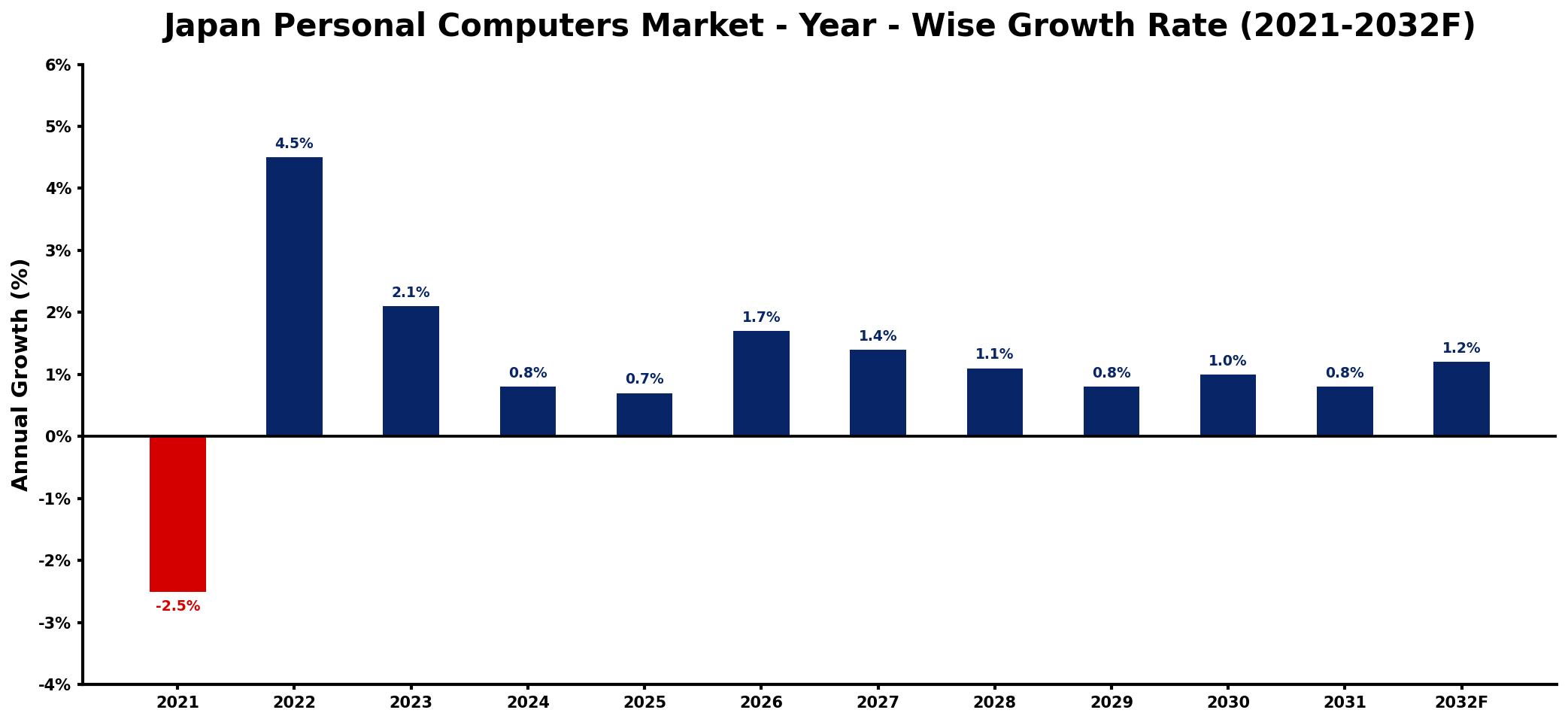
The table below presents the year‑wise growth rates along with the key drivers influencing the market
| Year | Growth Rate | Major Drivers |
| 2021 | -2.5% | decreased consumer electronics spending |
| 2022 | 4.5% | increased remote work adoption |
| 2023 | 2.1% | rise in online education platforms |
| 2024 | 0.8% | growing demand for gaming |
| 2025 | 0.7% | expansion of digital content creation |
| 2026 | 1.7% | enhanced cloud computing services |
| 2027 | 1.4% | emphasis on cybersecurity measures |
| 2028 | 1.1% | growth in e-commerce platforms |
| 2029 | 0.8% | increased mobile device integration |
| 2030 | 1.0% | improved raw material availability |
| 2031 | 0.8% | growing emerging market penetration |
| 2032 | 1.2% | growing interest in AI applications |
Note: Market size estimations and growth projections presented in this report are based on 6Wresearch's proprietary forecasting methodology, utilizing the latest available industry data, government publications, and primary research inputs.
Japan Personal Computers Market Synopsis
Recent momentum in the Japan Personal Computers Market has showcased resilience, especially in the face of competition from mobile devices. While traditional desktop sales have seen a decline, the push for innovative and portable computing solutions is paving the way for new opportunities in laptops and gaming systems.
Looking ahead, the market is expected to evolve further with advancements in AI and immersive technologies, enhancing user experience and functionality. As consumer expectations shift, manufacturers are now more focused on integrating sustainability and eco-friendly designs into their offerings, responding to the increasing demand for responsible technology.
Japan Personal Computers Market Key Takeaways
- Strong demand for lightweight, portable devices, particularly ultrabooks and 2-in-1 laptops, is reshaping consumer preferences.
- The gaming segment is experiencing a robust growth trend, driven by e-sports and content creation demands.
- Innovation in technology, such as AI and VR, is critical for enhancing consumer experience and maintaining competitive advantage.
- Sustainability initiatives are becoming a significant focus for manufacturers, aligning with eco-conscious consumer behavior.
- The market is navigating challenges posed by a declining population and increased competition from mobile alternatives.
Evaluation of Restraints in Japan Personal Computers Market
The Japan Personal Computers Market faces several limitations that could hinder growth. A declining population suggests a shrinking consumer base, making it challenging to sustain high sales volumes. Additionally, the rapid evolution of mobile technologies poses a persistent threat to traditional PC sales, as consumers increasingly gravitate toward multifunctional devices. Coupled with these factors, the pressure to innovate while maintaining quality standards places significant constraints on manufacturers. Furthermore, market saturation and the shift towards cloud computing models could further exacerbate the challenges faced by the sector, emphasizing the need for continuous adaptation.
Japan Personal Computers Market Trends
The current landscape of the Japan Personal Computers Market is defined by several key trends. There is a notable shift towards portable and lightweight computing, with ultrabooks and versatile 2-in-1 devices gaining traction among consumers seeking mobility. The demand for high-performance gaming laptops is on the rise, fueled by the expanding e-sports industry and the growing number of content creators. Additionally, integration of cutting-edge technologies like artificial intelligence and biometrics is becoming crucial for enhancing product appeal. On the sustainability front, manufacturers are actively developing energy-efficient PCs and implementing practices that mitigate electronic waste, resonating with a more environmentally-conscious consumer base.
Japan Personal Computers Market Opportunities
Opportunities for growth within the Japan Personal Computers Market are increasingly abundant, particularly in niche segments such as gaming and remote work. Companies that specialize in high-performance computing hardware, including gaming peripherals and custom-built PCs, stand to benefit significantly. The ongoing trend of hybrid work models post-pandemic further accentuates the need for reliable home-office equipment. Moreover, the increasing consumer preference for premium and customized solutions presents avenues for investment in innovative product development. Keeping an eye on emerging trends such as compact PCs and sustainable computing can also lead to lucrative opportunities in this dynamic market.
Government Initiatives in the Japan Personal Computers Market
The Japanese government plays an influential role in shaping the personal computers market through various policies aimed at promoting innovation and sustainability. Initiatives such as the RoHS directive ensure environmental protection, while the Top Runner Program encourages energy-efficient product development. The Home Appliance Recycling Law supports responsible e-waste management practices. Additionally, safety regulations under the Electrical Appliance and Material Safety Law bolster consumer protection. Overall, these governmental measures aim to create a conducive environment for growth and technological advancement within the market.
Future Insights of the Japan Personal Computers Market
As the Japan Personal Computers Market moves into the 2026-2032 period, it is poised for a moderate but steady growth trajectory. The increasing reliance on remote working solutions and the rise of gaming and esports are likely to sustain demand for high-performance devices. Manufacturers are expected to focus on innovation, particularly in enhancing connectivity and user experience. However, competition from mobile devices and persistent supply chain challenges may temper growth rates. Ultimately, the markets future will depend on its ability to adapt to evolving consumer preferences and technological advancements.
Japan Personal Computers Market Latest Developments (2025 - 2026)
In recent months, the Japan Personal Computers Market has been witnessing significant developments focused on innovation and sustainability. Companies are investing in research and development to create energy-efficient devices that align with consumer expectations for eco-friendly products. Additionally, the popularity of gaming continues to influence product offerings, with an uptick in dedicated gaming hardware. Furthermore, collaborations between tech firms and educational institutions are emerging, aimed at enhancing technological literacy and access within the workforce, indicative of the sector's commitment to future growth.
Japan Personal Computers Market - Key Attractiveness of the Report
- 10 Years of Market Numbers
- Historical Data Starting from 2022 to 2025
- Base Year: 2025
- Forecast Data until 2032
- Key Performance Indicators Impacting the Market
- Major Upcoming Developments and Projects
Key Highlights of the Report:
- Japan Personal Computers Market Outlook
- Market Size of Japan Personal Computers Market, 2025
- Forecast of Japan Personal Computers Market, 2032
- Historical Data and Forecast of Japan Personal Computers Revenues & Volume for the Period 2022-2032F
- Japan Personal Computers Market Trend Evolution
- Japan Personal Computers Market Drivers and Challenges
- Japan Personal Computers Price Trends
- Japan Personal Computers Porter's Five Forces
- Japan Personal Computers Industry Life Cycle
- Historical Data and Forecast of Japan Personal Computers Market Revenues & Volume By Product Type for the Period 2022-2032F
- Historical Data and Forecast of Japan Personal Computers Market Revenues & Volume By Desktop for the Period 2022-2032F
- Historical Data and Forecast of Japan Personal Computers Market Revenues & Volume By Notebook for the Period 2022-2032F
- Historical Data and Forecast of Japan Personal Computers Market Revenues & Volume By Workstation for the Period 2022-2032F
- Historical Data and Forecast of Japan Personal Computers Market Revenues & Volume By Others for the Period 2022-2032F
- Historical Data and Forecast of Japan Personal Computers Market Revenues & Volume By Distribution Channel for the Period 2022-2032F
- Historical Data and Forecast of Japan Personal Computers Market Revenues & Volume By Business-To-Business (B2B) for the Period 2022-2032F
- Historical Data and Forecast of Japan Personal Computers Market Revenues & Volume By Business-To-Consumer (B2C) for the Period 2022-2032F
- Historical Data and Forecast of Japan Personal Computers Market Revenues & Volume By Application for the Period 2022-2032F
- Historical Data and Forecast of Japan Personal Computers Market Revenues & Volume By Consumer for the Period 2022-2032F
- Historical Data and Forecast of Japan Personal Computers Market Revenues & Volume By Commercial for the Period 2022-2032F
- Historical Data and Forecast of Japan Personal Computers Market Revenues & Volume By Industrial for the Period 2022-2032F
- Japan Personal Computers Import Export Trade Statistics
- Market Opportunity Assessment By Product Type
- Market Opportunity Assessment By Distribution Channel
- Market Opportunity Assessment By Application
- Japan Personal Computers Top Companies Market Share
- Japan Personal Computers Competitive Benchmarking By Technical and Operational Parameters
- Japan Personal Computers Company Profiles
- Japan Personal Computers Key Strategic Recommendations






































