Japan Spend Analytics Market Size & Growth Rate (2026-2032)
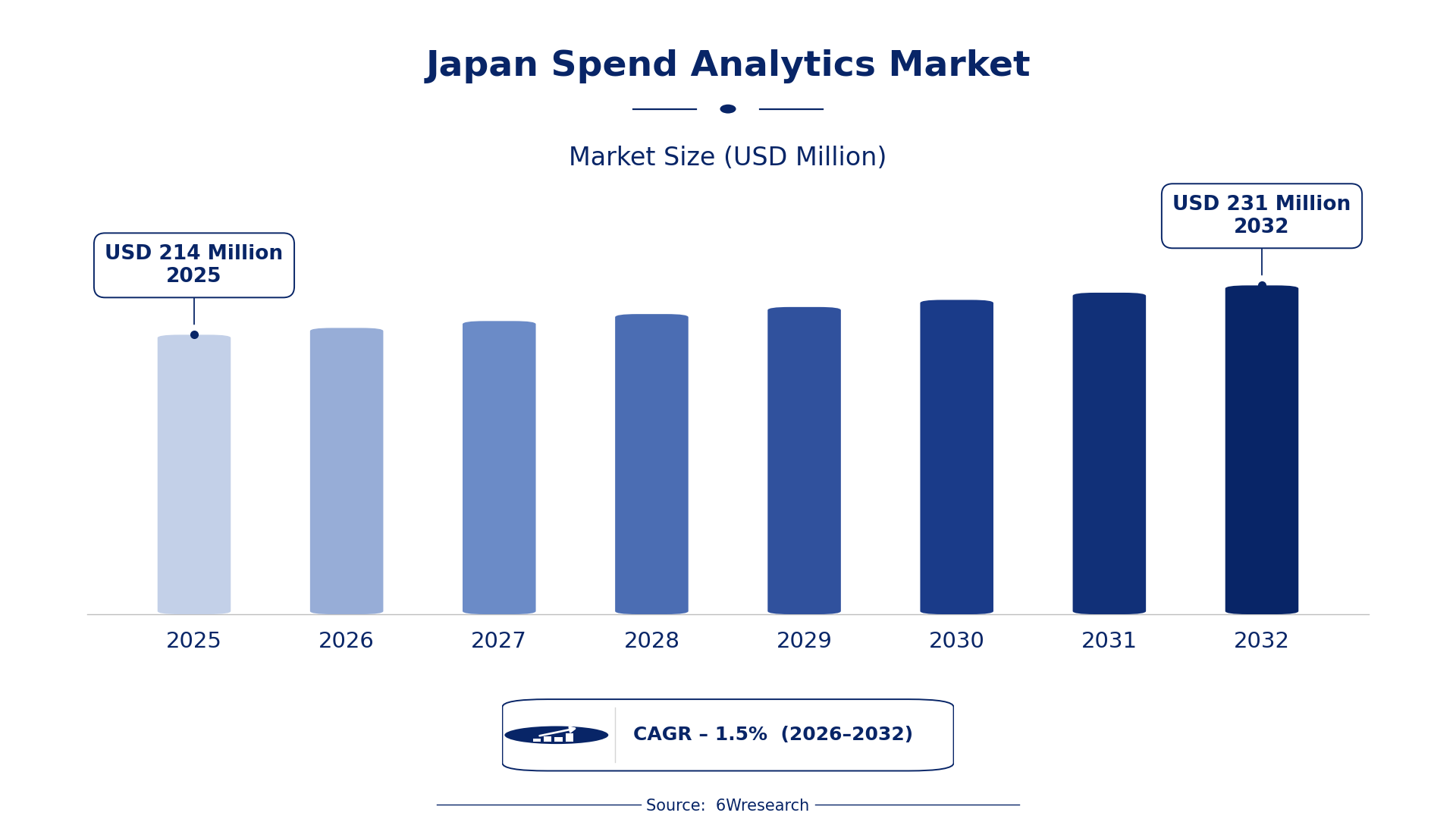
The Japan Spend Analytics Market was estimated at USD 214 Million in 2025 and is projected to reach USD 231 Million by 2032, growing at a CAGR of 1.5% from 2026 to 2032.
Japan Spend Analytics Market Synopsis
The Japan Spend Analytics Market is rapidly evolving, fueled by the increasing need for businesses to optimize expenditures and enhance operational efficiency. Organizations are realizing that traditional methods no longer suffice; they require sophisticated analytics tools that provide real-time insights into spending behaviors and procurement strategies.
This market shift is heavily influenced by the growing adoption of cloud-based solutions and AI technologies. Companies are not just looking at historical data but are actively seeking predictive insights to guide future spending, making the demand for spend analytics tools more critical than ever.
Japan Spend Analytics Market Year-wise Growth Rate and Key Drivers
This graph illustrates the annual growth rates of the Japan Spend Analytics Market from 2021 to 2032, highlighting a steady upward trajectory and projected expansion over the forecast period.
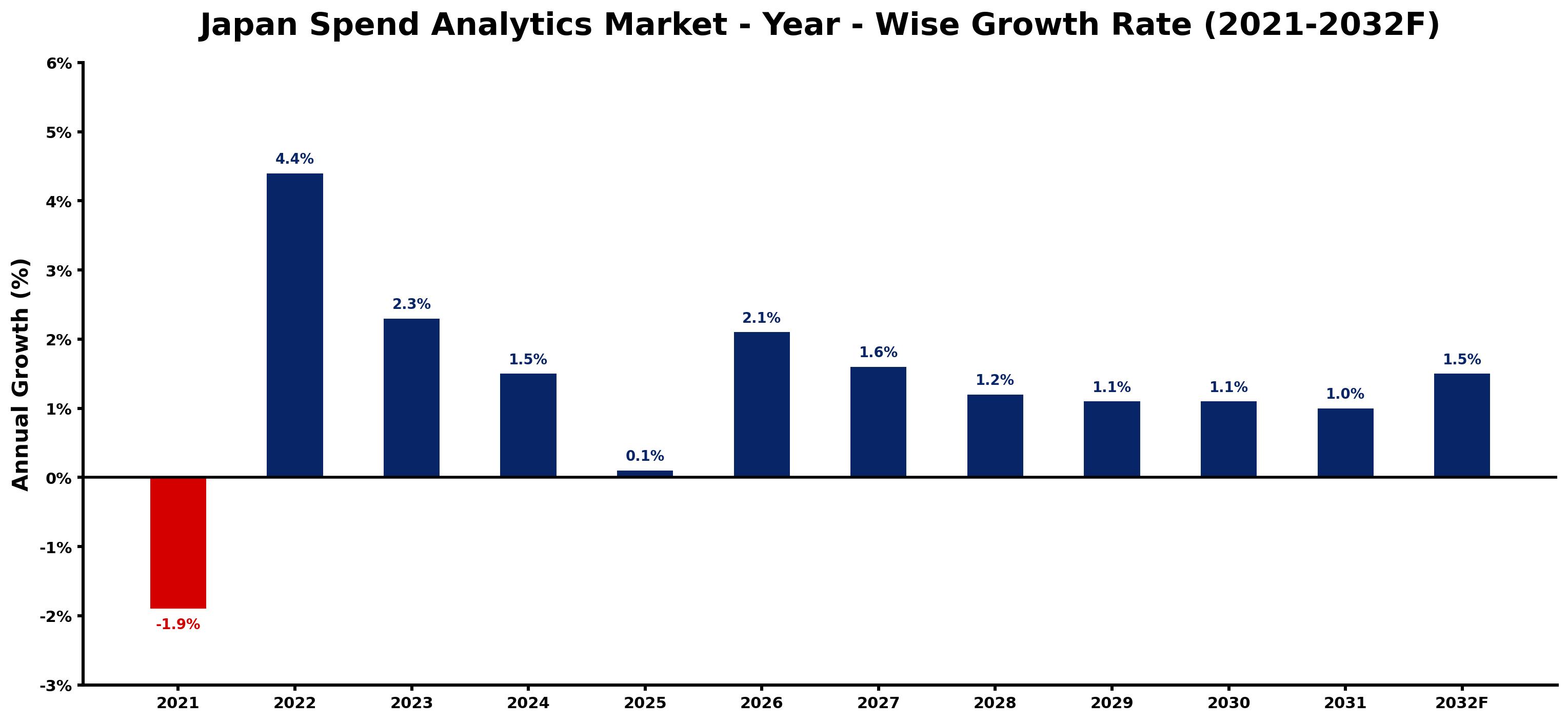
The table below presents the year‑wise growth rates along with the key drivers influencing the market
| Year | Growth Rate | Major Drivers |
| 2021 | -1.9% | Delayed adoption of AI-driven analytics technologies in Japan. |
| 2022 | 4.4% | Mita Technology's platform enhances procurement data insights. |
| 2023 | 2.3% | Tokyo's Smart City initiative boosts analytics investments. |
| 2024 | 1.5% | Regulatory focus on procurement transparency increases analytics adoption. |
| 2025 | 0.1% | Shift towards AI-driven cost optimization in enterprises. |
| 2026 | 2.1% | Rising corporate focus on sustainability fuels spend analytics. |
| 2027 | 1.6% | Increased competition in retail spurs analytics demand. |
| 2028 | 1.2% | Demand for real-time insights drives software enhancements. |
| 2029 | 1.1% | Adoption of blockchain for procurement ensures data accuracy. |
| 2030 | 1.1% | Local startups innovate spend analysis tools for SMEs. |
| 2031 | 1.0% | Growth of digital payment solutions enhances transaction data. |
| 2032 | 1.5% | Evolving consumer behavior drives advanced spend forecasting. |
Note: Market size estimations and growth projections presented in this report are based on 6Wresearch's proprietary forecasting methodology, utilizing the latest available industry data, government publications, and primary research inputs.
Japan Spend Analytics Market Key Takeaways
Below are some of the specific key takeaways from the market, including:
- Growing emphasis on data-driven decision-making among Japanese businesses.
- Shift towards cloud-based and AI-powered spend analytics solutions.
- Increased focus on predictive analytics to forecast spending trends.
- Rising adoption across various industries, including retail, manufacturing, and healthcare.
- Challenges in data quality and cultural resistance remain significant barriers.
Evaluation of Restraints in Japan Spend Analytics Market
Despite the promising growth potential, several factors hinder the Japan Spend Analytics Market. One major issue is the quality of data; organizations often grapple with disparate data sources and varying formats, which complicate accurate analysis. on top of that, the traditional business culture in Japan tends to be cautious about adopting new technologies, leading to slower integration of analytics tools. There’s also a noticeable shortage of skilled professionals capable of interpreting complex analytics, which limits companies' abilities to extract actionable insights from the data they collect. Addressing these challenges is essential for unlocking the market's full potential.
Japan Spend Analytics Market Trends
A few key trends are shaping the Japan Spend Analytics Market right now. First, cloud adoption is surging, as businesses recognize the cost efficiencies and real-time capabilities it offers. Second, there’s a notable increase in companies utilizing AI and machine learning, which not only streamline the analysis process but also allow for deeper insights into spending behaviors. Another trend is the growing use of predictive analytics, enabling firms to anticipate future spending and make informed decisions that align with strategic goals. This convergence of technology and analytics is driving organizations to rethink their procurement processes.
Japan Spend Analytics Market Opportunities
The Japan Spend Analytics Market is ripe with investment opportunities. As businesses prioritize cost reduction and efficiency, the demand for tailored analytics solutions is on the rise. Companies offering innovative tools or consulting services can capitalize on the need for improved procurement strategies. Additionally, the ongoing digital transformation across sectors offers a fertile ground for growth. Those who invest in developing user-friendly, effective analytics platforms are likely to see lucrative returns in this expanding market.
Government Initiatives in the Japan Spend Analytics Market
Government policy is actively shaping the Japan Spend Analytics Market. Recently, initiatives like the Open Data Policy have been launched to promote transparency in public spending, encouraging agencies to utilize analytics tools for better decision-making. Currently, the government is investing in digital transformation efforts aimed at enhancing data analytics capabilities across public sectors, which is fostering an environment conducive to the adoption of spend analytics solutions. Looking ahead, further policies focused on promoting accountability and efficiency in public spending are anticipated to roll out, signaling an ongoing commitment to data-driven governance.
Future Insights of the Japan Spend Analytics Market
Looking forward to 2026-2032, the Japan Spend Analytics Market is set to expand as organizations increasingly adopt advanced analytics tools. The growing need for real-time visibility into spending patterns and supplier performance will drive demand. As companies prioritize financial transparency and strategic sourcing, the importance of spend analytics will become even more pronounced. E-commerce growth and the rising prevalence of digital payment methods will further necessitate robust analytics solutions, setting the stage for a more sophisticated market environment.
Japan Spend Analytics Market Latest Developments
In the past year, several noteworthy developments have occurred in the Japan Spend Analytics Market. A leading regional operator launched a new cloud-based analytics platform aimed at improving procurement efficiency, with the rollout completed by late 2025. Ongoing initiatives include a major technology vendor's partnership with local enterprises to enhance data integration capabilities, which began in mid-2025 and remains underway. Looking ahead, an upcoming government initiative expected to begin in the second half of 2026 aims to further support public sector agencies in adopting spend analytics tools, reflecting a commitment to improving public spending efficiency.
Japan Spend Analytics Market - Key Attractiveness of the Report
- 10 Years of Market Numbers
- Historical Data Starting from 2022 to 2025
- Base Year: 2025
- Forecast Data until 2032
- Key Performance Indicators Impacting the Market
- Major Upcoming Developments and Projects
Key Highlights of the Report:
- Japan Spend Analytics Market Outlook
- Market Size of Japan Spend Analytics Market, 2025
- Forecast of Japan Spend Analytics Market, 2032
- Historical Data and Forecast of Japan Spend Analytics Revenues & Volume for the Period 2022-2032F
- Japan Spend Analytics Market Trend Evolution
- Japan Spend Analytics Market Drivers and Challenges
- Japan Spend Analytics Price Trends
- Japan Spend Analytics Porter's Five Forces
- Japan Spend Analytics Industry Life Cycle
- Historical Data and Forecast of Japan Spend Analytics Market Revenues & Volume By Application for the Period 2022-2032F
- Historical Data and Forecast of Japan Spend Analytics Market Revenues & Volume By Financial management for the Period 2022-2032F
- Historical Data and Forecast of Japan Spend Analytics Market Revenues & Volume By Risk management for the Period 2022-2032F
- Historical Data and Forecast of Japan Spend Analytics Market Revenues & Volume By Governance and compliance management for the Period 2022-2032F
- Historical Data and Forecast of Japan Spend Analytics Market Revenues & Volume By Supplier sourcing and performance management for the Period 2022-2032F
- Historical Data and Forecast of Japan Spend Analytics Market Revenues & Volume By Demand and supply forecasting for the Period 2022-2032F
- Historical Data and Forecast of Japan Spend Analytics Market Revenues & Volume By Others for the Period 2022-2032F
- Historical Data and Forecast of Japan Spend Analytics Market Revenues & Volume By Component for the Period 2022-2032F
- Historical Data and Forecast of Japan Spend Analytics Market Revenues & Volume By Software for the Period 2022-2032F
- Historical Data and Forecast of Japan Spend Analytics Market Revenues & Volume By Services for the Period 2022-2032F
- Historical Data and Forecast of Japan Spend Analytics Market Revenues & Volume By Analytics Type for the Period 2022-2032F
- Historical Data and Forecast of Japan Spend Analytics Market Revenues & Volume By Predictive for the Period 2022-2032F
- Historical Data and Forecast of Japan Spend Analytics Market Revenues & Volume By Prescriptive for the Period 2022-2032F
- Historical Data and Forecast of Japan Spend Analytics Market Revenues & Volume By Descriptive for the Period 2022-2032F
- Historical Data and Forecast of Japan Spend Analytics Market Revenues & Volume By Business Function for the Period 2022-2032F
- Historical Data and Forecast of Japan Spend Analytics Market Revenues & Volume By Finance for the Period 2022-2032F
- Historical Data and Forecast of Japan Spend Analytics Market Revenues & Volume By Information Technology (IT) for the Period 2022-2032F
- Historical Data and Forecast of Japan Spend Analytics Market Revenues & Volume By Marketing for the Period 2022-2032F
- Historical Data and Forecast of Japan Spend Analytics Market Revenues & Volume By Procurement for the Period 2022-2032F
- Historical Data and Forecast of Japan Spend Analytics Market Revenues & Volume By Deployment Model for the Period 2022-2032F
- Historical Data and Forecast of Japan Spend Analytics Market Revenues & Volume By On-premises for the Period 2022-2032F
- Historical Data and Forecast of Japan Spend Analytics Market Revenues & Volume By Cloud for the Period 2022-2032F
- Historical Data and Forecast of Japan Spend Analytics Market Revenues & Volume By Organization Size for the Period 2022-2032F
- Historical Data and Forecast of Japan Spend Analytics Market Revenues & Volume By Small and Medium Enterprises (SMEs) for the Period 2022-2032F
- Historical Data and Forecast of Japan Spend Analytics Market Revenues & Volume By Large enterprises for the Period 2022-2032F
- Historical Data and Forecast of Japan Spend Analytics Market Revenues & Volume By Industry Vertical for the Period 2022-2032F
- Historical Data and Forecast of Japan Spend Analytics Market Revenues & Volume By Manufacturing for the Period 2022-2032F
- Historical Data and Forecast of Japan Spend Analytics Market Revenues & Volume By Retail and eCommerce for the Period 2022-2032F
- Historical Data and Forecast of Japan Spend Analytics Market Revenues & Volume By Government and defense for the Period 2022-2032F
- Historical Data and Forecast of Japan Spend Analytics Market Revenues & Volume By Healthcare and life sciences for the Period 2022-2032F
- Historical Data and Forecast of Japan Spend Analytics Market Revenues & Volume By Telecommunications and IT for the Period 2022-2032F
- Historical Data and Forecast of Japan Spend Analytics Market Revenues & Volume By Energy and utilities for the Period 2022-2032F
- Historical Data and Forecast of Japan Spend Analytics Market Revenues & Volume By Banking, Financial Services, and Insurance (BFSI) for the Period 2022-2032F
- Japan Spend Analytics Import Export Trade Statistics
- Market Opportunity Assessment By Application
- Market Opportunity Assessment By Component
- Market Opportunity Assessment By Analytics Type
- Market Opportunity Assessment By Business Function
- Market Opportunity Assessment By Deployment Model
- Market Opportunity Assessment By Organization Size
- Market Opportunity Assessment By Industry Vertical
- Japan Spend Analytics Top Companies Market Share
- Japan Spend Analytics Competitive Benchmarking By Technical and Operational Parameters
- Japan Spend Analytics Company Profiles
- Japan Spend Analytics Key Strategic Recommendations






































