Japan String Market (2026-2032) | Trends, Growth, Value, Forecast, Analysis, Revenue, Companies, Industry, Share & Size
Market Forecast By Type (Guitar, Violins, Others), By Application (Personal Use, Commercial) And Competitive Landscape
| Product Code: ETC227542 | Publication Date: Aug 2022 | Updated Date: Mar 2026 | Product Type: Market Research Report | |
| Publisher: 6Wresearch | Author: Sachin Kumar Rai | No. of Pages: 75 | No. of Figures: 35 | No. of Tables: 20 |
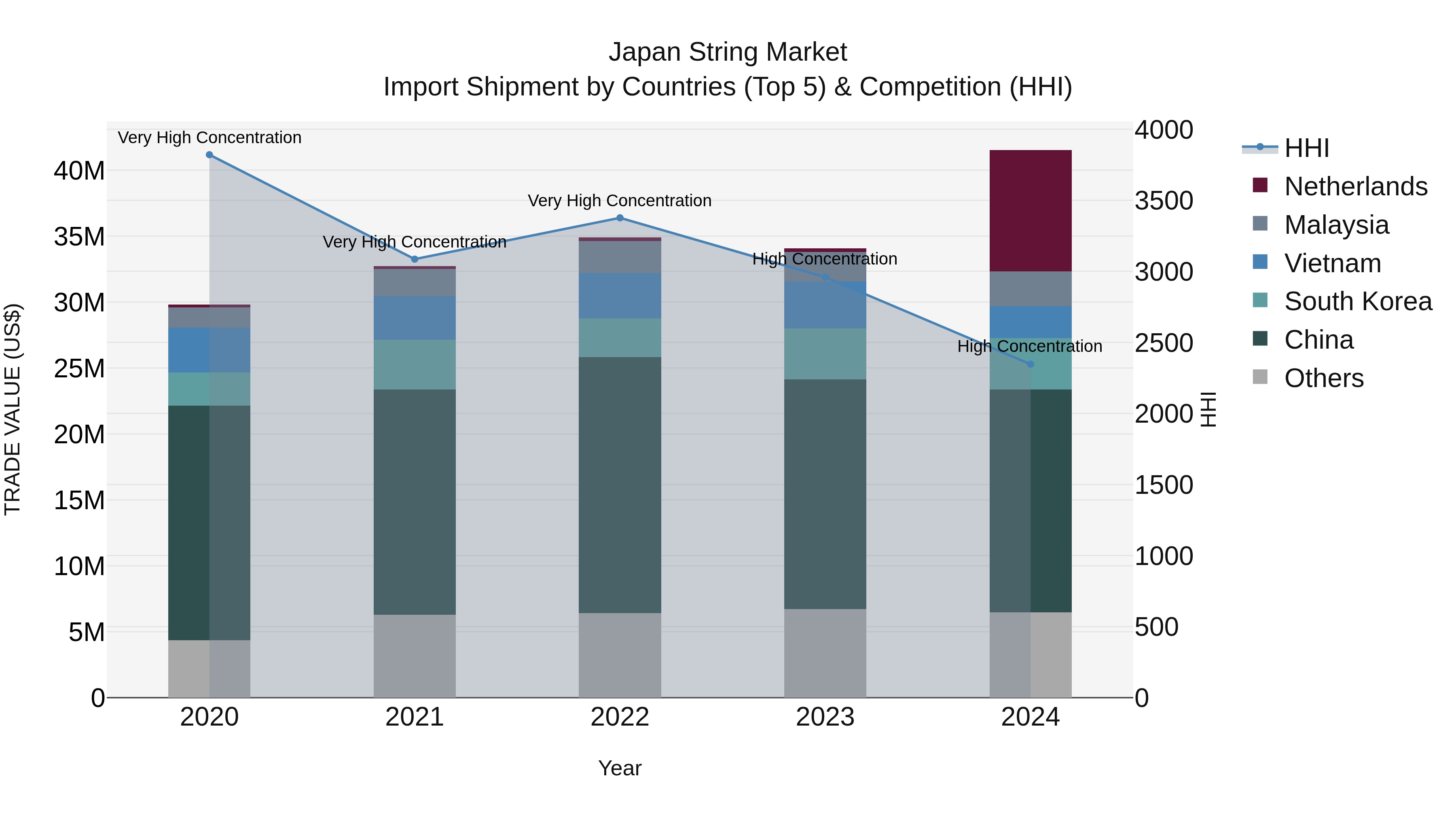
Japan String Market Import Shipment by Countries (Top 5) & Competition (HHI)
Japan's string import market in 2024 continued to see significant contributions from top exporting countries such as China, Netherlands, South Korea, Malaysia, and Vietnam. The high Herfindahl-Hirschman Index (HHI) indicates a concentrated market landscape. With a strong Compound Annual Growth Rate (CAGR) of 8.64% from 2020 to 2024 and a notable growth rate of 21.9% from 2023 to 2024, the string import sector in Japan is showing resilience and promising potential for continued expansion.
Japan String Market Growth Rate
According to 6Wresearch internal database and industry insights, the Japan String Market is projected to grow at a compound annual growth rate (CAGR) of 6.5% during the forecast period from 2026 to 2032.
Topics Covered in the Japan String Market Report
The Japan String Market report covers the market comprehensively by type and application. The report provides a detailed and unbiased analysis of the ongoing market trends, opportunities, challenges, and market drivers, assisting stakeholders in aligning strategies with current and future market dynamics.
Japan String Market Highlights
| Report Name | Japan String Market |
| Forecast period | 2026–2032 |
| CAGR | 6.5% |
| Growing Sector | Music Industry |
Japan String Market Synopsis
The Japan String Market is expected to witness steady growth, as it is driven by some major factors, such as the growing interest in music education and the popularity of live performances. String instruments like guitars, violins, and others are in high demand owing to their widespread usage in both personal and commercial settings. Along with that, the rise of e-commerce and online music platforms will further drive the market's expansion.
Evaluation of Growth Drivers in the Japan String Market
Below mentioned are some prominent drivers and their impact on the Japan String Market dynamics:
| Drivers | Primary Segments Affected | Why it matters (evidence) |
| Rising Interest in Music Education | By Application (Personal Use) | Increasing student enrollment in music schools increases the demand for beginner and intermediate string instruments. |
| Rise in Live Performances and Concerts | By Application (Commercial) | A growing number of live music performances and concert events increases the demand for professional-grade string instruments. |
| E-commerce Sector’s Growth | By Distribution Channel (Online Stores) | E-commerce platforms offer an easy access to a variety of string instruments and accessories. |
| Increasing Impact of Digital Music Platforms | By Application (Personal Use, Commercial) | There is an increasing consumer interest in string instruments, with the rising use of digital platforms like YouTube and streaming services |
| Innovation and Customization | By Product Type (Guitar, Violin, Others) | Demand for customized and high-quality string instruments is growing due to consumer preference for unique designs. |
The Japan String Market is projected to grow at a CAGR of 6.5% during the forecast period from 2026 to 2032. as it is influenced by the rise in music education, growing live performances, and increasing e-commerce availability for string instruments. Additionally, the influence of digital music platforms and online tutorials has made learning string instruments more accessible, which contribute to their popularity. E-commerce growth also plays an important role, offering consumers easy access to a wide variety of string instruments and accessories. There is a rising focus on high-quality products, alongside digital platforms and innovation, which will continue to support Japan String Market growth.
Restraints in the Japan String Market
Below mentioned are some major restraints and their influence on the Japan String Market dynamics:
| Restraints | Primary Segments Affected | What this means (evidence) |
| High Cost of Premium Instruments | By Product Type (Guitar, Violin, Others) | Premium string instruments are often expensive, which makes them inaccessible to price-sensitive consumers. |
| Limited Consumer Knowledge | By Application (Non-professional) | Many consumers are unfamiliar with different string instruments, which can reduce their interest in purchasing. |
| Competition from Local and Unbranded Products | By Brand (Private Label, Branded) | Lower-priced and unbranded string instruments present stiff competition, which appeals to budget-conscious consumers. |
| Regulatory Barriers for New Products | By Product Type (New String Instruments) | String instruments may face regulatory issues regarding quality certifications, and this delays the introduction of new products. |
Japan String Market Challenges
The Japan String Market has strong growth potential, but several challenges exist that could affect its growth. Such obstacles are the high cost of premium string instruments limits access for price-sensitive consumers, especially beginners. Another one is a lack of consumer knowledge about the various types and benefits of string instruments reduces adoption rates, especially among non-professionals. Other than that, competition from locally made and unbranded instruments, which are more affordable, poses a challenge in the budget-conscious segment.
Trends Shaping the Japan String Market
Below mentioned are some key trends in the Japan String Market, which include:
- Increasing Interest in Music Education: The demand for string instruments is increasing as people become more interested in music education, particularly among young consumers and beginners.
- A Surge of Online Music Platforms: The rise of online music platforms such as YouTube and streaming services has increased the popularity of string instruments, which provides them more exposure and learning opportunities.
- Customization and Personalization: Consumers are looking for customized and personalized string instruments, which creates opportunities for companies to offer unique and tailored options.
Major Investment Opportunities in the Japan String Market
Below mentioned are some major investment opportunities in the market:
- Increasing Music Education Platforms: Investing in online music tutorials and educational platforms can help support the growing interest in learning string instruments.
- Sustainable Manufacturing: There is a rising investment in the production of eco-friendly and sustainably sourced string instruments to meet the increasing demand for environmentally conscious products.
- Customization and High-Quality Instruments: Focusing on creating premium, customized string instruments tailored to the needs of individual musicians, particularly professionals.
Top 5 Leading Players in the Japan String Market
Here are some top companies contributing to the Japan String Market share:
1. Yonex Co., Ltd.
| Company Name | Yonex Co., Ltd. |
| Headquarters | Tokyo, Japan |
| Established | 1946 |
| Website | Click here |
Yonex is the global standard-bearer for badminton and tennis strings. Their high-performance synthetic strings are manufactured in their Japanese facilities and are used by the majority of professional athletes worldwide.
2. Gosen Co., Ltd.
| Company Name | Gosen Co., Ltd. |
| Headquarters | Osaka, Japan |
| Established | 1951 |
| Website | Click here |
A pioneer in synthetic gut technology, Gosen manufactures high-quality strings for racket sports, fishing tackle, and specialized industrial threads. They are renowned for their proprietary "Made in Japan" fiber technologies.
3. Marusan Hashimoto
| Company Name | Marusan Hashimoto |
| Headquarters | Nagahama, Shiga Prefecture |
| Established | 1908 |
| Website | Click here |
This heritage company is Japan’s premier producer of traditional silk strings for instruments like the Koto and Shamisen. They are essential to the preservation of Japanese musical arts and theater.
4. Gibson Brands, Inc.
| Company Name | Gibson Brands, Inc. |
| Headquarters | Nashville, Tennessee, USA (operating in Japan) |
| Established | 1902 |
| Website | Click here |
Known for its high-quality electric and acoustic guitars, Gibson is a major player in the string instrument market.
5. Toray Industries (Materials Division)
| Company Name | Toray Industries (Materials Division) |
| Headquarters | Tokyo, Japan |
| Established | 1926 |
| Website | Click here |
Toray is a chemical giant that provides the foundational fluorocarbon and nylon filaments used by most major Japanese string brands. Their advanced material science drives innovation in the fishing and sports string sectors.
Government Regulations in the Japan String Market
As per Japanese government data, the market is regulated by the authorities to make sure the quality and safety of string instruments sold within the country. String instruments must follow Japanese Industrial Standards (JIS), which govern manufacturing and the materials used in their production. For example, here are some rules that ensure that wood, strings, and varnishes used in instruments such as violins and guitars meet certain safety and quality standards. Besides that, imported string instruments are inspected and certified to ensure they meet these standards before being sold.
Future Insights of the Japan String Market
Japan string market share is expected to grow in the coming years, driven by rising demand for both entry-level and high-quality string instruments. With increased interest in music education and digital platforms, the market is seeing a large number of younger consumers who are willing to learn instruments like guitars and violins. As music education grows and digital music platforms gain popularity, the market will remain dynamic and more inclusive of diverse consumer segments.
Segmentation Analysis
The report offers a comprehensive study of the following market segments and their leading categories:
Guitars to Lead the Market – By Type
According to Ashutosh, Senior Research Analyst at 6Wresearch, In the Japan String Market by Type, guitars are the leading category, holding the largest share compared with violins and other string instruments. Guitars typically dominate this segment due to strong consumer demand, popular music trends, and widespread use among hobbyists and emerging musicians.
Personal use to Lead the Market – By Application
In the Japan String Market by Application, personal use is the leading category, contributing the largest share relative to commercial applications, as most string instruments are purchased for individual hobbyist, educational, or recreational purposes rather than purely commercial use.
Key Attractiveness of the Report
- 10 Years of Market Numbers
- Historical Data Starting from 2022 to 2025
- Base Year: 2025
- Forecast Data until 2032
- Key Performance Indicators Impacting the Market
- Major Upcoming Developments and Projects
Key Highlights of the Report:
- Japan String Market Outlook
- Market Size of Japan String Market, 2025
- Forecast of Japan String Market, 2032
- Historical Data and Forecast of Japan String Revenues & Volume for the Period 2022 - 2032
- Japan String Market Trend Evolution
- Japan String Market Drivers and Challenges
- Japan String Price Trends
- Japan String Porter's Five Forces
- Japan String Industry Life Cycle
- Historical Data and Forecast of Japan String Market Revenues & Volume By Type for the Period 2022 - 2032
- Historical Data and Forecast of Japan String Market Revenues & Volume By Guitar for the Period 2022 - 2032
- Historical Data and Forecast of Japan String Market Revenues & Volume By Violins for the Period 2022 - 2032
- Historical Data and Forecast of Japan String Market Revenues & Volume By Others for the Period 2022 - 2032
- Historical Data and Forecast of Japan String Market Revenues & Volume By Application for the Period 2022 - 2032
- Historical Data and Forecast of Japan String Market Revenues & Volume By Personal Use for the Period 2022 - 2032
- Historical Data and Forecast of Japan String Market Revenues & Volume By Commercial for the Period 2022 - 2032
- Japan String Import Export Trade Statistics
- Market Opportunity Assessment By Type
- Market Opportunity Assessment By Application
- Japan String Top Companies Market Share
- Japan String Competitive Benchmarking By Technical and Operational Parameters
- Japan String Company Profiles
- Japan String Key Strategic Recommendations
Market Covered
The report offers a comprehensive study of the following market segments and their leading categories:
By Type
- Guitar
- Violin
- Others
By Application
- Personal Use
- Commercial
Japan String Market (2026-2032): FAQs
The Japan String Market is expected to grow at a CAGR of 6.5% during the forecast period from 2026 to 2032.
Key drivers are rising interest in music education, growth in live performances, and the rise of digital platforms.
The Japan String Market is regulated by the Japanese Industrial Standards (JIS) and Environmental Impact Assessment (EIA) Regulations.
Guitars and violins categories in the market are expected to lead by product type, driven by the increasing demand for a variety of string instruments.
6Wresearch actively monitors the Japan String Market and publishes its comprehensive annual report, highlighting emerging trends, growth drivers, revenue analysis, and forecast outlook. Our insights help businesses to make data-backed strategic decisions with ongoing market dynamics. Our analysts track relevent industries related to the Japan String Market, allowing our clients with actionable intelligence and reliable forecasts tailored to emerging regional needs.
Yes, we provide customisation as per your requirements. To learn more, feel free to contact us on sales@6wresearch.com
|
1 Executive Summary |
|
2 Introduction |
|
2.1 Key Highlights of the Report |
|
2.2 Report Description |
|
2.3 Market Scope & Segmentation |
|
2.4 Research Methodology |
|
2.5 Assumptions |
|
3 Japan String Market Overview |
|
3.1 Japan Country Macro Economic Indicators |
|
3.2 Japan String Market Revenues & Volume, 2022 & 2032F |
|
3.3 Japan String Market - Industry Life Cycle |
|
3.4 Japan String Market - Porter's Five Forces |
|
3.5 Japan String Market Revenues & Volume Share, By Type, 2022 & 2032F |
|
3.6 Japan String Market Revenues & Volume Share, By Application, 2022 & 2032F |
|
4 Japan String Market Dynamics |
|
4.1 Impact Analysis |
|
4.2 Market Drivers |
|
4.2.1 Increasing popularity of traditional Japanese arts and crafts using strings |
|
4.2.2 Growing demand for high-quality strings in the music industry |
|
4.2.3 Rising adoption of strings in traditional Japanese fashion and accessories |
|
4.3 Market Restraints |
|
4.3.1 Intense competition from international string manufacturers |
|
4.3.2 Fluctuating raw material prices affecting production costs |
|
4.3.3 Limited availability of skilled artisans for handmade string products |
|
5 Japan String Market Trends |
|
6 Japan String Market, By Types |
|
6.1 Japan String Market, By Type |
|
6.1.1 Overview and Analysis |
|
6.1.2 Japan String Market Revenues & Volume, By Type, 2022 - 2032F |
|
6.1.3 Japan String Market Revenues & Volume, By Guitar, 2022 - 2032F |
|
6.1.4 Japan String Market Revenues & Volume, By Violins, 2022 - 2032F |
|
6.1.5 Japan String Market Revenues & Volume, By Others, 2022 - 2032F |
|
6.2 Japan String Market, By Application |
|
6.2.1 Overview and Analysis |
|
6.2.2 Japan String Market Revenues & Volume, By Personal Use, 2022 - 2032F |
|
6.2.3 Japan String Market Revenues & Volume, By Commercial, 2022 - 2032F |
|
7 Japan String Market Import-Export Trade Statistics |
|
7.1 Japan String Market Export to Major Countries |
|
7.2 Japan String Market Imports from Major Countries |
|
8 Japan String Market Key Performance Indicators |
|
8.1 Customer satisfaction index for string quality and durability |
|
8.2 Number of collaborations with popular Japanese artists and designers |
|
8.3 Percentage of revenue from new product innovations in the string market |
|
8.4 Efficiency ratio of production processes for strings |
|
8.5 Average lead time for string product development and launch |
|
9 Japan String Market - Opportunity Assessment |
|
9.1 Japan String Market Opportunity Assessment, By Type, 2022 & 2032F |
|
9.2 Japan String Market Opportunity Assessment, By Application, 2022 & 2032F |
|
10 Japan String Market - Competitive Landscape |
|
10.1 Japan String Market Revenue Share, By Companies, 2025 |
|
10.2 Japan String Market Competitive Benchmarking, By Operating and Technical Parameters |
|
11 Company Profiles |
|
12 Recommendations |
|
13 Disclaimer |
Export potential assessment - trade Analytics for 2030
Export potential enables firms to identify high-growth global markets with greater confidence by combining advanced trade intelligence with a structured quantitative methodology. The framework analyzes emerging demand trends and country-level import patterns while integrating macroeconomic and trade datasets such as GDP and population forecasts, bilateral import–export flows, tariff structures, elasticity differentials between developed and developing economies, geographic distance, and import demand projections. Using weighted trade values from 2020–2024 as the base period to project country-to-country export potential for 2030, these inputs are operationalized through calculated drivers such as gravity model parameters, tariff impact factors, and projected GDP per-capita growth. Through an analysis of hidden potentials, demand hotspots, and market conditions that are most favorable to success, this method enables firms to focus on target countries, maximize returns, and global expansion with data, backed by accuracy.
By factoring in the projected importer demand gap that is currently unmet and could be potential opportunity, it identifies the potential for the Exporter (Country) among 190 countries, against the general trade analysis, which identifies the biggest importer or exporter.
To discover high-growth global markets and optimize your business strategy:
Click Here
Pricing
- Single User License$ 1,995
- Department License$ 2,400
- Site License$ 3,120
- Global License$ 3,795

Search
Thought Leadership and Analyst Meet





Our Clients








Latest Reports
- Philippines Polyhydroxybutyrate-co-Hydroxyvalerate Market (2026-2032) | Trends, Insights, Challenges, Restraints, Competition, Size, Value, Forecast, Pricing, Share, Outlook, Revenue, Investment Opportunities, Strategy, Drivers, Demand, Growth, segmentation, Analysis, Companies
- Peru Polyhydroxybutyrate-co-Hydroxyvalerate Market (2026-2032) | Growth, Demand, Challenges, Share, Trends, Analysis, Pricing, Investment Opportunities, Drivers, Value, Forecast, Competition, Size, Companies, Insights, Outlook, Restraints, segmentation, Revenue, Strategy
- Pakistan Polyhydroxybutyrate-co-Hydroxyvalerate Market (2026-2032) | Restraints, segmentation, Pricing, Forecast, Share, Strategy, Competition, Trends, Insights, Drivers, Challenges, Growth, Revenue, Outlook, Value, Investment Opportunities, Companies, Size, Analysis, Demand
- Oman Polyhydroxybutyrate-co-Hydroxyvalerate Market (2026-2032) | Drivers, segmentation, Insights, Competition, Pricing, Outlook, Size, Revenue, Challenges, Forecast, Analysis, Growth, Value, Share, Trends, Investment Opportunities, Strategy, Restraints, Companies, Demand
- Nigeria Polyhydroxybutyrate-co-Hydroxyvalerate Market (2026-2032) | Value, Investment Opportunities, Analysis, Revenue, Restraints, Pricing, Outlook, Competition, Demand, Growth, Forecast, Companies, Trends, Challenges, segmentation, Drivers, Insights, Share, Size, Strategy
- Nepal Polyhydroxybutyrate-co-Hydroxyvalerate Market (2026-2032) | Insights, Analysis, Drivers, Share, Revenue, Demand, segmentation, Investment Opportunities, Competition, Forecast, Growth, Pricing, Companies, Strategy, Trends, Restraints, Challenges, Outlook, Size, Value
- Myanmar Polyhydroxybutyrate-co-Hydroxyvalerate Market (2026-2032) | Outlook, Revenue, Strategy, Restraints, Drivers, segmentation, Share, Forecast, Competition, Insights, Growth, Pricing, Size, Demand, Value, Companies, Trends, Challenges, Investment Opportunities, Analysis
- Morocco Polyhydroxybutyrate-co-Hydroxyvalerate Market (2026-2032) | Outlook, Investment Opportunities, Restraints, Strategy, Forecast, Challenges, Drivers, Growth, Companies, segmentation, Trends, Size, Competition, Revenue, Demand, Insights, Share, Analysis, Value, Pricing
- Mexico Polyhydroxybutyrate-co-Hydroxyvalerate Market (2026-2032) | Size, Drivers, Outlook, Share, Strategy, Growth, Pricing, Challenges, Companies, Demand, Value, Investment Opportunities, Restraints, Trends, Forecast, segmentation, Analysis, Insights, Competition, Revenue
- Malaysia Polyhydroxybutyrate-co-Hydroxyvalerate Market (2026-2032) | Share, segmentation, Size, Companies, Analysis, Insights, Forecast, Value, Revenue, Drivers, Restraints, Challenges, Investment Opportunities, Trends, Competition, Strategy, Demand, Growth, Outlook, Pricing
Industry Events and Analyst Meet

HIMTEX 2026

India Refining Summit 2026

India EV Show 2026

EV tech India Expo 2026

Auto Tech Asia 2026
Whitepaper
- Middle East & Africa Commercial Security Market Click here to view more.
- Middle East & Africa Fire Safety Systems & Equipment Market Click here to view more.
- GCC Drone Market Click here to view more.
- Middle East Lighting Fixture Market Click here to view more.
- GCC Physical & Perimeter Security Market Click here to view more.
6WResearch In News
- Doha a strategic location for EV manufacturing hub: IPA Qatar
- Demand for luxury TVs surging in the GCC, says Samsung
- Empowering Growth: The Thriving Journey of Bangladesh’s Cable Industry
- Demand for luxury TVs surging in the GCC, says Samsung
- Video call with a traditional healer? Once unthinkable, it’s now common in South Africa
- Intelligent Buildings To Smooth GCC’s Path To Net Zero


