Japan Tactical Communication Market (2026-2032) | Size, Analysis, Share, Trends, Companies, Growth, Revenue, Forecast, Industry & Value
Market Forecast By Application (Comm, & Control, ISR, Communication, Combat), By Platform (Ground, Airborne, Naval, Unmanned Systems), By Type (Soldier Radios, Manpacks, VIC, HCDR) And Competitive Landscape
| Product Code: ETC4559003 | Publication Date: Jul 2023 | Updated Date: Jul 2026 | Product Type: Report | |
| Publisher: 6Wresearch | Author: Shubham Deep | No. of Pages: 70 | No. of Figures: 35 | No. of Tables: 5 |
Japan Tactical Communication Market Growth Rate
According to 6Wresearch internal database and industry insights,
Japan Tactical Communication Market Year-wise Growth Rate and Key Drivers
This graph illustrates the annual growth rates of the Japan Tactical Communication Market from 2022 to 2032, highlighting stable industrial expansion, infrastructure-driven demand, and increasing adoption of precision finishing solutions.
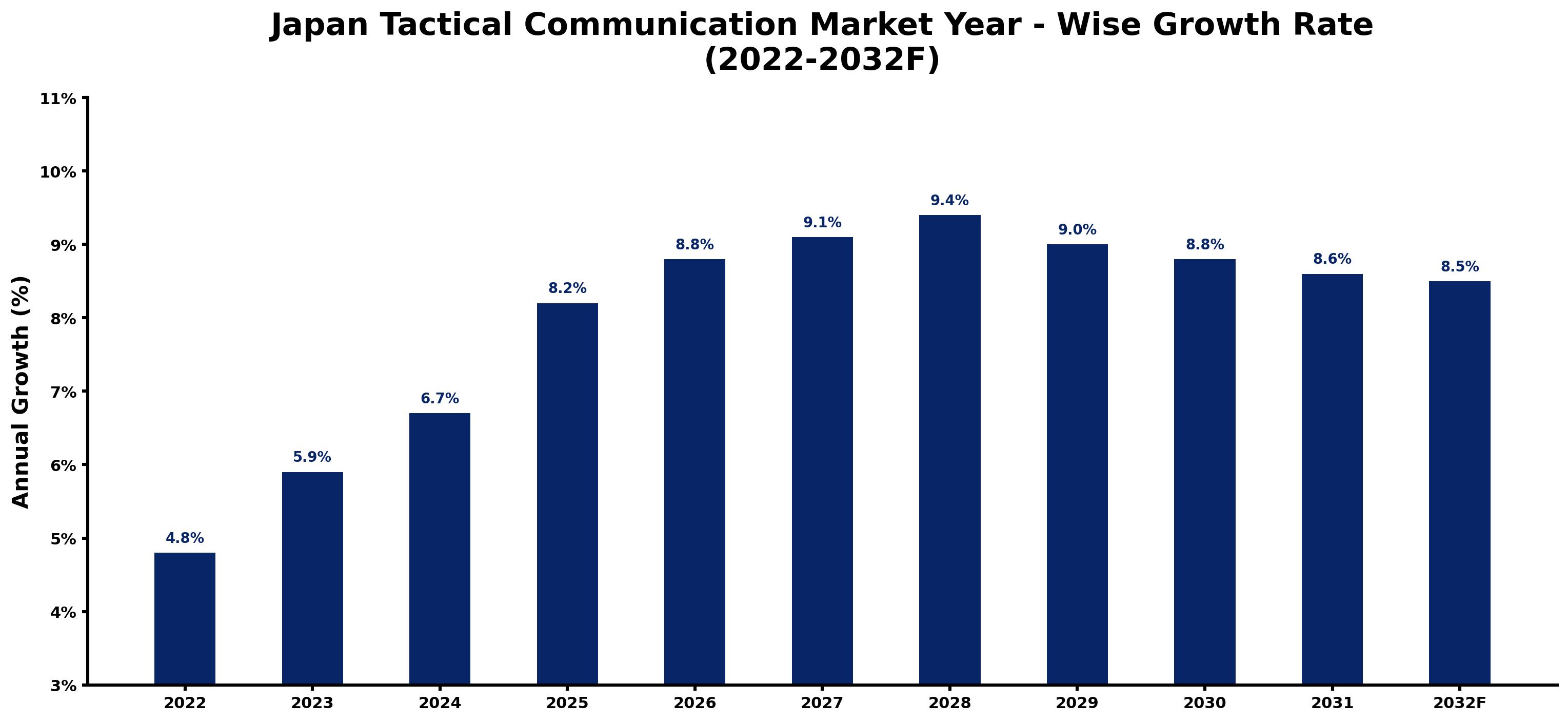
The following table summarizes the historical and forecasted growth rates of the Japan Tactical Communication Market, along with the rationale behind each year’s performance.
| Year | Estimated Growth (%) | Market Rationale |
| 2022 | 4.8% | Initial modernization of tactical communications under Japan's Multi-Domain Defense Force strategy. |
| 2023 | 5.9% | Increased procurement of secure SDRs and interoperability upgrades with allied forces. |
| 2024 | 6.7% | Expansion of unmanned platforms and digital battlefield communication systems. |
| 2025 | 8.2% | Higher defense budget and implementation of National Security Strategy programs. |
| 2026 | 8.8% | Large-scale deployment of next-generation tactical radios and encrypted communication networks. |
| 2027 | 9.1% | Integration of C4ISR, satellite communication, and AI-enabled command systems. |
| 2028 | 9.4% | Continued investments in network-centric warfare and joint-force interoperability. |
| 2029 | 9% | Stable procurement following completion of major modernization phases. |
| 2030 | 8.8% | Ongoing replacement of legacy communication systems and software upgrades. |
| 2031 | 8.6% | Market approaches maturity while sustained defense investments maintain growth. |
| 2032 | 8.5% | Stable expansion driven by lifecycle upgrades, cybersecurity, and tactical network enhancements. |
Topics Covered in the Japan Tactical Communication Market Report
The Japan Tactical Communication Market report thoroughly covers the market by application, platform and type. The report provides an unbiased and detailed analysis of ongoing market trends, opportunities/high-growth areas, and market drivers that will help stakeholders devise and align strategies according to current and future market dynamics.
Japan Tactical Communication Market Highlights
| Report Name | Japan Tactical Communication Market |
| Forecast period | 2026-2032 |
| CAGR | 8.7% |
| Growing Sector | Defense & Security |
Japan Tactical Communication Market Synopsis
Japan Tactical Communication Industry is anticipated to witness robust growth supported by Japan–U.S. alliance integration, multi-domain defense posture, and accelerated adoption of secure IP, SDR, SATCOM, and tactical 5G across dispersed island terrain. Expansion on ground units, JMSDF task groups, JASDF aircraft, and unmanned systems are propelled by high-capacity data radios (HCDR), vehicular intercom systems (VIC), and resilient SATCOM leveraging X-band DSN and commercial Ku/Ka, while QZSS-backed PNT improves network resilience in contested environments.
Evaluation of Growth Drivers in the Japan Tactical Communication Market
Below mentioned are some prominent drivers and their influence on the Japan Tactical Communication Market dynamics:
| Drivers | Primary Segments Affected | Why it Matters (Evidence) |
| Alliance Interoperability with U.S. Forces | Application; Type | Standardized waveforms, crypto, and C2 data exchange underpin combined operations and Indo-Pacific contingencies. |
| Island-Chain Maritime Security | Platform | Long littoral lines require SOTM, MANET mesh, and HF/V/UHF redundancy for JMSDF patrols and amphib ops. |
| Private 5G/Tactical LTE Adoption | Application; Platform | Portable cells at bases/FOBs boost bandwidth for sensors, ATAK-like apps, and blue-force tracking. |
| HCDR & SATCOM Expansion | Type | High-throughput radios and DSN/Ku/Ka SATCOM carry ISR video, mission data, and cross-domain chat. |
| Unmanned Systems Proliferation | Platform | C2 and payload links for UAV/USV/UGV demand low-latency, jam-resistant communications. |
The Japan Tactical Communication Market is expected to grow steadily at a 8.7% CAGR between 2026 and 2032. The upward trajectory of the market is credited to SDR migration, SATCOM/HCDR densification, and alliance-driven interoperability. Along with that, omni-platform fielding (ground vehicles, surface/undersea vessels, aircraft, and unmanned systems) and local integration with prime OEMs reinforce demand. Crypto agility, PNT resilience via QZSS, and MANET optimization broaden options for contested environments. Backed by the need for secure, high-throughput edge networks, waveform efficiency, power-aware routing, and ruggedization drive mission availability and lifecycle reliability. Additionally, continuous government investments in defense digitization and next-generation communication infrastructure further strengthen Japan’s tactical network modernization efforts.
Evaluation of Restraints in the Japan Tactical Communication Market
Below mentioned are some major restraints and their influence on the Japan Tactical Communication Market dynamics:
| Restraints | Primary Segments Affected | What this Means (Evidence) |
| Procurement Phasing & Multi-year Budgets | Application | Staggered tranches extend timelines; incremental upgrades favored over whole-fleet replacements. |
| Maritime Climate & Typhoons | Platform; Type | Salt fog, humidity, shocks require IP67/68, anti-corrosion, and MIL-STD environmental hardening. |
| Spectrum & Type Approvals | Type | National allocations and certification add lead time; drive use of standardized waveforms. |
| Export Controls & Crypto Sovereignty | Type | ITAR/controls and national crypto policies form sourcing and key-management frameworks. |
| Aging Workforce & Skills Gap | Application; Platform | Advanced SDR/5G systems demand specialized training, which raises deployment and sustainment problem |
Japan Tactical Communication Market Challenges
While the market is developing, several constraints also come across such as end-to-end encryption with low latency for ISR streams, stable MANET performance across mountainous and maritime corridors, and multi-bearer (HF/VHF/UHF/LTE/SATCOM) integration without excessive Swap at the soldier/platform level. Building depot MRO capacity near naval/air hubs, scaling sovereign key management, and sustaining coalition interoperability during large exercises remain critical to readiness.
Japan Tactical Communication Market Trends
Several significant trends are impacting the Japan Tactical Communication Market
- SDR & Waveform Libraries: Multi-waveform SDR fleets enable rapid updates and backward compatibility for coalition ops.
- Tactical 5G/Private Cellular: Deployable cores and RAN kits provide high bandwidth for apps, sensors, and C2 in dispersed bases.
- SATCOM-on-the-Move (SOTM): Low-profile terminals on ships/vehicles sustain C2 during maneuver across long sea lanes.
- Edge Apps & Mission Servers: Tactical apps and gateways deliver maps, chat, and sensor fusion to small units afloat/ashore.
- Digital VIC Ecosystems: Networked intercoms unify radios, headsets, and crew stations; reduce cabling and improve aural intelligibility.
Investment Opportunities in the Japan Tactical Communication Industry
Some of the notable investment opportunities are:
- Local Integration & MRO Hubs: In-country labs and depots shorten turnaround and support spiral upgrades with primes and SMEs.
- Maritime SOTM & HCDR: High-throughput links for ISR video and mission data across JMSDF patrols and task groups.
- Private 5G for Bases & Ports: Portable 5G for logistics nodes, amphibious staging, and disaster response.
- Crypto & Key Infrastructure: Sovereign algorithms, OTAR, and zeroization suites aligned to national doctrines.
- Training & Simulation: LVC environments for littoral, urban, and island operations reduce fielding risk and improve readiness.
Top 5 Leading Players in the Japan Tactical Communication Market
Below is the list of prominent companies leading in the Japan Tactical Communication Market Share:
1. NEC Corporation
| Company Name | NEC Corporation |
| Established Year | 1899 |
| Headquarters | Tokyo, Japan |
| Official Website | Click Here |
Provides tactical radios, secure networks, and system integration; strong role in defense communications and base networks.
2. Fujitsu Limited
| Company Name | Fujitsu Limited |
| Established Year | 1935 |
| Headquarters | Tokyo, Japan |
| Official Website | Click Here |
Secure IP networking, edge servers, and mission applications; supports tactical cloud and cyber-resilient architectures.
3. Mitsubishi Electric Corporation
| Company Name | Mitsubishi Electric Corporation |
| Established Year | 1921 |
| Headquarters | Tokyo, Japan |
| Official Website | Click Here |
Airborne/naval data links, SATCOM terminals, and C2 integration; extensive maritime communications expertise.
4. L3Harris Technologies
| Company Name | L3Harris Technologies |
| Established Year | 2019 (merger legacy earlier) |
| Headquarters | Melbourne, Florida, USA; Japan presence via partners |
| Official Website | Click Here |
SDRs, manpacks, and HCDR portfolios with SOTM solutions; interoperability toolsets for coalition operations.
5. Thales Group
| Company Name | Thales Group |
| Established Year | 1893 |
| Headquarters | Paris, France; Japan operations via subsidiaries/partners |
| Official Website | Click Here |
Tactical radios, SATCOM, and secure networking; multi-waveform libraries suited to joint and maritime missions.
Government Regulations Introduced in the Japan Tactical Communication Market
According to Japanese Government Data, programs like the National Defense Strategy and Defense Buildup Program, the growth of the Space Operations Squadron, and growth of the X-band DSN satellite network, all assist in making connections secure and stable. Spectrum management and cybersecurity directives guide certification and crypto/key frameworks. Other initiatives like multi-domain defense integration, QZSS-backed PNT resilience, and alliance interoperability standards bolster adoption of SDR, SATCOM, HCDR, and VIC capabilities, at the same time disaster-response readiness supports dual-use deployment.
Future Insights of the Japan Tactical Communication Market
Japan Tactical Communication Industry will maintain its upward growth trajectory as services scale SDR fleets, expand tactical 5G nodes, and invest in SOTM for maritime and joint maneuver. Public–private partnerships and local integration broaden maintenance and assembly, while crypto agility and PNT resilience differentiate portfolios. Automated spectrum tools, power-aware routing, and platform ruggedization will help achieve resilient edge networking with higher availability and lower total cost of ownership.
Market Segmentation Analysis
The report offers a comprehensive study of the subsequent market segments and their leading categories.
By Application – Command & Control (C2) to Dominate the Market
According to Vineet, Senior Research Analyst, 6Wresearch, Command & Control (C2) applications are expected to dominate Japan tactical communication market size as joint and alliance operations require a common operational picture, mission apps, and blue-force tracking across dispersed islands and sea lanes.
By Platform – Naval to Lead the Market
Naval platforms are projected to lead the Japan Tactical Communication Market growth, driven by JMSDF’s wide-area patrols, maritime domain awareness, and expeditionary roles across long littoral stretches.
By Type – HCDR to Dominate the Market
High-Capacity Data Radios (HCDR) are anticipated to dominate as the primary bearer for ISR video, mission data, and high-throughput apps across maritime and air nodes. Soldier radios proliferate at team level, manpacks provide higher power and gateway roles at platoon/company, and VIC underpins platform integration and crew coordination.
Key Attractiveness of the Report
- 10 Years of Market Numbers
- Historical Data Starting from 2022 to 2025
- Base Year: 2025
- Forecast Data until 2032
- Key Performance Indicators Impacting the Market
- Major Upcoming Developments and Projects
Key Highlights of the Report:
- Japan Tactical Communication Market Outlook
- Market Size of Japan Tactical Communication Market, 2025
- Forecast of Japan Tactical Communication Market, 2032
- Historical Data and Forecast of Japan Tactical Communication Revenues & Volume for the Period 2022-2032
- Japan Tactical Communication Market Trend Evolution
- Japan Tactical Communication Market Drivers and Challenges
- Japan Tactical Communication Price Trends
- Japan Tactical Communication Porter's Five Forces
- Japan Tactical Communication Industry Life Cycle
- Historical Data and Forecast of Japan Tactical Communication Market Revenues & Volume By Application for the Period 2022-2032
- Historical Data and Forecast of Japan Tactical Communication Market Revenues & Volume By Comm for the Period 2022-2032
- Historical Data and Forecast of Japan Tactical Communication Market Revenues & Volume By & Control for the Period 2022-2032
- Historical Data and Forecast of Japan Tactical Communication Market Revenues & Volume By ISR for the Period 2022-2032
- Historical Data and Forecast of Japan Tactical Communication Market Revenues & Volume By Communication for the Period 2022-2032
- Historical Data and Forecast of Japan Tactical Communication Market Revenues & Volume By Combat for the Period 2022-2032
- Historical Data and Forecast of Japan Tactical Communication Market Revenues & Volume By Platform for the Period 2022-2032
- Historical Data and Forecast of Japan Tactical Communication Market Revenues & Volume By Ground for the Period 2022-2032
- Historical Data and Forecast of Japan Tactical Communication Market Revenues & Volume By Airborne for the Period 2022-2032
- Historical Data and Forecast of Japan Tactical Communication Market Revenues & Volume By Naval for the Period 2022-2032
- Historical Data and Forecast of Japan Tactical Communication Market Revenues & Volume By Unmanned Systems for the Period 2022-2032
- Historical Data and Forecast of Japan Tactical Communication Market Revenues & Volume By Type for the Period 2022-2032
- Historical Data and Forecast of Japan Tactical Communication Market Revenues & Volume By Soldier Radios for the Period 2022-2032
- Historical Data and Forecast of Japan Tactical Communication Market Revenues & Volume By Manpacks for the Period 2022-2032
- Historical Data and Forecast of Japan Tactical Communication Market Revenues & Volume By VIC for the Period 2022-2032
- Historical Data and Forecast of Japan Tactical Communication Market Revenues & Volume By HCDR for the Period 2022-2032
- Japan Tactical Communication Import Export Trade Statistics
- Market Opportunity Assessment By Application
- Market Opportunity Assessment By Platform
- Market Opportunity Assessment By Type
- Japan Tactical Communication Top Companies Market Share
- Japan Tactical Communication Competitive Benchmarking By Technical and Operational Parameters
- Japan Tactical Communication Company Profiles
- Japan Tactical Communication Key Strategic Recommendations
Market Covered
The report offers a comprehensive study of the subsequent market segments:
By Application
- Comm, & Control (C2)
- ISR
- Communication
- Combat
By Platform
- Ground
- Airborne
- Naval
- Unmanned Systems
By Type
- Soldier Radios
- Manpacks
- VIC
- HCDR
Japan Tactical Communication Market (2026-2032): FAQ's
The Japan Tactical Communication Market is projected to grow at a CAGR of 8.7% during the forecast period.
Command & Control (C2) dominates due to the requirement for a common operational picture and secure multi-bearer networking across dispersed island and maritime theaters.
NEC Corporation, Fujitsu Limited, and Mitsubishi Electric Corporation
6Wresearch actively monitors the Japan Tactical Communication Market and publishes its comprehensive annual report, highlighting emerging trends, growth drivers, revenue analysis, and forecast outlook. Our insights help businesses to make data-backed strategic decisions with ongoing market dynamics. Our analysts track relevent industries related to the Japan Tactical Communication Market, allowing our clients with actionable intelligence and reliable forecasts tailored to emerging regional needs.
Yes, we provide customisation as per your requirements. To learn more, feel free to contact us on sales@6wresearch.com
| 1 Executive Summary |
| 2 Introduction |
| 2.1 Key Highlights of the Report |
| 2.2 Report Description |
| 2.3 Market Scope & Segmentation |
| 2.4 Research Methodology |
| 2.5 Assumptions |
| 3 Japan Tactical Communication Market Overview |
| 3.1 Japan Country Macro Economic Indicators |
| 3.2 Japan Tactical Communication Market Revenues & Volume, 2022 & 2032F |
| 3.3 Japan Tactical Communication Market - Industry Life Cycle |
| 3.4 Japan Tactical Communication Market - Porter's Five Forces |
| 3.5 Japan Tactical Communication Market Revenues & Volume Share, By Application, 2022 & 2032F |
| 3.6 Japan Tactical Communication Market Revenues & Volume Share, By Platform, 2022 & 2032F |
| 3.7 Japan Tactical Communication Market Revenues & Volume Share, By Type, 2022 & 2032F |
| 4 Japan Tactical Communication Market Dynamics |
| 4.1 Impact Analysis |
| 4.2 Market Drivers |
| 4.2.1 Increasing demand for advanced communication technologies in defense and law enforcement sectors |
| 4.2.2 Technological advancements leading to the development of more sophisticated tactical communication systems |
| 4.2.3 Rising focus on enhancing national security and disaster management capabilities |
| 4.3 Market Restraints |
| 4.3.1 High initial investment costs associated with implementing and upgrading tactical communication systems |
| 4.3.2 Stringent regulatory requirements and standards for security and encryption in communication systems |
| 4.3.3 Limited interoperability and compatibility issues between different tactical communication systems |
| 5 Japan Tactical Communication Market Trends |
| 6 Japan Tactical Communication Market, By Types |
| 6.1 Japan Tactical Communication Market, By Application |
| 6.1.1 Overview and Analysis |
| 6.1.2 Japan Tactical Communication Market Revenues & Volume, By Application, 2022-2032F |
| 6.1.3 Japan Tactical Communication Market Revenues & Volume, By Comm, 2022-2032F |
| 6.1.4 Japan Tactical Communication Market Revenues & Volume, By & Control, 2022-2032F |
| 6.1.5 Japan Tactical Communication Market Revenues & Volume, By ISR, 2022-2032F |
| 6.1.6 Japan Tactical Communication Market Revenues & Volume, By Communication, 2022-2032F |
| 6.1.7 Japan Tactical Communication Market Revenues & Volume, By Combat, 2022-2032F |
| 6.2 Japan Tactical Communication Market, By Platform |
| 6.2.1 Overview and Analysis |
| 6.2.2 Japan Tactical Communication Market Revenues & Volume, By Ground, 2022-2032F |
| 6.2.3 Japan Tactical Communication Market Revenues & Volume, By Airborne, 2022-2032F |
| 6.2.4 Japan Tactical Communication Market Revenues & Volume, By Naval, 2022-2032F |
| 6.2.5 Japan Tactical Communication Market Revenues & Volume, By Unmanned Systems, 2022-2032F |
| 6.3 Japan Tactical Communication Market, By Type |
| 6.3.1 Overview and Analysis |
| 6.3.2 Japan Tactical Communication Market Revenues & Volume, By Soldier Radios, 2022-2032F |
| 6.3.3 Japan Tactical Communication Market Revenues & Volume, By Manpacks, 2022-2032F |
| 6.3.4 Japan Tactical Communication Market Revenues & Volume, By VIC, 2022-2032F |
| 6.3.5 Japan Tactical Communication Market Revenues & Volume, By HCDR, 2022-2032F |
| 7 Japan Tactical Communication Market Import-Export Trade Statistics |
| 7.1 Japan Tactical Communication Market Export to Major Countries |
| 7.2 Japan Tactical Communication Market Imports from Major Countries |
| 8 Japan Tactical Communication Market Key Performance Indicators |
| 8.1 Percentage increase in RD investment in tactical communication technologies |
| 8.2 Number of successful government contracts awarded for tactical communication projects |
| 8.3 Rate of adoption of next-generation communication technologies in defense and law enforcement agencies |
| 9 Japan Tactical Communication Market - Opportunity Assessment |
| 9.1 Japan Tactical Communication Market Opportunity Assessment, By Application, 2022 & 2032F |
| 9.2 Japan Tactical Communication Market Opportunity Assessment, By Platform, 2022 & 2032F |
| 9.3 Japan Tactical Communication Market Opportunity Assessment, By Type, 2022 & 2032F |
| 10 Japan Tactical Communication Market - Competitive Landscape |
| 10.1 Japan Tactical Communication Market Revenue Share, By Companies, 2025 |
| 10.2 Japan Tactical Communication Market Competitive Benchmarking, By Operating and Technical Parameters |
| 11 Company Profiles |
| 12 Recommendations |
| 13 Disclaimer |
Global Go To Market Strategy - 2030
Export potential enables firms to identify high-growth global markets with greater confidence by combining advanced trade intelligence with a structured quantitative methodology. The framework analyzes emerging demand trends and country-level import patterns while integrating macroeconomic and trade datasets such as GDP and population forecasts, bilateral import–export flows, tariff structures, elasticity differentials between developed and developing economies, geographic distance, and import demand projections. Using weighted trade values from 2020–2024 as the base period to project country-to-country export potential for 2030, these inputs are operationalized through calculated drivers such as gravity model parameters, tariff impact factors, and projected GDP per-capita growth. Through an analysis of hidden potentials, demand hotspots, and market conditions that are most favorable to success, this method enables firms to focus on target countries, maximize returns, and global expansion with data, backed by accuracy.
By factoring in the projected importer demand gap that is currently unmet and could be potential opportunity, it identifies the potential for the Exporter (Country) among 190 countries, against the general trade analysis, which identifies the biggest importer or exporter.
To discover high-growth global markets and optimize your business strategy:
Click Here
Pricing
- Single User License$ 1,995
- Department License$ 2,400
- Site License$ 3,120
- Global License$ 3,795

Leadership Perspectives from Industry Events
Search
Thought Leadership and Analyst Meet





Our Clients








6WResearch In News
- India Export Attractiveness Tracker 2026
- India Air Conditioner Market Set for Strong Rebound in 2026 After Weather-Led Correction and GST-Driven Recovery: 6Wresearch
- ADAS in India: How Automatic Emergency Braking, Blind Spot Detection & Driver Monitoring are Transforming Road Safety
- Doha a strategic location for EV manufacturing hub: IPA Qatar
- Demand for luxury TVs surging in the GCC, says Samsung
- Empowering Growth: The Thriving Journey of Bangladesh’s Cable Industry
Latest Reports
- Nicaragua RPG Gaming Market (2026-2032)
- New Zealand RPG Gaming Market (2026-2032)
- Netherlands RPG Gaming Market (2026-2032)
- Nauru RPG Gaming Market (2026-2032)
- Namibia RPG Gaming Market (2026-2032)
- Mozambique RPG Gaming Market (2026-2032)
- Montenegro RPG Gaming Market (2026-2032)
- Mongolia RPG Gaming Market (2026-2032)
- Monaco RPG Gaming Market (2026-2032)
- Micronesia RPG Gaming Market (2026-2032)
Industry Events and Analyst Meet

EV India Expo 2026

HIMTEX 2026

India Refining Summit 2026

India EV Show 2026

EV tech India Expo 2026
Whitepaper
- Middle East & Africa Commercial Security Market Click here to view more.
- Middle East & Africa Fire Safety Systems & Equipment Market Click here to view more.
- GCC Drone Market Click here to view more.
- Middle East Lighting Fixture Market Click here to view more.
- GCC Physical & Perimeter Security Market Click here to view more.


