Japan Wearable Technology Market Size & Growth Rate
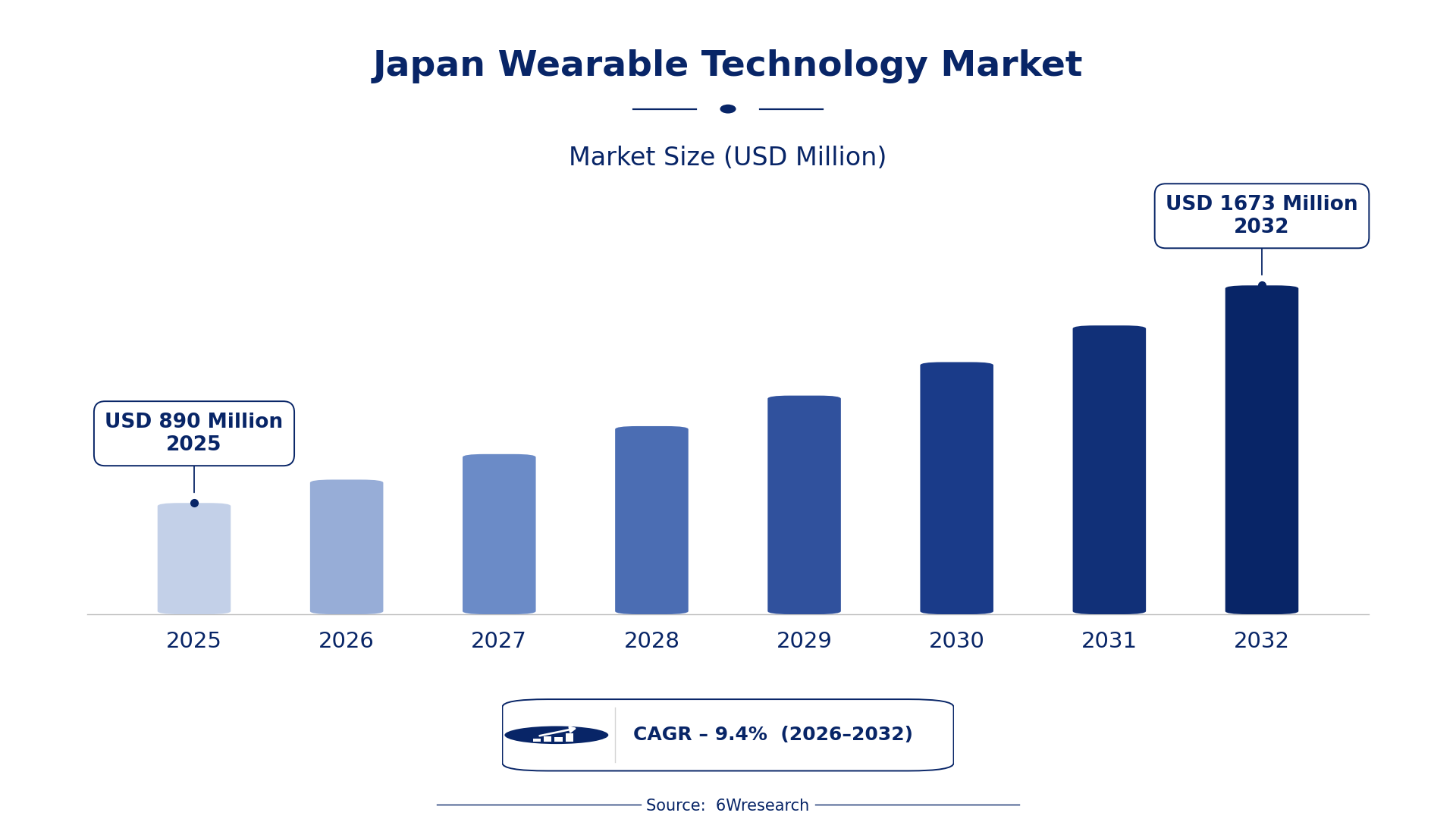
According to 6Wresearch internal database and industry insights, the Japan Wearable Technology Market was valued at USD 890 Million in 2025 and is projected to reach USD 1,673 Million by 2032, growing at a CAGR of approximately 9.4% during 2026–2032.
Japan Wearable Technology Market Highlights
| Report Metric | Details |
| Report Name | Japan Wearable Technology Market (2026-2032) |
| Market Size 2025 | USD 890 Million |
| Market Size 2032 | USD 1,673 Million |
| Absolute Growth 2025–2032 | USD 783 Million |
| CAGR 2026–2032 | 9.4% |
| Peak Annual Growth | 11.9% in 2026 |
| Forecast Period | 2026–2032 |
| Historical Data | 2022–2025 |
| Base Year | 2025 |
| Leading Product, 2025 | Wristwear (46% share) |
| Leading Type, 2025 | Wearable Smart Textiles (65% share) |
| Leading Application, 2025 | Consumer Electronics (48% share) |
| Fastest-Growing Product | Headwear (13.5% CAGR) |
| Fastest-Growing Type | Wearable Products and Devices (Non-Textiles) (13.3% CAGR) |
| Fastest-Growing Application | Healthcare (12.1% CAGR) |
| Growing Sector | Healthcare applications |
| Key End Users | Healthcare providers, fitness enthusiasts, technology developers, corporate wellness programs |
Japan Wearable Technology Market Year-wise Growth Rate and Key Drivers (2022–2032)
This graph illustrates the annual growth rates of the market from 2022 to 2032, highlighting a steady upward trajectory and projected market expansion over the forecast period.
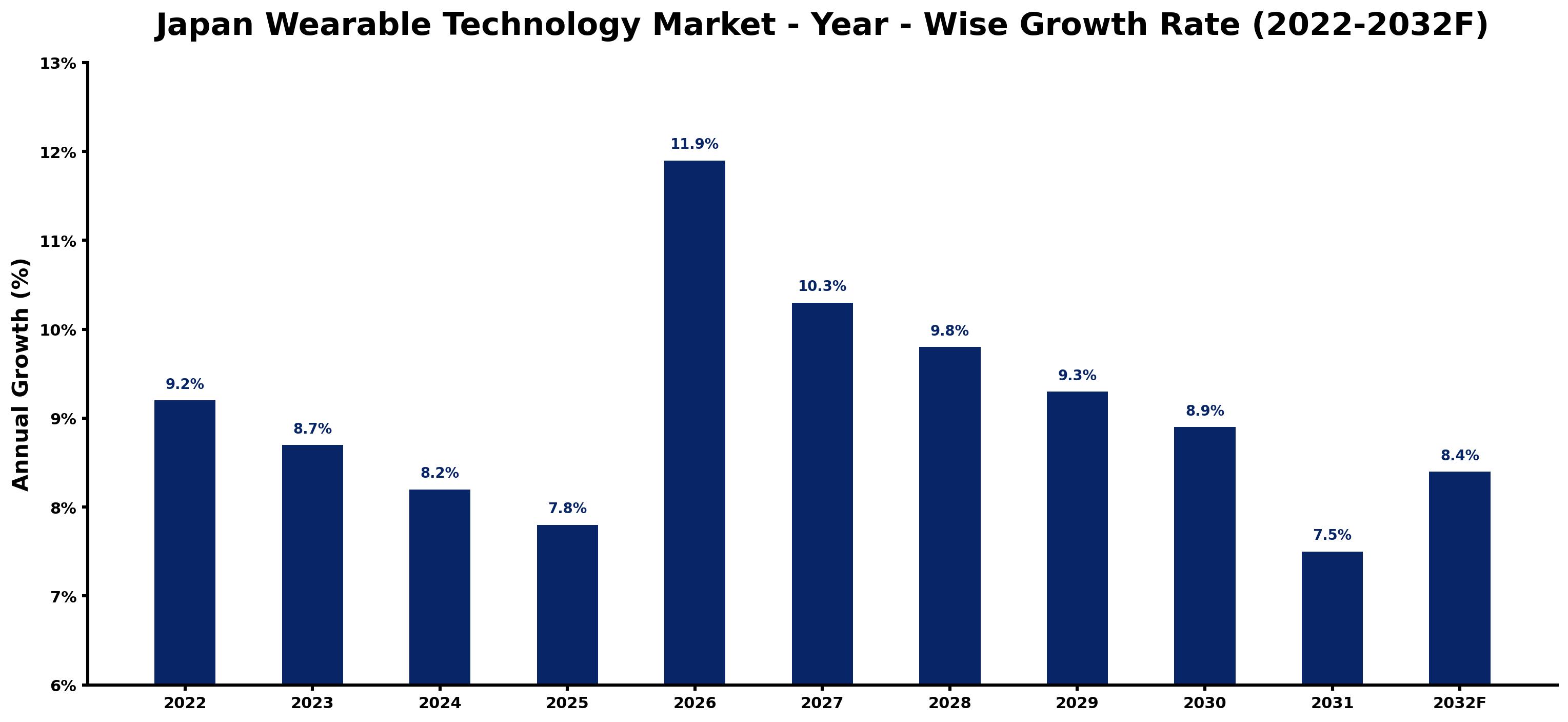
Each row of the following table gives one year's estimated growth and the event or demand shift that explains it.
| Year | Estimated Annual Growth (%) | Market Rationale |
| 2022 | 9.2 | The market showed strong consumer interest in health monitoring devices. |
| 2023 | 8.7 | Adoption rates slowed as consumers became more selective about technology features. |
| 2024 | 8.2 | Interest in wearable technology remained steady but growth rates declined slightly. |
| 2025 | 7.8 | Market growth slowed due to saturation in fitness tracking devices. |
| 2026 | 11.9 | Demand surged with new innovations in wearable smart textiles and health applications. |
| 2027 | 10.3 | Growth moderated as competition intensified among product offerings. |
| 2028 | 9.8 | Consumer interest continued to shift towards multifunctional health devices. |
| 2029 | 9.3 | Market expansion slowed as consumers evaluated new technology investments. |
| 2030 | 8.9 | Growth rates declined as market maturity set in for established products. |
| 2031 | 7.5 | The market experienced a slowdown as consumer spending stabilised. |
| 2032 | 8.4 | Growth is projected to rise again with new healthcare applications emerging. |
Note: Market size estimations and growth projections presented in this report are based on 6Wresearch's proprietary forecasting methodology, utilizing the latest available industry data, government publications, and primary research inputs.
Japan Wearable Technology Market Synopsis
Wearable technology encompasses electronic devices worn on the body that integrate sensors and connectivity features for health monitoring, fitness tracking, and user convenience. The Japan Wearable Technology Market is growing due to increasing demand from healthcare applications and consumer electronics, with over 5 million users adopting wearable devices for patient monitoring. The Tokyo 2023 Tech Expo showcased numerous innovations, while the Ministry of Health, Labour and Welfare actively promotes wearable technology in health management, further propelling market growth. This combination of elements positions the market for ongoing expansion as technology advances and consumer preferences evolve.
Market Dynamics Impact Analysis (2026–2032)
| Factor | Type | Impact | Primary Segment Affected |
| Increasing adoption of wearable devices for health monitoring | Driver | High | Healthcare |
| Rising consumer interest in fitness tracking solutions | Driver | High | Wristwear |
| Emerging applications in elderly care services | Opportunity | High | Healthcare |
| Growing demand for wearable smart textiles in sports | Opportunity | Medium | Wearable Smart Textiles |
| Market saturation in basic fitness trackers | Restraint | High | Wristwear |
| High competition among wearable technology providers | Restraint | Medium | Wearable Products and Devices (Non-Textiles) |
| High development costs for advanced wearable technology | Challenge | High | Wearable Smart Textiles |
| Regulatory hurdles for medical-grade devices | Challenge | Medium | Healthcare |
Evaluation of Drivers in Japan Wearable Technology Market (2026–2032)
Below are the drivers that matter most for revenue growth, with supporting evidence.
| Drivers | Primary Segment Affected | Why It Matters (Evidence) |
| Rising healthcare expenditure encouraging technology adoption | Healthcare | In Japan, healthcare spending exceeds USD 400 billion, leading to increased purchases of health monitoring devices. |
| Growing fitness awareness among consumers | Wristwear | Around 20% of Japan's population uses fitness trackers, driving demand for advanced wristwear solutions. |
| Technological advancements in wearable smart textiles | Wearable Smart Textiles | Innovations in fabric technology are attracting sports professionals, expanding the market for smart textiles. |
| Corporate wellness programs integrating wearable technology | Consumer Electronics | Many companies are adopting wearables for employee health monitoring, with participation at industry expos increasing. |
| Government initiatives promoting health management | Healthcare | The Ministry of Health, Labour and Welfare supports wearable tech in health programs, increasing market penetration. |
Orders keep climbing as healthcare expenditure in Japan exceeds USD 400 billion, prompting hospitals to invest in wearable devices for patient monitoring. Approximately 20% of the population uses fitness trackers, motivating manufacturers to improve wristwear features. Technological advancements in smart textiles are appealing to sports professionals, expanding the market.
Evaluation of Restraints in Japan Wearable Technology Market
The following restraints limit how fast demand can grow.
| Market Restraint | Primary Segment Affected | Why It Matters (Evidence) |
| Market saturation limiting growth potential | Wristwear | With 20% of the population already using fitness trackers, new customer acquisition becomes challenging. |
| Intense competition among manufacturers | Wearable Products and Devices (Non-Textiles) | Numerous brands are vying for market share, resulting in price wars and reduced margins. |
| High development costs for advanced features | Wearable Smart Textiles | Investing in R&D for advanced textiles can exceed USD 1 million, impacting profitability. |
| Regulatory challenges for medical devices | Healthcare | Compliance with the Clinical Trials Act can delay product launches by several months. |
| Consumer hesitance towards new technology | Consumer Electronics | Many users are cautious about adopting new wearables, preferring established products. |
Japan Wearable Technology Market Challenges
A major obstacle in the wearable technology market is the integration of advanced technology, as many producers struggle to implement sophisticated sensors and connectivity features. High production costs hinder affordability, with premium models often priced above 30,000 yen, limiting access for consumers. Supply chain disruptions lead to delays in component delivery, pushing product launch timelines back by six months for manufacturers. Buyers face confusion in a fragmented market, particularly among the 20% of the population using fitness trackers, resulting in hesitation to adopt new devices.
Trends in the Japan Wearable Technology Market
Below are the shifts with the largest effect on the Japan Wearable Technology Market.
- Shift from Basic to Advanced Wearables: A clear shift towards advanced wearables offering multifunctional health monitoring features has emerged. The Tokyo 2023 Tech Expo attracted over 10,000 attendees, reflecting strong market interest in these innovations.
- Transition from Fitness to Healthcare Applications: The focus is transitioning from fitness tracking to healthcare applications, with over 5 million users adopting wearables for patient monitoring. This trend highlights a growing need for health management solutions in Japan.
- Consumer Electronics Prioritised over Fashion Wearables: Consumer electronics are gaining precedence over fashion wearables as practical applications become more popular. This shift is evident in the 48% market share of consumer electronics projected for 2025.
- Emergence of Wearable Smart Textiles: Wearable smart textiles are gaining momentum, particularly in sports and rehabilitation applications. This segment is expected to experience substantial growth, driven by advancements in fabric integration.
Investment Opportunities in the Japan Wearable Technology Market
The openings below show where demand in the Japan Wearable Technology Market is visible and how suppliers can enter.
- Tokyo Tech Expo as a Launchpad: The Tokyo 2023 Tech Expo provides an excellent platform for showcasing new wearable technologies, attracting over 10,000 attendees. Companies can use this event to introduce new products.
- Growing Demand for Elderly Care Solutions: With Japan's aging population, the demand for wearable technology in elderly care is rising. This presents an opportunity for suppliers to develop tailored solutions for this demographic.
- Investment in Smart Textiles for Sports: Now is the time to invest in wearable smart textiles, particularly for sports applications. Collaborating with sports facilities can facilitate market entry and product testing.
- Partnerships with Healthcare Providers: Establishing partnerships with healthcare providers can improve market penetration. The Ministry of Health, Labour and Welfare supports initiatives that integrate wearable technology into health management.
Government Initiatives in the Japan Wearable Technology Market
The Semiconductor and Digital Industry Strategy, initiated by METI in June 2021, aims to secure domestic semiconductor manufacturing, essential for producing wearable technology. This measure encourages local manufacturers to invest in advanced semiconductor capabilities, ensuring a steady supply chain for wearable devices. Furthermore, the strategy supports the development of technologies that can enhance the functionality of wearables, contributing to market growth.
In 2023, the government launched a program to integrate wearable technology into elderly care services, administered by the Ministry of Health, Labour and Welfare. This initiative is set to improve the quality of care for the aging population, with funding allocated for research and development in wearable health solutions. The program aims to enhance the effectiveness of health monitoring systems, benefiting both providers and users.
Future Insight of the Japan Wearable Technology Market
The group most likely to experience change by 2032 is healthcare providers, as wearable technology will become integral to patient monitoring. Over 10 million users are expected to engage with these devices, improving health management and reducing hospital visits. Innovations in smart textiles will enhance rehabilitation efforts, offering tailored solutions for recovery. Government initiatives to incorporate wearable technology into elderly care services will further encourage adoption, ensuring the market adapts to the needs of an ageing population.
Market Segmentation Analysis
Japan Wearable Technology Market report covers a detailed analysis of the following market segments:
By Product – Wristwear Leads, Headwear Expected to Grow Fastest
According to Dhaval Chaurasia, Assistant Manager at 6Wresearch, Wristwear accounted for 46% of the market by product in 2025. Wristwear dominates the market as it is extensively used for fitness tracking and health monitoring, appealing to a broad user base. With over 5 million users in Japan, these devices are integral to personal health management. Over 2026–2032, Headwear is expected to post the fastest growth, at a CAGR of 13.5%. Headwear is experiencing rapid growth due to its expanding role in augmented reality applications. The Tokyo 2023 Tech Expo highlighted this trend, attracting over 10,000 attendees eager to explore advancements in headwear technology. Suppliers should focus on enhancing wristwear features while also investing in headwear innovations to meet consumer demands.
By Type – Wearable Smart Textiles Lead, Wearable Products and Devices (Non-Textiles) Expected to Grow Fastest
With 65% of type revenue in 2025, Wearable Smart Textiles was the largest category. Wearable Smart Textiles leads the market as they are effectively integrated into clothing for health monitoring, catering to users who prioritise convenience. This trend aligns with Japan's focus on advancing health and wellness technologies. Wearable Products and Devices (Non-Textiles) is projected to grow fastest, at a CAGR of 13.3% during 2026–2032. Wearable Products and Devices (Non-Textiles) are growing quickly, driven by the increasing adoption of smartwatches and fitness trackers. With around 20% of the population using fitness trackers, the demand for these devices is on the rise. Buyers can expect a broader range of wearable products, while suppliers must innovate to keep pace with changing consumer preferences.
By Application – Consumer Electronics Leads, Healthcare Expected to Grow Fastest
Consumer Electronics took 48% of application revenue in 2025, more than any other category. Consumer Electronics holds the largest share as these devices are widely utilised in personal gadgets, attracting a diverse consumer demographic. This popularity underscores Japan's tech-savvy population and their affinity for advanced technology. Healthcare is set to record the highest CAGR in this split, 12.1% over 2026–2032. Healthcare is the fastest-growing application, crucial for patient monitoring and health data collection, supported by government initiatives that promote wearable technology in health management. The push to integrate wearables into elderly care services further fuels this growth. Suppliers should prioritise healthcare applications to align with market trends and capitalise on regulatory support.
Key Attractiveness of the Report
- 10 Years of Market Numbers
- Historical Data Starting from 2022 to 2025
- Base Year 2025
- Forecast Data until 2032
- Key Performance Indicators Impacting the Market
- Major Upcoming Developments and Projects
Key Highlights of the Report:
- Japan Wearable Technology Market Outlook
- Market Size of Japan Wearable Technology Market, 2025
- Forecast of Japan Wearable Technology Market, 2032
- Historical Data and Forecast of Japan Wearable Technology Revenues & Volume for the Period 2022-2032
- Japan Wearable Technology Market Trend Evolution
- Japan Wearable Technology Market Drivers and Challenges
- Japan Wearable Technology Price Trends
- Japan Wearable Technology Porter's Five Forces
- Japan Wearable Technology Industry Life Cycle
- Historical Data and Forecast of Japan Wearable Technology Market Revenues & Volume By Product for the Period 2022-2032
- Historical Data and Forecast of Japan Wearable Technology Market Revenues & Volume By Wristwear for the Period 2022-2032
- Historical Data and Forecast of Japan Wearable Technology Market Revenues & Volume By Headwear for the Period 2022-2032
- Historical Data and Forecast of Japan Wearable Technology Market Revenues & Volume By Footwear for the Period 2022-2032
- Historical Data and Forecast of Japan Wearable Technology Market Revenues & Volume By Fashion & Jewelry for the Period 2022-2032
- Historical Data and Forecast of Japan Wearable Technology Market Revenues & Volume By Bodywear for the Period 2022-2032
- Historical Data and Forecast of Japan Wearable Technology Market Revenues & Volume By Other Wearable Technology for the Period 2022-2032
- Historical Data and Forecast of Japan Wearable Technology Market Revenues & Volume By Type for the Period 2022-2032
- Historical Data and Forecast of Japan Wearable Technology Market Revenues & Volume By Wearable Smart Textiles for the Period 2022-2032
- Historical Data and Forecast of Japan Wearable Technology Market Revenues & Volume By Wearable Products and Devices (Non-Textiles) for the Period 2022-2032
- Historical Data and Forecast of Japan Wearable Technology Market Revenues & Volume By Application for the Period 2022-2032
- Historical Data and Forecast of Japan Wearable Technology Market Revenues & Volume By Consumer Electronics for the Period 2022-2032
- Historical Data and Forecast of Japan Wearable Technology Market Revenues & Volume By Healthcare for the Period 2022-2032
- Historical Data and Forecast of Japan Wearable Technology Market Revenues & Volume By Enterprise and Industrial Applications for the Period 2022-2032
- Historical Data and Forecast of Japan Wearable Technology Market Revenues & Volume By Other Applications for the Period 2022-2032
- Japan Wearable Technology Import Export Trade Statistics
- Market Opportunity Assessment By Product
- Market Opportunity Assessment By Type
- Market Opportunity Assessment By Application
- Japan Wearable Technology Top Companies Market Share
- Japan Wearable Technology Competitive Benchmarking By Technical and Operational Parameters
- Japan Wearable Technology Company Profiles
- Japan Wearable Technology Key Strategic Recommendations
Market Covered
Segments analysed in this report are listed below.
By Product
- Wristwear
- Headwear
- Footwear
- Fashion & Jewelry
- Bodywear
- Other Wearable Technology
By Type
- Wearable Smart Textiles
- Wearable Products and Devices (Non-Textiles)
By Application
- Consumer Electronics
- Healthcare
- Enterprise and Industrial Applications
- Other Applications






































