Kazakhstan Contactless Payment Market Size & Growth Rate (2026-2032)
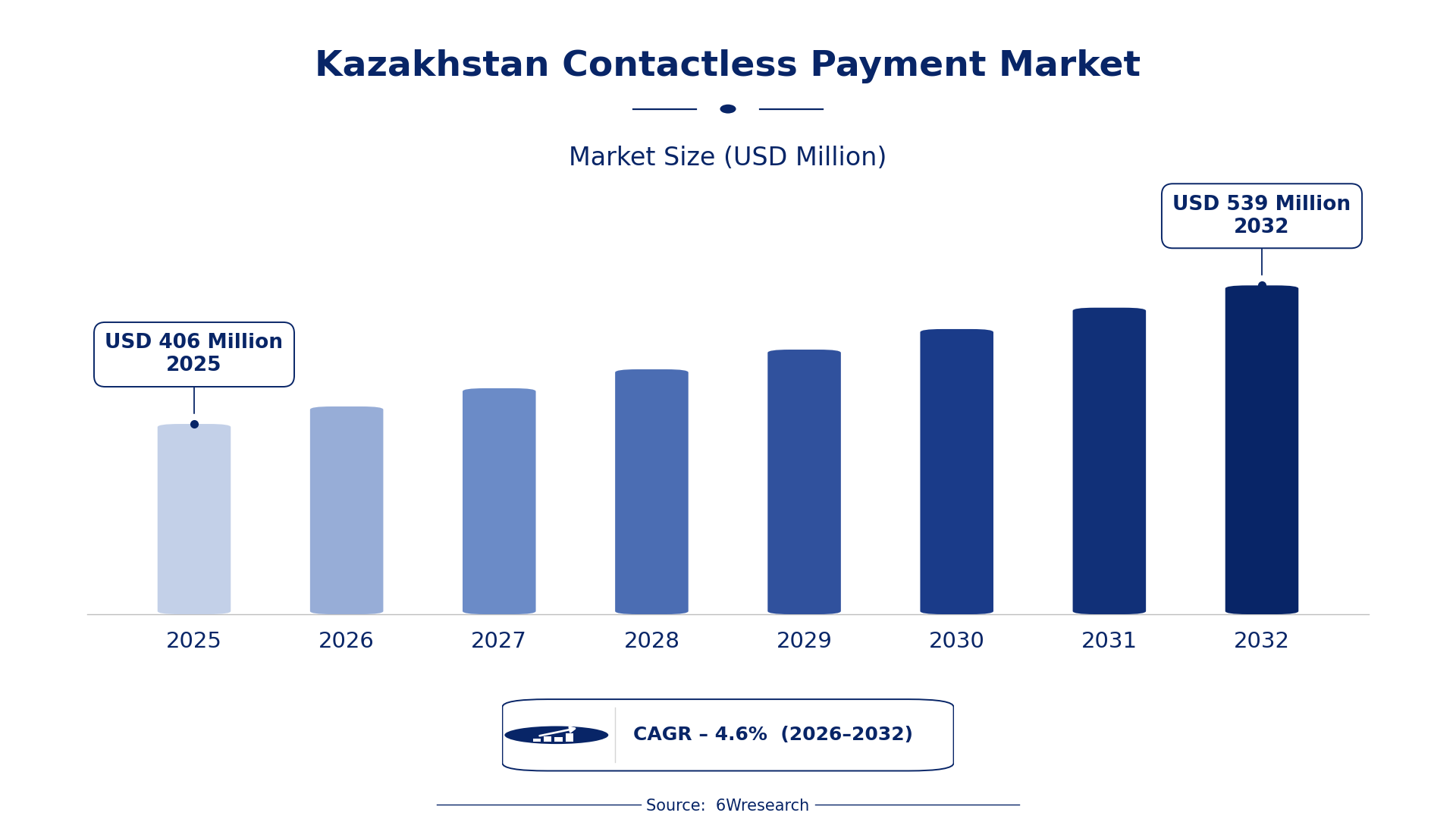
The Kazakhstan Contactless Payment Market was estimated at USD 406 Million in 2025 and is projected to reach USD 539 Million by 2032, growing at a CAGR of 4.6% from 2026 to 2032.
Kazakhstan Contactless Payment Market Synopsis
As digital payment solutions gain momentum, the demand for contactless payment methods in Kazakhstan is surging. With an increasing number of consumers opting for quick and secure transactions, the market is rapidly evolving to meet this preference.
Retailers are responding to this shift by upgrading their payment infrastructures. The proliferation of NFC-enabled cards and mobile wallets further fuels this growth, allowing merchants to cater to tech-savvy consumers looking for efficient payment options.
Kazakhstan Contactless Payment Market Year-wise Growth Rate and Key Drivers
This graph illustrates the annual growth rates of the Kazakhstan Contactless Payment Market from 2021 to 2032, highlighting a steady upward trajectory and projected expansion over the forecast period.
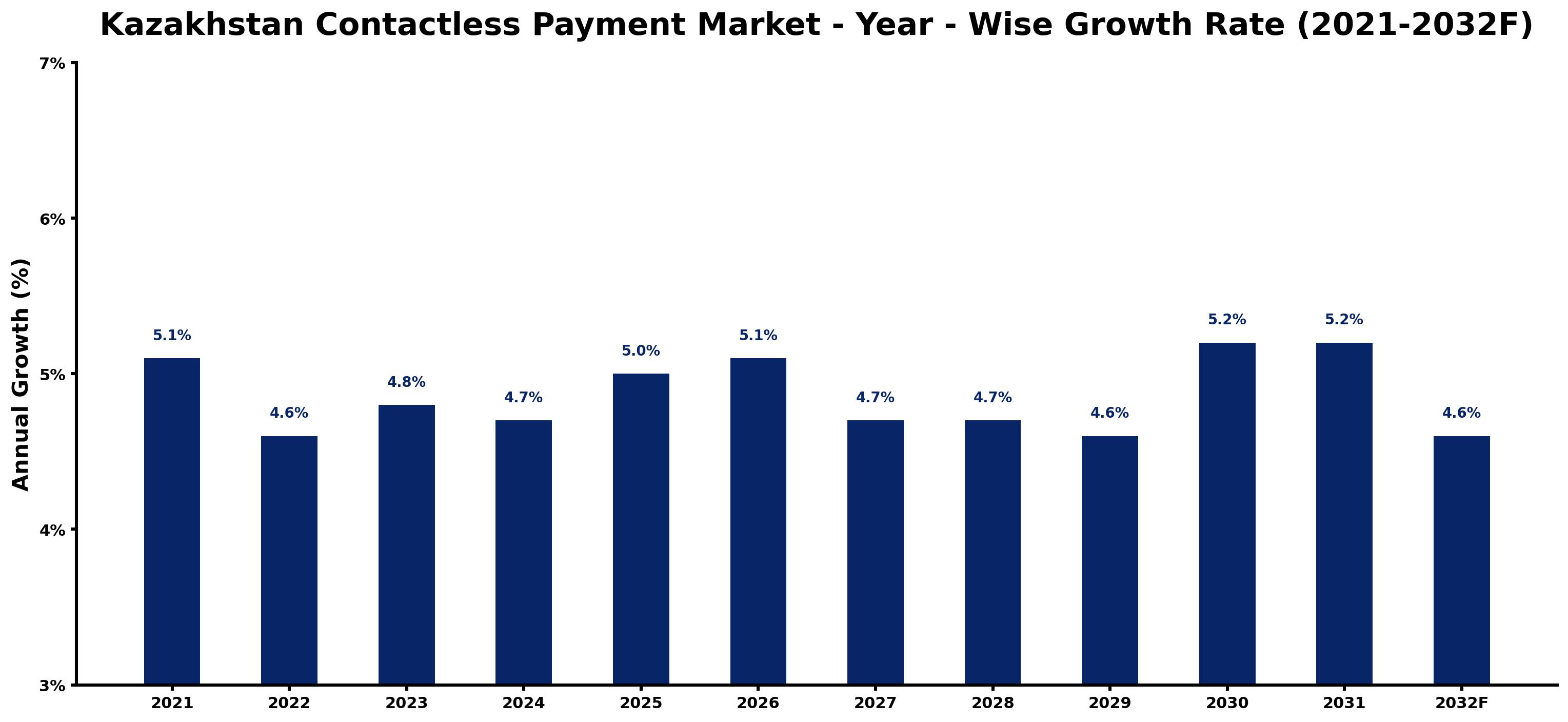
The table below presents the year‑wise growth rates along with the key drivers influencing the market
| Year | Growth Rate | Major Drivers |
| 2021 | 5.1% | National Digital Payment Development Program implementation. |
| 2022 | 4.6% | Rise in e-commerce transactions post-pandemic. |
| 2023 | 4.8% | Increased mobile wallet acceptance among local retailers. |
| 2024 | 4.7% | Government incentives for digital banking services expansion. |
| 2025 | 5.0% | Youth demographic shift towards contactless payment methods. |
| 2026 | 5.1% | Urbanization leading to more tech-savvy consumers. |
| 2027 | 4.7% | Integration of contactless options in public transportation systems. |
| 2028 | 4.7% | Investment in fintech startups enhancing payment solutions. |
| 2029 | 4.6% | Adoption of QR code payments among small businesses. |
| 2030 | 5.2% | Regulatory support for fintech innovations in payments. |
| 2031 | 5.2% | Collaboration of telecom companies with payment providers. |
| 2032 | 4.6% | Growth of loyalty programs encouraging contactless usage. |
Note: Market size estimations and growth projections presented in this report are based on 6Wresearch's proprietary forecasting methodology, utilizing the latest available industry data, government publications, and primary research inputs.
Kazakhstan Contactless Payment Market Key Takeaways
Below are some of the specific key takeaways from the market, including:
- Consumer adoption of contactless payment methods is significantly increasing due to the ease of use and speed.
- The market is supported by a growing number of contactless payment terminals across various sectors.
- Smartphone penetration with NFC capabilities is enhancing the accessibility of contactless payments.
- Government initiatives are fostering a favorable environment for digital payment adoption.
- Concerns about security and fraud are the primary barriers to faster market growth.
Evaluation of Restraints in Kazakhstan Contactless Payment Market
Despite the enthusiasm surrounding contactless payments, the market faces notable constraints. The initial investment required for merchants to adopt the necessary infrastructure remains a significant hurdle. Many small and medium enterprises are hesitant to incur these costs without a clear return on investment. on top of that, consumers' lingering concerns about security and potential fraud can slow down the widespread acceptance of contactless solutions. Until these issues are adequately addressed, the market's growth will likely be tempered.
Kazakhstan Contactless Payment Market Trends
The trend towards cashless transactions is gaining traction, with contactless payment methods leading the charge. More consumers are opting for mobile wallets and wearable devices, aligning with global shifts in payment preferences. Retailers are increasingly adopting loyalty programs integrated with contactless payments, enhancing customer experience and engagement. on top of that, the rise of fintech solutions is also contributing to the competitive landscape, providing innovative payment solutions tailored for local consumers.
Kazakhstan Contactless Payment Market Opportunities
The Kazakhstan Contactless Payment Market presents numerous opportunities for growth and investment. The expansion of digital payment infrastructure offers potential partnerships for technology providers. Retailers can capitalize on the trend by integrating contactless payment options into their service offerings. Additionally, as financial literacy increases, more consumers are likely to explore advanced digital payment solutions, creating a fertile ground for further innovation.
Government Initiatives in the Kazakhstan Contactless Payment Market
The government of Kazakhstan is actively promoting the adoption of contactless payment technologies as part of its broader strategy to advance the digital economy. Regulatory frameworks are being established to ensure secure transactions, enhancing consumer confidence in these systems. Such initiatives are crucial in building a resilient digital payment ecosystem that supports financial inclusion.
- A national digital payment framework introduced in early 2025 aims to standardize contactless transaction processes across financial institutions.
- Ongoing efforts include public awareness campaigns to educate consumers about the benefits and security of contactless payments.
- A planned infrastructure upgrade expected to commence by mid-2026 will improve the availability of contactless payment terminals nationwide.
- Recently completed initiatives have included the rollout of pilot programs in urban centers to test new payment technologies in collaboration with local banks.
- Current discussions are underway regarding a legislative proposal to incentivize merchants to adopt contactless payment systems.
Future Insights of the Kazakhstan Contactless Payment Market
Looking ahead to 2026-2032, the Kazakhstan Contactless Payment Market is set to witness transformative growth. As consumer preferences shift towards cashless transactions, the demand for contactless solutions will continue to escalate. The evolution of technology, combined with supportive government policies, will play a crucial role in shaping the market's trajectory. Financial institutions and retailers that can swiftly adapt to these changes stand to gain a competitive advantage, positioning themselves at the forefront of the digital payment revolution.
Kazakhstan Contactless Payment Market Latest Developments
Over the past year, the Kazakhstan Contactless Payment Market has seen several noteworthy developments. As consumer demand for efficient payment methods grows, key players have been focusing on technological advancements and infrastructure expansion. Increased collaboration between financial institutions and tech companies has also emerged, aimed at enhancing the overall payment experience.
- A major technology vendor launched an innovative mobile wallet solution in Q3 2025, designed to streamline contactless transactions for consumers.
- In early 2025, a leading regional operator completed the installation of contactless payment terminals across several retail chains, significantly enhancing consumer access.
- Current initiatives include partnerships between banks and fintech startups to develop more secure and user-friendly payment applications, with ongoing testing scheduled for late 2026.
- A forthcoming government-backed initiative, expected to be announced by early 2026, aims to subsidize the cost of contactless terminals for small businesses.
- An ongoing pilot program launched in mid-2025 is testing biometric payment options, potentially paving the way for future technology adoption in the retail sector.
Kazakhstan Contactless Payment Market - Key Attractiveness of the Report
- 10 Years of Market Numbers
- Historical Data Starting from 2022 to 2025
- Base Year: 2025
- Forecast Data until 2032
- Key Performance Indicators Impacting the Market
- Major Upcoming Developments and Projects
Key Highlights of the Report:
- Kazakhstan Contactless Payment Market Outlook
- Market Size of Kazakhstan Contactless Payment Market, 2025
- Forecast of Kazakhstan Contactless Payment Market, 2032
- Historical Data and Forecast of Kazakhstan Contactless Payment Revenues & Volume for the Period 2022-2032F
- Kazakhstan Contactless Payment Market Trend Evolution
- Kazakhstan Contactless Payment Market Drivers and Challenges
- Kazakhstan Contactless Payment Price Trends
- Kazakhstan Contactless Payment Porter's Five Forces
- Kazakhstan Contactless Payment Industry Life Cycle
- Historical Data and Forecast of Kazakhstan Contactless Payment Market Revenues & Volume By Component for the Period 2022-2032F
- Historical Data and Forecast of Kazakhstan Contactless Payment Market Revenues & Volume By Hardware for the Period 2022-2032F
- Historical Data and Forecast of Kazakhstan Contactless Payment Market Revenues & Volume By Solutions for the Period 2022-2032F
- Historical Data and Forecast of Kazakhstan Contactless Payment Market Revenues & Volume By Services for the Period 2022-2032F
- Historical Data and Forecast of Kazakhstan Contactless Payment Market Revenues & Volume By Vertical for the Period 2022-2032F
- Historical Data and Forecast of Kazakhstan Contactless Payment Market Revenues & Volume By Retail for the Period 2022-2032F
- Historical Data and Forecast of Kazakhstan Contactless Payment Market Revenues & Volume By Hospitality for the Period 2022-2032F
- Historical Data and Forecast of Kazakhstan Contactless Payment Market Revenues & Volume By Healthcare for the Period 2022-2032F
- Historical Data and Forecast of Kazakhstan Contactless Payment Market Revenues & Volume By Energy and Utilities for the Period 2022-2032F
- Historical Data and Forecast of Kazakhstan Contactless Payment Market Revenues & Volume By Transportation and Logistics for the Period 2022-2032F
- Historical Data and Forecast of Kazakhstan Contactless Payment Market Revenues & Volume By BFSI for the Period 2022-2032F
- Historical Data and Forecast of Kazakhstan Contactless Payment Market Revenues & Volume By Others (Government, telecommunications, and education) for the Period 2022-2032F
- Kazakhstan Contactless Payment Import Export Trade Statistics
- Market Opportunity Assessment By Component
- Market Opportunity Assessment By Vertical
- Kazakhstan Contactless Payment Top Companies Market Share
- Kazakhstan Contactless Payment Competitive Benchmarking By Technical and Operational Parameters
- Kazakhstan Contactless Payment Company Profiles
- Kazakhstan Contactless Payment Key Strategic Recommendations






































