Kazakhstan Food & Grocery Retail Market Size, Share & Growth Rate
The Kazakhstan Food & Grocery Retail Market was estimated at USD 407 Million in 2025 and is projected to reach USD 765 Million by 2032, growing at a CAGR of 9.4% from 2026 to 2032. This impressive growth trajectory is fueled by a confluence of factors, including increasing urbanization, a burgeoning middle class with rising disposable incomes, and a marked shift in consumer preferences toward convenience and higher-quality food options. As consumers increasingly embrace modern retail formats and e-commerce platforms, the sector is evolving to meet these changing demands.
Kazakhstan Food & Grocery Retail Market Year-wise Growth Rate and Key Drivers
This graph highlights how the Kazakhstan Food & Grocery Retail Market has steadily grown over the years, supported by major growth factors.
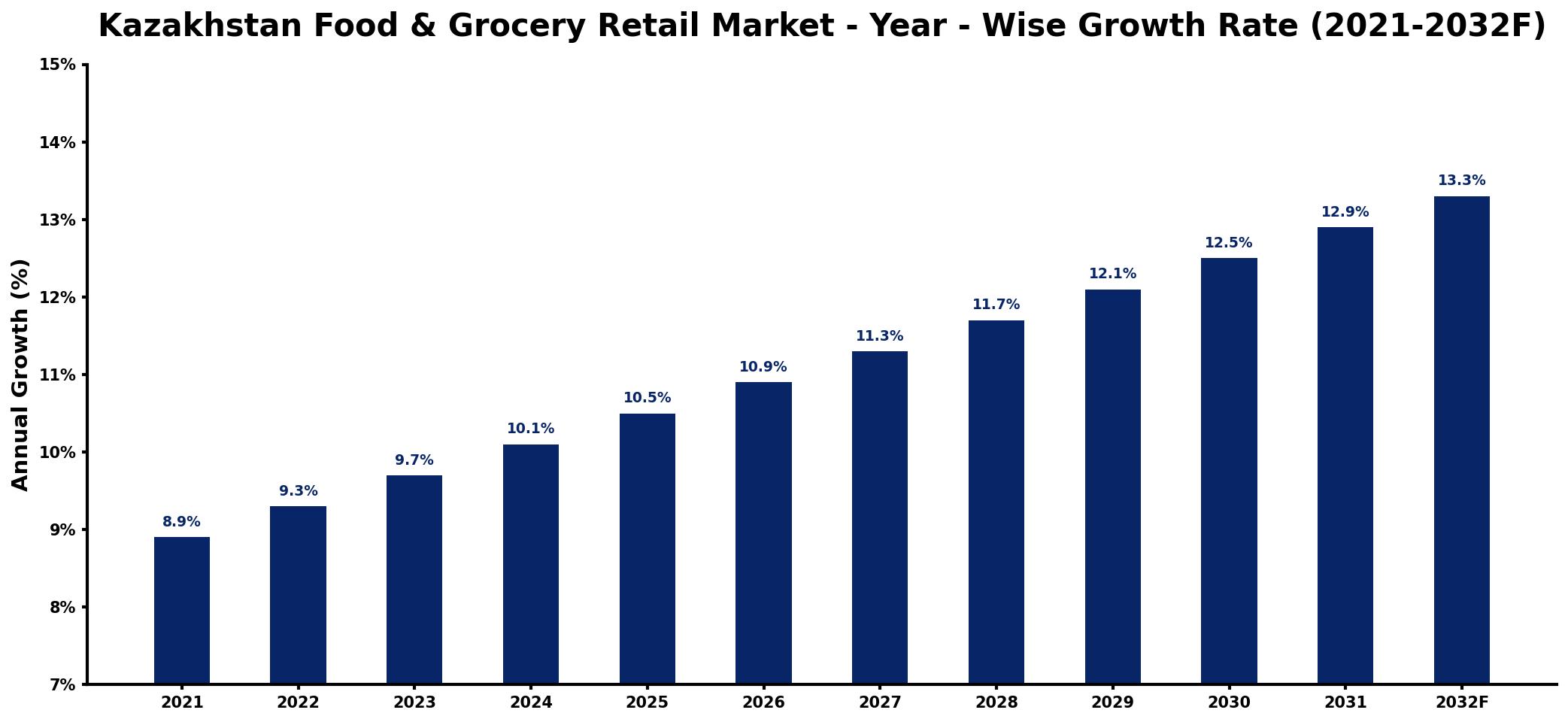
The table below presents the year‑wise growth rates along with the key drivers influencing the market
| Year | Growth Rate | Major Drivers |
| 2021 | 8.9% | Rising consumer spending power |
| 2022 | 9.3% | Expansion of online shopping platforms |
| 2023 | 9.7% | Increased urbanization rates observed |
| 2024 | 10.1% | Growth in local production capabilities |
| 2025 | 10.5% | Emergence of new market entrants |
| 2026 | 10.9% | Investment in supply chain technology |
| 2027 | 11.3% | Enhancement of logistics infrastructure |
| 2028 | 11.7% | Diversification of product offerings |
| 2029 | 12.1% | Strengthening of distribution networks |
| 2030 | 12.5% | Adoption of sustainable practices |
| 2031 | 12.9% | Growing demand for convenience options |
| 2032 | 13.3% | Rise in health-conscious consumers |
Note: Market size estimations and growth projections presented in this report are based on 6Wresearch's proprietary forecasting methodology, utilizing the latest available industry data, government publications, and primary research inputs.
Kazakhstan Food & Grocery Retail Market Synopsis
Recently, the Kazakhstan Food & Grocery Retail Market has witnessed substantial growth, driven by an expanding retail landscape that blends traditional markets with modern formats. As this dynamic sector continues to evolve, expectations are set for ongoing transformation, with the increasing popularity of online shopping and the demand for healthier food options leading the charge.
In the coming years, the market is poised to further capitalize on changing consumer behaviors, particularly the inclination toward e-commerce and quality products. Retailers must navigate these shifting tides while adapting to the expectations of a health-conscious consumer base eager for innovation and convenience.
- The market is estimated to grow significantly, reflecting increasing disposable incomes and urbanization.
- Healthier and organic food options are gaining popularity among consumers.
- E-commerce platforms are becoming essential for retailers to meet changing shopping preferences.
- Logistical and regulatory challenges require strategic innovation from market players.
- Investment opportunities abound in modernizing retail formats and expanding online grocery services.
The Kazakhstan Food & Grocery Retail Market is currently challenged by intense competition, where both local and international retailers vie for market share, often resulting in price pressures that can affect profit margins. Additionally, logistical hurdles, particularly in the transportation and distribution of perishable goods across a vast country, pose significant operational challenges. As consumer preferences evolve, retailers must continuously adapt, facing obstacles such as changing buying behavior and regulatory complexities that can inhibit market growth and expansion.
The Kazakhstan Food & Grocery Retail Market is currently experiencing notable trends that are reshaping consumer demand. A marked shift toward healthier eating habits has sparked interest in organic and premium food products. Concurrently, the convenience-driven culture has led to an uptick in demand for ready-to-eat meals and quick-service options. Retailers are also investing heavily in enhancing their e-commerce capabilities, with an emphasis on user-friendly online shopping experiences and efficient home delivery services. Furthermore, international food products are gaining traction, appealing to affluent consumers looking for quality and variety.
The future of the Kazakhstan Food & Grocery Retail Market holds substantial opportunities for growth and investment. Key areas include the expansion of online grocery delivery services, which cater to the increasing consumer preference for convenience. Additionally, modernizing traditional grocery outlets to enhance the customer experience offers further potential. There is also a growing market for innovative and health-focused food products, especially as consumers prioritize quality and wellness. Retailers willing to diversify their offerings and adapt to shifting consumer behaviors are well-positioned for long-term success in this evolving landscape.
The Kazakhstan government has implemented several policies aimed at enhancing the food and grocery retail market's growth and sustainability. These initiatives focus on ensuring food safety and quality standards are upheld, alongside regulations concerning pricing and labeling. Additionally, efforts to promote local producers and boost domestic production are critical in reducing reliance on imports. The government is also investing in improvements to distribution networks and infrastructure to enhance overall accessibility to food and grocery products for consumers.
The outlook for the Kazakhstan Food & Grocery Retail Market is optimistic, with sustained growth expected from 2026 to 2032. Increasing urbanization, rising disposable income, and an ever-evolving consumer landscape will continue to drive market expansion. The ongoing digital transformation of retail, particularly the integration of e-commerce solutions, presents new avenues for reaching consumers. However, retailers must remain vigilant in navigating challenges such as intense competition and regulatory dynamics to capitalize fully on the market's potential.
Recent trends within the Kazakhstan Food & Grocery Retail Market indicate a rapid acceleration in digital transformation, as several retailers enhance their online shopping platforms to accommodate evolving consumer preferences. The shift toward healthier food options is prompting retailers to introduce more organic and premium product lines. Furthermore, logistical improvements and government support for local producers are expected to bolster the sector's growth. As competition intensifies, innovation in retail offerings remains a focal point for companies seeking to differentiate themselves in this vibrant market.
- 10 Years of Market Numbers
- Historical Data Starting from 2022 to 2025
- Base Year: 2025
- Forecast Data until 2032
- Key Performance Indicators Impacting the Market
- Major Upcoming Developments and Projects
Key Highlights of the Report:
- Kazakhstan Food & Grocery Retail Market Outlook
- Market Size of Kazakhstan Food & Grocery Retail Market, 2025
- Forecast of Kazakhstan Food & Grocery Retail Market, 2032
- Historical Data and Forecast of Kazakhstan Food & Grocery Retail Revenues & Volume for the Period 2022-2032F
- Kazakhstan Food & Grocery Retail Market Trend Evolution
- Kazakhstan Food & Grocery Retail Market Drivers and Challenges
- Kazakhstan Food & Grocery Retail Price Trends
- Kazakhstan Food & Grocery Retail Porter's Five Forces
- Kazakhstan Food & Grocery Retail Industry Life Cycle
- Historical Data and Forecast of Kazakhstan Food & Grocery Retail Market Revenues & Volume By Product for the Period 2022-2032F
- Historical Data and Forecast of Kazakhstan Food & Grocery Retail Market Revenues & Volume By Fresh Food for the Period 2022-2032F
- Historical Data and Forecast of Kazakhstan Food & Grocery Retail Market Revenues & Volume By Frozen Food for the Period 2022-2032F
- Historical Data and Forecast of Kazakhstan Food & Grocery Retail Market Revenues & Volume By Food Cupboard for the Period 2022-2032F
- Historical Data and Forecast of Kazakhstan Food & Grocery Retail Market Revenues & Volume By Beverages for the Period 2022-2032F
- Historical Data and Forecast of Kazakhstan Food & Grocery Retail Market Revenues & Volume By Cleaning & Household for the Period 2022-2032F
- Historical Data and Forecast of Kazakhstan Food & Grocery Retail Market Revenues & Volume By Others for the Period 2022-2032F
- Historical Data and Forecast of Kazakhstan Food & Grocery Retail Market Revenues & Volume By Distribution Channel for the Period 2022-2032F
- Historical Data and Forecast of Kazakhstan Food & Grocery Retail Market Revenues & Volume By Supermarkets & Hypermarkets for the Period 2022-2032F
- Historical Data and Forecast of Kazakhstan Food & Grocery Retail Market Revenues & Volume By Convenience Stores for the Period 2022-2032F
- Historical Data and Forecast of Kazakhstan Food & Grocery Retail Market Revenues & Volume By Departmental Stores & Clubs for the Period 2022-2032F
- Historical Data and Forecast of Kazakhstan Food & Grocery Retail Market Revenues & Volume By Online for the Period 2022-2032F
- Kazakhstan Food & Grocery Retail Import Export Trade Statistics
- Market Opportunity Assessment By Product
- Market Opportunity Assessment By Distribution Channel
- Kazakhstan Food & Grocery Retail Top Companies Market Share
- Kazakhstan Food & Grocery Retail Competitive Benchmarking By Technical and Operational Parameters
- Kazakhstan Food & Grocery Retail Company Profiles
- Kazakhstan Food & Grocery Retail Key Strategic Recommendations






































