Kazakhstan Smart Locks Market Size, Share & Growth Rate
The Kazakhstan Smart Locks Market was estimated at USD 1326 Million in 2025 and is projected to reach USD 2493 Million by 2032, growing at a CAGR of 9.4% from 2026 to 2032. This impressive trajectory is largely driven by the increasing integration of smart technologies within homes and businesses, where security remains a paramount concern. With a growing urban population and a significant shift towards automation, smart locks are becoming integral to enhancing residential and commercial safety.
Kazakhstan Smart Locks Market Year-wise Growth Rate and Key Drivers
This graph highlights how the Kazakhstan Smart Locks Market has steadily grown over the years, supported by major growth factors.
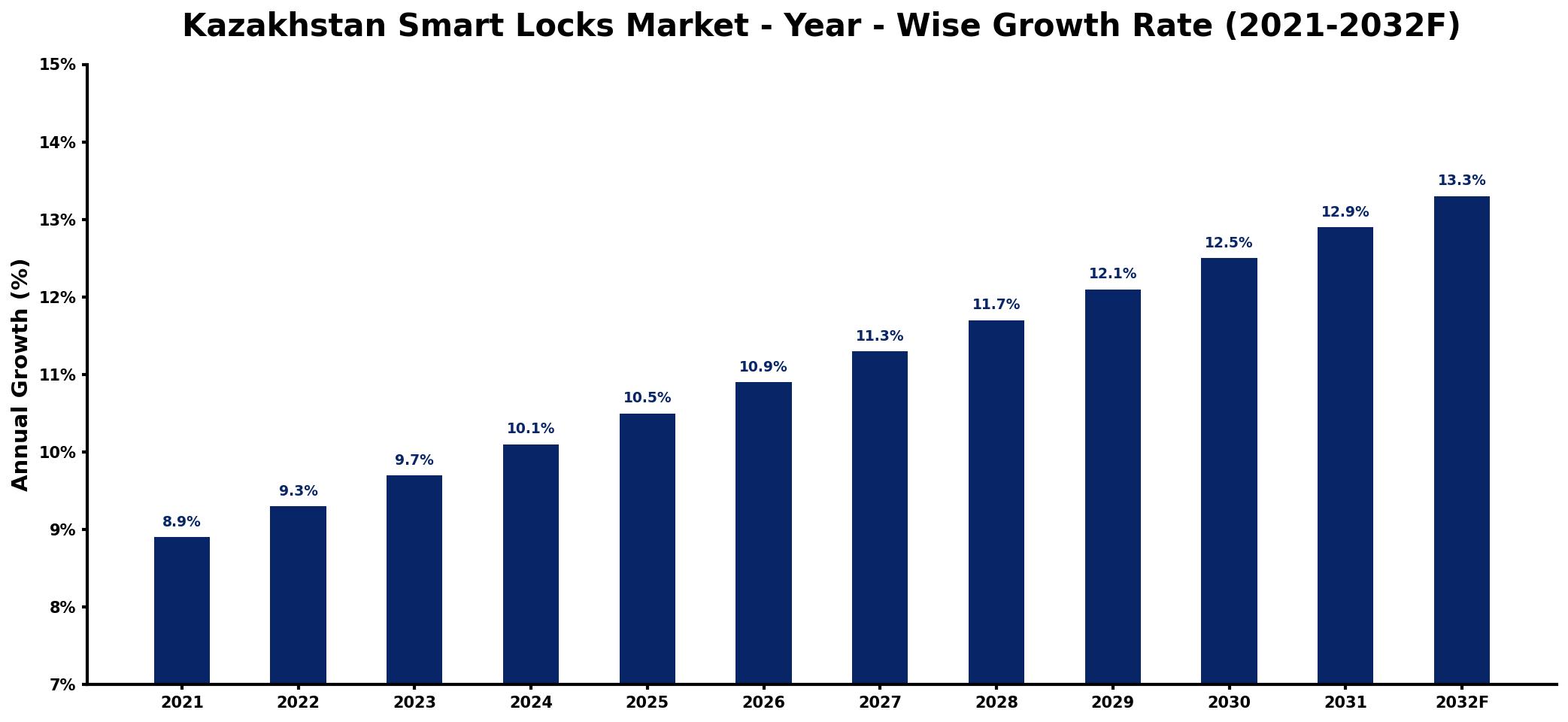
The table below presents the year‑wise growth rates along with the key drivers influencing the market
| Year | Growth Rate | Major Drivers |
| 2021 | 8.9% | Rising urbanization and modernization |
| 2022 | 9.3% | Increased focus on home security |
| 2023 | 9.7% | Growth in IoT technology adoption |
| 2024 | 10.1% | Surge in residential construction projects |
| 2025 | 10.5% | Higher consumer awareness on safety |
| 2026 | 10.9% | enhanced product quality standards |
| 2027 | 11.3% | Development of innovative security solutions |
| 2028 | 11.7% | Increase in disposable income levels |
| 2029 | 12.1% | Emerging trends in property automation |
| 2030 | 12.5% | Investment in advanced technology integration |
| 2031 | 12.9% | Growing demand for remote management |
| 2032 | 13.3% | Focus on energy-efficient security systems |
Note: Market size estimations and growth projections presented in this report are based on 6Wresearch's proprietary forecasting methodology, utilizing the latest available industry data, government publications, and primary research inputs.
Kazakhstan Smart Locks Market Synopsis
In Kazakhstan, the adoption of smart locks is rapidly gaining traction, reflecting a global trend towards advanced security solutions. Homeowners and businesses alike are opting for smart locks that provide convenience, robust security features, and the ability to integrate seamlessly with other smart home devices.
The market's momentum is fueled by technological advancements such as biometric authentication and remote access features, which not only enhance security but also align with the growing demand for connectivity. This burgeoning sector is attracting considerable interest from consumers eager to embrace modern living solutions.
Kazakhstan Smart Locks Market Key Takeaways
- The demand for smart locks is driven by heightened security concerns and a growing preference for smart home devices among consumers.
- Key innovations include biometric recognition and integration with popular voice assistants, catering to tech-savvy individuals.
- Wireless connectivity options, including Bluetooth and Wi-Fi, are becoming standard features, enhancing usability and convenience.
- Market growth is supported by government initiatives aimed at promoting smart technologies across various sectors.
- Despite challenges, the potential for investment and development in the smart locks sector remains substantial.
Evaluation of Restraints in Kazakhstan Smart Locks Market
While the Kazakhstan Smart Locks Market is poised for growth, several challenges must be addressed to unlock its full potential. Key concerns revolve around data security and privacy, as the reliance on connectivity increases the risk of unauthorized access. Additionally, the compatibility of smart locks with existing infrastructure poses a barrier to widespread adoption. Consumer trust is another critical factor; many still prefer traditional locking systems over newer technologies. Furthermore, the initial cost of smart locks can deter potential buyers, highlighting the need for education about the benefits and security enhancements these products provide.
Kazakhstan Smart Locks Market Trends
The Kazakhstan Smart Locks Market is characterized by a few significant trends that are shaping its future. First, the push for convenience is leading consumers to favor smart locks that offer features such as remote access and compatibility with home automation systems. The rise of biometric authentication is particularly noteworthy, providing enhanced security measures that appeal to both residential and commercial users.
Furthermore, the design of smart locks is evolving, with manufacturers focusing on modern aesthetics that resonate with design-conscious consumers. As technology advances, theres an increasing reliance on wireless communication methods, allowing users to monitor and control their locks via smartphones, thus driving demand for more sophisticated and user-friendly products.
Kazakhstan Smart Locks Market Opportunities
With the Kazakhstan Smart Locks Market on an upward trajectory, various opportunities for investment and growth are emerging. The increasing urbanization and the government's focus on smart city initiatives present a fertile ground for smart lock technologies. Investors can explore partnerships with local manufacturers or service providers to tailor innovative solutions that meet the specific demands of the Kazakhstani market. Additionally, collaboration with real estate developers to integrate smart locks into new housing projects could lead to significant market penetration and customer acquisition.
Government Initiatives in the Kazakhstan Smart Locks Market
The government of Kazakhstan is actively promoting the adoption of smart technologies, including smart locks, as part of broader efforts to enhance security and efficiency in urban environments. Incentives such as tax breaks and subsidies are being offered to encourage the integration of these technologies into both residential and commercial buildings. Furthermore, regulations ensuring the security and privacy of smart lock systems are being instituted, fostering a supportive environment for market growth and innovation.
Future Insights of the Kazakhstan Smart Locks Market
Looking ahead, the Kazakhstan Smart Locks Market is expected to experience robust growth through 2032, fueled by the continued rise of smart home technologies and growing consumer awareness around security. As technological advancements make smart locks more affordable and accessible, their integration into everyday living is likely to become mainstream. The trend towards connected devices, coupled with an increasing focus on convenience and security, positions the smart locks segment for a promising future.
Kazakhstan Smart Locks Market Latest Developments (2025 - 2026)
Recent developments within the Kazakhstan Smart Locks Market indicate a strong movement towards enhancing product offerings and addressing consumer concerns. Manufacturers are focusing on improving data security features, alongside expanding compatibility with popular smart home ecosystems. Additionally, there has been a notable increase in marketing efforts aimed at educating consumers about the benefits and functionalities of smart locks, helping to build trust and drive adoption across various demographics.
Kazakhstan Smart Locks Market - Key Attractiveness of the Report
- 10 Years of Market Numbers
- Historical Data Starting from 2022 to 2025
- Base Year: 2025
- Forecast Data until 2032
- Key Performance Indicators Impacting the Market
- Major Upcoming Developments and Projects
Key Highlights of the Report:
- Kazakhstan Smart Locks Market Outlook
- Market Size of Kazakhstan Smart Locks Market, 2025
- Forecast of Kazakhstan Smart Locks Market, 2032
- Historical Data and Forecast of Kazakhstan Smart Locks Revenues & Volume for the Period 2022-2032F
- Kazakhstan Smart Locks Market Trend Evolution
- Kazakhstan Smart Locks Market Drivers and Challenges
- Kazakhstan Smart Locks Price Trends
- Kazakhstan Smart Locks Porter's Five Forces
- Kazakhstan Smart Locks Industry Life Cycle
- Historical Data and Forecast of Kazakhstan Smart Locks Market Revenues & Volume By Product for the Period 2022-2032F
- Historical Data and Forecast of Kazakhstan Smart Locks Market Revenues & Volume By Deadbolts for the Period 2022-2032F
- Historical Data and Forecast of Kazakhstan Smart Locks Market Revenues & Volume By Lever Handles for the Period 2022-2032F
- Historical Data and Forecast of Kazakhstan Smart Locks Market Revenues & Volume By Padlocks for the Period 2022-2032F
- Historical Data and Forecast of Kazakhstan Smart Locks Market Revenues & Volume By Others for the Period 2022-2032F
- Historical Data and Forecast of Kazakhstan Smart Locks Market Revenues & Volume By Technology for the Period 2022-2032F
- Historical Data and Forecast of Kazakhstan Smart Locks Market Revenues & Volume By Bluetooth for the Period 2022-2032F
- Historical Data and Forecast of Kazakhstan Smart Locks Market Revenues & Volume By Wi-Fi for the Period 2022-2032F
- Historical Data and Forecast of Kazakhstan Smart Locks Market Revenues & Volume By End User for the Period 2022-2032F
- Historical Data and Forecast of Kazakhstan Smart Locks Market Revenues & Volume By Residential for the Period 2022-2032F
- Historical Data and Forecast of Kazakhstan Smart Locks Market Revenues & Volume By Commercial for the Period 2022-2032F
- Kazakhstan Smart Locks Import Export Trade Statistics
- Market Opportunity Assessment By Product
- Market Opportunity Assessment By Technology
- Market Opportunity Assessment By End User
- Kazakhstan Smart Locks Top Companies Market Share
- Kazakhstan Smart Locks Competitive Benchmarking By Technical and Operational Parameters
- Kazakhstan Smart Locks Company Profiles
- Kazakhstan Smart Locks Key Strategic Recommendations






































