Kenya Modular Kitchen Market Size, Share & Growth Rate
The Kenya Modular Kitchen Market was estimated at USD 836 Million in 2025 and is projected to reach USD 1189 Million by 2032, growing at a CAGR of 5.2% from 2026 to 2032. This growth trajectory is being propelled by rapid urbanization and an increase in residential construction and renovation projects. As consumers become more discerning about modern kitchen designs, the shift towards modular kitchens that combine functionality with aesthetic appeal is becoming increasingly pronounced.
Kenya Modular Kitchen Market Year-wise Growth Rate and Key Drivers
This graph highlights how the Kenya Modular Kitchen Market has steadily grown over the years, supported by major growth factors.
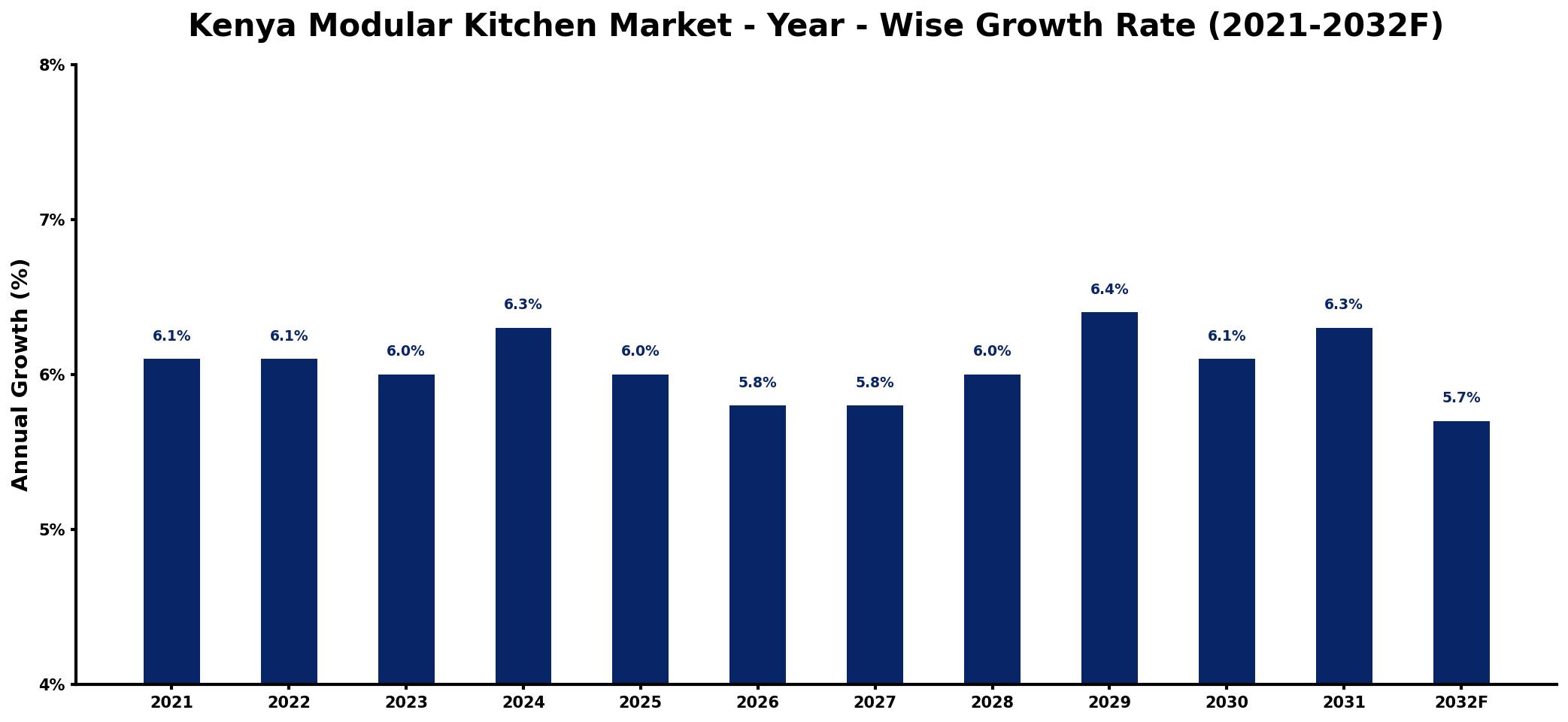
The table below presents the year‑wise growth rates along with the key drivers influencing the market
| Year | Growth Rate | Major Drivers |
| 2021 | 6.1% | Rising urban population demands housing |
| 2022 | 6.1% | Increased disposable income for households |
| 2023 | 6.0% | Growing interest in interior design |
| 2024 | 6.3% | Expansion of real estate projects |
| 2025 | 6.0% | Higher investment in home renovations |
| 2026 | 5.8% | Increase in expatriate population moving |
| 2027 | 5.8% | Enhanced awareness of sustainable materials |
| 2028 | 6.0% | strengthening international trade flows |
| 2029 | 6.4% | growing downstream application demand |
| 2030 | 6.1% | Surge in eco-friendly living choices |
| 2031 | 6.3% | expanding manufacturing base activity |
| 2032 | 5.7% | Growing demand for multifunctional spaces |
Note: Market size estimations and growth projections presented in this report are based on 6Wresearch's proprietary forecasting methodology, utilizing the latest available industry data, government publications, and primary research inputs.
Kenya Modular Kitchen Market Synopsis
Recently, the modular kitchen market in Kenya has witnessed momentum driven by the urban middle classs demand for modern solutions. However, the future outlook indicates a slower, yet steady growth as consumers continue to learn about the advantages of customizable kitchen setups.
While the current interest reflects an eagerness for contemporary kitchen solutions, there remains a cultural inclination towards traditional layouts that could hinder wider acceptance. This duality presents both challenges and opportunities for market players aiming to educate potential customers on the benefits of modular kitchens.
Kenya Modular Kitchen Market Key Takeaways
- Urbanization and changing lifestyles are primary drivers for growth in the modular kitchen market.
- Customization and space efficiency are critical elements influencing consumer preferences.
- A lack of awareness and high costs are significant barriers to market penetration.
- Government policies and urban development initiatives could enhance market reach.
- There is a growing trend towards modern designs that accommodate smaller living spaces.
Evaluation of Restraints in Kenya Modular Kitchen Market
The modular kitchen market in Kenya faces notable restraints that could limit its potential. Chief among these is the general lack of awareness about the distinct advantages offered by modular kitchens compared to traditional options. Additionally, affordability poses a major barrier, particularly for low-income households that may find the initial investment daunting. The reliance on imported components further complicates the landscape, as it drives up costs and creates logistical challenges. Cultural preferences for conventional kitchen layouts also play a role in restricting broader acceptance, potentially hampering growth in key demographics.
Kenya Modular Kitchen Market Trends
Emerging trends in the Kenya Modular Kitchen Market indicate a growing preference for eco-friendly materials and sustainable designs. As consumers become more conscious of their environmental impact, manufacturers are responding with greener solutions that appeal to this demographic. Additionally, the integration of smart technology within kitchen designs is gaining traction, with features such as automated appliances and energy-efficient systems becoming desirable attributes. This intersection of technology and design is likely to further shape consumer expectations moving forward.
Kenya Modular Kitchen Market Opportunities
The prospects for growth in the Kenya Modular Kitchen Market are substantial, particularly in urban areas where housing development is on the rise. Investment in marketing strategies aimed at educating potential customers about the benefits of modular kitchens could open up new segments of the market. Moreover, the establishment of local manufacturers to reduce dependency on imports could lower costs and improve accessibility for consumers. Targeting young professionals and middle-income households through tailored solutions could also yield fruitful returns for industry players.
Government Initiatives in the Kenya Modular Kitchen Market
The Kenyan government is increasingly focused on urban development initiatives aimed at promoting efficient use of space within residential settings. While specific incentives for the modular kitchen sector remain limited, overall policies favoring housing construction and renovation are likely to benefit the market indirectly. By facilitating access to financing options and developing infrastructure, the government could help foster a more conducive environment for modular kitchen adoption.
Future Insights of the Kenya Modular Kitchen Market
Looking ahead to 2026-2032, the Kenya Modular Kitchen Market is poised for gradual but steady expansion. As urbanization continues and consumer preferences evolve, the demand for modern, space-efficient kitchen designs is expected to solidify. The intersection of technology and design will likely become more pronounced, with a significant emphasis on user experience and customization options. Educating consumers on the benefits and possibilities of modular kitchens will be crucial in paving the way for market growth.
Kenya Modular Kitchen Market Latest Developments (2025 - 2026)
Recent developments in the Kenya Modular Kitchen Market highlight increased collaboration between manufacturers and local suppliers to enhance product offerings. Additionally, several companies are exploring innovative designs that cater to the unique needs of smaller urban dwellings. There has also been a noticeable shift towards online marketing strategies, enabling brands to reach a broader audience and educate consumers about modular kitchen benefits.
Kenya Modular Kitchen Market - Key Attractiveness of the Report
- 10 Years of Market Numbers
- Historical Data Starting from 2022 to 2025
- Base Year: 2025
- Forecast Data until 2032
- Key Performance Indicators Impacting the Market
- Major Upcoming Developments and Projects
Key Highlights of the Report:
- Kenya Modular Kitchen Market Outlook
- Market Size of Kenya Modular Kitchen Market, 2025
- Forecast of Kenya Modular Kitchen Market, 2032
- Historical Data and Forecast of Kenya Modular Kitchen Revenues & Volume for the Period 2022-2032F
- Kenya Modular Kitchen Market Trend Evolution
- Kenya Modular Kitchen Market Drivers and Challenges
- Kenya Modular Kitchen Price Trends
- Kenya Modular Kitchen Porter's Five Forces
- Kenya Modular Kitchen Industry Life Cycle
- Historical Data and Forecast of Kenya Modular Kitchen Market Revenues & Volume By Product for the Period 2022-2032F
- Historical Data and Forecast of Kenya Modular Kitchen Market Revenues & Volume By Floor Cabinet & Wall Cabinets for the Period 2022-2032F
- Historical Data and Forecast of Kenya Modular Kitchen Market Revenues & Volume By Tall Storage Cabinets for the Period 2022-2032F
- Historical Data and Forecast of Kenya Modular Kitchen Market Revenues & Volume By Others for the Period 2022-2032F
- Historical Data and Forecast of Kenya Modular Kitchen Market Revenues & Volume By End-User for the Period 2022-2032F
- Historical Data and Forecast of Kenya Modular Kitchen Market Revenues & Volume By Residential for the Period 2022-2032F
- Historical Data and Forecast of Kenya Modular Kitchen Market Revenues & Volume By Commercial for the Period 2022-2032F
- Historical Data and Forecast of Kenya Modular Kitchen Market Revenues & Volume By Distribution Channel for the Period 2022-2032F
- Historical Data and Forecast of Kenya Modular Kitchen Market Revenues & Volume By Offline (Contractors, Builders, and Others) for the Period 2022-2032F
- Historical Data and Forecast of Kenya Modular Kitchen Market Revenues & Volume By Online for the Period 2022-2032F
- Kenya Modular Kitchen Import Export Trade Statistics
- Market Opportunity Assessment By Product
- Market Opportunity Assessment By End-User
- Market Opportunity Assessment By Distribution Channel
- Kenya Modular Kitchen Top Companies Market Share
- Kenya Modular Kitchen Competitive Benchmarking By Technical and Operational Parameters
- Kenya Modular Kitchen Company Profiles
- Kenya Modular Kitchen Key Strategic Recommendations






































