Kenya Transportation Analytics Market Size & Growth Rate (2026-2032)
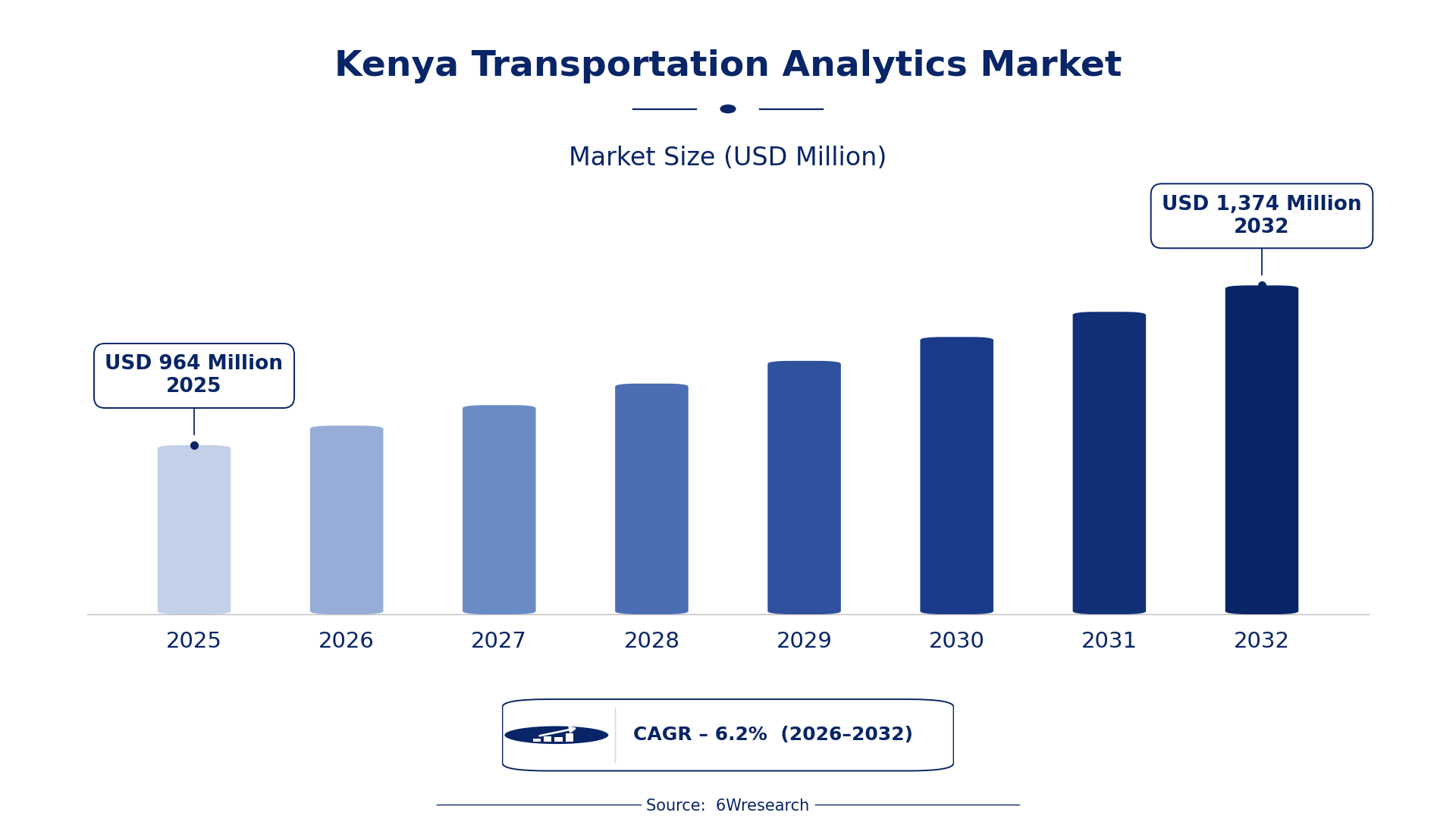
The Kenya Transportation Analytics Market was estimated at USD 964 Million in 2025 and is projected to reach USD 1374 Million by 2032, growing at a CAGR of 6.2% from 2026 to 2032.
Kenya Transportation Analytics Market Synopsis
The ongoing urbanization in Kenya is the most potent factor driving growth in the transportation analytics market. As cities expand and populations swell, the demand for innovative solutions to manage traffic and enhance operational efficiency becomes increasingly critical.
Transportation companies are increasingly turning to data analytics and AI technologies to optimize routes and improve safety. These advancements empower stakeholders to make informed decisions that can lead to significant cost savings and better service delivery.
Kenya Transportation Analytics Market Year-wise Growth Rate and Key Drivers
This graph illustrates the annual growth rates of the Kenya Transportation Analytics Market from 2021 to 2032, highlighting a steady upward trajectory and projected expansion over the forecast period.
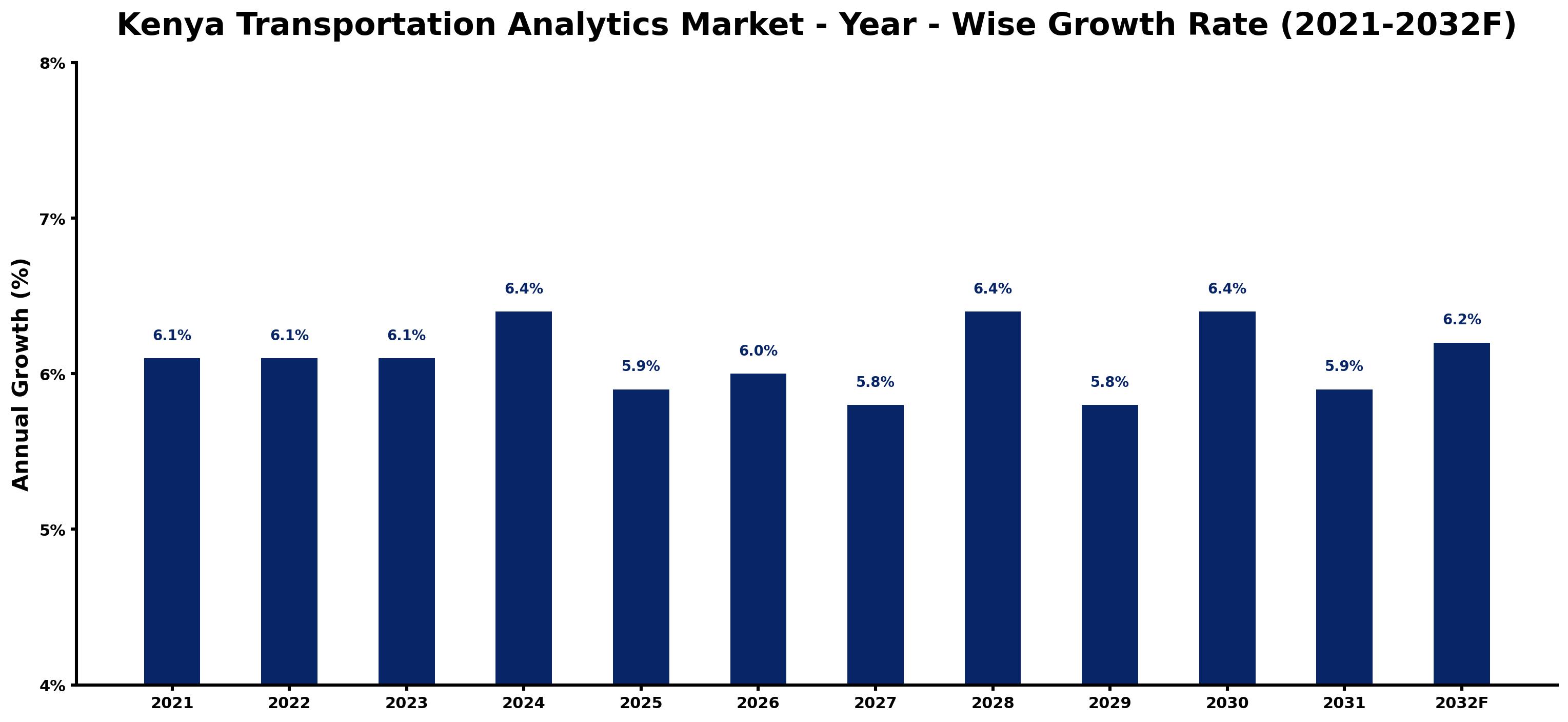
The table below presents the year‑wise growth rates along with the key drivers influencing the market
| Year | Growth Rate | Major Drivers |
| 2021 | 6.1% | Implementation of Vision 2030 transport development goals. |
| 2022 | 6.1% | Adoption of smart traffic management systems in Nairobi. |
| 2023 | 6.1% | Increased focus on data-driven transport safety initiatives. |
| 2024 | 6.4% | Launch of national transport policy promoting analytics use. |
| 2025 | 5.9% | Rising smartphone penetration enhancing real-time transport data access. |
| 2026 | 6.0% | Partnerships between government and analytics firms for logistics. |
| 2027 | 5.8% | Investment in digital infrastructure for transport monitoring solutions. |
| 2028 | 6.4% | Emergence of local startups innovating transport analytics tools. |
| 2029 | 5.8% | Growing urban population driving demand for efficient transit analytics. |
| 2030 | 6.4% | Government incentives for technology adoption in transportation sector. |
| 2031 | 5.9% | Integration of transportation analytics in national urban planning. |
| 2032 | 6.2% | Increased collaborations with international tech firms for data solutions. |
Note: Market size estimations and growth projections presented in this report are based on 6Wresearch's proprietary forecasting methodology, utilizing the latest available industry data, government publications, and primary research inputs.
Kenya Transportation Analytics Market Key Takeaways
Below are some of the specific key takeaways from the market, including:
- The market is fueled by rapid urbanization and increasing population density.
- Data analytics is critical for improving traffic flow and reducing congestion.
- Government initiatives are actively promoting the modernization of transportation infrastructure.
- The lack of comprehensive data collection remains a significant challenge.
- Privacy concerns are creating obstacles to the full adoption of analytics platforms.
Evaluation of Restraints in Kenya Transportation Analytics Market
The Kenya Transportation Analytics Market is grappling with several restraints that hinder its full potential. A primary issue is the inadequate data collection infrastructure, which limits access to essential real-time data on traffic conditions and passenger behavior. This data gap diminishes the reliability of analytics solutions, ultimately affecting decision-making processes. on top of that, privacy and security concerns regarding data sharing hinder the development of more comprehensive analytics platforms, as stakeholders are often reluctant to share sensitive information.
Kenya Transportation Analytics Market Trends
A shift toward smart transportation systems is becoming increasingly apparent in Kenya. The integration of IoT devices in transportation analytics is enhancing real-time data collection and analysis. Additionally, the focus on sustainability is driving demand for solutions that can optimize energy use within transportation networks. As the market evolves, AI-driven predictive analytics will likely take center stage, allowing for proactive measures in traffic management and resource allocation.
Kenya Transportation Analytics Market Opportunities
Growth opportunities are abundant in the Kenya Transportation Analytics Market, particularly in the areas of public transportation and logistics management. The increasing need for efficient transport solutions presents a ripe environment for investment in analytics technologies. Companies that can provide tailored solutions for urban and rural transportation challenges will be well-positioned to capture market share. Additionally, partnerships between public and private sectors could facilitate the development of critical infrastructure, further enhancing the demand for analytics solutions.
Government Initiatives in the Kenya Transportation Analytics Market
The Kenyan government is actively working to modernize the transportation sector through a variety of initiatives aimed at integrating analytics technologies. The regulatory environment is becoming more favorable for private sector participation, which is essential for driving innovation and improving transportation efficiency.
- A national digital infrastructure upgrade programme launched in early 2025 aims to enhance data collection and analytics capabilities across the transportation sector.
- A current initiative is underway to implement smart traffic management systems in major urban centers, utilizing real-time data to optimize traffic flow.
- Planned for 2027, a public-private partnership is expected to focus on improving logistics management through advanced analytics solutions.
- Ongoing discussions about new data governance frameworks aim to address privacy concerns and enhance data sharing among stakeholders.
- Recently completed efforts include the establishment of analytics training programs for local transportation authorities to improve data literacy.
Future Insights of the Kenya Transportation Analytics Market
Looking ahead to 2026-2032, the Kenya Transportation Analytics Market is set to experience considerable transformation. With urbanization continuing to accelerate, the demand for analytics solutions will only intensify. As the government rolls out initiatives to modernize infrastructure, the market can expect increased investments in technology. Adoption of AI and machine learning will facilitate enhanced decision-making processes, paving the way for smarter, safer transportation networks. Companies that adapt to these changes and invest in innovative technologies will likely thrive.
Kenya Transportation Analytics Market Latest Developments
In the last year, the Kenya Transportation Analytics Market has witnessed a surge in activity, with several key developments aimed at enhancing the efficiency of transportation systems. Stakeholders are focusing on integrating advanced technologies to improve traffic management and operational efficiency.
- A major technology vendor launched an AI-driven analytics platform in early 2025, designed specifically for urban transportation systems, to enhance route optimization.
- Currently, an initiative is underway to equip public buses with IoT sensors, which will provide real-time data on passenger loads and traffic conditions.
- A partnership between logistics firms and analytics providers is planned for late 2026, aiming to streamline supply chain processes across the region.
- In mid-2025, a city-wide pilot program was completed, demonstrating the effectiveness of predictive analytics in reducing traffic congestion.
- Upcoming regulatory updates are expected to be announced in early 2026, focusing on standardizing data collection practices across various transportation modes.
Kenya Transportation Analytics Market - Key Attractiveness of the Report
- 10 Years of Market Numbers
- Historical Data Starting from 2022 to 2025
- Base Year: 2025
- Forecast Data until 2032
- Key Performance Indicators Impacting the Market
- Major Upcoming Developments and Projects
Key Highlights of the Report:
- Kenya Transportation Analytics Market Outlook
- Market Size of Kenya Transportation Analytics Market, 2025
- Forecast of Kenya Transportation Analytics Market, 2032
- Historical Data and Forecast of Kenya Transportation Analytics Revenues & Volume for the Period 2022-2032F
- Kenya Transportation Analytics Market Trend Evolution
- Kenya Transportation Analytics Market Drivers and Challenges
- Kenya Transportation Analytics Price Trends
- Kenya Transportation Analytics Porter's Five Forces
- Kenya Transportation Analytics Industry Life Cycle
- Historical Data and Forecast of Kenya Transportation Analytics Market Revenues & Volume By Type for the Period 2022-2032F
- Historical Data and Forecast of Kenya Transportation Analytics Market Revenues & Volume By Descriptive Analytics for the Period 2022-2032F
- Historical Data and Forecast of Kenya Transportation Analytics Market Revenues & Volume By Predictive Analytics for the Period 2022-2032F
- Historical Data and Forecast of Kenya Transportation Analytics Market Revenues & Volume By Prescriptive Analytics for the Period 2022-2032F
- Historical Data and Forecast of Kenya Transportation Analytics Market Revenues & Volume By Mode for the Period 2022-2032F
- Historical Data and Forecast of Kenya Transportation Analytics Market Revenues & Volume By Roadways for the Period 2022-2032F
- Historical Data and Forecast of Kenya Transportation Analytics Market Revenues & Volume By Railways for the Period 2022-2032F
- Historical Data and Forecast of Kenya Transportation Analytics Market Revenues & Volume By Airways for the Period 2022-2032F
- Historical Data and Forecast of Kenya Transportation Analytics Market Revenues & Volume By Waterways for the Period 2022-2032F
- Kenya Transportation Analytics Import Export Trade Statistics
- Market Opportunity Assessment By Type
- Market Opportunity Assessment By Mode
- Kenya Transportation Analytics Top Companies Market Share
- Kenya Transportation Analytics Competitive Benchmarking By Technical and Operational Parameters
- Kenya Transportation Analytics Company Profiles
- Kenya Transportation Analytics Key Strategic Recommendations






































