Latvia Benzaldehyde Market Size (2020-2030)
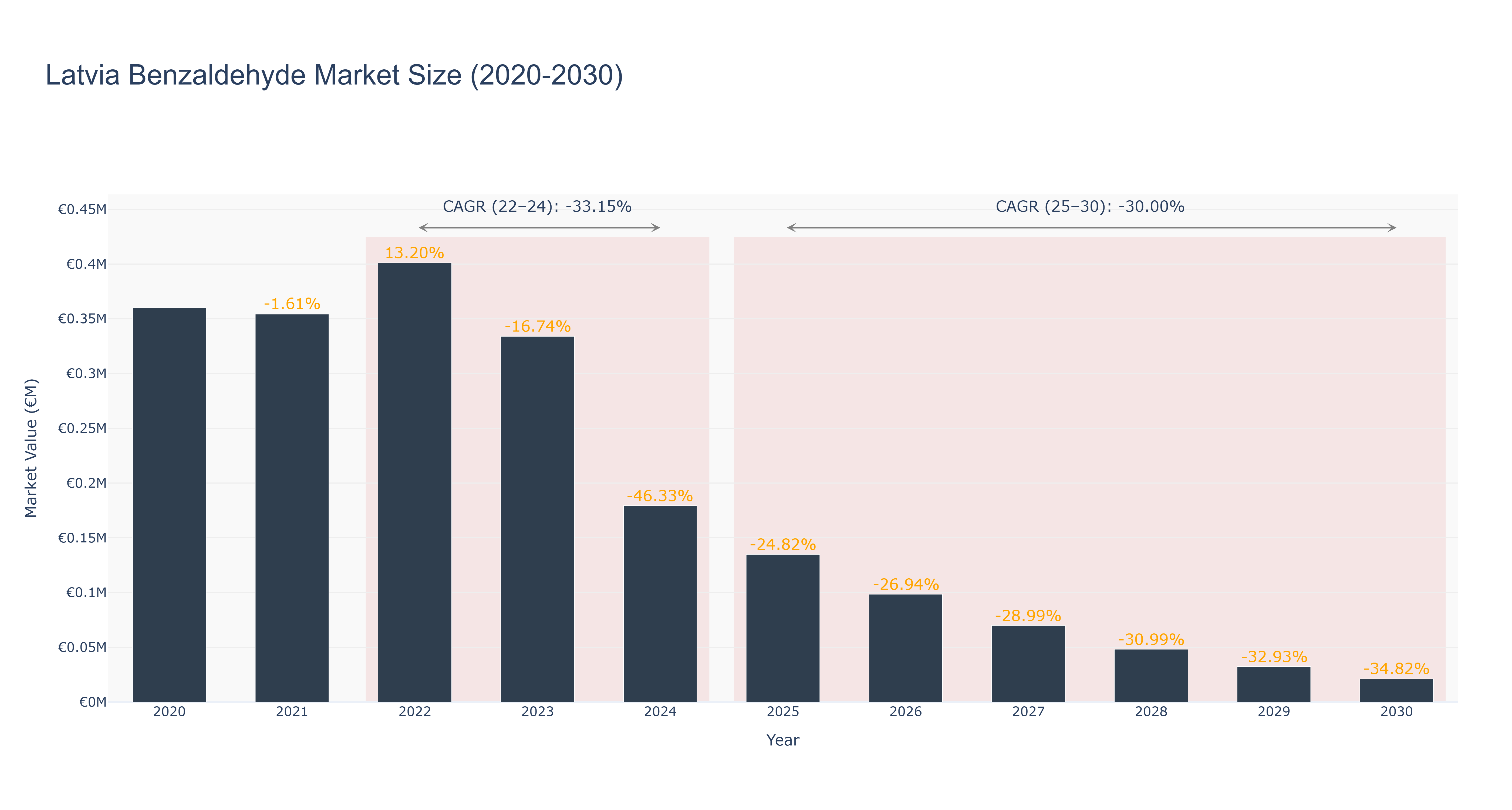
Latvia Benzaldehyde Market has experienced a significant decline in market size over the past decade. The peak market size of €0.40 million was recorded in 2022, followed by a sharp decrease to €0.18 million in 2024. The forecasted market size from 2025 to 2030 continues to show a downward trend, with a projected size of €0.02 million in 2030. The CAGR for the period 2022-24 was -33.15%, while the CAGR for 2025-30 is expected to be -30.0%. The market downturn can be attributed to various factors such as changing consumer preferences, economic fluctuations, and increased competition. Despite these challenges, upcoming developments in the chemical industry in Latvia, including advancements in production technologies and sustainable practices, may offer opportunities for market recovery in the future.
Latvia Benzaldehyde Market: Production & Trade Performance (2019-2025)
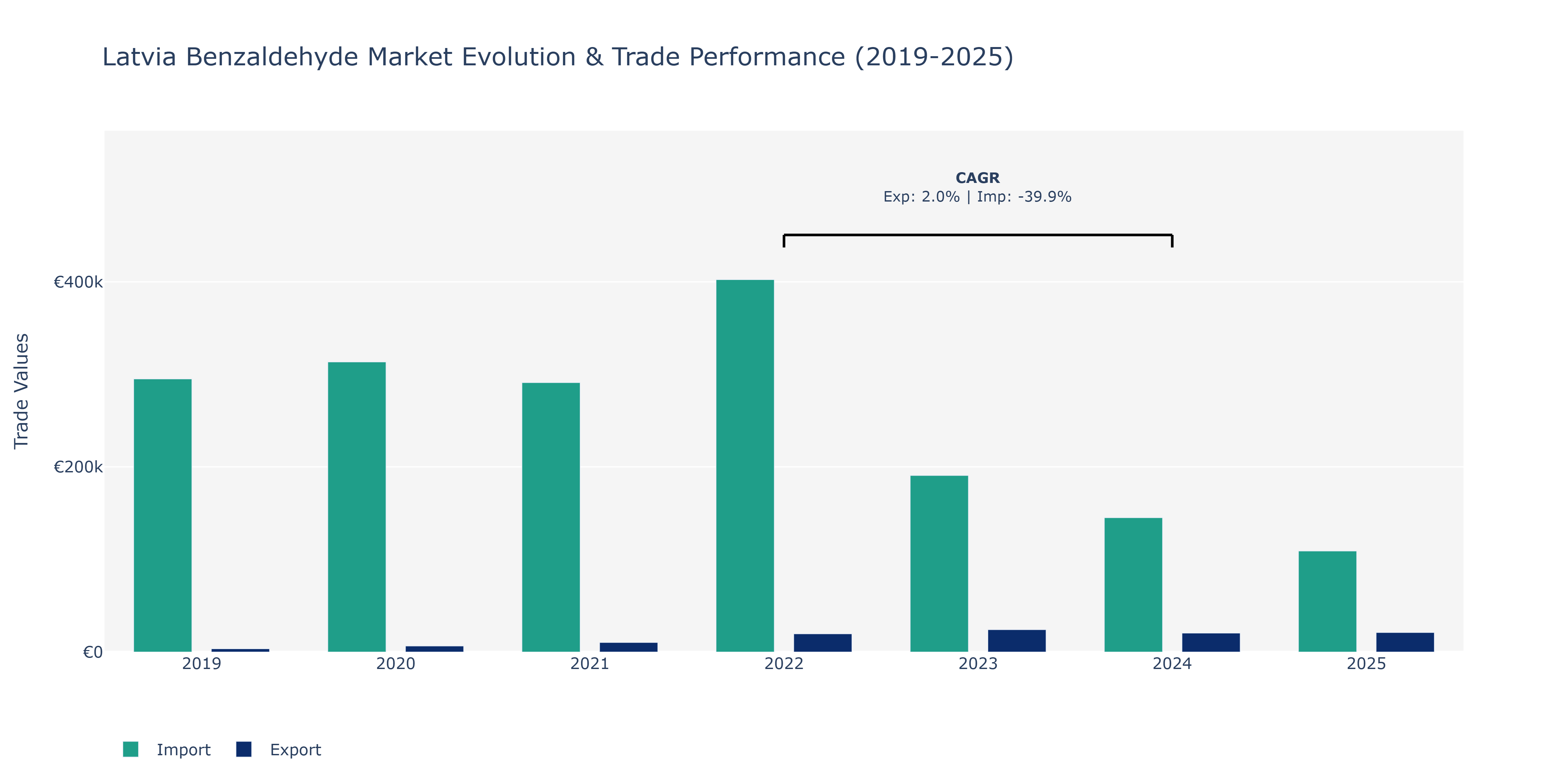
Between 2019 and 2025, Latvia's Benzaldehyde Market experienced notable fluctuations in both exports and imports. The data shows a consistent increase in exports from €3.51 thousand in 2019 to €21.11 thousand in 2025. Peak points were observed in 2022 with €19.68 thousand and 2025 with €21.11 thousand. Conversely, imports fluctuated, reaching their peak in 2020 at €313.43 thousand and declining to €109.12 thousand in 2025. The sharp decline in imports between 2022 and 2023 can be attributed to various factors such as changes in demand patterns, global market conditions, or shifts in sourcing strategies. To sustain export growth, local producers might have focused on enhancing product quality or expanding market reach, aligning with the global trend towards sustainable and high-quality ingredients in the cosmetic and pharmaceutical industries.
Key Highlights of the Report:
- Latvia Benzaldehyde Market Outlook
- Market Size of Latvia Benzaldehyde Market, 2025
- Forecast of Latvia Benzaldehyde Market, 2032
- Historical Data and Forecast of Latvia Benzaldehyde Revenues & Volume for the Period 2022 - 2032F
- Latvia Benzaldehyde Market Trend Evolution
- Latvia Benzaldehyde Market Drivers and Challenges
- Latvia Benzaldehyde Price Trends
- Latvia Benzaldehyde Porter`s Five Forces
- Latvia Benzaldehyde Industry Life Cycle
- Historical Data and Forecast of Latvia Benzaldehyde Market Revenues & Volume By Grade for the Period 2022 - 2032F
- Historical Data and Forecast of Latvia Benzaldehyde Market Revenues & Volume By FCC Grade for the Period 2022 - 2032F
- Historical Data and Forecast of Latvia Benzaldehyde Market Revenues & Volume By Technical Grade for the Period 2022 - 2032F
- Historical Data and Forecast of Latvia Benzaldehyde Market Revenues & Volume By Application for the Period 2022 - 2032F
- Historical Data and Forecast of Latvia Benzaldehyde Market Revenues & Volume By Flavor & Fragrances for the Period 2022 - 2032F
- Historical Data and Forecast of Latvia Benzaldehyde Market Revenues & Volume By Pharmaceutical & intermediates for the Period 2022 - 2032F
- Historical Data and Forecast of Latvia Benzaldehyde Market Revenues & Volume By Beverages for the Period 2022 - 2032F
- Historical Data and Forecast of Latvia Benzaldehyde Market Revenues & Volume By Food for the Period 2022 - 2032F
- Historical Data and Forecast of Latvia Benzaldehyde Market Revenues & Volume By Agrochemical for the Period 2022 - 2032F
- Historical Data and Forecast of Latvia Benzaldehyde Market Revenues & Volume By Dye & coatings for the Period 2022 - 2032F
- Historical Data and Forecast of Latvia Benzaldehyde Market Revenues & Volume By Others for the Period 2022 - 2032F
- Latvia Benzaldehyde Import Export Trade Statistics
- Market Opportunity Assessment By Grade
- Market Opportunity Assessment By Application
- Latvia Benzaldehyde Top Companies Market Share
- Latvia Benzaldehyde Competitive Benchmarking By Technical and Operational Parameters
- Latvia Benzaldehyde Company Profiles
- Latvia Benzaldehyde Key Strategic Recommendations






































