Latvia Edible Oils Market Size (2020-2030)
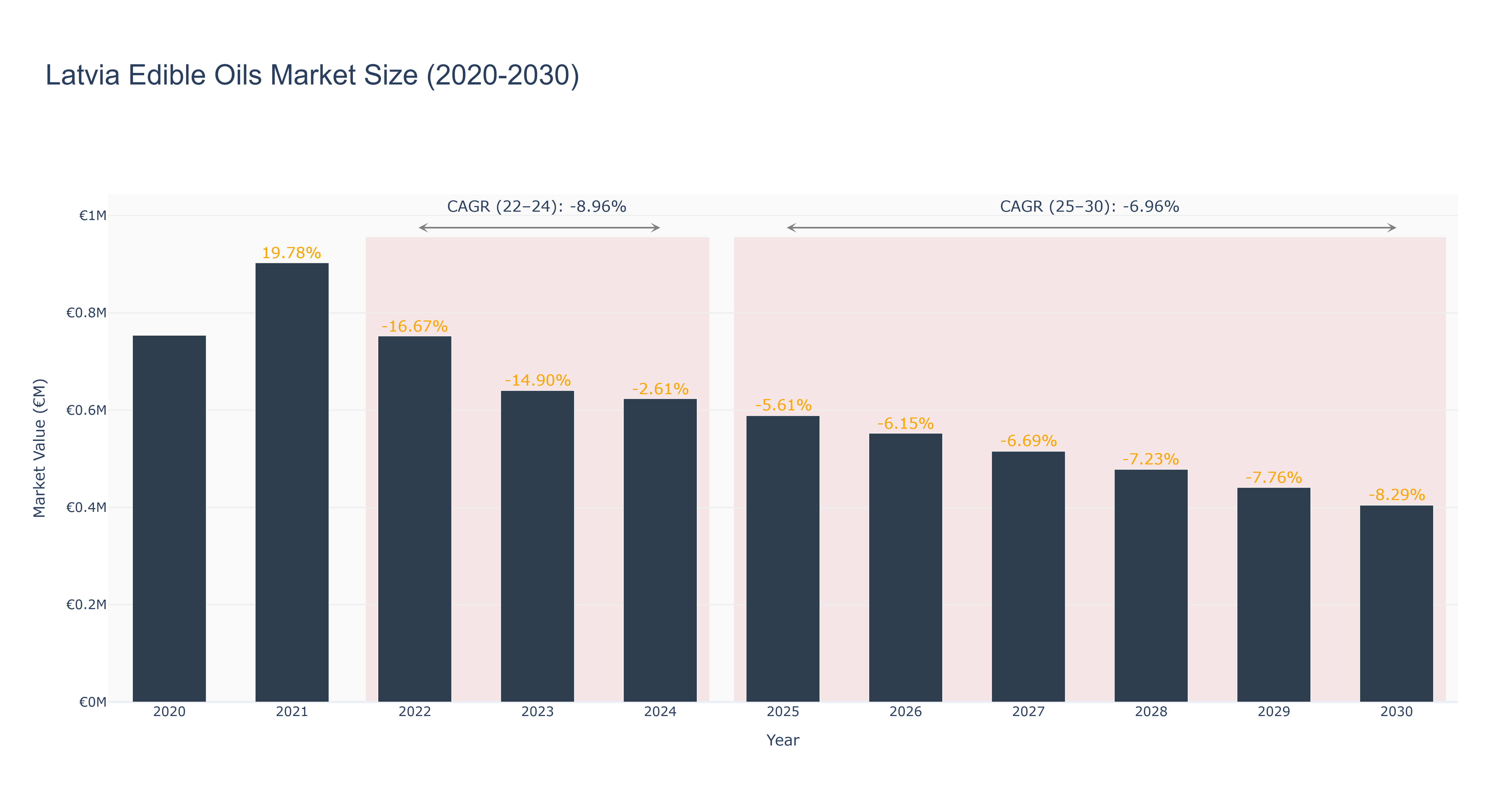
Latvia Edible Oils Market has seen a decline in market size from €0.75 million in 2020 to €0.62 million in 2024, with a negative growth trend. The market is forecasted to continue shrinking, with an expected size of €0.40 million by 2030. The CAGR for the period 2022-24 stands at -8.96%, while for 2025-30, it is projected at -6.96%. The downturn can be attributed to changing consumer preferences towards healthier alternatives and increased competition in the market. To counter this trend, industry players are focusing on product innovation and marketing strategies to retain market share. Looking ahead, the Latvia Edible Oils Market is expected to witness advancements in sustainable sourcing practices and technological innovations to meet evolving consumer demands for eco-friendly products.
Latvia Edible Oils Market: Production & Trade Performance (2019-2025)
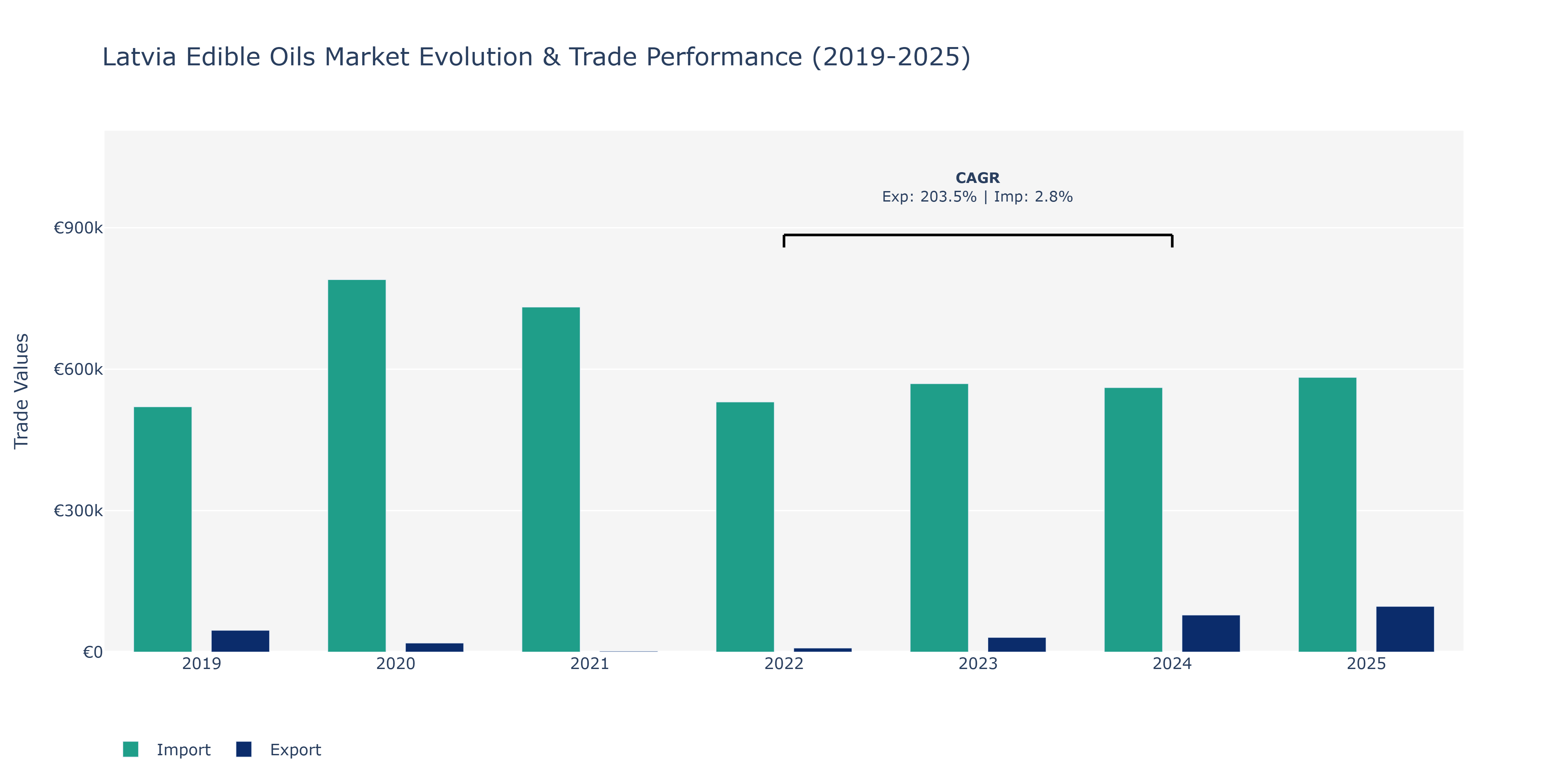
In the Latvia Edible Oils Market, exports experienced notable fluctuations over the years. Beginning at €46.08 thousand in 2019, the export value decreased sharply in 2020 to €19.09 thousand and further plummeted to €1.84 thousand in 2021 before rebounding in 2022 to €8.52 thousand. A substantial surge was witnessed in 2023, reaching €31.05 thousand, and peaking at €78.52 thousand in 2024. This significant growth could be attributed to increased demand for high-quality edible oils from foreign markets and improved production efficiency within the country. Conversely, imports demonstrated a more stable trend, starting at €520.3 thousand in 2019 and consistently decreasing to €561.02 thousand in 2024. The market's import dynamics may have been influenced by global price fluctuations of edible oils, trade agreements affecting import volumes, and shifts in consumer preferences towards domestically produced oils, aligning with the industry trend of promoting local products and sustainability practices.
Key Highlights of the Report:
- Latvia Edible Oils Market Outlook
- Market Size of Latvia Edible Oils Market, 2024
- Forecast of Latvia Edible Oils Market, 2031
- Historical Data and Forecast of Latvia Edible Oils Revenues & Volume for the Period 2021-2031
- Latvia Edible Oils Market Trend Evolution
- Latvia Edible Oils Market Drivers and Challenges
- Latvia Edible Oils Price Trends
- Latvia Edible Oils Porter`s Five Forces
- Latvia Edible Oils Industry Life Cycle
- Historical Data and Forecast of Latvia Edible Oils Market Revenues & Volume By Type for the Period 2021-2031
- Historical Data and Forecast of Latvia Edible Oils Market Revenues & Volume By Palm Oil for the Period 2021-2031
- Historical Data and Forecast of Latvia Edible Oils Market Revenues & Volume By Soybean Oil for the Period 2021-2031
- Historical Data and Forecast of Latvia Edible Oils Market Revenues & Volume By Sunflower Oil for the Period 2021-2031
- Historical Data and Forecast of Latvia Edible Oils Market Revenues & Volume By Rapeseed Oil for the Period 2021-2031
- Historical Data and Forecast of Latvia Edible Oils Market Revenues & Volume By Olive Oil for the Period 2021-2031
- Historical Data and Forecast of Latvia Edible Oils Market Revenues & Volume By Packaging Type for the Period 2021-2031
- Historical Data and Forecast of Latvia Edible Oils Market Revenues & Volume By Pouches for the Period 2021-2031
- Historical Data and Forecast of Latvia Edible Oils Market Revenues & Volume By Jars for the Period 2021-2031
- Historical Data and Forecast of Latvia Edible Oils Market Revenues & Volume By Cans for the Period 2021-2031
- Historical Data and Forecast of Latvia Edible Oils Market Revenues & Volume By Bottles for the Period 2021-2031
- Historical Data and Forecast of Latvia Edible Oils Market Revenues & Volume By End Use for the Period 2021-2031
- Historical Data and Forecast of Latvia Edible Oils Market Revenues & Volume By Domestic for the Period 2021-2031
- Historical Data and Forecast of Latvia Edible Oils Market Revenues & Volume By Food Service for the Period 2021-2031
- Historical Data and Forecast of Latvia Edible Oils Market Revenues & Volume By Industrial for the Period 2021-2031
- Latvia Edible Oils Import Export Trade Statistics
- Market Opportunity Assessment By Type
- Market Opportunity Assessment By Packaging Type
- Market Opportunity Assessment By End Use
- Latvia Edible Oils Top Companies Market Share
- Latvia Edible Oils Competitive Benchmarking By Technical and Operational Parameters
- Latvia Edible Oils Company Profiles
- Latvia Edible Oils Key Strategic Recommendations






































