Latvia Packaging Printing Market Top 5 Importing Countries and Market Competition (HHI) Analysis
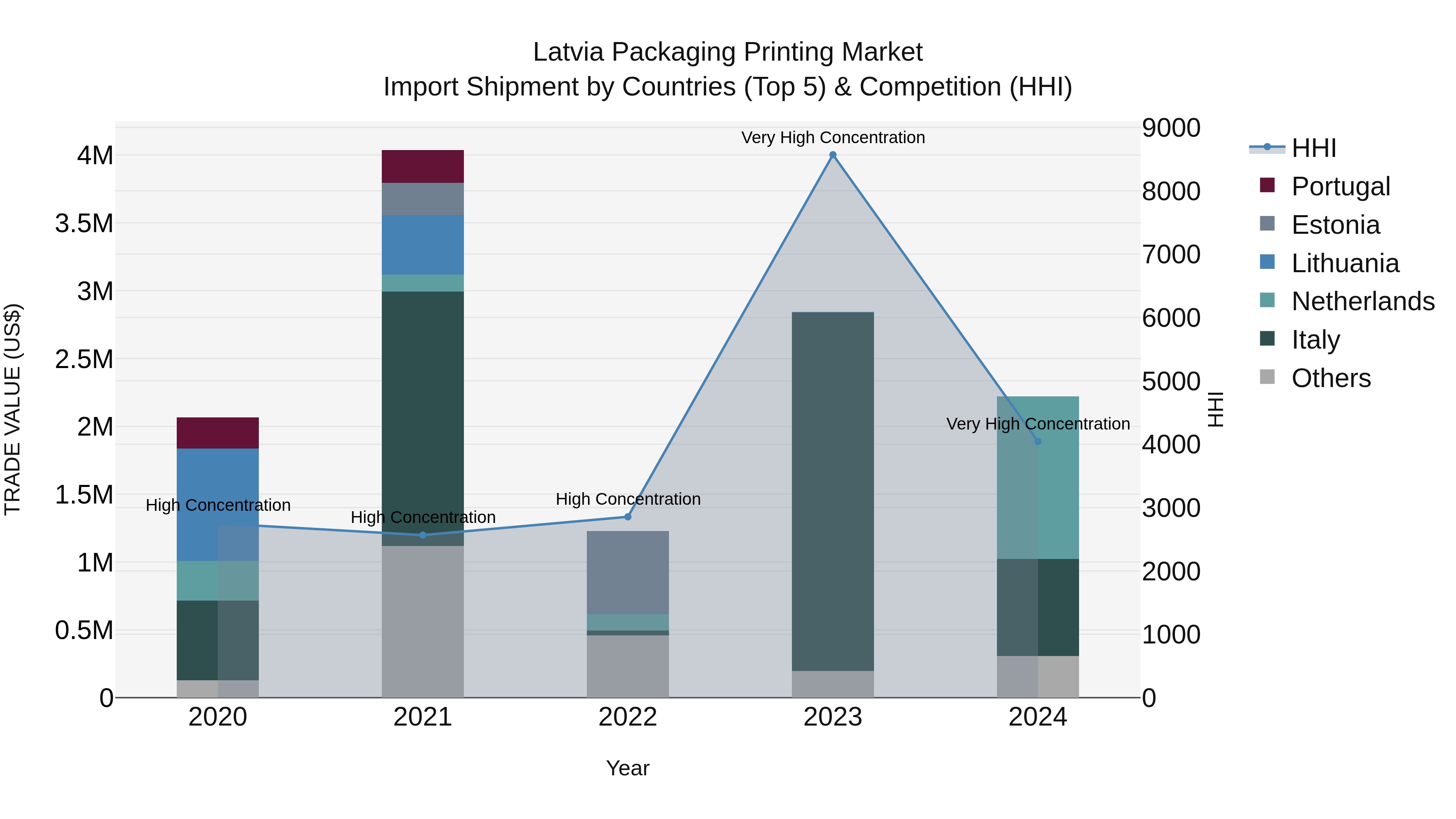
In 2024, Latvia continued to see significant import shipments of packaging printing, with top exporting countries including Netherlands, Italy, China, Poland, and Finland. The high Herfindahl-Hirschman Index (HHI) indicates a concentrated market. Despite a slight compound annual growth rate (CAGR) of 1.82% from 2020 to 2024, there was a notable decline in growth rate from 2023 to 2024 at -21.93%. This data suggests a dynamic landscape in the packaging printing import market in Latvia, influenced by both internal and external factors.
Latvia Packaging Printing Market Synopsis
The Latvia Packaging Printing Market is characterized by a growing demand for high-quality and innovative packaging solutions across various industries such as food and beverage, cosmetics, pharmaceuticals, and retail. The market is driven by factors like the increasing focus on sustainable packaging, stringent regulations regarding packaging materials, and the rise in e-commerce activities. Flexography, digital printing, and lithography are among the popular printing techniques used in the Latvian market. Key players in the industry are investing in advanced technology and materials to offer customized packaging solutions that meet the evolving needs of consumers. The market is expected to witness steady growth in the coming years, propelled by the growing awareness of environmental concerns and the importance of attractive packaging in brand promotion.
Latvia Packaging Printing Market Trends
The Latvia Packaging Printing Market is experiencing growth driven by factors such as increasing demand for sustainable packaging solutions, rising e-commerce activities, and advancements in printing technologies. Digital printing is gaining popularity due to its customization capabilities and shorter turnaround times, while flexographic printing remains a dominant technique for high-volume runs. Opportunities lie in catering to the growing demand for eco-friendly packaging materials, such as recyclable and biodegradable options, as well as offering innovative packaging designs to enhance product visibility and appeal. Collaboration with brands to provide value-added services like variable data printing for personalization can also help packaging printers differentiate themselves in the competitive market landscape. Overall, the Latvia Packaging Printing Market presents prospects for growth through technological innovation and sustainability initiatives.
Latvia Packaging Printing Market Challenges
In the Latvia Packaging Printing Market, some key challenges include increasing competition from foreign companies offering lower prices, fluctuating raw material costs impacting profit margins, and the need to invest in advanced printing technologies to meet evolving customer demands. Additionally, environmental concerns are driving the industry towards sustainable packaging solutions, requiring companies to adopt eco-friendly practices and materials which can be more expensive. Moreover, keeping up with rapidly changing design trends and consumer preferences poses a challenge for companies looking to stay competitive in the market. Overall, navigating these challenges requires companies in the Latvia Packaging Printing Market to innovate, streamline operations, and invest strategically in technology and sustainability measures to ensure long-term success.
Latvia Packaging Printing Market Investment Opportunities
The Latvia Packaging Printing Market is primarily driven by the increasing demand for eco-friendly packaging solutions, as consumers are becoming more environmentally conscious. Additionally, the growth of the e-commerce industry in Latvia is fueling the need for innovative packaging designs to enhance product visibility and protect goods during shipping. The rise of the food and beverage sector is also a significant driver, as companies seek attractive and informative packaging to stand out on store shelves. Furthermore, advancements in printing technology, such as digital printing and customization options, are playing a crucial role in driving the market by enabling cost-effective and high-quality packaging solutions for various industries in Latvia.
Latvia Packaging Printing Market Government Polices
Government policies in Latvia related to the Packaging Printing Market focus on promoting sustainability and environmental responsibility. The government has implemented regulations to reduce the use of non-biodegradable materials in packaging, encouraging the adoption of eco-friendly alternatives. Additionally, there are initiatives to support local packaging printing companies through grants and subsidies, aiming to boost domestic production and reduce reliance on imported packaging materials. The government also emphasizes the importance of meeting quality and safety standards in packaging printing to protect consumers and ensure product integrity. Overall, the policies in Latvia`s Packaging Printing Market align with global trends towards sustainable practices and aim to create a more environmentally conscious and competitive industry.
Latvia Packaging Printing Market Future Outlook
The future outlook for the Latvia Packaging Printing Market appears promising, driven by several key factors. The increasing demand for sustainable packaging solutions, coupled with advancements in printing technology, is expected to fuel market growth. Companies are likely to focus on innovative packaging designs and materials to differentiate their products in the competitive market landscape. Additionally, the rising e-commerce sector is anticipated to create opportunities for customized packaging solutions to enhance brand visibility and customer experience. With a growing emphasis on environmentally friendly practices, there is a shift towards eco-friendly packaging options, driving the adoption of digital printing techniques. Overall, the Latvia Packaging Printing Market is poised for expansion, supported by evolving consumer preferences and industry trends.
Key Highlights of the Report:
- Latvia Packaging Printing Market Outlook
- Market Size of Latvia Packaging Printing Market, 2024
- Forecast of Latvia Packaging Printing Market, 2031
- Historical Data and Forecast of Latvia Packaging Printing Revenues & Volume for the Period 2021- 2031
- Latvia Packaging Printing Market Trend Evolution
- Latvia Packaging Printing Market Drivers and Challenges
- Latvia Packaging Printing Price Trends
- Latvia Packaging Printing Porter's Five Forces
- Latvia Packaging Printing Industry Life Cycle
- Historical Data and Forecast of Latvia Packaging Printing Market Revenues & Volume By Printing for the Period 2021- 2031
- Historical Data and Forecast of Latvia Packaging Printing Market Revenues & Volume By Flexography for the Period 2021- 2031
- Historical Data and Forecast of Latvia Packaging Printing Market Revenues & Volume By Offset for the Period 2021- 2031
- Historical Data and Forecast of Latvia Packaging Printing Market Revenues & Volume By Digital for the Period 2021- 2031
- Historical Data and Forecast of Latvia Packaging Printing Market Revenues & Volume By Others for the Period 2021- 2031
- Historical Data and Forecast of Latvia Packaging Printing Market Revenues & Volume By Substrate for the Period 2021- 2031
- Historical Data and Forecast of Latvia Packaging Printing Market Revenues & Volume By Paper for the Period 2021- 2031
- Historical Data and Forecast of Latvia Packaging Printing Market Revenues & Volume By Plastic for the Period 2021- 2031
- Historical Data and Forecast of Latvia Packaging Printing Market Revenues & Volume By Fabric for the Period 2021- 2031
- Historical Data and Forecast of Latvia Packaging Printing Market Revenues & Volume By Others for the Period 2021- 2031
- Latvia Packaging Printing Import Export Trade Statistics
- Market Opportunity Assessment By Printing
- Market Opportunity Assessment By Substrate
- Latvia Packaging Printing Top Companies Market Share
- Latvia Packaging Printing Competitive Benchmarking By Technical and Operational Parameters
- Latvia Packaging Printing Company Profiles
- Latvia Packaging Printing Key Strategic Recommendations






































