Latvia Palmitic Acid Market Size (2020-2030)
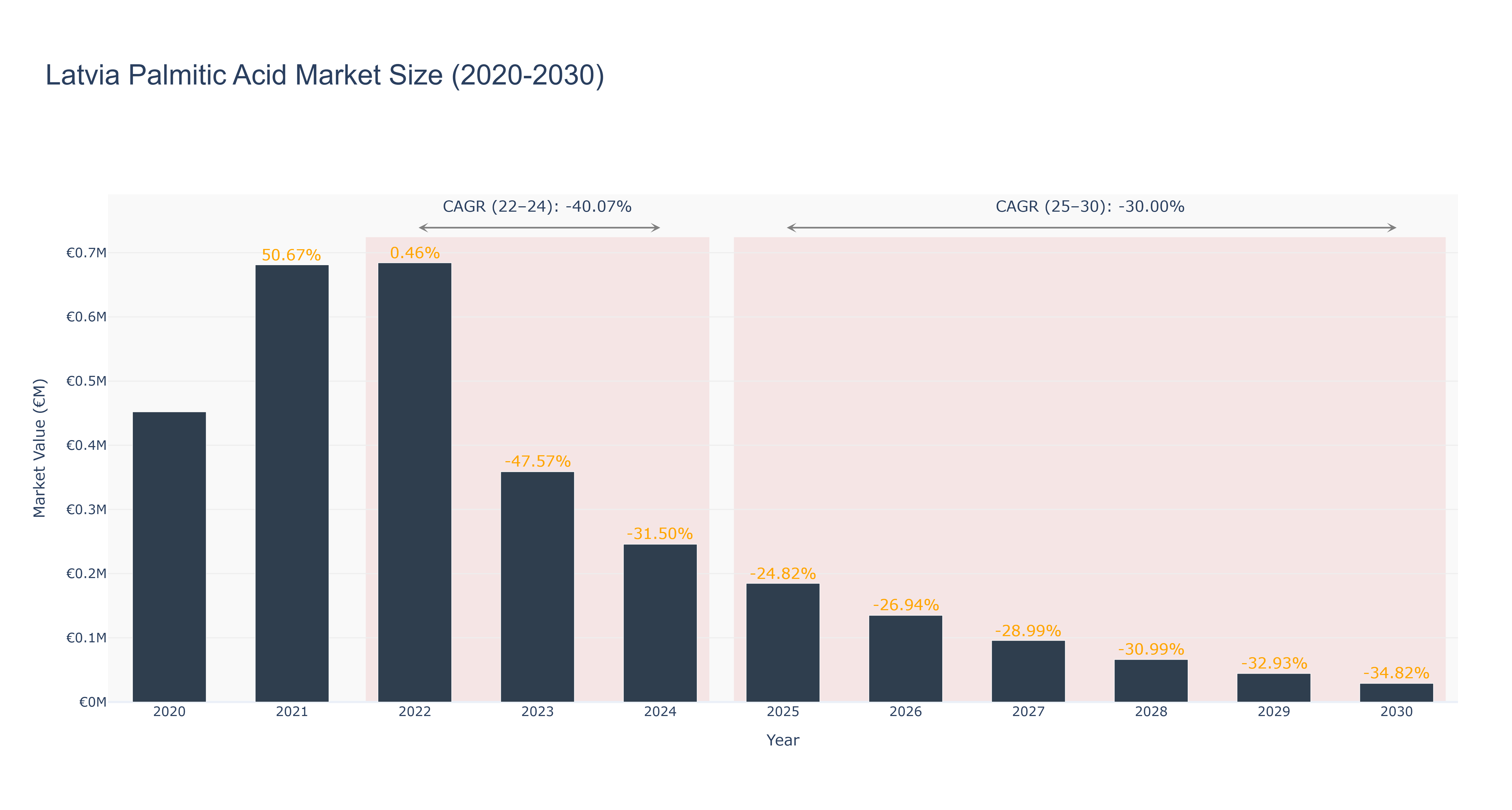
Latvia Palmitic Acid Market has experienced a decline in market size over the years, with the peak size of €0.68 million in 2021. The actual market size decreased to €0.25 million in 2024, reflecting a negative trend. The forecasted market size is expected to continue this downward trajectory, reaching €0.03 million by 2030. The CAGR from 2022 to 2024 was -40.07%, while the CAGR from 2025 to 2030 is projected at -30.0%. The market's decline can be attributed to factors such as changing consumer preferences towards alternative products and evolving regulatory landscapes. Despite the current challenges, upcoming investments in research and development initiatives aimed at enhancing product quality and sustainability could potentially revitalize the market in the near future.
Latvia Palmitic Acid Market: Production & Trade Performance (2019-2025)
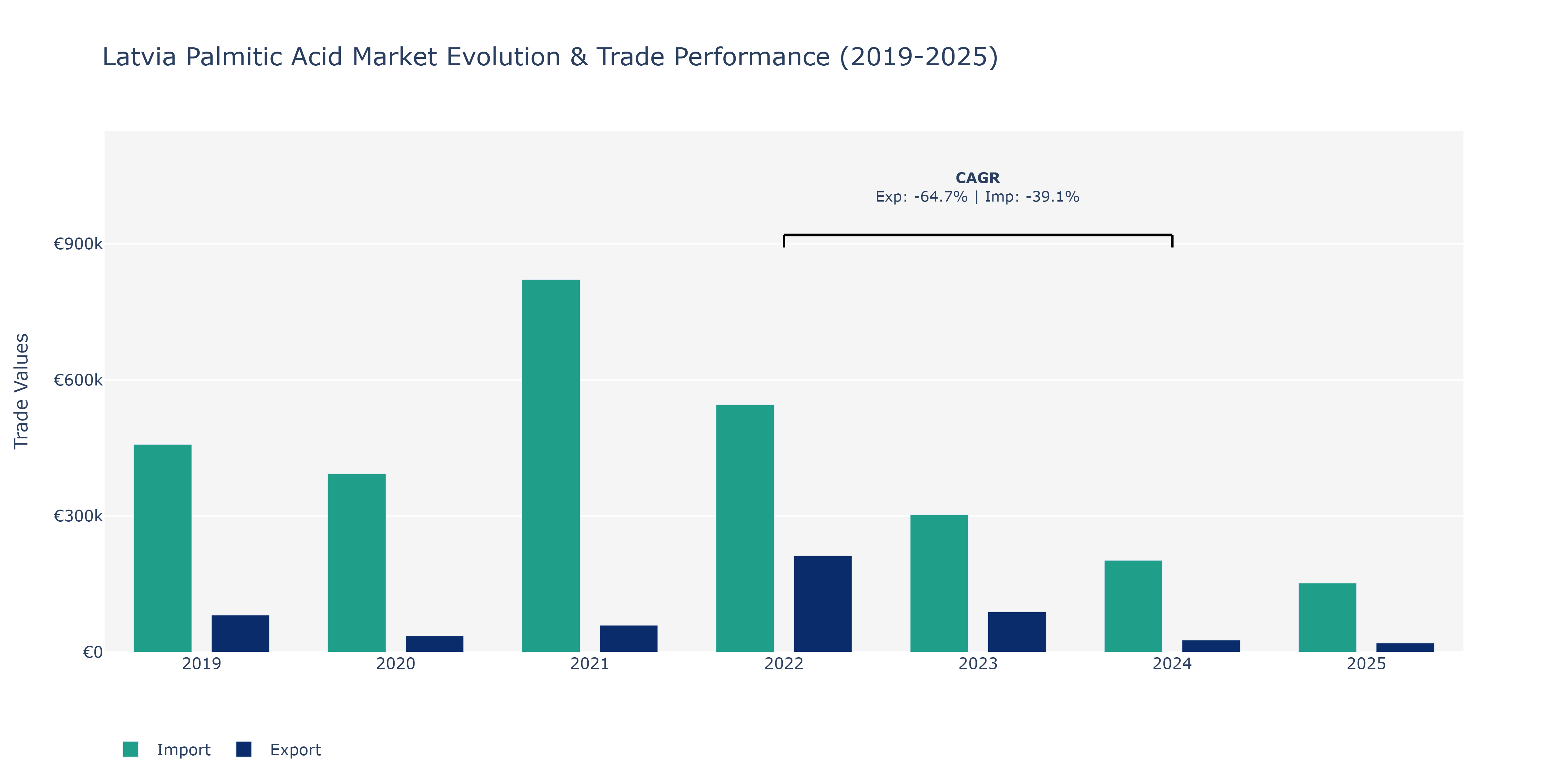
In the Latvia Palmitic Acid Market, exports experienced notable fluctuations over the observed period. Starting at €81.61 thousand in 2019, exports declined sharply to €35.38 thousand in 2020, showcasing a decrease of approximately 56.6%. However, a substantial recovery was witnessed in 2021 when exports surged to €59.32 thousand, representing an upturn of about 67.7%. The peak point for exports occurred in 2022, reaching €212.11 thousand, reflecting an impressive growth rate. Conversely, imports demonstrated a more consistent trend, starting at €457.94 thousand in 2019, decreasing to €392.93 thousand in 2020, and then gradually increasing to €821.12 thousand in 2021. Despite a slight decline in 2022 to €545.44 thousand, imports remained relatively stable compared to the volatile Export value. These fluctuations in exports can be attributed to shifts in global demand for palmitic acid products, influenced by factors such as changes in consumer preferences, regulatory developments impacting the industry, and fluctuations in raw material prices affecting production costs.
Key Highlights of the Report:
- Latvia Palmitic Acid Market Outlook
- Market Size of Latvia Palmitic Acid Market, 2025
- Forecast of Latvia Palmitic Acid Market, 2032
- Historical Data and Forecast of Latvia Palmitic Acid Revenues & Volume for the Period 2022 - 2032F
- Latvia Palmitic Acid Market Trend Evolution
- Latvia Palmitic Acid Market Drivers and Challenges
- Latvia Palmitic Acid Price Trends
- Latvia Palmitic Acid Porter`s Five Forces
- Latvia Palmitic Acid Industry Life Cycle
- Historical Data and Forecast of Latvia Palmitic Acid Market Revenues & Volume By Type for the Period 2022 - 2032F
- Historical Data and Forecast of Latvia Palmitic Acid Market Revenues & Volume By Distilled Type for the Period 2022 - 2032F
- Historical Data and Forecast of Latvia Palmitic Acid Market Revenues & Volume By Fractionated Type for the Period 2022 - 2032F
- Historical Data and Forecast of Latvia Palmitic Acid Market Revenues & Volume By Application for the Period 2022 - 2032F
- Historical Data and Forecast of Latvia Palmitic Acid Market Revenues & Volume By Soap & Detergent for the Period 2022 - 2032F
- Historical Data and Forecast of Latvia Palmitic Acid Market Revenues & Volume By Cosmetics for the Period 2022 - 2032F
- Historical Data and Forecast of Latvia Palmitic Acid Market Revenues & Volume By Grease & Lubricant for the Period 2022 - 2032F
- Historical Data and Forecast of Latvia Palmitic Acid Market Revenues & Volume By Others for the Period 2022 - 2032F
- Latvia Palmitic Acid Import Export Trade Statistics
- Market Opportunity Assessment By Type
- Market Opportunity Assessment By Application
- Latvia Palmitic Acid Top Companies Market Share
- Latvia Palmitic Acid Competitive Benchmarking By Technical and Operational Parameters
- Latvia Palmitic Acid Company Profiles
- Latvia Palmitic Acid Key Strategic Recommendations






































