Latvia Processed Food Market Top 5 Importing Countries and Market Competition (HHI) Analysis
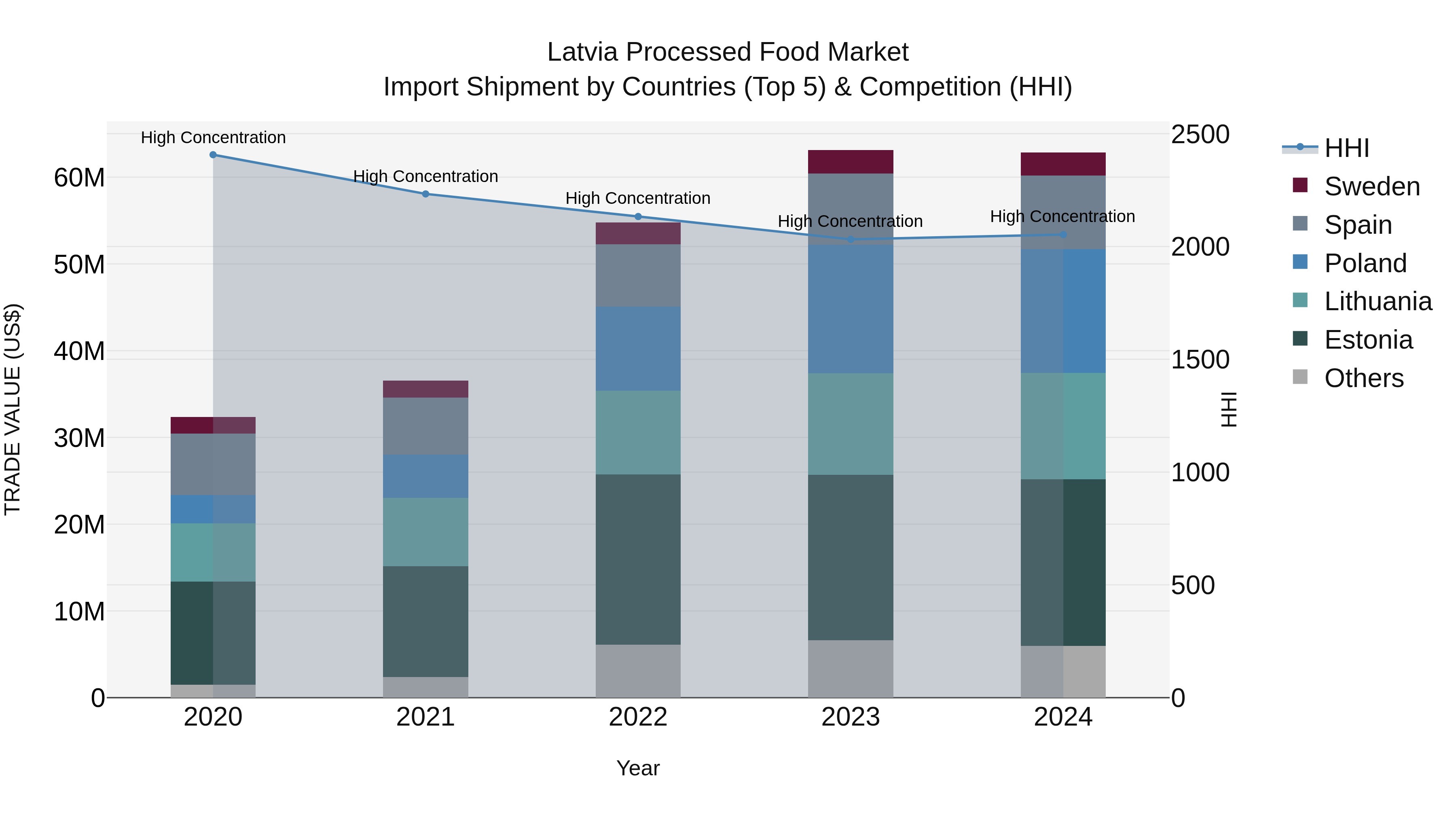
In 2024, Latvia continued to show strong reliance on processed food imports, with top exporters being Estonia, Poland, Lithuania, Spain, and Sweden. The high Herfindahl-Hirschman Index (HHI) indicates a concentrated market. Despite a notable Compound Annual Growth Rate (CAGR) of 18.07% from 2020 to 2024, there was a slight decline in growth rate from 2023 to 2024 at -0.44%. This data suggests a mature market with steady growth potential, as Latvia remains a key player in the processed food import sector within the region.
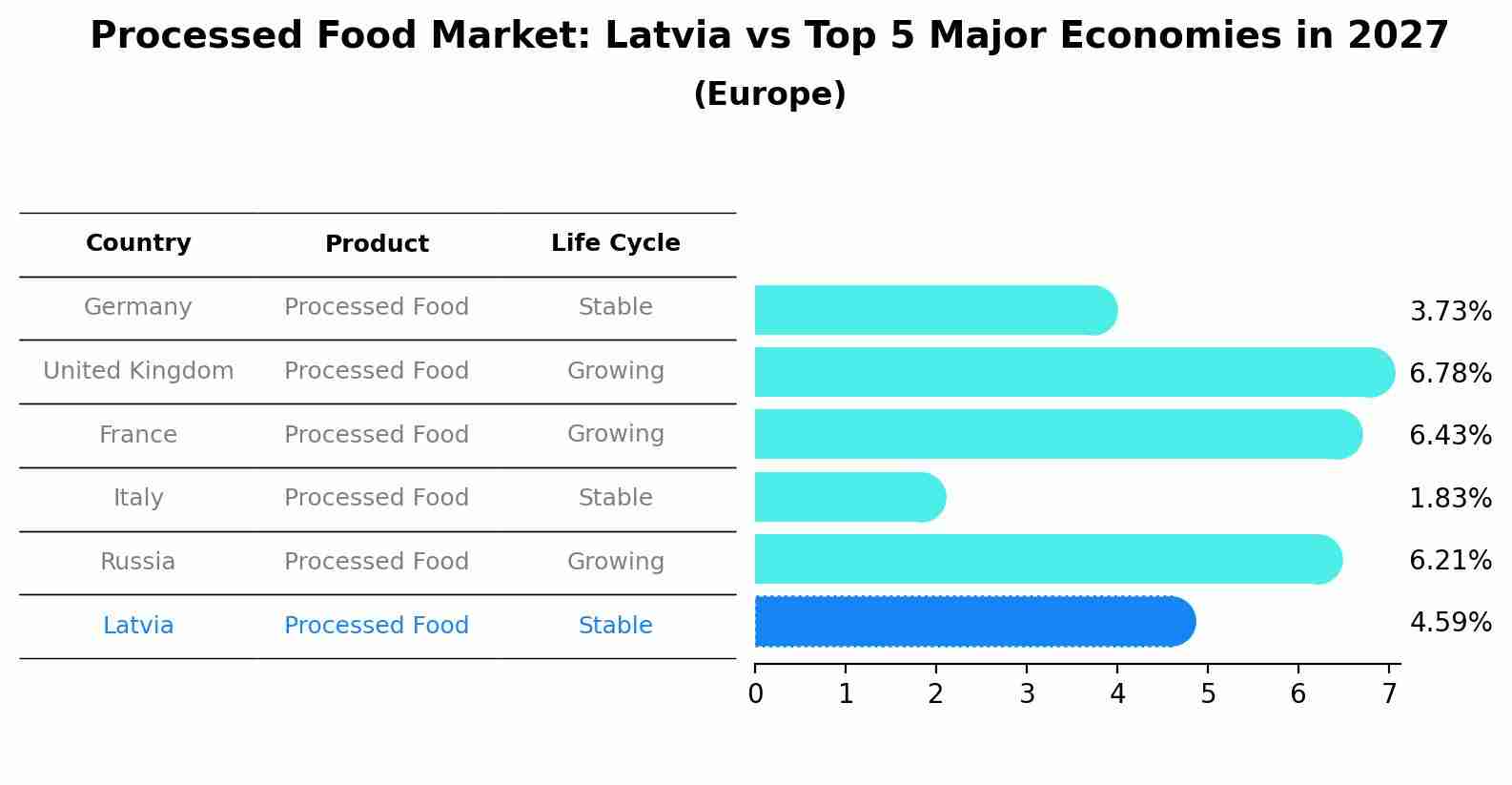
Processed Food Market: Latvia vs Top 5 Major Economies in 2027 (Europe)
By 2027, Latvia's Processed Food market is forecasted to achieve a stable growth rate of 4.59%, with Germany leading the Europe region, followed by United Kingdom, France, Italy and Russia.
Key Highlights of the Report:
- Latvia Processed Food Market Outlook
- Market Size of Latvia Processed Food Market, 2025
- Forecast of Latvia Processed Food Market, 2032
- Historical Data and Forecast of Latvia Processed Food Revenues & Volume for the Period 2022 - 2032F
- Latvia Processed Food Market Trend Evolution
- Latvia Processed Food Market Drivers and Challenges
- Latvia Processed Food Price Trends
- Latvia Processed Food Porter`s Five Forces
- Latvia Processed Food Industry Life Cycle
- Historical Data and Forecast of Latvia Processed Food Market Revenues & Volume By Process for the Period 2022 - 2032F
- Historical Data and Forecast of Latvia Processed Food Market Revenues & Volume By Minimally for the Period 2022 - 2032F
- Historical Data and Forecast of Latvia Processed Food Market Revenues & Volume By Highly for the Period 2022 - 2032F
- Historical Data and Forecast of Latvia Processed Food Market Revenues & Volume By Product type for the Period 2022 - 2032F
- Historical Data and Forecast of Latvia Processed Food Market Revenues & Volume By Plant based for the Period 2022 - 2032F
- Historical Data and Forecast of Latvia Processed Food Market Revenues & Volume By Fruits for the Period 2022 - 2032F
- Historical Data and Forecast of Latvia Processed Food Market Revenues & Volume By Vegetables for the Period 2022 - 2032F
- Historical Data and Forecast of Latvia Processed Food Market Revenues & Volume By Legumes for the Period 2022 - 2032F
- Historical Data and Forecast of Latvia Processed Food Market Revenues & Volume By Extracted foods for the Period 2022 - 2032F
- Historical Data and Forecast of Latvia Processed Food Market Revenues & Volume By Others for the Period 2022 - 2032F
- Historical Data and Forecast of Latvia Processed Food Market Revenues & Volume By Animal based for the Period 2022 - 2032F
- Historical Data and Forecast of Latvia Processed Food Market Revenues & Volume By Milk for the Period 2022 - 2032F
- Historical Data and Forecast of Latvia Processed Food Market Revenues & Volume By Application for the Period 2022 - 2032F
- Historical Data and Forecast of Latvia Processed Food Market Revenues & Volume By Baked foods for the Period 2022 - 2032F
- Historical Data and Forecast of Latvia Processed Food Market Revenues & Volume By Baby food for the Period 2022 - 2032F
- Historical Data and Forecast of Latvia Processed Food Market Revenues & Volume By Breakfast Cereal for the Period 2022 - 2032F
- Historical Data and Forecast of Latvia Processed Food Market Revenues & Volume By Biscuits for the Period 2022 - 2032F
- Historical Data and Forecast of Latvia Processed Food Market Revenues & Volume By Cheese for the Period 2022 - 2032F
- Historical Data and Forecast of Latvia Processed Food Market Revenues & Volume By Chocolate confectionary for the Period 2022 - 2032F
- Historical Data and Forecast of Latvia Processed Food Market Revenues & Volume By Ice creams for the Period 2022 - 2032F
- Historical Data and Forecast of Latvia Processed Food Market Revenues & Volume By Instant Noodles for the Period 2022 - 2032F
- Latvia Processed Food Import Export Trade Statistics
- Market Opportunity Assessment By Process
- Market Opportunity Assessment By Product type
- Market Opportunity Assessment By Application
- Latvia Processed Food Top Companies Market Share
- Latvia Processed Food Competitive Benchmarking By Technical and Operational Parameters
- Latvia Processed Food Company Profiles
- Latvia Processed Food Key Strategic Recommendations






































