Lithuania Blenders Market Size (2020-2030)
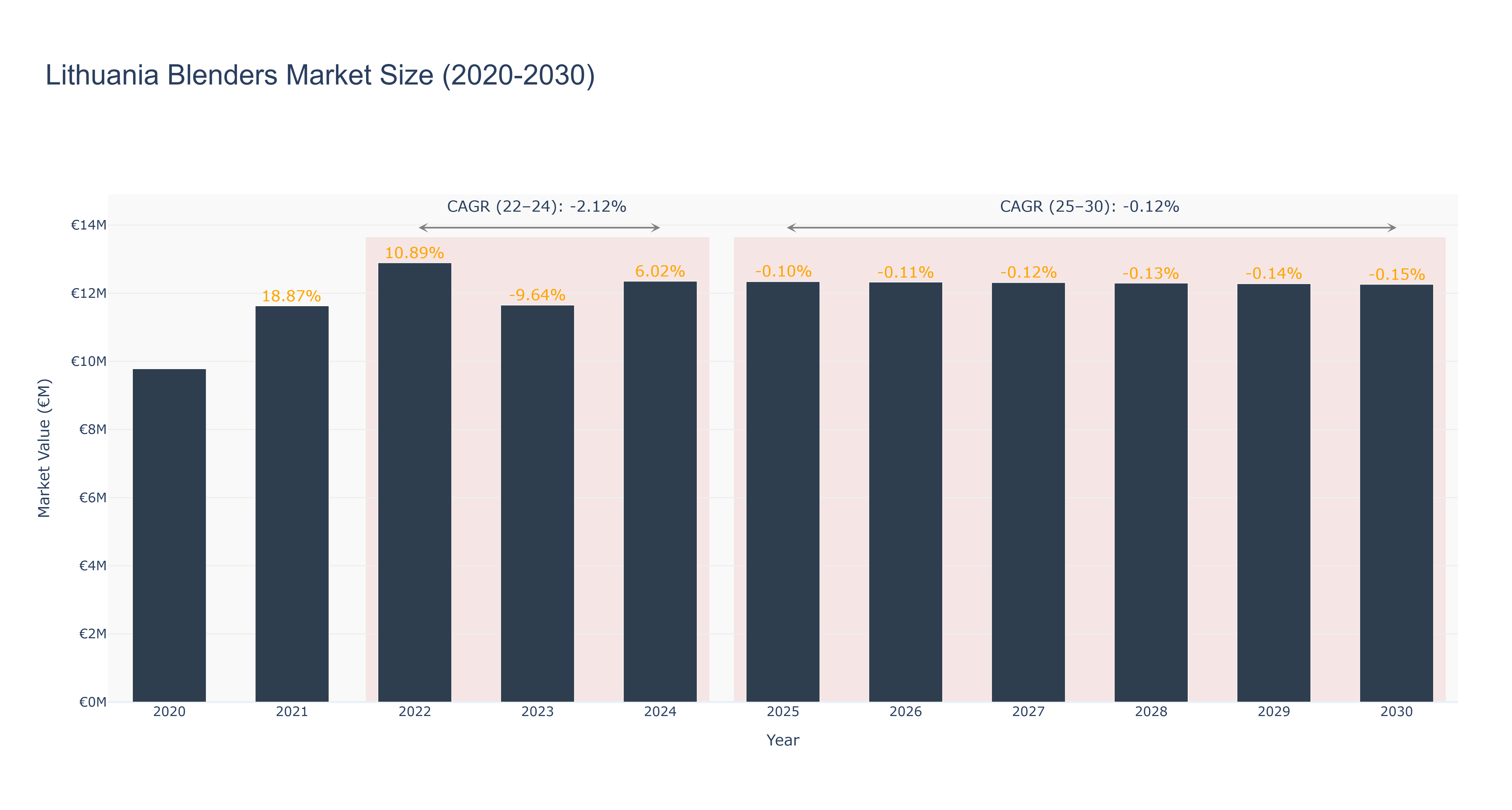
The Lithuania Blenders Market experienced a peak market size of €12.89 million in 2022, with a subsequent decline to €12.35 million in 2024. The forecasted trend shows a gradual decrease from €12.34 million in 2025 to €12.26 million in 2030, with a CAGR of -0.123% from 2025 to 2030. The market faced challenges post-2022 due to evolving consumer preferences and increased competition, leading to a slight contraction in size. Looking ahead, the market is expected to focus on innovation and product differentiation to regain momentum. Recent developments indicate a shift towards sustainable blending technologies and the introduction of smart blender models to cater to the growing demand for convenience and health-conscious products in the region. These initiatives are poised to drive growth and revitalize the market in the coming years.
Lithuania Blenders Market: Production & Trade Performance (2019-2025)
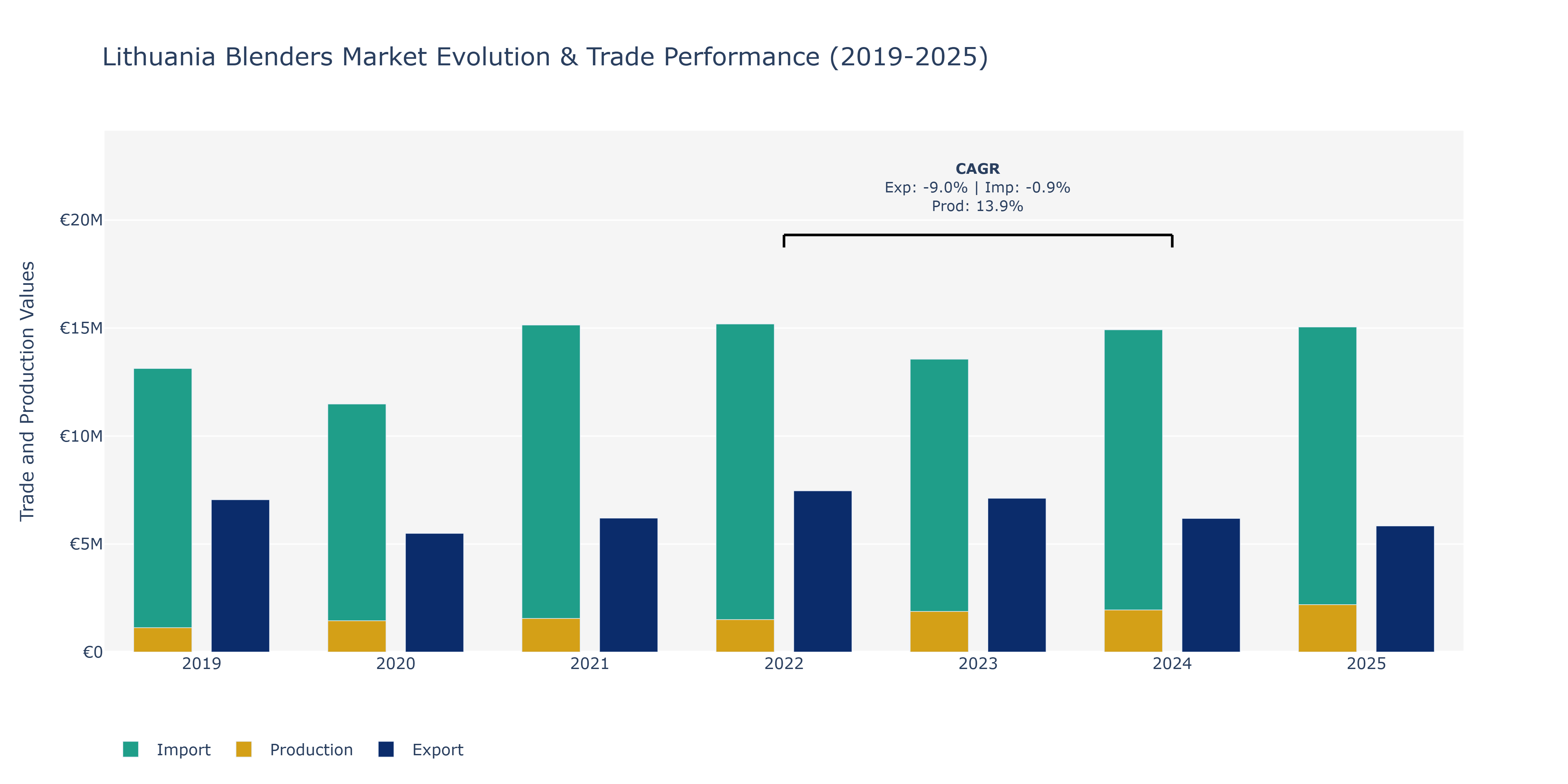
The Lithuania Blenders Market witnessed fluctuations in Exports, Imports, and Production from 2019 to 2025. Exports saw a peak in 2022 at €7.46 million, followed by a decline in subsequent years. Imports, on the other hand, showed a consistent increase, reaching €15.05 million in 2025. Production peaked in 2025 at €2.19 billion, showcasing a steady growth trend. The surge in Production could be attributed to advancements in blending technologies, leading to increased efficiency and output capacity. The decline in Exports post-2022 may be linked to changing global trade dynamics or intensified competition in the blender market. The upward trajectory of Imports suggests a growing demand for blended products in Lithuania, possibly fueled by evolving consumer preferences towards convenience and quality. These trends signify the evolving landscape of the blender market, necessitating market players to adapt strategies to remain competitive and meet changing consumer demands.
Key Highlights of the Report:
- Lithuania Blenders Market Outlook
- Market Size of Lithuania Blenders Market, 2025
- Forecast of Lithuania Blenders Market, 2032
- Historical Data and Forecast of Lithuania Blenders Revenues & Volume for the Period 2022 - 2032F
- Lithuania Blenders Market Trend Evolution
- Lithuania Blenders Market Drivers and Challenges
- Lithuania Blenders Price Trends
- Lithuania Blenders Porter`s Five Forces
- Lithuania Blenders Industry Life Cycle
- Historical Data and Forecast of Lithuania Blenders Market Revenues & Volume By Types for the Period 2022 - 2032F
- Historical Data and Forecast of Lithuania Blenders Market Revenues & Volume By Hand Blenders for the Period 2022 - 2032F
- Historical Data and Forecast of Lithuania Blenders Market Revenues & Volume By Single-Serve Blenders for the Period 2022 - 2032F
- Historical Data and Forecast of Lithuania Blenders Market Revenues & Volume By Full-Size Blenders for the Period 2022 - 2032F
- Historical Data and Forecast of Lithuania Blenders Market Revenues & Volume By Applications for the Period 2022 - 2032F
- Historical Data and Forecast of Lithuania Blenders Market Revenues & Volume By Commercial for the Period 2022 - 2032F
- Historical Data and Forecast of Lithuania Blenders Market Revenues & Volume By Household for the Period 2022 - 2032F
- Lithuania Blenders Import Export Trade Statistics
- Market Opportunity Assessment By Types
- Market Opportunity Assessment By Applications
- Lithuania Blenders Top Companies Market Share
- Lithuania Blenders Competitive Benchmarking By Technical and Operational Parameters
- Lithuania Blenders Company Profiles
- Lithuania Blenders Key Strategic Recommendations






































