Lithuania Chewing Gum Market Size (2020-2030)
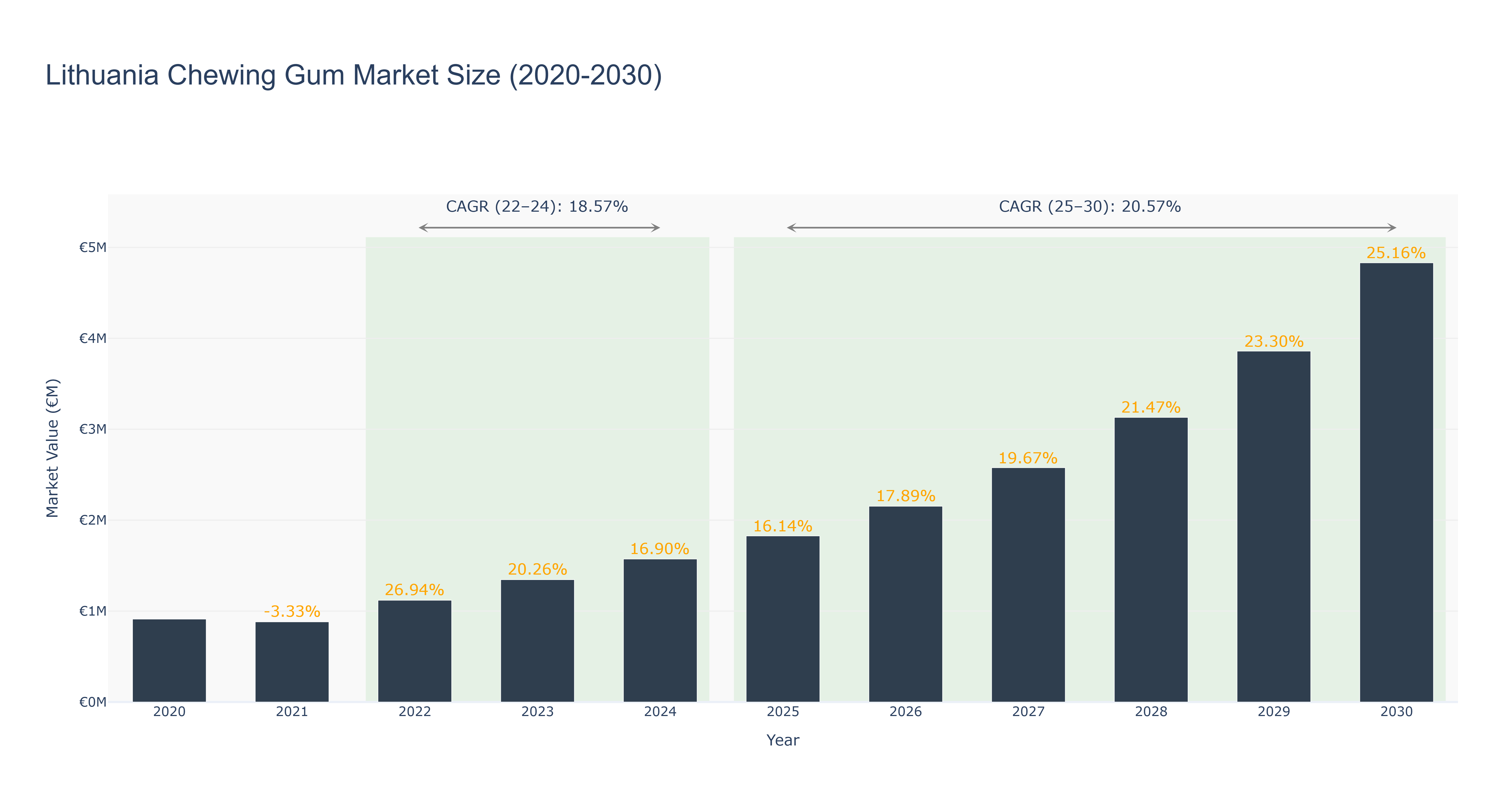
Lithuania Chewing Gum Market has shown a steady growth trajectory over the years. The market size increased from €0.91 million in 2020 to €4.83 million in 2030, with a notable spike in 2026 to €2.15 million. This growth is fueled by a strong CAGR of 18.57% from 2022 to 2024 and a projected CAGR of 20.57% from 2025 to 2030. The market's expansion can be attributed to increasing consumer demand for convenience snacks and the introduction of innovative gum flavors. Looking ahead, Lithuania is set to witness advancements in sustainable packaging for chewing gum products, aligning with the growing environmental consciousness among consumers. This market is poised for further growth as manufacturers focus on product diversification and sustainability initiatives to meet evolving consumer preferences.
Lithuania Chewing Gum Market: Production & Trade Performance (2019-2025)
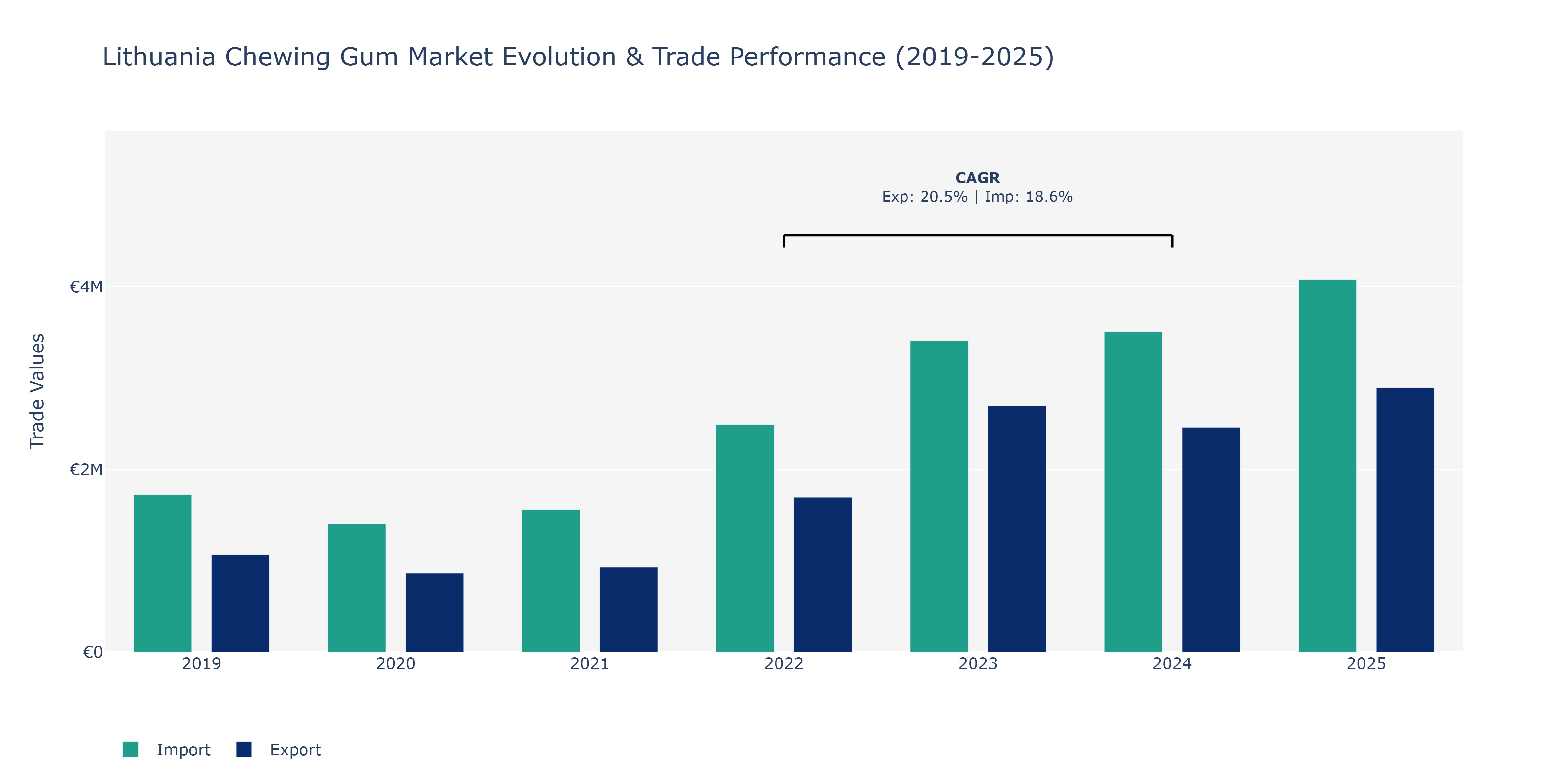
Between 2019 and 2025, Lithuania's Chewing Gum Market witnessed notable changes in both Exports and Imports. Exports started at €1.07 million in 2019, saw a decrease in 2020 to €865.07 thousand, before experiencing a substantial increase to €2.69 million in 2023 and slightly dropping to €2.46 million in 2024. By 2025, exports reached €2.9 million. In comparison, Imports began at €1.72 million in 2019, decreased to €1.4 million in 2020, and then surged to €4.08 million in 2025. The market's growth can be attributed to various factors such as increasing demand for chewing gum products, expansions in production capacities, and strategic marketing initiatives. The rise in imports could be due to the availability of a broader range of international chewing gum brands in the market, reflecting consumer preferences for diverse product offerings. These trends emphasize the market's responsiveness to consumer demands and the industry's ability to adapt to changing market conditions.
Key Highlights of the Report:
- Lithuania Chewing Gum Market Outlook
- Market Size of Lithuania Chewing Gum Market, 2025
- Forecast of Lithuania Chewing Gum Market, 2032
- Historical Data and Forecast of Lithuania Chewing Gum Revenues & Volume for the Period 2022 - 2032F
- Lithuania Chewing Gum Market Trend Evolution
- Lithuania Chewing Gum Market Drivers and Challenges
- Lithuania Chewing Gum Price Trends
- Lithuania Chewing Gum Porter`s Five Forces
- Lithuania Chewing Gum Industry Life Cycle
- Historical Data and Forecast of Lithuania Chewing Gum Market Revenues & Volume By Product Type for the Period 2022 - 2032F
- Historical Data and Forecast of Lithuania Chewing Gum Market Revenues & Volume By Sugared Chewing Gum for the Period 2022 - 2032F
- Historical Data and Forecast of Lithuania Chewing Gum Market Revenues & Volume By Sugar-free Chewing Gum for the Period 2022 - 2032F
- Historical Data and Forecast of Lithuania Chewing Gum Market Revenues & Volume By Distribution Channel for the Period 2022 - 2032F
- Historical Data and Forecast of Lithuania Chewing Gum Market Revenues & Volume By Supermarkets and Hypermarkets for the Period 2022 - 2032F
- Historical Data and Forecast of Lithuania Chewing Gum Market Revenues & Volume By Convenience Stores for the Period 2022 - 2032F
- Historical Data and Forecast of Lithuania Chewing Gum Market Revenues & Volume By Specialist Retailers for the Period 2022 - 2032F
- Historical Data and Forecast of Lithuania Chewing Gum Market Revenues & Volume By Online Retail for the Period 2022 - 2032F
- Historical Data and Forecast of Lithuania Chewing Gum Market Revenues & Volume By Others for the Period 2022 - 2032F
- Lithuania Chewing Gum Import Export Trade Statistics
- Market Opportunity Assessment By Product Type
- Market Opportunity Assessment By Distribution Channel
- Lithuania Chewing Gum Top Companies Market Share
- Lithuania Chewing Gum Competitive Benchmarking By Technical and Operational Parameters
- Lithuania Chewing Gum Company Profiles
- Lithuania Chewing Gum Key Strategic Recommendations






































