Lithuania Conductive Yarn Market Size (2020-2030)
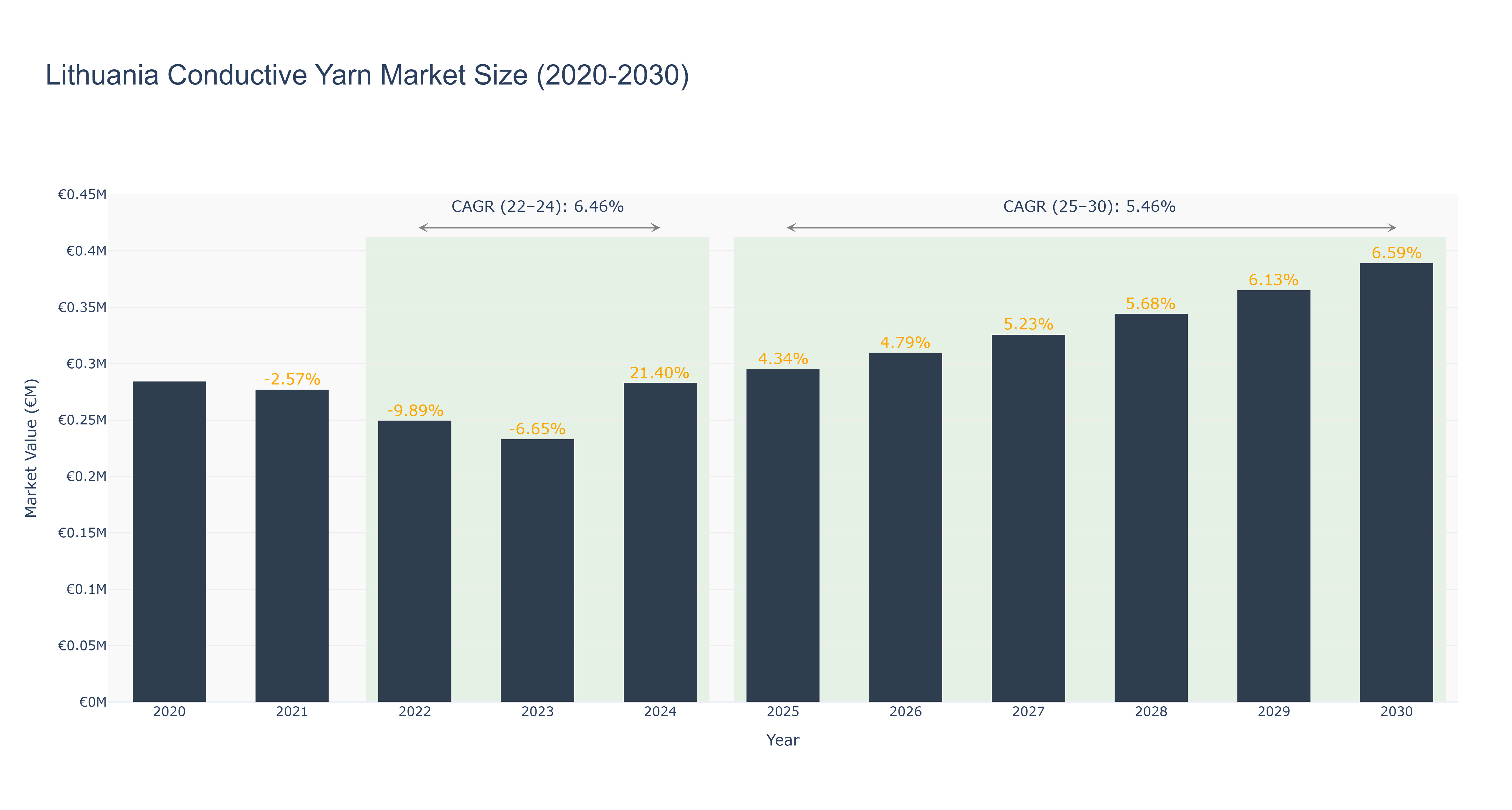
The Lithuania Conductive Yarn Market experienced a fluctuating trend in recent years. The peak market size of €0.39 million was reached in 2030, with a steady growth trajectory observed from 2020 to 2024, despite a slight dip in 2022. The market is forecasted to continue its growth from 2025 to 2030, with a Compound Annual Growth Rate (CAGR) of 5.46%. The market saw a significant increase in 2024, attributed to increased demand for conductive yarn in the textile industry. The recent development in Lithuania includes the initiation of a government-backed project to promote the use of conductive yarn in smart textiles, further boosting market growth. Looking ahead, the market is poised for sustained expansion driven by technological advancements and increasing applications in wearable technology and healthcare sectors.
Lithuania Conductive Yarn Market: Production & Trade Performance (2019-2025)
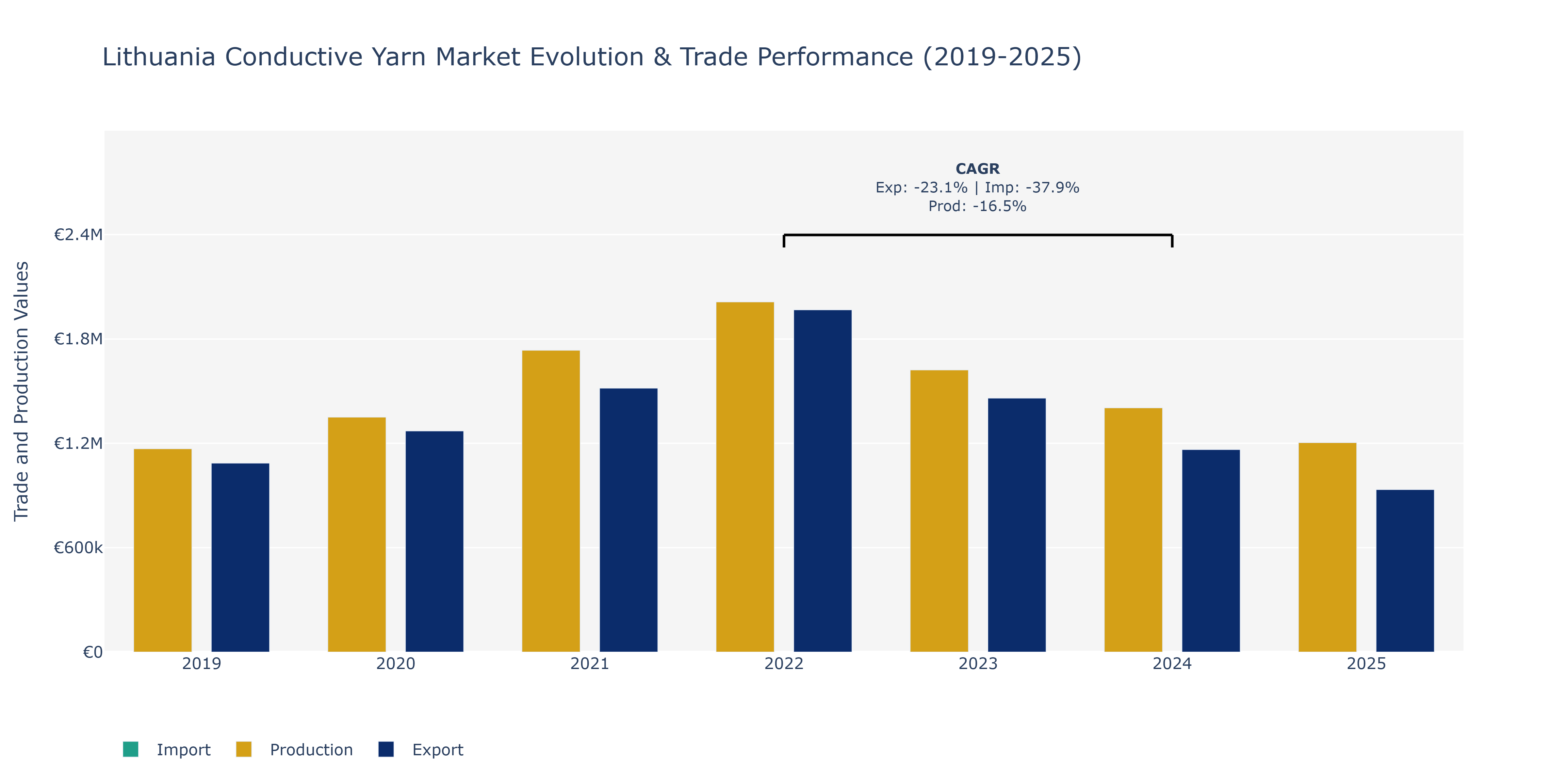
In the Lithuania Conductive Yarn Market, exports demonstrated a fluctuating pattern over the observed years. Starting at €1.09 million in 2019, exports peaked in 2021 at €1.52 million before experiencing a significant decline to €933.79 thousand in 2025. This downward trend could be attributed to fluctuations in global demand for specialized yarn products, especially during economic uncertainties. Conversely, imports showcased a more consistent trajectory, with a gradual decrease from €193.08 thousand in 2019 to €37.18 thousand in 2025. Such a decline may indicate a shift towards domestic production or alternative sourcing strategies within the market. Production levels followed a similar pattern, peaking in 2022 at €1.97 million before decreasing to €1.20 million in 2025. This decline could be a result of market saturation or technological advancements leading to more efficient production processes. These trends highlight the market's sensitivity to global economic conditions and the importance of strategic planning to mitigate risks and capitalize on opportunities in the conductive yarn industry.
Key Highlights of the Report:
- Lithuania Conductive Yarn Market Outlook
- Market Size of Lithuania Conductive Yarn Market, 2025
- Forecast of Lithuania Conductive Yarn Market, 2032
- Historical Data and Forecast of Lithuania Conductive Yarn Revenues & Volume for the Period 2022 - 2032F
- Lithuania Conductive Yarn Market Trend Evolution
- Lithuania Conductive Yarn Market Drivers and Challenges
- Lithuania Conductive Yarn Price Trends
- Lithuania Conductive Yarn Porter`s Five Forces
- Lithuania Conductive Yarn Industry Life Cycle
- Historical Data and Forecast of Lithuania Conductive Yarn Market Revenues & Volume By ProductType for the Period 2022 - 2032F
- Historical Data and Forecast of Lithuania Conductive Yarn Market Revenues & Volume By Metallic Type for the Period 2022 - 2032F
- Historical Data and Forecast of Lithuania Conductive Yarn Market Revenues & Volume By Carbon-Based Type for the Period 2022 - 2032F
- Historical Data and Forecast of Lithuania Conductive Yarn Market Revenues & Volume By Metal Compound Type for the Period 2022 - 2032F
- Historical Data and Forecast of Lithuania Conductive Yarn Market Revenues & Volume By Application for the Period 2022 - 2032F
- Historical Data and Forecast of Lithuania Conductive Yarn Market Revenues & Volume By Anti-Static Fabric for the Period 2022 - 2032F
- Historical Data and Forecast of Lithuania Conductive Yarn Market Revenues & Volume By Signal Transmission for the Period 2022 - 2032F
- Historical Data and Forecast of Lithuania Conductive Yarn Market Revenues & Volume By Cellphone Protective Cover for the Period 2022 - 2032F
- Lithuania Conductive Yarn Import Export Trade Statistics
- Market Opportunity Assessment By ProductType
- Market Opportunity Assessment By Application
- Lithuania Conductive Yarn Top Companies Market Share
- Lithuania Conductive Yarn Competitive Benchmarking By Technical and Operational Parameters
- Lithuania Conductive Yarn Company Profiles
- Lithuania Conductive Yarn Key Strategic Recommendations






































