Lithuania Natural Vanillin Market Size (2020-2030)
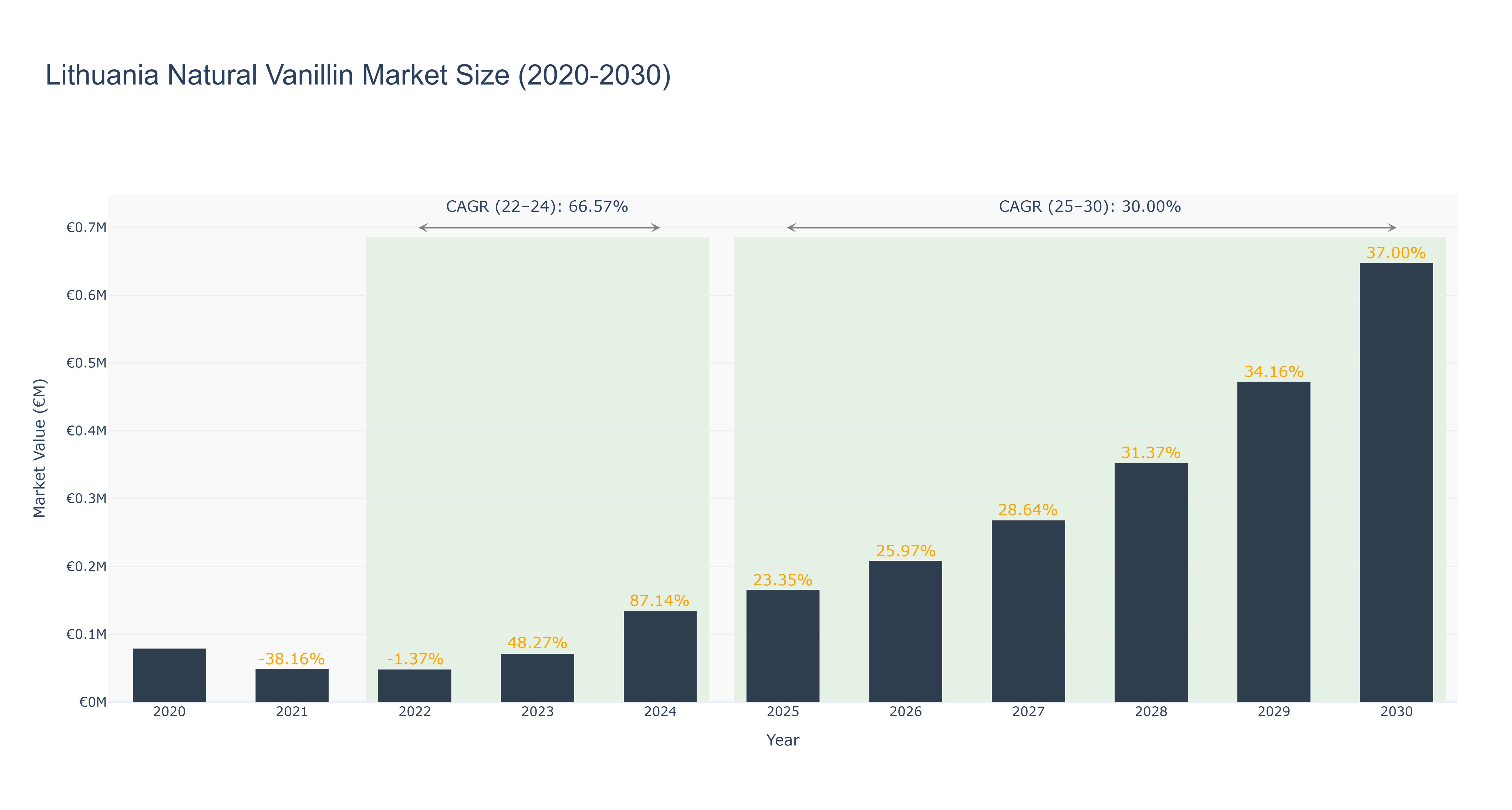
The Lithuania Natural Vanillin Market witnessed a notable growth trajectory, with its peak market size of €0.65 million in 2030. From 2020 to 2024, the market size showed a steady increase, reaching €0.13 million in 2024. Forecasted data from 2025 to 2030 indicates a continued growth trend, with an expected market size of €0.47 million in 2029. The CAGR for the period 2022-24 was 66.57%, reflecting a rapid expansion phase, while the CAGR for 2025-30 is projected at 30.0%. Industry drivers such as increasing consumer demand for natural ingredients and the rising popularity of vanillin in food and beverage applications have been key factors contributing to this growth. Looking ahead, Lithuania is set to witness advancements in sustainable sourcing practices for natural vanillin, aligning with the market's focus on quality and eco-friendly products.
Lithuania Natural Vanillin Market: Production & Trade Performance (2019-2025)
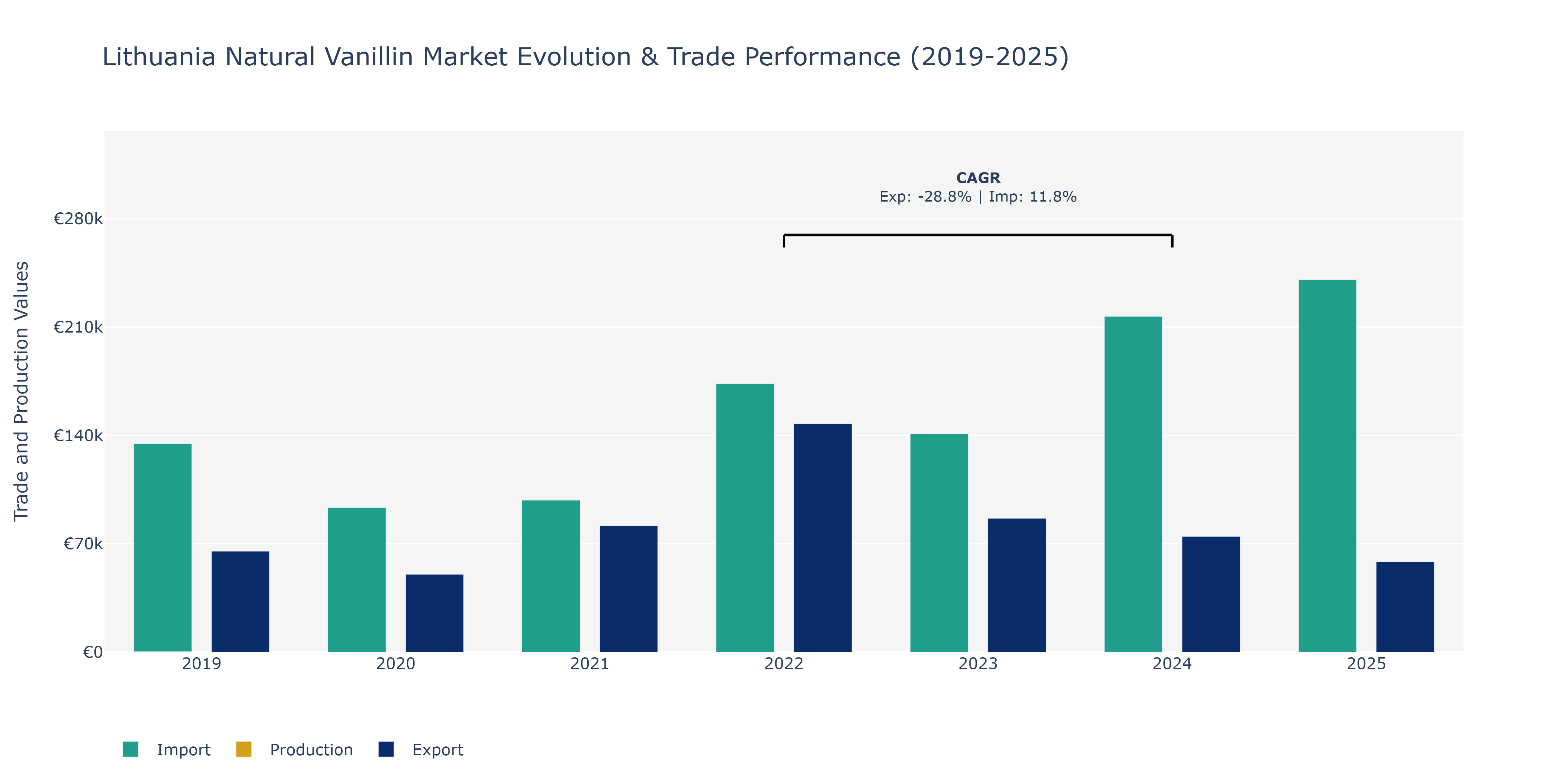
In the Lithuania Natural Vanillin Market, from 2019 to 2025, exports experienced fluctuations. Starting at €65.19 thousand in 2019, there was a decline in 2020 to €50.3 thousand, followed by a significant increase in 2021 to €81.62 thousand. The peak was observed in 2022 at €147.57 thousand, followed by a decrease in 2023 to €86.45 thousand and a further decline to €74.79 thousand in 2024, and €58.26 thousand in 2025. On the other hand, imports showed a consistent upward trend, starting at €134.73 thousand in 2019, reaching €240.62 thousand in 2025. Production remained relatively stable throughout the years, standing at €0.18 million in 2019. The fluctuations in exports can be attributed to changes in demand and supply dynamics, global market conditions, and competition from synthetic vanillin sources. The upward trajectory in imports indicates a growing demand for natural vanillin in Lithuania, potentially driven by consumer preference for natural ingredients and the expanding food and beverage industry in the region.
Key Highlights of the Report:
- Lithuania Natural Vanillin Market Outlook
- Market Size of Lithuania Natural Vanillin Market, 2025
- Forecast of Lithuania Natural Vanillin Market, 2032
- Historical Data and Forecast of Lithuania Natural Vanillin Revenues & Volume for the Period 2022 - 2032F
- Lithuania Natural Vanillin Market Trend Evolution
- Lithuania Natural Vanillin Market Drivers and Challenges
- Lithuania Natural Vanillin Price Trends
- Lithuania Natural Vanillin Porter`s Five Forces
- Lithuania Natural Vanillin Industry Life Cycle
- Historical Data and Forecast of Lithuania Natural Vanillin Market Revenues & Volume By Source for the Period 2022 - 2032F
- Historical Data and Forecast of Lithuania Natural Vanillin Market Revenues & Volume By Vanilla Bean Extract for the Period 2022 - 2032F
- Historical Data and Forecast of Lithuania Natural Vanillin Market Revenues & Volume By Ferulic Acid Synthesis for the Period 2022 - 2032F
- Historical Data and Forecast of Lithuania Natural Vanillin Market Revenues & Volume By Eugenol Synthesis for the Period 2022 - 2032F
- Historical Data and Forecast of Lithuania Natural Vanillin Market Revenues & Volume By Application for the Period 2022 - 2032F
- Historical Data and Forecast of Lithuania Natural Vanillin Market Revenues & Volume By Food & Beverages for the Period 2022 - 2032F
- Historical Data and Forecast of Lithuania Natural Vanillin Market Revenues & Volume By Pharmaceuticals for the Period 2022 - 2032F
- Historical Data and Forecast of Lithuania Natural Vanillin Market Revenues & Volume By Cosmetics & Personal Care for the Period 2022 - 2032F
- Lithuania Natural Vanillin Import Export Trade Statistics
- Market Opportunity Assessment By Source
- Market Opportunity Assessment By Application
- Lithuania Natural Vanillin Top Companies Market Share
- Lithuania Natural Vanillin Competitive Benchmarking By Technical and Operational Parameters
- Lithuania Natural Vanillin Company Profiles
- Lithuania Natural Vanillin Key Strategic Recommendations






































