Lithuania Oscillator Market Top 5 Importing Countries and Market Competition (HHI) Analysis
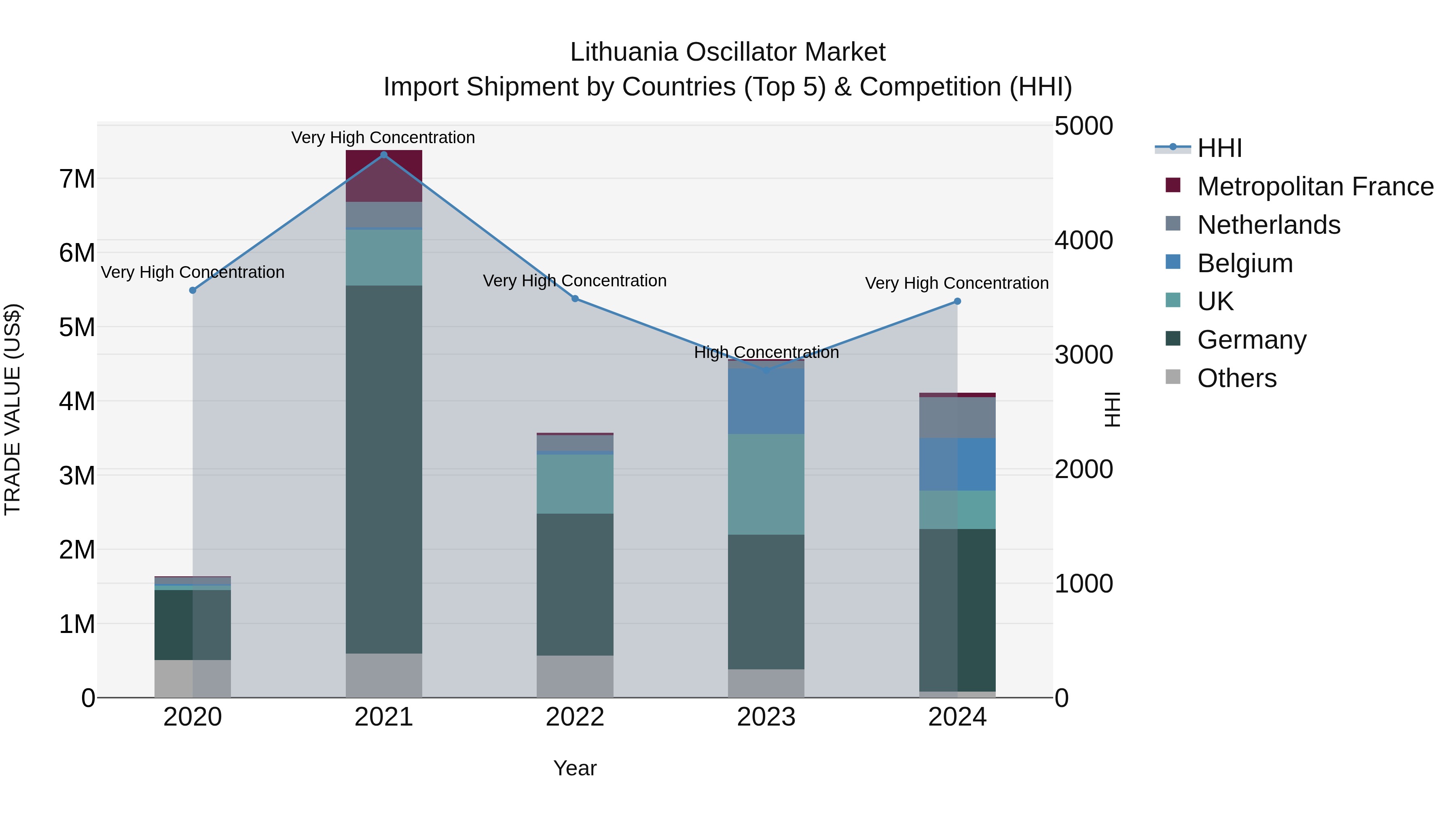
The Lithuania oscillator import market continues to show strong growth, with a notable CAGR of 25.92% from 2020 to 2024. However, there was a slight decline in growth rate from 2023 to 2024, indicating some market challenges. The top countries exporting to Lithuania, including Germany, Belgium, Netherlands, UK, and Metropolitan France, play a significant role in supplying oscillators to meet the country`s demand. The market concentration, as measured by the HHI, has increased from high to very high in 2024, suggesting a more consolidated market landscape with potentially fewer competitors dominating the market.
Lithuania Oscillator Market Overview
The Lithuania oscillator market is experiencing steady growth driven by increasing demand across various industries such as electronics, telecommunications, and automotive. Oscillators play a crucial role in generating precise and stable frequencies in electronic devices, making them essential components in modern technology. The market is characterized by a range of oscillator types including quartz, MEMS, and SAW oscillators, each catering to specific application requirements. The growing adoption of advanced technologies like 5G networks, IoT devices, and autonomous vehicles is further fueling the demand for oscillators in Lithuania. Key market players in the country are focusing on product innovations, partnerships, and strategic collaborations to enhance their market presence and cater to the evolving needs of customers in this dynamic market landscape.
Lithuania Oscillator Market Trends and Opportunities
The Lithuania Oscillator Market is experiencing significant growth and opportunities due to the increasing demand for precision timing and frequency control in various industries such as telecommunications, automotive, and healthcare. The market is seeing a shift towards compact and energy-efficient oscillators with improved performance characteristics to meet the evolving technological requirements. Additionally, the emergence of advanced technologies such as MEMS oscillators and the adoption of wireless communication systems are driving market growth. Opportunities exist for companies to innovate and develop customized solutions for specific applications, as well as to expand their product portfolios to cater to the growing demand for oscillators in emerging sectors like IoT and smart devices. Overall, the Lithuania Oscillator Market is poised for expansion and offers prospects for companies to capitalize on the evolving market dynamics.
Lithuania Oscillator Market Challenges
In the Lithuania Oscillator Market, several challenges are faced, including increasing competition from international players offering lower-priced products, fluctuating raw material prices affecting production costs, and a relatively small domestic market size leading to limited growth opportunities. Additionally, rapid technological advancements and changing consumer preferences create the need for constant innovation and product development to stay competitive. Furthermore, compliance with stringent regulations and standards, such as those related to product quality and safety, adds complexity to market entry and operations. Overall, navigating these challenges requires companies in the Lithuania Oscillator Market to focus on cost efficiency, market differentiation, and strategic partnerships to sustain growth and profitability in a competitive environment.
Lithuania Oscillator Market Drivers
The Lithuania Oscillator Market is primarily driven by the increasing demand for advanced electronic devices across various industries such as telecommunications, automotive, healthcare, and aerospace. The growing need for precise and stable frequency signals in electronic equipment for applications like communication systems, radars, and instrumentation is fueling the market growth. Additionally, the rising adoption of wireless technologies, IoT devices, and smart wearables is boosting the demand for oscillators in Lithuania. Technological advancements leading to the development of compact, energy-efficient, and high-frequency oscillators are also driving market growth. Furthermore, government initiatives to support the electronics industry and the expanding manufacturing sector in Lithuania are contributing to the increasing demand for oscillators in the country.
Lithuania Oscillator Market Government Policies
The Lithuania Oscillator Market is subject to government policies that aim to regulate the production, distribution, and use of oscillators in the country. These policies include technical standards and certifications that manufacturers must adhere to when producing oscillators to ensure quality and safety. Additionally, there may be import/export regulations governing the trade of oscillators across borders. The government may also provide incentives or support for research and development in the oscillator industry to promote innovation and competitiveness. Overall, the government`s policies in Lithuania regarding the oscillator market are geared towards fostering a thriving and compliant industry that contributes to the country`s economic growth and technological advancement.
Lithuania Oscillator Market Future Outlook
The Lithuania Oscillator Market is expected to experience steady growth in the coming years due to increasing demand for oscillators in various industries such as telecommunications, automotive, and consumer electronics. The market is likely to be driven by advancements in technology, leading to the development of more precise and efficient oscillators. Additionally, the growing adoption of IoT devices and the expansion of 5G networks are anticipated to further boost the demand for oscillators in Lithuania. However, factors such as fluctuating raw material prices and competition from alternative technologies may pose challenges to market growth. Overall, the Lithuania Oscillator Market is poised for expansion, with opportunities for innovation and strategic partnerships to drive market players` success.
Key Highlights of the Report:
- Lithuania Oscillator Market Outlook
- Market Size of Lithuania Oscillator Market, 2024
- Forecast of Lithuania Oscillator Market, 2031
- Historical Data and Forecast of Lithuania Oscillator Revenues & Volume for the Period 2021- 2031
- Lithuania Oscillator Market Trend Evolution
- Lithuania Oscillator Market Drivers and Challenges
- Lithuania Oscillator Price Trends
- Lithuania Oscillator Porter's Five Forces
- Lithuania Oscillator Industry Life Cycle
- Historical Data and Forecast of Lithuania Oscillator Market Revenues & Volume By Type for the Period 2021- 2031
- Historical Data and Forecast of Lithuania Oscillator Market Revenues & Volume By Temperature Compensated Crystal Oscillator (TCXO) for the Period 2021- 2031
- Historical Data and Forecast of Lithuania Oscillator Market Revenues & Volume By Voltage-controlled Crystal Oscillator (VCXO) for the Period 2021- 2031
- Historical Data and Forecast of Lithuania Oscillator Market Revenues & Volume By Oven-controlled Crystal Oscillator (OCXO) for the Period 2021- 2031
- Historical Data and Forecast of Lithuania Oscillator Market Revenues & Volume By MEMS Oscillators for the Period 2021- 2031
- Historical Data and Forecast of Lithuania Oscillator Market Revenues & Volume By Mounting Type for the Period 2021- 2031
- Historical Data and Forecast of Lithuania Oscillator Market Revenues & Volume By Surface Mount for the Period 2021- 2031
- Historical Data and Forecast of Lithuania Oscillator Market Revenues & Volume By Thru-hole for the Period 2021- 2031
- Historical Data and Forecast of Lithuania Oscillator Market Revenues & Volume By Others for the Period 2021- 2031
- Historical Data and Forecast of Lithuania Oscillator Market Revenues & Volume By End-user Industry for the Period 2021- 2031
- Historical Data and Forecast of Lithuania Oscillator Market Revenues & Volume By Consumer Electronics for the Period 2021- 2031
- Historical Data and Forecast of Lithuania Oscillator Market Revenues & Volume By Automotive for the Period 2021- 2031
- Historical Data and Forecast of Lithuania Oscillator Market Revenues & Volume By Telecom and Networking for the Period 2021- 2031
- Historical Data and Forecast of Lithuania Oscillator Market Revenues & Volume By Aerospace and Defense for the Period 2021- 2031
- Historical Data and Forecast of Lithuania Oscillator Market Revenues & Volume By Research and Medical for the Period 2021- 2031
- Historical Data and Forecast of Lithuania Oscillator Market Revenues & Volume By Industrial for the Period 2021- 2031
- Lithuania Oscillator Import Export Trade Statistics
- Market Opportunity Assessment By Type
- Market Opportunity Assessment By Mounting Type
- Market Opportunity Assessment By End-user Industry
- Lithuania Oscillator Top Companies Market Share
- Lithuania Oscillator Competitive Benchmarking By Technical and Operational Parameters
- Lithuania Oscillator Company Profiles
- Lithuania Oscillator Key Strategic Recommendations






































