Prefabricated Building Market: Lithuania vs Top 5 Major Economies in 2027 (Europe)
By 2027, the Prefabricated Building market in Lithuania is anticipated to reach a growth rate of 2.82%, as part of an increasingly competitive Europe region, where Germany remains at the forefront, supported by United Kingdom, France, Italy and Russia, driving innovations and market adoption across sectors.
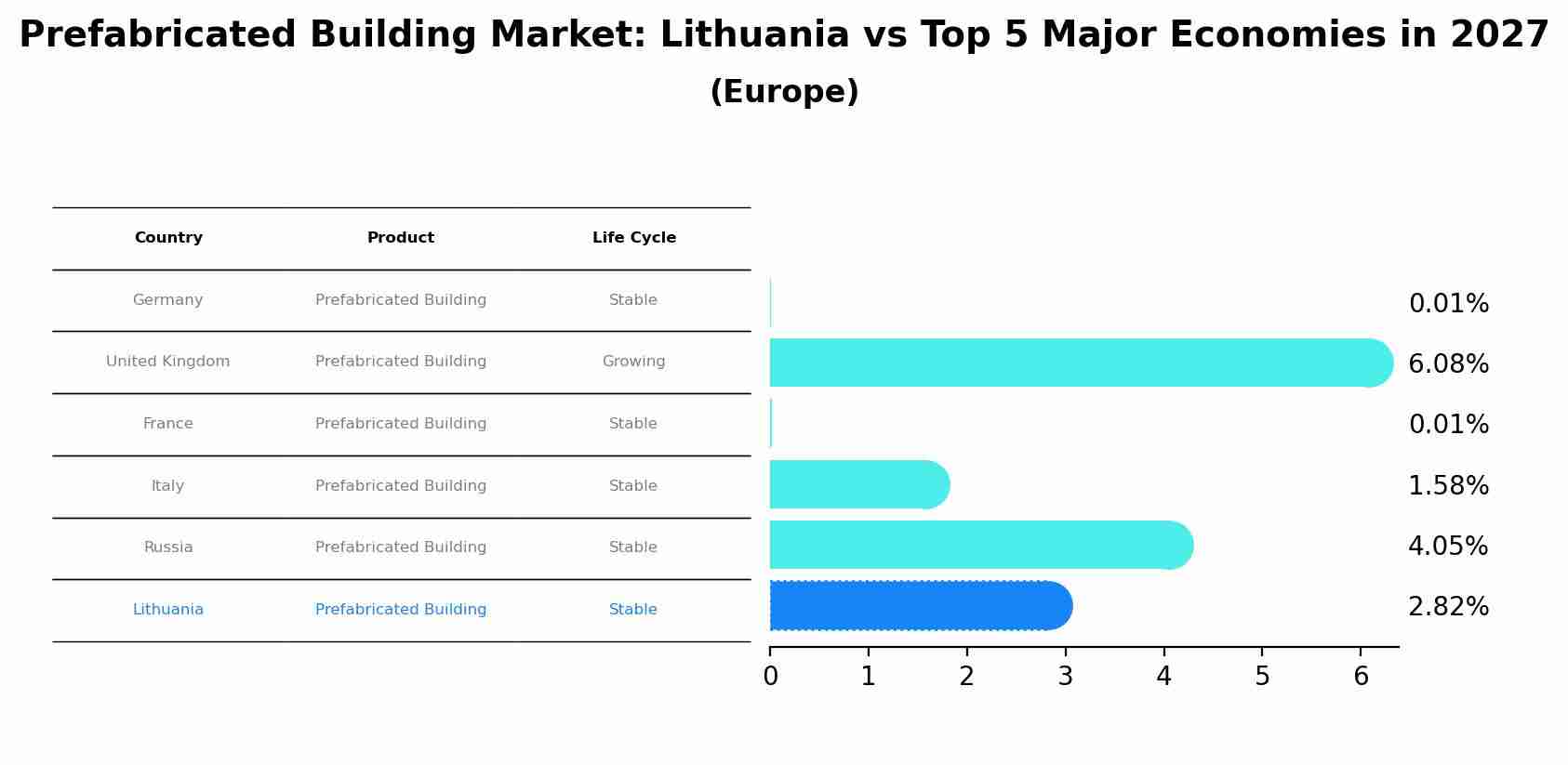
Lithuania Prefabricated Building Market Growth Rate
According to 6Wresearch internal database and industry insights, the Lithuania Prefabricated Building Market is projected to grow at a compound annual growth rate (CAGR) of 8% during the forecast period from 2026 to 2032.
Five-Year Growth Trajectory of the Lithuania Prefabricated Building Market with Core Drivers
Below mentioned are the evaluation of year-wise growth rate along with key drivers:
| Years | CAGR (%) | Growth Drivers |
| 2021 | 7 | Increasing demand for cost-effective and sustainable construction solutions. |
| 2022 | 7.2 | Increased adoption of modular and energy-efficient buildings. |
| 2023 | 7.4 | Rising awareness of environmental impact and sustainable building methods. |
| 2024 | 7.6 | Government encouragements and regulations for prefab construction. |
| 2025 | 7.8 | Rise of infrastructure projects and urbanization trends. |
Topics Covered in the Lithuania Prefabricated Building Market Report
The Lithuania Prefabricated Building Market report thoroughly covers the market by dimensions and applications, providing an unbiased and detailed analysis of ongoing market trends, opportunities, challenges, and market drivers, helping stakeholders align their strategies with current and future market dynamics.
Lithuania Prefabricated Building Market Highlights
| Report Name | Lithuania Prefabricated Building Market |
| Forecast period | 2026-2032 |
| CAGR | 8% |
| Growing Sector | Prefabricated Buildings |
Lithuania Prefabricated Building Market Synopsis
The demand for environmentally conscious, cheap, and alternative energy efficient building options is creating tremendous opportunity for Lithuanian Prefabricated Building Market Growth. The adoption of prefabricated building systems is noticed to be increasing in the construction industry as they save time, require less capital, and comply with environmental regulations. Furthermore, Government Sponsored Incentives and eco-friendly legislation are still the main factors behind the expansion of this industry.
Evaluation of Growth Drivers in the Lithuania Prefabricated Building Market
Below mentioned are some prominent drivers and their impact on the market dynamics:
| Drivers | Primary Segments Affected | Why It Matters (Evidence) |
| Increased Demand for Sustainable Solutions | All Segments | Growing environmental concerns and government regulations are pushing the demand for eco-friendly building materials. |
| Cost-Efficiency and Speed of Construction | Residential, Non-Residential | Compared to traditional methods, prefabricated buildings save time and cost. |
| Technological Advancements in Prefabrication | All Segments | Advances in modular and off-site construction methods increase the attractiveness and viability of prefabricated buildings. |
| Government Support and Incentives | All Segments | Market growth is being driven by government initiatives that encourage energy-efficient and sustainable building practices. |
| Urbanization and Population Growth | Residential, Non-Residential | Increasing urban populations and the need for fast, scalable housing and infrastructure solutions are fueling demand for prefabricated buildings. |
The Lithuania Prefabricated Building Market is projected to grow at a CAGR of 8% from 2026 to 2032. With the push for cheaper, energy-efficient, and environmentally friendly building, the demand for Lithuania Prefabricated Building Market has increased widely due to growing technological development, government subsidies, and a greater acceptance of modular & sustainable construction practices. Urbanization and new infrastructure development will further drive the demand for Prefabricated Buildings as they continue to become cheaper and more efficient. Therefore, this market growth will continue for an extended period.
Evaluation of Restraints in the Lithuania Prefabricated Building Market
Below mentioned are some major restraints and their influence on the market dynamics:
| Restraints | Primary Segments Affected | What This Means (Evidence) |
| High Initial Investment Costs | Residential, Non-Residential | The initial cost of prefabricated building materials can be higher than traditional methods, limiting access to price-sensitive consumers. |
| Limited Availability of Skilled Labor | All Segments | Skilled labor shortages could slow down and reduce the quality of prefabricated construction. |
| Consumer Perception | All Segments | There is a perception among some consumers that prefabricated buildings are not as durable or high-quality as traditional ones. |
| Regulatory Hurdles | All Segments | In some regions, tough regulations can result in increased compliance costs and delayed construction timelines. |
| Supply Chain Challenges | All Segments | Delays in material delivery or disturbances in the supply chain can lead to a delay in completion of prefabrication building projects. |
Lithuania Prefabricated Building Market Challenges
Due to the high initial capital expenses associated with producing prefabricated buildings and the continuous lack of well-trained construction workers in Lithuania. The Lithuanian Prefabricated Building Industry has several hurdles that impede its growth potential. While prefabricated buildings have several advantages for the consumer including Being constructed rapidly and efficiently at lower labor costs than traditional building methods, many prospective buyers are unaware of the long-term durability and performance of prefabricated building types as compared to conventional methods of construction.
Lithuania Prefabricated Building Market Trends
Here are some major trends changing the Lithuania Prefabricated Building Market dynamics:
- Rising Demand for Modular & Offsite Construction Methods: There is a growing demand for both Modular and Offsite construction methods. These methods allow for the shortening of Build Times and Building Costs, with minimal compromise on Quality. Therefore, Prefabricated Buildings have become attractive in both the residential and non-residential sectors alike.
- Sustainable/Green Construction: As awareness increases regarding environmental concerns, more construction companies are utilizing sustainable and recyclable materials for Prefabricated Buildings. This reflects the increasing demand for Energy Efficient Building Products, with many companies emphasizing the minimization of the Carbon Footprint of Construction Projects.
- Smart Buildings: Prefabricated Buildings: With the development of Smart Technology, the use of Smart Prefabricated Buildings is becoming increasingly popular. These Prefabricated Buildings can provide Greater Energy Savings, Greater Automation and User Comfort. Therefore the growing demand for Smart Homes, Smart Commercial Buildings and Smart Cities has further increased this trend.
- Urbanization & Infrastructure Development: The increasing Urbanization in Lithuania and Growing Infrastructure Development will result in an increase in demand for Prefabricated Buildings. The rapid deployment of these products greatly benefits residential and commercial building projects within urban environments.
Investment Opportunities in the Lithuania Prefabricated Building Market
The Lithuania Prefabricated Building Market presents several investment opportunities, including:
- Researching and Developing New Advanced Prefab Techniques – Investing in Research and Development of New Advanced Prefab Techniques could enable to reduce costs, improve quality and provide innovative products by providing with more options in design and function.
- Eco-Friendly and Sustainable Materials – With increased pressure from society for more Sustainable products, companies investing in R&D to develop new Eco-Friendly Prefabricated product offerings will have many advantages over other competitors.
- Smart Modular Prefabricated Buildings – The Demand for both energy efficient and high technology products in both the residential and commercial construction industry continues to grow. Therefore, any company that invests in the smart modular prefabricated building markets will be well positioned to meet the increasing demand for such products.
- Urban Development Projects – The worldwide rise of urbanization creates a significant opportunity for investors to invest in large urban development projects which will involve creating residential housing and infrastructure through the use of prefabricated structures.
Top 5 Leading Players in the Lithuania Prefabricated Building Market
Below is the list of prominent companies leading the Lithuania Prefabricated Building Market Share:
1. Skanska AB
| Company Name | Skanska AB |
|---|---|
| Established Year | 1887 |
| Headquarters | Stockholm, Sweden |
| Website | Click Here |
Skanska is a leading global construction company offering a range of prefabricated building solutions, including energy-efficient and sustainable buildings.
2. Vöhringer GmbH
| Company Name | Vöhringer GmbH |
|---|---|
| Established Year | 1921 |
| Headquarters | Germany |
| Website | - |
Vöhringer specializes in the production of prefabricated building systems, offering innovative solutions for both residential and commercial buildings.
3. Katerra
| Company Name | Katerra |
|---|---|
| Established Year | 2015 |
| Headquarters | Menlo Park, California, USA |
| Website | - |
Katerra focuses on off-site construction and prefabrication with a strong emphasis on sustainability and reducing construction timelines.
4. LTL Group
| Company Name | LTL Group |
|---|---|
| Established Year | 1998 |
| Headquarters | Vilnius, Lithuania |
| Website | - |
LTL Group is a leading Lithuanian company offering a wide range of prefabricated buildings, focusing on energy-efficient and eco-friendly solutions.
5. Plannja
| Company Name | Plannja |
|---|---|
| Established Year | 1969 |
| Headquarters | Stockholm, Sweden |
| Website | Click Here |
Plannja provides innovative prefabricated building systems, specializing in sustainable materials and modular construction methods.
Government Regulations Introduced in the Lithuania Prefabricated Building Market
According to Lithuanian Government data, Lithuania Construction Product Certification Centre (CPC) under the Ministry Of The Environment has created rules regarding health and safety that apply to all prefabricated building systems. Health and safety are generally determined by the energy-efficient materials selected by the company, in compliance with environmental regulations set by the relevant governing bodies. Moreover, besides making it mandatory for the companies, that intend to purchase and develop new constructions with prefabricated elements, to comply with these requirements, the Government of Lithuania also presents a variety of benefits to any company or institution that, on its own accord, implements a green construction practice.
Future Insights of the Lithuania Prefabricated Building Market
The outlook for Lithuania Prefabricated Building Market is positive, with strong growth projected due to the demand for cost-effective, sustainable, and energy-efficient construction solutions. The market growth is anticipated to be highly influenced by the technological innovations in the prefabrication and modular construction sectors. Furthermore, the government’s inclination towards environmentally sustainable policies and green construction projects will also be a major contributor to the demand for prefab buildings thus enabling the market to be more consistent in its growth and acceptance of such modern eco-friendly construction practices in Lithuania.
Market Segmentation Analysis
The report offers a comprehensive study of the following market segments and their leading categories:
By Dimensions – Skeleton System to Dominate the Market
According to Ritika Kalra, Senior Research Analyst, 6Wresearch, the Skeleton System is expected to dominate the Lithuania Prefabricated Building Market due to its versatility, structural integrity, and suitability for both residential and non-residential applications.
By Application – Residential Segment to Dominate the Market
The residential sector is anticipated to be the primary application for prefabricated buildings, fueled by the increasing demand for affordable, energy-efficient housing.
Key Attractiveness of the Report
- 10 Years of Market Numbers
- Historical Data Starting from 2022 to 2025
- Base Year: 2025
- Forecast Data until 2032
- Key Performance Indicators Impacting the Market
- Major Upcoming Developments and Projects
Key Highlights of the Report:
- Lithuania Prefabricated Building Market Outlook
- Market Size of Lithuania Prefabricated Building Market, 2025
- Forecast of Lithuania Prefabricated Building Market, 2032
- Historical Data and Forecast of Lithuania Prefabricated Building Revenues & Volume for the Period 2022-2032
- Lithuania Prefabricated Building Market Trend Evolution
- Lithuania Prefabricated Building Market Drivers and Challenges
- Lithuania Prefabricated Building Price Trends
- Lithuania Prefabricated Building Porter`s Five Forces
- Lithuania Prefabricated Building Industry Life Cycle
- Historical Data and Forecast of Lithuania Prefabricated Building Market Revenues & Volume By Dimensions for the Period 2022-2032
- Historical Data and Forecast of Lithuania Prefabricated Building Market Revenues & Volume By Skeleton System for the Period 2022-2032
- Historical Data and Forecast of Lithuania Prefabricated Building Market Revenues & Volume By Panel System for the Period 2022-2032
- Historical Data and Forecast of Lithuania Prefabricated Building Market Revenues & Volume By Cellular System for the Period 2022-2032
- Historical Data and Forecast of Lithuania Prefabricated Building Market Revenues & Volume By Combined System for the Period 2022-2032
- Historical Data and Forecast of Lithuania Prefabricated Building Market Revenues & Volume By Application for the Period 2022-2032
- Historical Data and Forecast of Lithuania Prefabricated Building Market Revenues & Volume By Residential for the Period 2022-2032
- Historical Data and Forecast of Lithuania Prefabricated Building Market Revenues & Volume By Non-Residential for the Period 2022-2032
- Lithuania Prefabricated Building Import Export Trade Statistics
- Market Opportunity Assessment By Dimensions
- Market Opportunity Assessment By Application
- Lithuania Prefabricated Building Top Companies Market Share
- Lithuania Prefabricated Building Competitive Benchmarking By Technical and Operational Parameters
- Lithuania Prefabricated Building Company Profiles
- Lithuania Prefabricated Building Key Strategic Recommendations
Market Covered
The report offers a comprehensive study of the subsequent market segments:
By Dimensions:
- Skeleton System
- Panel System
- Cellular System
- Combined System
By Application:
- Residential
- Non-Residential






































