Lithuania Umbrella Market Size (2020-2030)
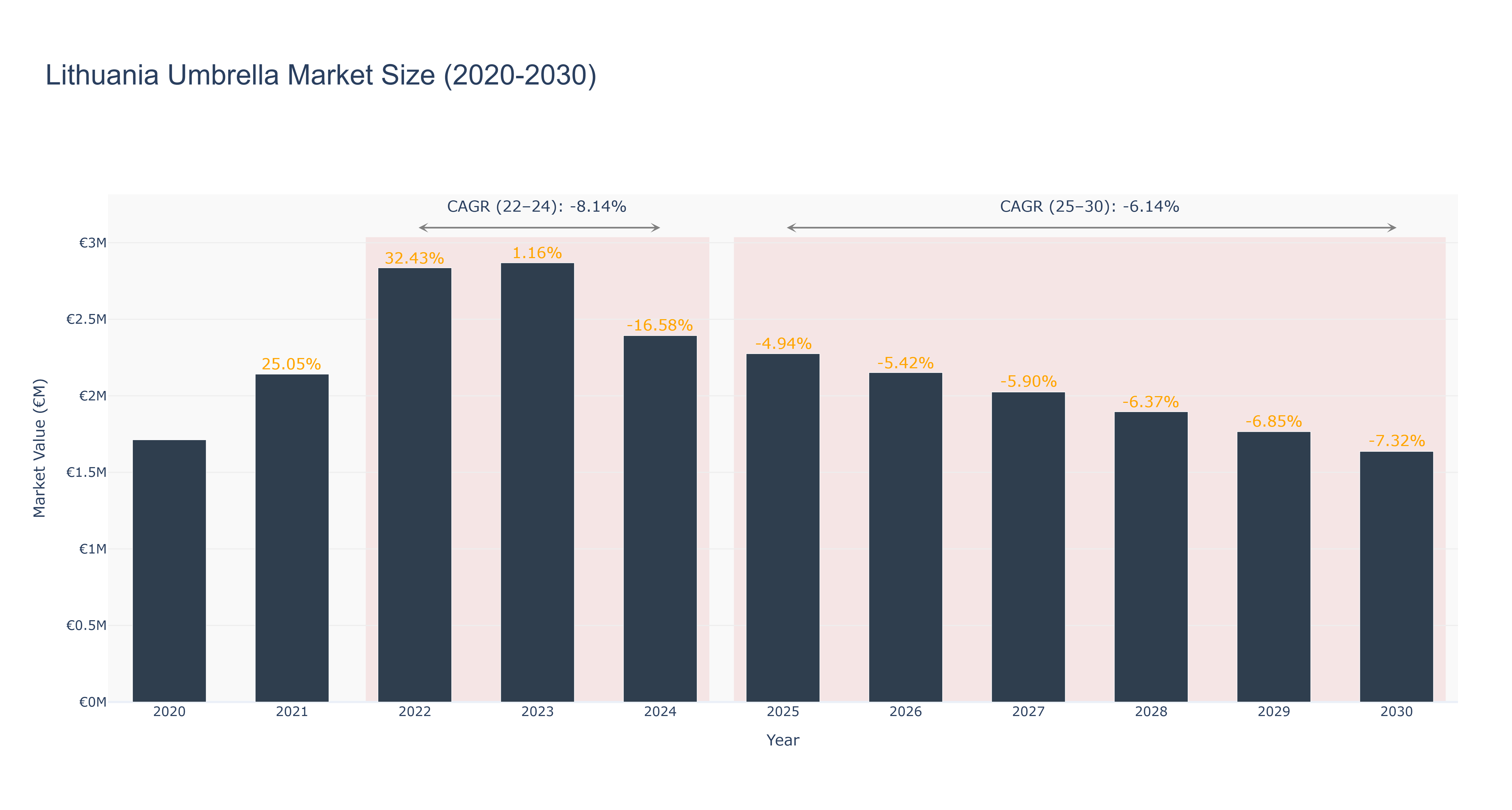
The Lithuania Umbrella Market experienced significant growth from 2020 to 2022, peaking in 2022 with a market size of €2.84 million and a remarkable growth rate of 32.43%. However, this upward trend faltered in 2023, with a marginal increase to €2.87 million followed by a notable decline to €2.39 million in 2024, resulting in a negative CAGR of -8.14% for the actual period from 2022 to 2024. Looking ahead, the forecasted market size is projected to further decline, reaching €1.64 million by 2030, with a CAGR of -6.14% from 2025 to 2030. This downturn may be attributed to market saturation, changes in consumer preferences favoring more durable outdoor gear, and economic factors influencing discretionary spending. As the market adapts, potential opportunities may arise with innovations in sustainable materials and designs, but overall, the outlook remains challenging without significant strategic interventions.
Lithuania Umbrella Market: Production & Trade Performance (2019-2025)
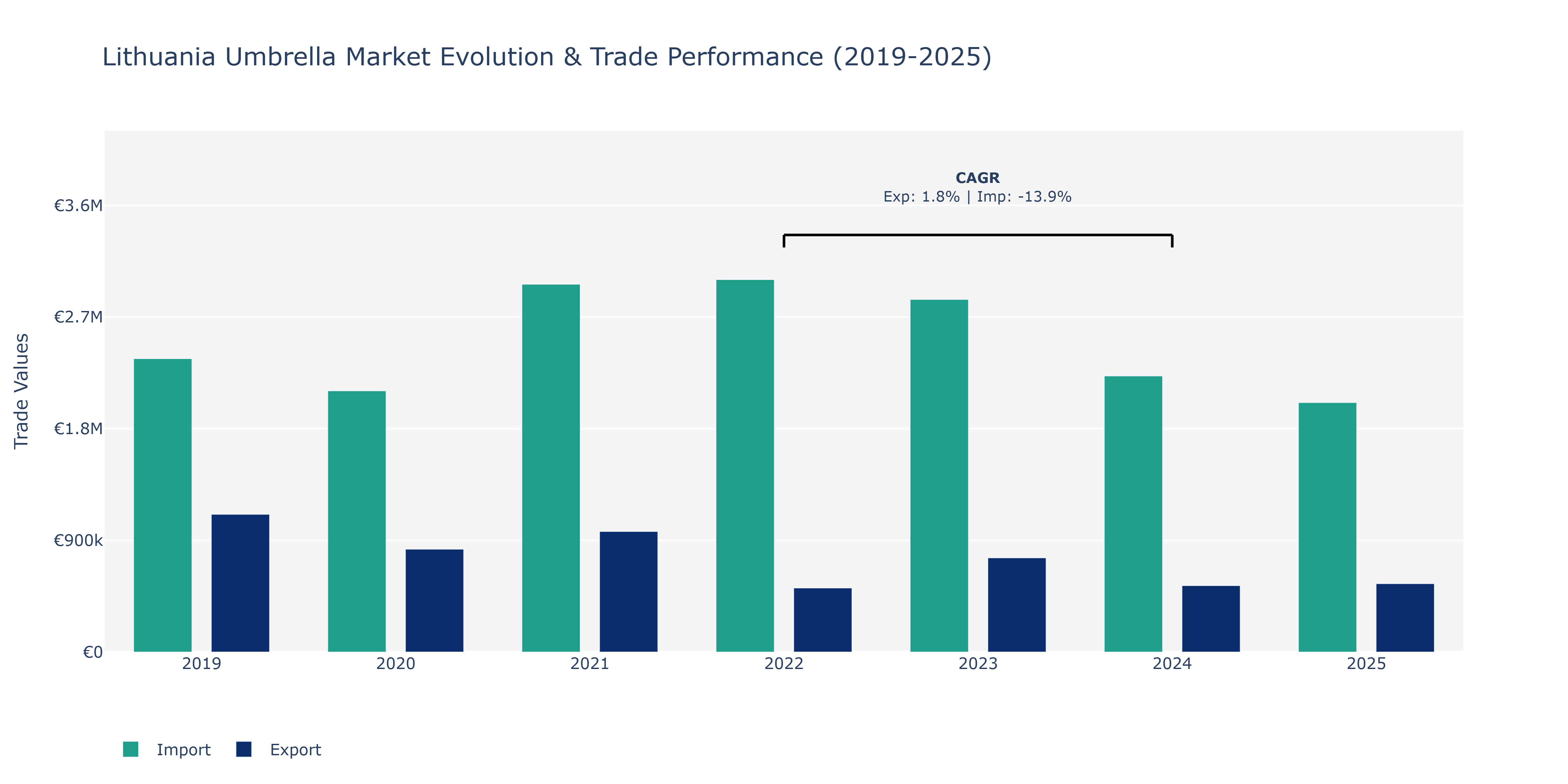
From 2019 to 2025, Lithuania's umbrella market experienced varying trends in exports and imports. In 2019, imports were highest at €2.36 million, while exports were at €1.11 million. Over the following years, both exports and imports saw fluctuations. In 2020, there was a notable decline in both metrics, with exports at €828.62 thousand and imports at €2.1 million. The following year, 2021, showcased a rebound in trade activity with exports increasing to €971.44 thousand and imports to €2.96 million. However, by 2024, both exports and imports experienced a decline with exports at €534.87 thousand and imports at €2.23 million. 2025 also saw a slight decrease in exports and imports. These fluctuations may be attributed to changing consumer preferences, global economic conditions, and supply chain disruptions. The rise in umbrella imports in 2021 could be linked to a surge in demand for quality umbrellas, potentially due to changing weather patterns or fashion trends.
Key Highlights of the Report:
- Lithuania Umbrella Market Outlook
- Market Size of Lithuania Umbrella Market, 2025
- Forecast of Lithuania Umbrella Market, 2032
- Historical Data and Forecast of Lithuania Umbrella Revenues & Volume for the Period 2022 - 2032F
- Lithuania Umbrella Market Trend Evolution
- Lithuania Umbrella Market Drivers and Challenges
- Lithuania Umbrella Price Trends
- Lithuania Umbrella Porter`s Five Forces
- Lithuania Umbrella Industry Life Cycle
- Historical Data and Forecast of Lithuania Umbrella Market Revenues & Volume By Product for the Period 2022 - 2032F
- Historical Data and Forecast of Lithuania Umbrella Market Revenues & Volume By Reverse Umbrella for the Period 2022 - 2032F
- Historical Data and Forecast of Lithuania Umbrella Market Revenues & Volume By Straight Umbrella for the Period 2022 - 2032F
- Historical Data and Forecast of Lithuania Umbrella Market Revenues & Volume By Folding Umbrella for the Period 2022 - 2032F
- Historical Data and Forecast of Lithuania Umbrella Market Revenues & Volume By Automatic Umbrella for the Period 2022 - 2032F
- Historical Data and Forecast of Lithuania Umbrella Market Revenues & Volume By Other for the Period 2022 - 2032F
- Historical Data and Forecast of Lithuania Umbrella Market Revenues & Volume By Application for the Period 2022 - 2032F
- Historical Data and Forecast of Lithuania Umbrella Market Revenues & Volume By Commercial Use for the Period 2022 - 2032F
- Historical Data and Forecast of Lithuania Umbrella Market Revenues & Volume By Entertainment Use for the Period 2022 - 2032F
- Lithuania Umbrella Import Export Trade Statistics
- Market Opportunity Assessment By Product
- Market Opportunity Assessment By Application
- Lithuania Umbrella Top Companies Market Share
- Lithuania Umbrella Competitive Benchmarking By Technical and Operational Parameters
- Lithuania Umbrella Company Profiles
- Lithuania Umbrella Key Strategic Recommendations






































