Lithuania Urea Market Size (2020-2030)
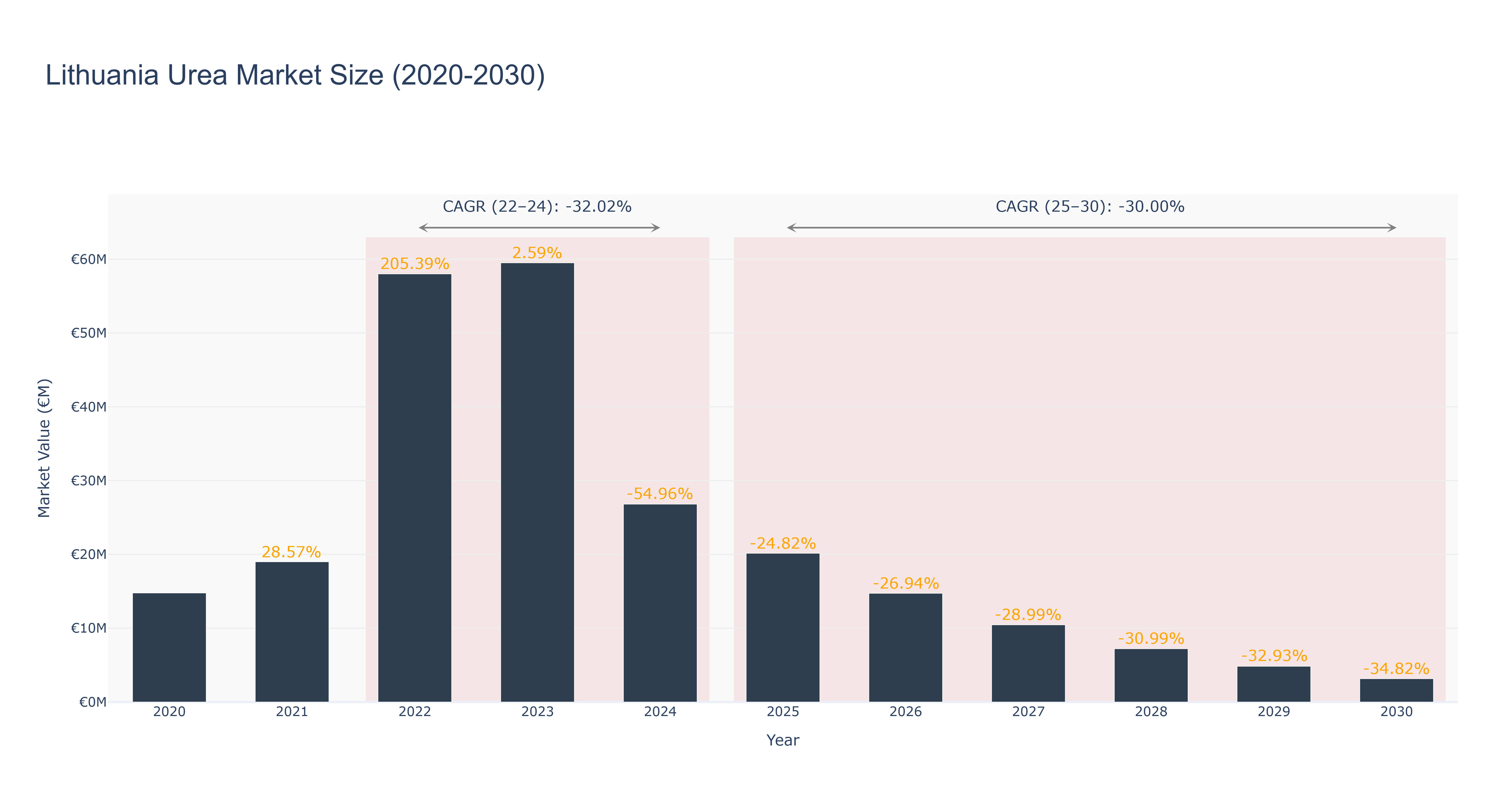
The Lithuania Urea Market, once at its peak in 2023 with a market size of €59.51 million, has seen a significant decline in recent years. The market size decreased to €20.15 million in 2025 and further dropped to €14.72 million in 2026. The CAGR from 2022-24 was -32.02%, while from 2025-30 it is projected to be -30.0%. The downward trend can be attributed to factors such as changing consumer preferences, economic fluctuations, and increased competition in the market. Looking ahead, the market is expected to stabilize with upcoming investments in sustainable farming practices and technological advancements in urea production processes. These developments aim to enhance product quality and reduce environmental impact, positioning Lithuania as a key player in the global urea market.
Lithuania Urea Market: Production & Trade Performance (2019-2025)
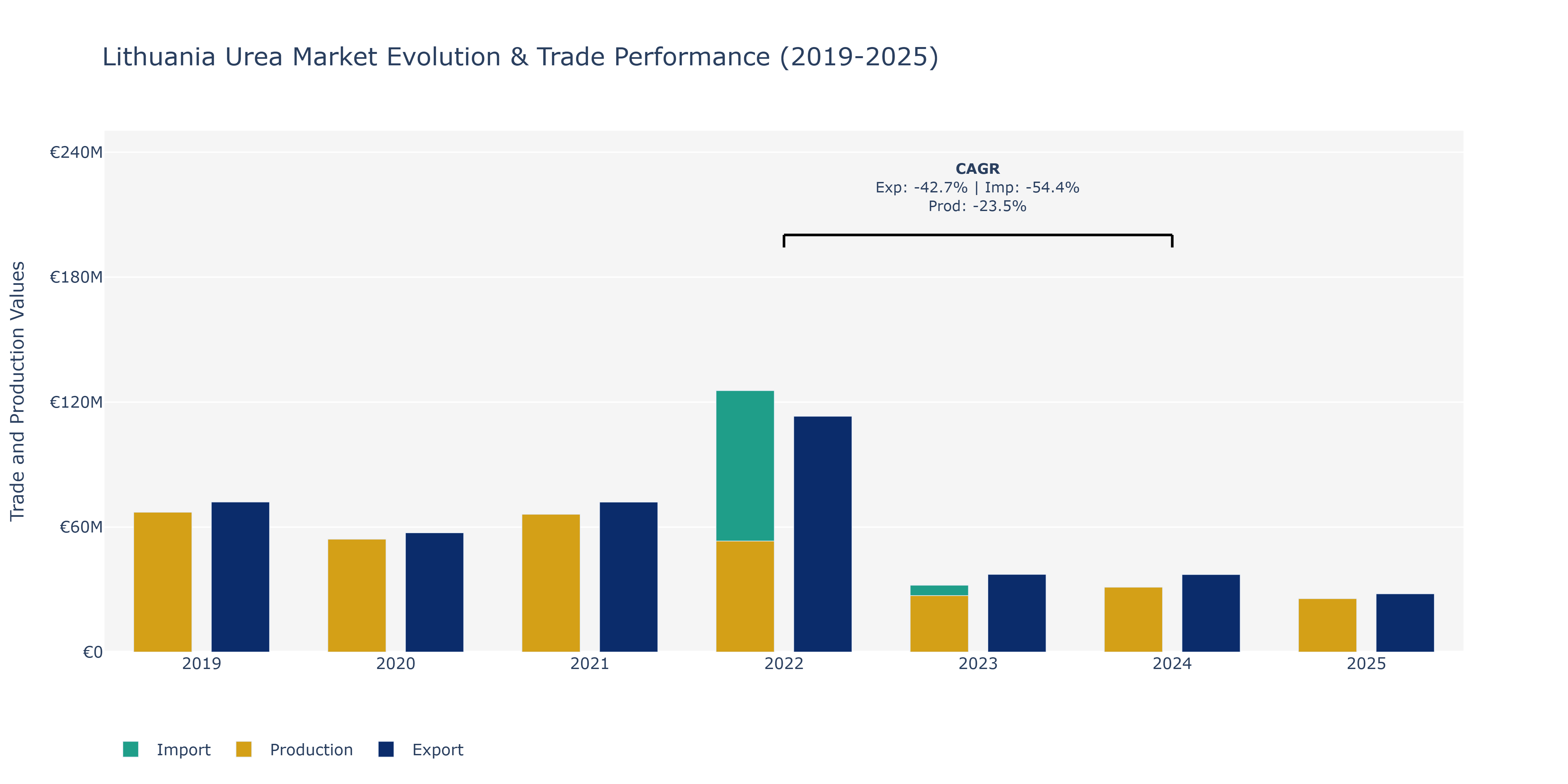
Between 2019 and 2025, the Lithuania Urea Market exhibited diverse trends in Exports, Imports, and Production. Exports peaked in 2022 at approximately €113.18 million before sharply declining in subsequent years, reaching around €27.97 million in 2025. In contrast, Imports fluctuated, with the highest value in 2022 at €125.53 million, followed by a decrease to about €19.65 million in 2025. Production, which stood at €67.14 million in 2019, experienced a notable drop to €25.66 million by 2025. These fluctuations can be attributed to various factors such as changes in global demand for urea, price fluctuations in the fertilizer market, and possibly shifts in local production capacity. The declining trend in Exports and Production could be influenced by competitive pressures from other markets or changes in domestic consumption patterns. To ensure market stability, stakeholders could focus on enhancing production efficiency, exploring new export markets, and strategic pricing strategies aligned with market demands.
Key Highlights of the Report:
- Lithuania Urea Market Outlook
- Market Size of Lithuania Urea Market, 2025
- Forecast of Lithuania Urea Market, 2032
- Historical Data and Forecast of Lithuania Urea Revenues & Volume for the Period 2022 - 2032F
- Lithuania Urea Market Trend Evolution
- Lithuania Urea Market Drivers and Challenges
- Lithuania Urea Price Trends
- Lithuania Urea Porter`s Five Forces
- Lithuania Urea Industry Life Cycle
- Historical Data and Forecast of Lithuania Urea Market Revenues & Volume By Grade for the Period 2022 - 2032F
- Historical Data and Forecast of Lithuania Urea Market Revenues & Volume By Fertilizer for the Period 2022 - 2032F
- Historical Data and Forecast of Lithuania Urea Market Revenues & Volume By Feed for the Period 2022 - 2032F
- Historical Data and Forecast of Lithuania Urea Market Revenues & Volume By Technical for the Period 2022 - 2032F
- Historical Data and Forecast of Lithuania Urea Market Revenues & Volume By End-user Industry for the Period 2022 - 2032F
- Historical Data and Forecast of Lithuania Urea Market Revenues & Volume By Agriculture for the Period 2022 - 2032F
- Historical Data and Forecast of Lithuania Urea Market Revenues & Volume By Chemical for the Period 2022 - 2032F
- Historical Data and Forecast of Lithuania Urea Market Revenues & Volume By Automotive for the Period 2022 - 2032F
- Historical Data and Forecast of Lithuania Urea Market Revenues & Volume By Medical for the Period 2022 - 2032F
- Historical Data and Forecast of Lithuania Urea Market Revenues & Volume By Others for the Period 2022 - 2032F
- Lithuania Urea Import Export Trade Statistics
- Market Opportunity Assessment By Grade
- Market Opportunity Assessment By End-user Industry
- Lithuania Urea Top Companies Market Share
- Lithuania Urea Competitive Benchmarking By Technical and Operational Parameters
- Lithuania Urea Company Profiles
- Lithuania Urea Key Strategic Recommendations






































