Malawi Cement Market Size Growth Rate
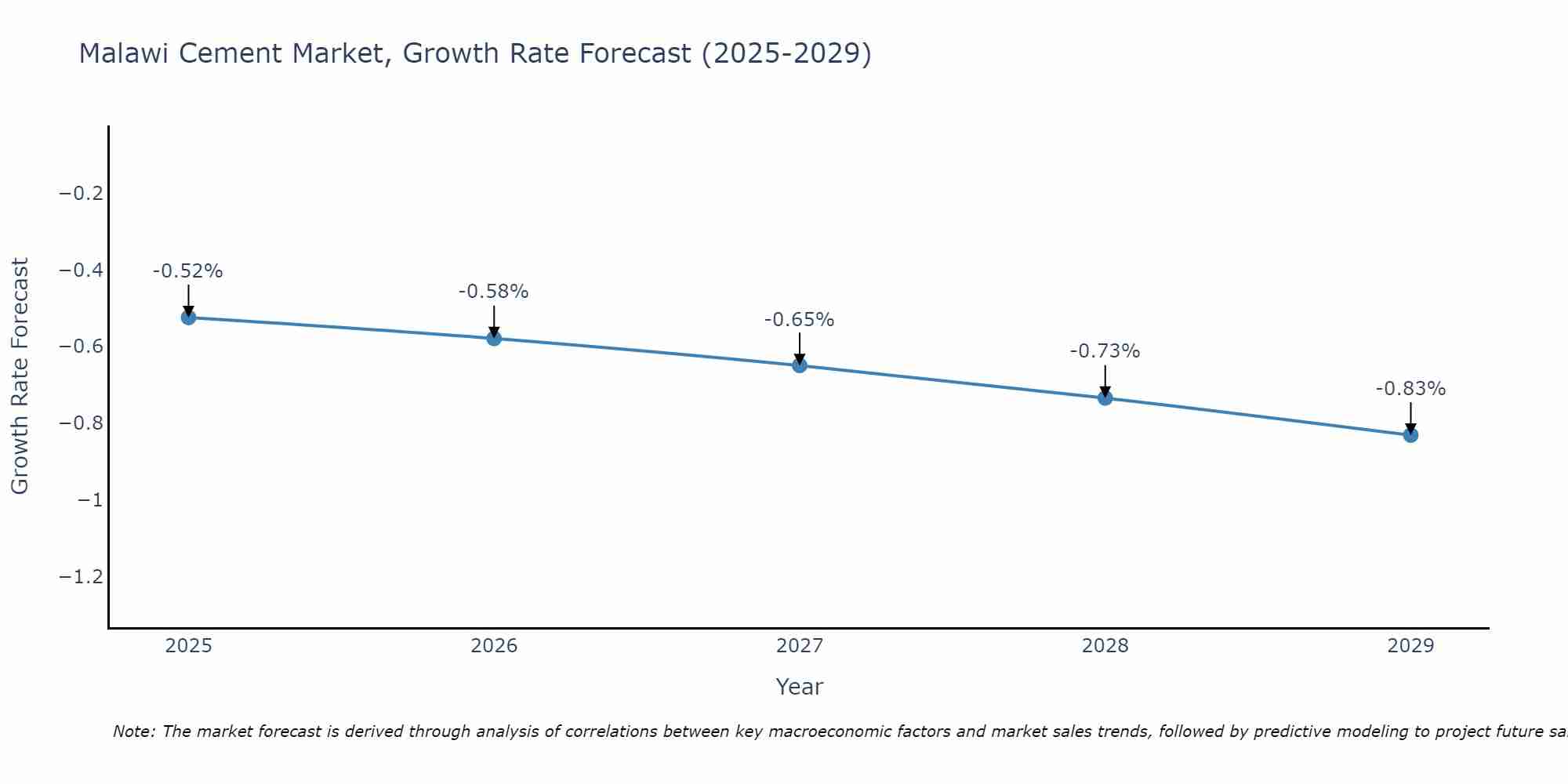
The Malawi Cement Market may undergo a gradual slowdown in growth rates between 2025 and 2029. Starting high at -0.52% in 2025, the market steadily declines to -0.83% by 2029.
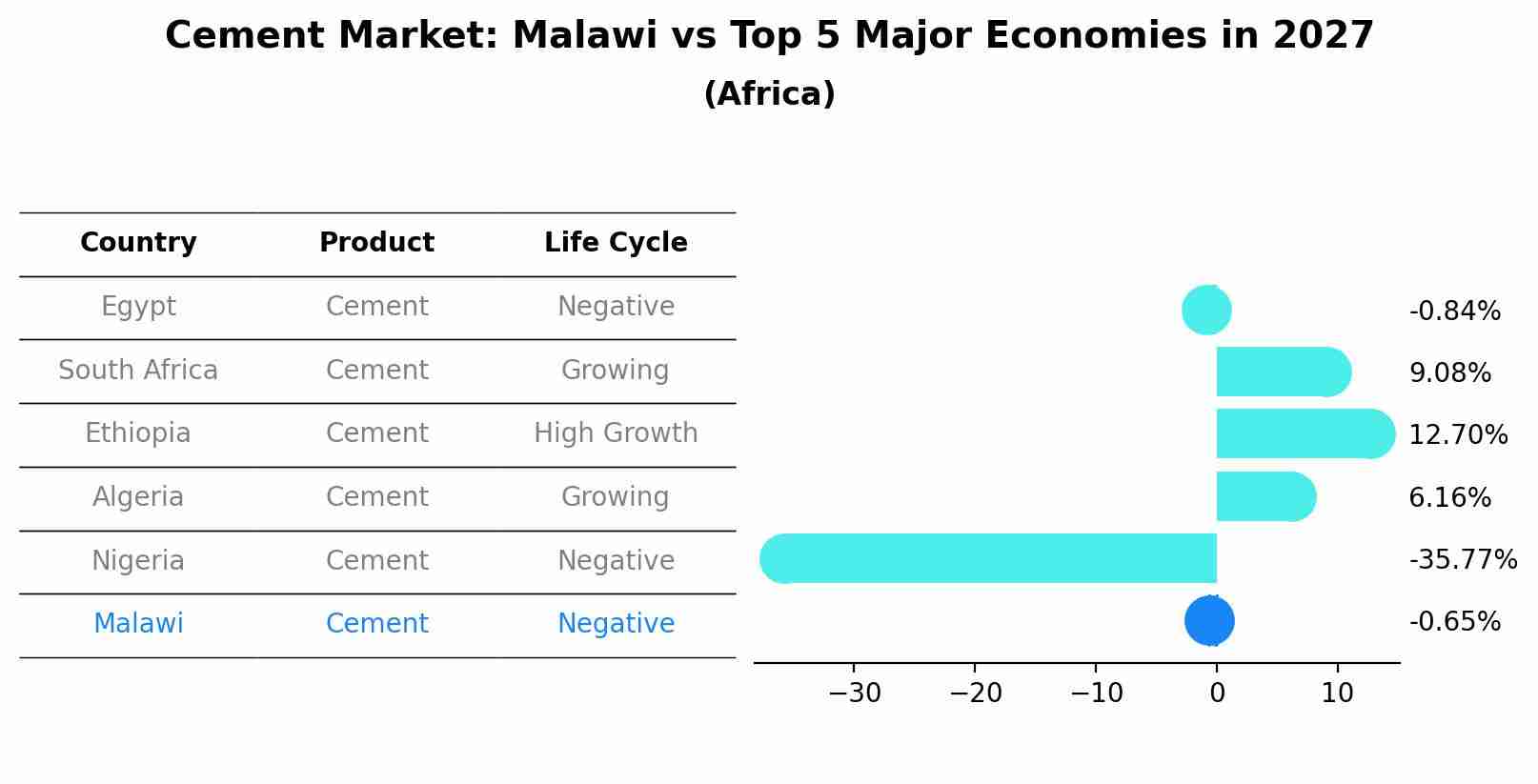
Cement Market: Malawi vs Top 5 Major Economies in 2027 (Africa)
Malawi's Cement market is anticipated to experience a negative growth rate of -0.65% by 2027, reflecting trends observed in the largest economy Egypt, followed by South Africa, Ethiopia, Algeria and Nigeria.
Malawi Cement Market Growth Rate
According to 6Wresearch internal database and industry insights, the Malawi Cement Market is projected to grow at a compound annual growth rate (CAGR) of 6.4% during the forecast period from 2026 to 2032.
Topics Covered in the Malawi Cement Market Report
The Malawi Cement Market report thoroughly covers the market by product and application. It provides an unbiased and detailed analysis of ongoing market trends, opportunities, challenges, and market drivers, helping stakeholders align their strategies with current and future market dynamics.
Malawi Cement Market Highlights
| Report Name | Malawi Cement Market |
| Forecast period | 2025-2031 |
| CAGR | 6.4% |
| Growing Sector | Construction & Infrastructure |
Malawi Cement Market Synopsis
Malawi Cement Market is expected to experience a steady growth, driven by increasing government support for industrialization, growing awareness about sustainable building materials, and high demand for localized construction solutions. The market is also fuelled by new advancements in clinkerization technology, declining costs of domestic limestone processing, and favourable government policies such as the "Malawi 2063" industrialization drive. With growing demand for high-strength building materials and a strong commitment to economic self-sufficiency, the Malawi Cement Market is expected to have a steady expansion.
Evaluation of Growth Drivers in the Malawi Cement Market
Below mentioned are some prominent drivers and their impact on the Malawi Cement Market dynamics:
| Drivers | Primary Segment Affected | Why It Matters (Evidence) |
| Import Substitution Strategy | All Segments | Government efforts to localize the entire value chain to reduce the drain on foreign exchange reserves. |
| Urbanization and Housing Gap | Residential | A requirement of approximately 21,000 new housing units per year to meet urban demand is fueling cement consumption. |
| Green Technology Adoption | Portland Cement | The use of Limestone Calcined Clay Cement (LC3) lowers CO2 emissions and production costs. |
| Regional Trade Integration | Infrastructure | Integration with the SADC and Nacala Corridor facilitates export to neighboring markets, including Mozambique. |
| Industrial Investment | All Segments | Significant capital injections from global investors are quadrupling local production capacities. |
Malawi Cement Market is projected to grow at a CAGR of 6.4% from 2026 to 2032. Key growth factors are government support for domestic manufacturing, new advancements in integrated plant technology, and an increasing demand for sustainable construction materials. The demand for cement, particularly Portland variants, is increasing in the residential and infrastructure sectors as Malawi aims to meet urban development targets and reduce the logistics costs associated with landlocked trade. The expanding local quarrying infrastructure and the rising popularity of eco-friendly cement blends are also contributing to the Malawi Cement Market Growth.
Evaluation of Restraints in the Malawi Cement Market
Below mentioned are some major restraints and their influence on the Malawi Cement Market dynamics:
| Restraints | Primary Segment Affected | What This Means (Evidence) |
| Energy Grid Instability | All Segments | High reliance on fragile hydro-power leads to production halts or expensive diesel backup costs. |
| Poor Transport Logistics | Infrastructure | Poor transportation logistics and infrastructure, including weak road and rail networks, lead to high haulage costs, resulting in higher cement retail prices. |
| Foreign Exchange Shortages | All Segments | Foreign exchange shortages, limiting local enterprises ability to acquire spare parts and machinery upgrades. |
| Smuggling and Illegal Imports | All Segments | Unrecorded inflows of cheaper cement from neighboring nations have undercut local manufacturers prices. |
| High Production Costs | All Segments | Energy and fuel account for nearly 30% of total input costs, making local cement less price-competitive. |
Malawi Cement Market Challenges
Malawi Cement Industry confronts many challenges such as regulatory difficulties regarding land rights for limestone quarrying, high investment prices for integrated kilns, and limited availability of reliable high-voltage electricity. Inconsistency in fuel availability, particularly for coal-fired kilns, can reduce the operational efficiency of production lines. Despite all these challenges, the government support for "Buy Malawi" initiatives and new advancements in alternative fuel use is likely to continue to drive demand in this market. Increasing awareness about the benefits of climate-resilient structures and the potential for regional export is pushing more investors and developers to commit to the Malawi cement sector.
Emerging Trends in the Malawi Cement Market
Trends driving the Malawi Cement Market include:
- Transition to Integrated Manufacturing: Companies are shifting from being simple "grinders" (using imported clinker) to integrated makers using local limestone.
- Adoption of Alternative Fuels: There are a growing trend of using the agricultural waste and crop by-products used as biomass substitutes for up to 20% of coal in cement kilns.
- Green Cement Movement: The usage of LC3 technology demonstrates that Malawi is one of the first countries in Africa to provide low carbon, environmentally friendly construction materials.
- Rise of Multi-Storey Urban Construction: Increasing demand for high strength cement for vertical expansion due to land scarcity issues experienced during development in cities like Lilongwe.
- Digitalization of Supply Chains: Major players are beginning to use digital logistics platforms to monitor distribution and manage the movement of clinker from quarries to plants.
Investment Opportunities in the Malawi Cement Market
Key investment avenues in the Malawi Cement Market are:
- Captive Power Solutions: Building a solar or wind combined source of supply (or hybrid) power plant for cement manufacturers so that manufacturers can avoid using unreliable national electricity and operate their factories 24/7.
- Domestic Clinker Production: Developing local limestone quarries and processing facilities offers a massive opportunity to substitute $35 million in annual imports.
- Expansion of Specialized Mortars: Producing pre-mixed mortar and tile adhesive products that are ready for use in the growing high-end residential construction market within urban areas.
- Logistics and Warehousing Hubs: Establishing strategic storage facilities along the Nacala and Beira corridors to facilitate easier regional exports.
- Waste-to-Energy Projects: Collaborating with agriculture to produce biomass fuel pellets for cement plant operations creates an environmentally friendly and cost-effective source of fuel.
Top 5 Leading Players in the Malawi Cement Market
Below is the list of prominent companies leading in the Malawi Cement Market:
1. Portland Cement (Malawi) Limited
| Company Name | Portland Cement (Malawi) Limited |
|---|---|
| Headquarters | Blantyre, Malawi |
| Established | 1956 |
| Official Website | Click Here |
Portland Cement (Malawi) Limited is one of the oldest and largest cement manufacturers in Malawi. The company recently upgraded its operations with a $100 million integrated plant in Balaka, increasing production capacity to around 1.1 million tonnes annually to support infrastructure and construction demand.
2. Shayona Cement Corporation Limited
| Company Name | Shayona Cement Corporation Limited |
|---|---|
| Headquarters | Kasungu, Malawi |
| Established | 1994 |
| Official Website | Click Here |
Shayona Cement Corporation Limited is a major local cement producer known for its Akshar brand. The company operates an integrated manufacturing facility in Kasungu and focuses on producing high-quality Portland Pozzolana Cement for residential and commercial construction projects.
3. Cement Products Limited (CPL)
| Company Name | Cement Products Limited (CPL) |
|---|---|
| Headquarters | Mangochi, Malawi |
| Established | 2005 |
| Official Website | Click Here |
Cement Products Limited operates a modern integrated cement plant in Mangochi. The company has played an important role in supporting the “Buy Malawi” initiative by focusing on locally produced cement solutions for residential construction and infrastructure development.
4. MUBAS Commercial Limited
| Company Name | MUBAS Commercial Limited |
|---|---|
| Headquarters | Blantyre, Malawi |
| Established | 2021 |
| Official Website | Click Here |
MUBAS Commercial Limited is the commercial arm of the Malawi University of Business and Applied Sciences. The company focuses on research-driven innovation and the development of specialized cement products designed for technical and educational applications.
5. LafargeHolcim
| Company Name | Lafarge Holcim (Malawi) |
|---|---|
| Headquarters | Blantyre, Malawi |
| Established | 1960 |
| Official Website | Click Here |
Lafarge Holcim (Malawi) is part of the global building materials group Holcim. The company focuses on supplying specialized cement grades for major infrastructure and construction projects while maintaining strong distribution networks across Southern Africa.
Government Regulations Introduced in the Malawi Cement Market
According to Malawi’s government data, many initiatives have been implemented to support the development of the cement sector, such as the Green Energy Subsidy Program, which provides incentives for industries switching to renewable energy. Malawi also participates in the National Construction Industry Council (NCIC) regulations to ensure the standardization of cement quality in public works. The government Import Duty Waivers on heavy machinery and investment tax credits under the Malawi Investment and Trade Centre (MITC) support the growth of integrated power projects, making local manufacturing a better option for private investments.
Future Insights of the Malawi Cement Market
Malawi Cement Market Share is expected to experience a major significant in the next few years with the help of substantial investments in integrated manufacturing infrastructure, government support for urbanization, and new advancements in low-carbon cement technology. The decreasing cost of domestic clinker production, increasing usage of renewable energy in factories, and a high demand for infrastructure projects like the Mpatamanga Hydropower project will continue to push this market in the forward direction. The large-scale road development projects and new innovations in climate-resilient concrete leads to the market growth in the coming years.
Market Segmentation Analysis
The report offers a comprehensive study of the following market segments and their leading categories:
By Product - Portland Cement to dominate the market
According to Ekta Gupta, Senior Research Analyst, 6Wresearch, Portland cement is expected to dominate the Malawi market share due to its essential role in heavy infrastructure and high-rise construction. As the government emphasizes the construction of dams, bridges, and industrial parks, the need for high-strength Ordinary Portland Cement (OPC) grows.
By Application - Non-residential/Infrastructure to dominate the market
Non-residential and infrastructure applications dominate the market in Malawi, owing to huge state-led projects and regional corridor developments. The "Malawi 2063" agenda places heavy emphasis on building transport networks, energy facilities, and hospitals, all of which require bulk cement supplies. This segment is bolstered by foreign direct investment in the mining and energy sectors, which creates a consistent and large-scale demand for industrial-grade cement solutions.
Key Attractiveness of the Report
- 10 Years of Market Numbers
- Historical Data Starting from 2022 to 2025
- Base Year: 2025
- Forecast Data until 2032
- Key Performance Indicators Impacting the Market
- Major Upcoming Developments and Projects
Key Highlights of the Report:
- Malawi Cement Market Outlook
- Market Size of Malawi Cement Market, 2025
- Forecast of Malawi Cement Market, 2032
- Historical Data and Forecast of Malawi Cement Revenues & Volume for the Period 2022-2032
- Malawi Cement Market Trend Evolution
- Malawi Cement Market Drivers and Challenges
- Malawi Cement Price Trends
- Malawi Cement Porter`s Five Forces
- Malawi Cement Industry Life Cycle
- Historical Data and Forecast of Malawi Cement Market Revenues & Volume By Product for the Period 2022-2032
- Historical Data and Forecast of Malawi Cement Market Revenues & Volume By Portland for the Period 2022-2032
- Historical Data and Forecast of Malawi Cement Market Revenues & Volume By Others for the Period 2022-2032
- Historical Data and Forecast of Malawi Cement Market Revenues & Volume By Application for the Period 2022-2032
- Historical Data and Forecast of Malawi Cement Market Revenues & Volume By Residential for the Period 2022-2032
- Historical Data and Forecast of Malawi Cement Market Revenues & Volume By Non-residential/Infrastructure for the Period 2022-2032
- Malawi Cement Import Export Trade Statistics
- Market Opportunity Assessment By Product
- Market Opportunity Assessment By Application
- Malawi Cement Top Companies Market Share
- Malawi Cement Competitive Benchmarking By Technical and Operational Parameters
- Malawi Cement Company Profiles
- Malawi Cement Key Strategic Recommendations
Market Covered
The report offers a comprehensive study of the following Malawi Cement Market segments:
By Product
- Portland
- Others
By Application
- Residential
- Non-residential/Infrastructure






































