Malaysia App Analytics Market Size & Growth Rate (2026-2032)
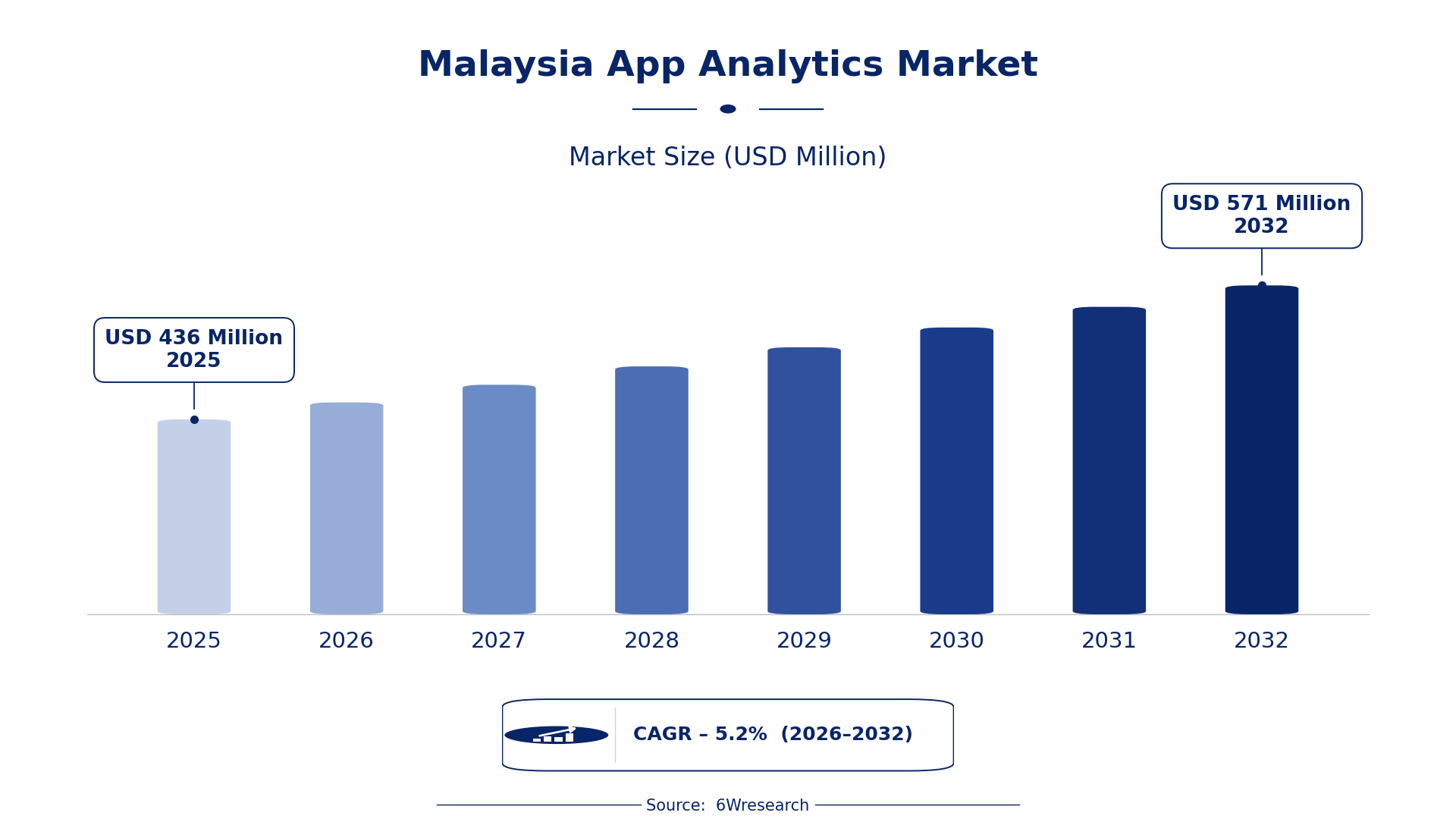
The Malaysia App Analytics Market was estimated at USD 436 Million in 2025 and is projected to reach USD 571 Million by 2032, growing at a CAGR of 5.2% from 2026 to 2032.
Malaysia App Analytics Market Synopsis
The Malaysia app analytics market has witnessed a surge in recent years, primarily driven by the rapid adoption of mobile applications across various sectors. As businesses increasingly recognize the value of data-driven decision-making, the demand for sophisticated app analytics tools has intensified. This trend is on track to continue as companies seek to refine user experiences and optimize their app offerings.
Looking ahead, the market is expected to maintain its upward trajectory, fueled by the growing digital economy and an increasingly connected population. The focus on enhancing user engagement and monetization strategies will further bolster investments in app analytics, setting the stage for significant growth in the coming years.
Malaysia App Analytics Market Year-wise Growth Rate and Key Drivers
This graph illustrates the annual growth rates of the Malaysia App Analytics Market from 2021 to 2032, highlighting a steady upward trajectory and projected expansion over the forecast period.
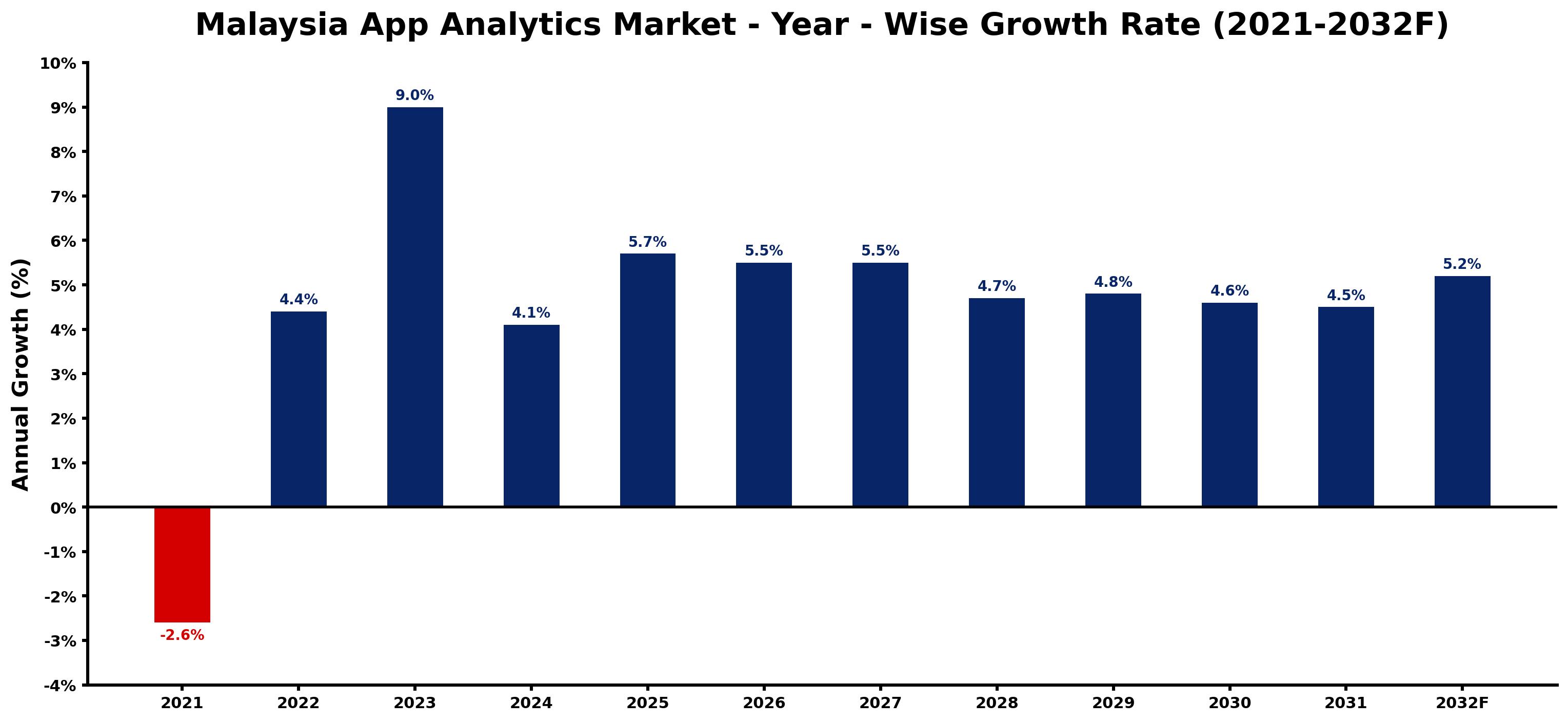
The table below presents the year‑wise growth rates along with the key drivers influencing the market
| Year | Growth Rate | Major Drivers |
| 2021 | -2.6% | MCO restrictions limited app usage growth in Malaysia. |
| 2022 | 4.4% | Increased smartphone penetration among urban Malaysian youth |
| 2023 | 9.0% | Government push for digital economy via MyDIGITAL initiative |
| 2024 | 4.1% | Surge in e-commerce apps driven by online shopping trends |
| 2025 | 5.7% | Growing interest in health and fitness app analytics |
| 2026 | 5.5% | Rise of mobile gaming popularity among Malaysian consumers |
| 2027 | 5.5% | Focus on data privacy compliance by local app developers |
| 2028 | 4.7% | Demand for language translation apps for cultural diversity |
| 2029 | 4.8% | Investment in fintech apps driven by Islamic finance growth |
| 2030 | 4.6% | Adoption of AR features in shopping apps gaining traction |
| 2031 | 4.5% | Increased usage of social media analytics for marketing |
| 2032 | 5.2% | Government incentives for startups in tech and data analysis |
Note: Market size estimations and growth projections presented in this report are based on 6Wresearch's proprietary forecasting methodology, utilizing the latest available industry data, government publications, and primary research inputs.
Malaysia App Analytics Market Key Takeaways
Below are some of the specific key takeaways from the market, including:
- The market is projected to grow significantly, with a CAGR of 4.6% from 2026 to 2032.
- Increased reliance on mobile applications is driving demand for app analytics tools.
- Insights from app analytics are essential for enhancing user experiences and driving customer retention.
- Privacy regulations are creating complexities in data collection and analysis for app developers.
- Local and global players are innovating to offer tailored solutions for Malaysian businesses.
Evaluation of Restraints in Malaysia App Analytics Market
The Malaysia app analytics market faces real challenges that could hinder its growth. One major issue is the complexity surrounding data accuracy. With a multitude of mobile devices and operating systems in use, gathering reliable data becomes increasingly complicated. Additionally, privacy regulations introduce a layer of compliance that can be daunting for app developers. Striking a balance between extracting valuable insights and adhering to stringent privacy laws continues to be a pressing concern.
Malaysia App Analytics Market Trends
A few trends are shaping the Malaysia app analytics market. The integration of artificial intelligence and machine learning into analytics tools is enabling businesses to gain deeper insights into user behavior and preferences. Real-time analytics capabilities are also gaining traction, allowing companies to make swift adjustments to their strategies. As consumer demands evolve, the focus on personalization in app experiences is driving the need for advanced analytics solutions.
Malaysia App Analytics Market Opportunities
The potential for growth in the Malaysia app analytics market is substantial. Opportunities exist in sectors like e-commerce and gaming, where understanding user engagement can directly impact revenue. on top of that, as businesses prioritize mobile-first strategies, the demand for analytics tools that provide actionable insights will continue to rise. Companies that can innovate and deliver tailored solutions will likely capture significant market share.
Government Initiatives in the Malaysia App Analytics Market
The Malaysian government is taking proactive steps to foster a conducive environment for the app analytics market. Regulatory frameworks are being established to enhance data protection while promoting innovation. Such initiatives are crucial for building trust between consumers and businesses, enabling a thriving app ecosystem.
- A regulatory framework introduced in 2025 mandating data transparency to improve consumer confidence.
- A national digital infrastructure upgrade programme now in its rollout phase, aimed at enhancing connectivity.
- A planned public-private initiative expected to develop analytics training programmes by 2026.
- A recently launched initiative focusing on promoting local tech startups that specialize in analytics solutions.
- Current efforts to streamline compliance processes for app developers to ease the burden of regulatory adherence.
Future Insights of the Malaysia App Analytics Market
From 2026 to 2032, the Malaysia app analytics market is set for sustained growth, driven by technological advancements and an evolving consumer base. Businesses will increasingly turn to analytics for real-time insights, enabling them to adapt to market changes swiftly. This shift will not only enhance user experiences but also open up new avenues for revenue generation through more effective monetization strategies.
Malaysia App Analytics Market Latest Developments
In the past year, the Malaysia app analytics market has seen a flurry of activity, reflecting the urgency among businesses to optimize their mobile offerings. The demand for innovative analytics tools is leading to collaborations and new product launches aimed at addressing specific market needs.
- A major technology vendor launched a comprehensive app analytics suite in early 2025, integrating AI capabilities for enhanced user insights.
- An ongoing partnership between local startups and educational institutions focuses on developing analytics skills among graduates, fostering a new generation of talent.
- A new analytics platform is currently being developed by a collaborative effort involving several local tech firms, expected to debut by mid-2026.
- A leading regional operator completed a significant upgrade to its analytics infrastructure in Q1 2025, enhancing data processing capabilities.
- Upcoming initiatives aim to introduce advanced privacy features in analytics tools to comply with evolving regulations, set to roll out in late 2026.
Malaysia App Analytics Market - Key Attractiveness of the Report
- 10 Years of Market Numbers
- Historical Data Starting from 2022 to 2025
- Base Year: 2025
- Forecast Data until 2032
- Key Performance Indicators Impacting the Market
- Major Upcoming Developments and Projects
Key Highlights of the Report:
- Malaysia App Analytics Market Outlook
- Market Size of Malaysia App Analytics Market, 2025
- Forecast of Malaysia App Analytics Market, 2032
- Historical Data and Forecast of Malaysia App Analytics Revenues & Volume for the Period 2022-2032F
- Malaysia App Analytics Market Trend Evolution
- Malaysia App Analytics Market Drivers and Challenges
- Malaysia App Analytics Price Trends
- Malaysia App Analytics Porter's Five Forces
- Malaysia App Analytics Industry Life Cycle
- Historical Data and Forecast of Malaysia App Analytics Market Revenues & Volume By Component for the Period 2022-2032F
- Historical Data and Forecast of Malaysia App Analytics Market Revenues & Volume By Software for the Period 2022-2032F
- Historical Data and Forecast of Malaysia App Analytics Market Revenues & Volume By Services for the Period 2022-2032F
- Historical Data and Forecast of Malaysia App Analytics Market Revenues & Volume By Application for the Period 2022-2032F
- Historical Data and Forecast of Malaysia App Analytics Market Revenues & Volume By Revenue analytics for the Period 2022-2032F
- Historical Data and Forecast of Malaysia App Analytics Market Revenues & Volume By App performance analytics and operations for the Period 2022-2032F
- Historical Data and Forecast of Malaysia App Analytics Market Revenues & Volume By User analytics for the Period 2022-2032F
- Historical Data and Forecast of Malaysia App Analytics Market Revenues & Volume By Ad monitoring and marketing analytics for the Period 2022-2032F
- Historical Data and Forecast of Malaysia App Analytics Market Revenues & Volume By Type for the Period 2022-2032F
- Historical Data and Forecast of Malaysia App Analytics Market Revenues & Volume By Mobile app analytics for the Period 2022-2032F
- Historical Data and Forecast of Malaysia App Analytics Market Revenues & Volume By Web app analytics for the Period 2022-2032F
- Historical Data and Forecast of Malaysia App Analytics Market Revenues & Volume By Vertical for the Period 2022-2032F
- Historical Data and Forecast of Malaysia App Analytics Market Revenues & Volume By Banking, Financial Services, and Insurance (BFSI) for the Period 2022-2032F
- Historical Data and Forecast of Malaysia App Analytics Market Revenues & Volume By Retail for the Period 2022-2032F
- Historical Data and Forecast of Malaysia App Analytics Market Revenues & Volume By Media and entertainment for the Period 2022-2032F
- Historical Data and Forecast of Malaysia App Analytics Market Revenues & Volume By Logistics, travel, and transportation for the Period 2022-2032F
- Historical Data and Forecast of Malaysia App Analytics Market Revenues & Volume By Telecom and IT for the Period 2022-2032F
- Historical Data and Forecast of Malaysia App Analytics Market Revenues & Volume By Others for the Period 2022-2032F
- Malaysia App Analytics Import Export Trade Statistics
- Market Opportunity Assessment By Component
- Market Opportunity Assessment By Application
- Market Opportunity Assessment By Type
- Market Opportunity Assessment By Vertical
- Malaysia App Analytics Top Companies Market Share
- Malaysia App Analytics Competitive Benchmarking By Technical and Operational Parameters
- Malaysia App Analytics Company Profiles
- Malaysia App Analytics Key Strategic Recommendations






































