Malaysia Artificial Intelligence in Retail Market Size & Growth Rate (2026-2032)
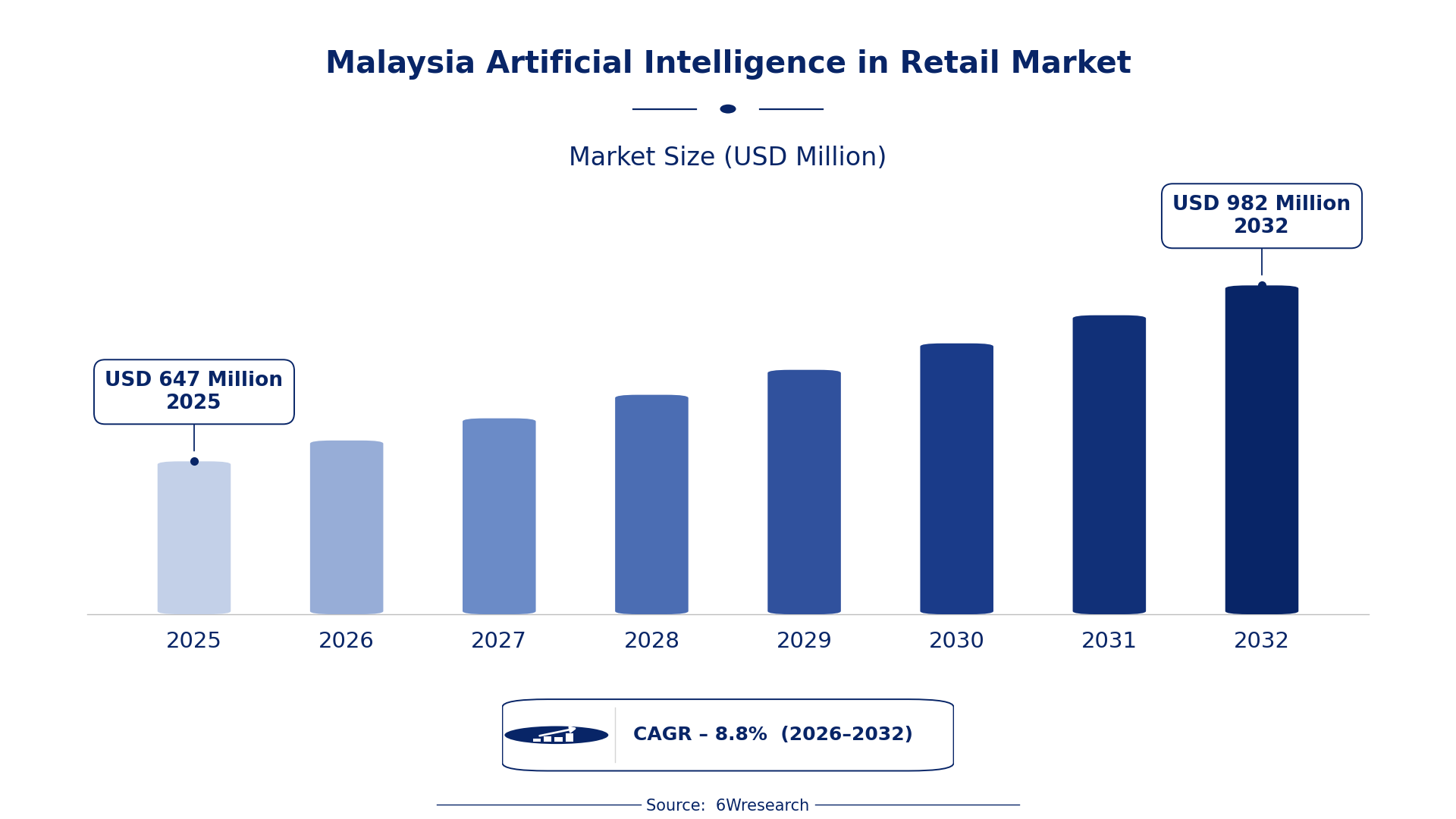
The Malaysia Artificial Intelligence in Retail Market was estimated at USD 647 Million in 2025 and is projected to reach USD 982 Million by 2032, growing at a CAGR of 8.8% from 2026 to 2032.
Malaysia Artificial Intelligence in Retail Market Synopsis
Retailers in Malaysia are increasingly adopting AI technologies to refine their customer engagement strategies. The integration of AI in areas such as personalized marketing and demand forecasting is helping businesses to better understand and cater to consumer preferences.
As consumers become more accustomed to tailored shopping experiences, retailers are under pressure to innovate continually. AI solutions not only enhance customer satisfaction but also optimize inventory management, ensuring that stock levels align with fluctuating demand.
Malaysia Artificial Intelligence in Retail Market Year-wise Growth Rate and Key Drivers
This graph illustrates the annual growth rates of the Malaysia Artificial Intelligence in Retail Market from 2021 to 2032, highlighting a steady upward trajectory and projected expansion over the forecast period.
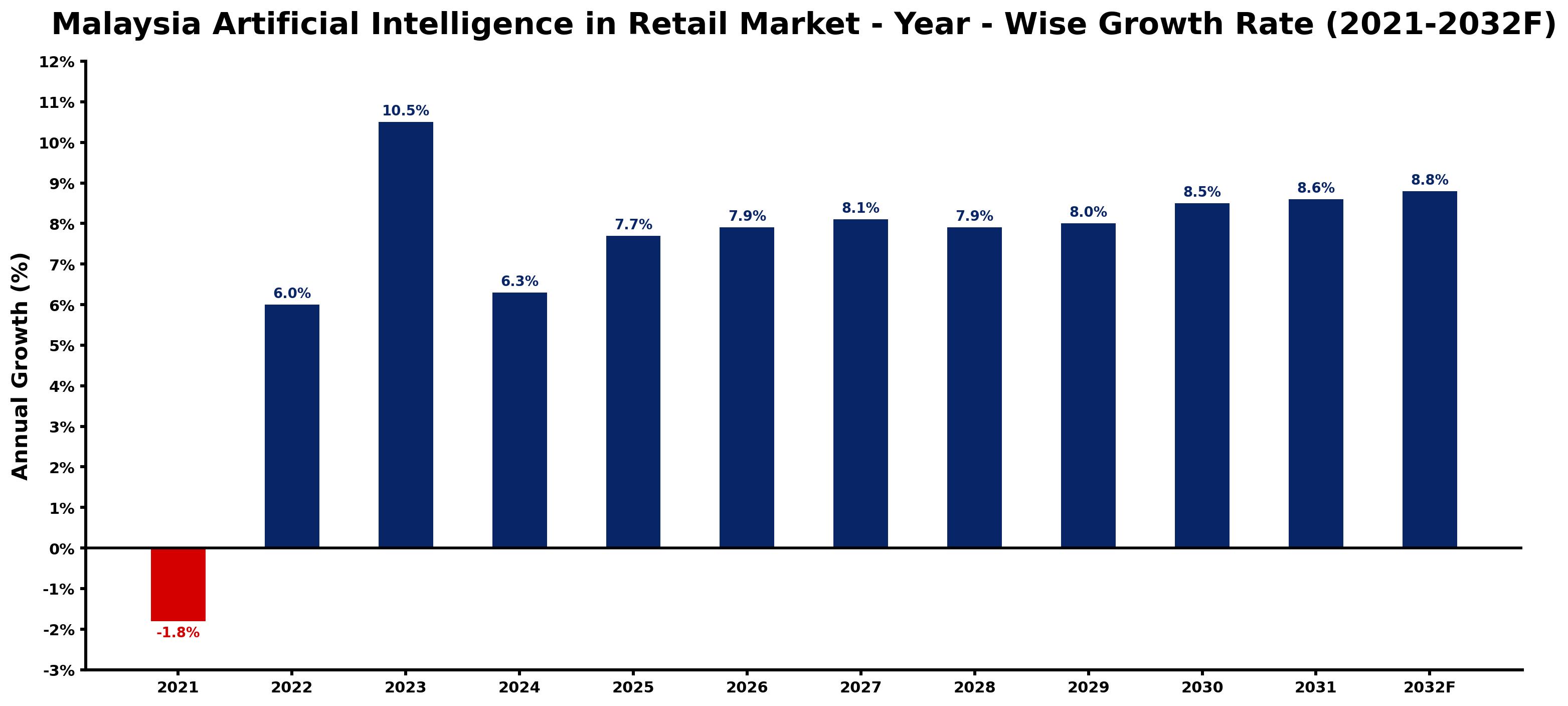
The table below presents the year‑wise growth rates along with the key drivers influencing the market
| Year | Growth Rate | Major Drivers |
| 2021 | -1.8% | Delayed government AI adoption initiatives affecting retail investments |
| 2022 | 6.0% | Government support for AI innovation through MDEC initiatives. |
| 2023 | 10.5% | Increased retail analytics adoption via AI-driven insights. |
| 2024 | 6.3% | Growing e-commerce sector investing in AI solutions. |
| 2025 | 7.7% | Retailers enhancing customer engagement with AI chatbots. |
| 2026 | 7.9% | Implementation of AI-driven inventory management systems. |
| 2027 | 8.1% | Rising consumer preference for AI-powered loyalty programs. |
| 2028 | 7.9% | Collaboration between universities and retail for AI research. |
| 2029 | 8.0% | Government policies promoting digital transformation in retail. |
| 2030 | 8.5% | Emergence of local AI startups focused on retail solutions. |
| 2031 | 8.6% | Rising urbanization driving AI adoption in retail strategies. |
| 2032 | 8.8% | Increased focus on AI to optimize supply chain efficiency. |
Note: Market size estimations and growth projections presented in this report are based on 6Wresearch's proprietary forecasting methodology, utilizing the latest available industry data, government publications, and primary research inputs.
Malaysia Artificial Intelligence in Retail Market Key Takeaways
Below are some of the specific key takeaways from the market, including:
- AI-driven analytics are becoming essential for retailers to adapt to changing consumer behaviors.
- Personalized customer experiences significantly enhance customer loyalty and retention rates.
- Challenges related to data privacy are prompting retailers to reconsider their AI strategies.
- Investment in AI technology is increasingly seen as a necessity for competitive advantage.
- The COVID-19 pandemic has accelerated the integration of AI in retail operations.
Evaluation of Restraints in Malaysia Artificial Intelligence in Retail Market
Despite the growth potential, several constraints hamper the market's acceleration. Retailers face a delicate balancing act between utilizing AI for personalization and adhering to stringent data privacy regulations. Increasing consumer wariness of data usage presents a significant hurdle. on top of that, the financial burden associated with AI implementation can deter smaller retailers, who often lack the resources to invest in advanced technologies. A shortage of skilled professionals in AI further complicates the ability of retailers to fully embrace these innovations.
Malaysia Artificial Intelligence in Retail Market Trends
Several trends are shaping the Malaysian AI in retail market. One prominent trend is the shift toward omnichannel retailing, where AI facilitates a cohesive shopping experience across online and offline platforms. Enhanced predictive analytics is also on the rise, allowing retailers to anticipate consumer needs more accurately. Additionally, there is a growing emphasis on sustainability, with AI tools helping retailers optimize supply chains to minimize waste and environmental impact.
Malaysia Artificial Intelligence in Retail Market Opportunities
The market presents numerous growth avenues. Retailers can capitalize on AI for real-time inventory management, significantly improving operational efficiency. The demand for AI-driven customer service solutions, such as chatbots and virtual assistants, is on the rise, providing retailers with opportunities to enhance customer engagement. on top of that, the increasing importance of data analytics in decision-making processes offers further investment prospects as businesses seek to harness actionable insights.
Government Initiatives in the Malaysia Artificial Intelligence in Retail Market
Government support plays a crucial role in shaping the trajectory of the AI in retail market in Malaysia. Recent policy initiatives aimed at fostering digital transformation emphasize the need for regulatory frameworks that encourage innovation while safeguarding consumer rights. This regulatory environment is vital as it defines how retailers can deploy AI technologies responsibly.
- A national digital infrastructure upgrade programme was recently completed, enhancing connectivity for retail operations.
- Current initiatives focus on developing AI ethics guidelines to ensure responsible use of technology in the retail sector.
- A planned public-private partnership aims to create AI training programmes for retail professionals by 2026.
- The government has introduced tax incentives for retailers investing in AI technologies, promoting further adoption.
Future Insights of the Malaysia Artificial Intelligence in Retail Market
Looking ahead to 2026-2032, the AI in retail market in Malaysia is likely to witness transformative changes. The increasing sophistication of AI technologies will enable more personalized and intuitive shopping experiences. As retailers continue to embrace these advancements, they will also need to prioritize ethical considerations, particularly regarding data privacy. The intersection of consumer demand for personalization and regulatory compliance will be critical in shaping future developments in this sector.
Malaysia Artificial Intelligence in Retail Market Latest Developments
In the past year, the Malaysian AI in retail market has seen significant activity, reflecting a strong commitment to innovation. Retailers are not only adopting new technologies but are also exploring collaborative efforts to enhance their AI capabilities. As the industry evolves, these developments signal a promising direction for future growth.
- A leading technology vendor launched an AI-powered inventory management solution in Q2 2025, aimed at optimizing stock levels in real-time.
- In early 2025, a major retail chain initiated a pilot programme utilizing AI for personalized marketing campaigns, which is currently underway.
- A partnership between a regional AI firm and several retail businesses was established in late 2025 to develop customized AI solutions tailored to local consumer preferences.
- A rollout of AI chatbots across multiple retail platforms is expected to commence by mid-2026, enhancing customer service capabilities.
Malaysia Artificial Intelligence in Retail Market - Key Attractiveness of the Report
- 10 Years of Market Numbers
- Historical Data Starting from 2022 to 2025
- Base Year: 2025
- Forecast Data until 2032
- Key Performance Indicators Impacting the Market
- Major Upcoming Developments and Projects
Key Highlights of the Report:
- Malaysia Artificial Intelligence in Retail Market Outlook
- Market Size of Malaysia Artificial Intelligence in Retail Market, 2025
- Forecast of Malaysia Artificial Intelligence in Retail Market, 2032
- Historical Data and Forecast of Malaysia Artificial Intelligence in Retail Revenues & Volume for the Period 2022-2032F
- Malaysia Artificial Intelligence in Retail Market Trend Evolution
- Malaysia Artificial Intelligence in Retail Market Drivers and Challenges
- Malaysia Artificial Intelligence in Retail Price Trends
- Malaysia Artificial Intelligence in Retail Porter's Five Forces
- Malaysia Artificial Intelligence in Retail Industry Life Cycle
- Historical Data and Forecast of Malaysia Artificial Intelligence in Retail Market Revenues & Volume By Type for the Period 2022-2032F
- Historical Data and Forecast of Malaysia Artificial Intelligence in Retail Market Revenues & Volume By Online for the Period 2022-2032F
- Historical Data and Forecast of Malaysia Artificial Intelligence in Retail Market Revenues & Volume By Offline for the Period 2022-2032F
- Historical Data and Forecast of Malaysia Artificial Intelligence in Retail Market Revenues & Volume By Service for the Period 2022-2032F
- Historical Data and Forecast of Malaysia Artificial Intelligence in Retail Market Revenues & Volume By Professional for the Period 2022-2032F
- Historical Data and Forecast of Malaysia Artificial Intelligence in Retail Market Revenues & Volume By Managed for the Period 2022-2032F
- Historical Data and Forecast of Malaysia Artificial Intelligence in Retail Market Revenues & Volume By Technology for the Period 2022-2032F
- Historical Data and Forecast of Malaysia Artificial Intelligence in Retail Market Revenues & Volume By Machine Learning for the Period 2022-2032F
- Historical Data and Forecast of Malaysia Artificial Intelligence in Retail Market Revenues & Volume By Deep Learning for the Period 2022-2032F
- Historical Data and Forecast of Malaysia Artificial Intelligence in Retail Market Revenues & Volume By NLP for the Period 2022-2032F
- Malaysia Artificial Intelligence in Retail Import Export Trade Statistics
- Market Opportunity Assessment By Type
- Market Opportunity Assessment By Service
- Market Opportunity Assessment By Technology
- Malaysia Artificial Intelligence in Retail Top Companies Market Share
- Malaysia Artificial Intelligence in Retail Competitive Benchmarking By Technical and Operational Parameters
- Malaysia Artificial Intelligence in Retail Company Profiles
- Malaysia Artificial Intelligence in Retail Key Strategic Recommendations






































