Malaysia Bisphenol A Market Size Growth Rate
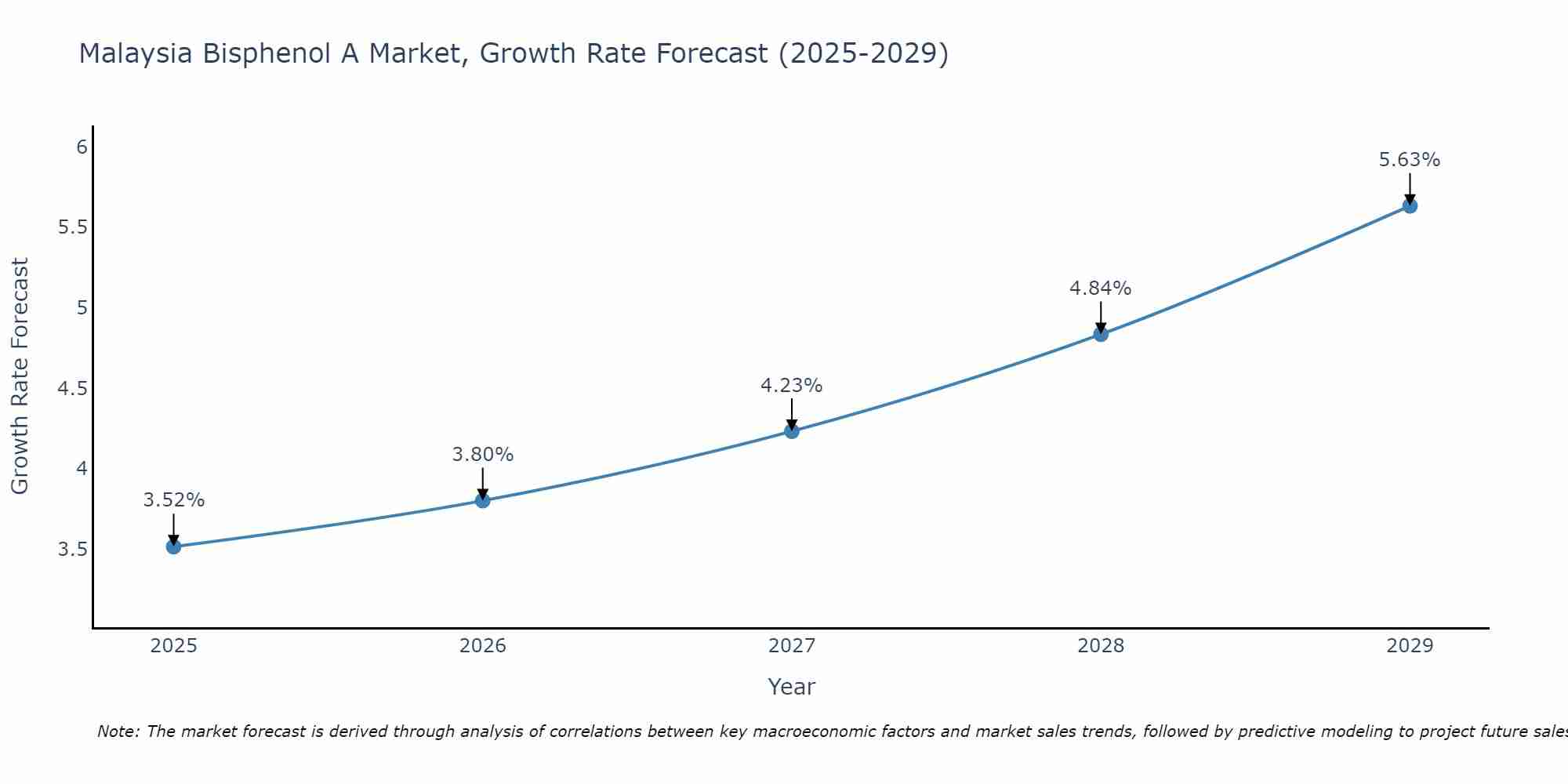
The Malaysia Bisphenol A Market is poised for steady growth rate improvements from 2025 to 2029. From 3.52% in 2025, the growth rate steadily ascends to 5.63% in 2029.
Bisphenol A Market: Malaysia vs Top 5 Major Economies in 2027 (Asia)
The Bisphenol A market in Malaysia is projected to grow at a stable growth rate of 4.23% by 2027, highlighting the country's increasing focus on advanced technologies within the Asia region, where China holds the dominant position, followed closely by India, Japan, Australia and South Korea, shaping overall regional demand.

Malaysia Bisphenol A Market Synopsis
The bisphenol A (BPA) market size in Malaysia was valued around USD 11 million during 2018 and is expected to grow significantly on account of rising demand from food packaging sector especially plastic bottles along with growing health awareness among consumers regarding safer food products coupled with government initiatives towards curbing hazardous substances present even minute amounts within packaged goods driving preference towards eco-friendly alternatives such as BPA free containers. The overall bisphenol A capacity utilization rate for Malaysiaproducers reached 93% while global average stands around 70%. Moreover, the total BPA output generated within Malaysiaregion amounted 8500 metric tons annually during 2025 which has grown remarkably since then.
Market Drivers of the market
The Malaysia bisphenol A market is influenced by its use in the production of polycarbonate plastics and epoxy resins. Bisphenol A is a key component in manufacturing clear plastics, protective coatings, and consumer products like food and beverage containers. The market`s growth is driven by the demand for durable and versatile materials in industries such as electronics, automotive, and packaging. As technological advancements lead to new applications and product innovations, the bisphenol A market continues to expand.
Challenges of the market
In the Malaysia bisphenol A market, challenges arise from growing awareness of health concerns and regulatory restrictions. Bisphenol A has faced scrutiny due to potential health risks, leading to consumer preferences for BPA-free products. Market players must address these concerns by developing alternative materials and solutions that meet safety standards while maintaining the desired properties of bisphenol A. Additionally, regulatory changes related to chemical usage and environmental impact may impact the market`s operations and future directions.
Covid-19 Impact on the market
The Malaysia bisphenol A market encountered challenges associated with shifts in consumer behavior and regulatory changes during the pandemic. Increased awareness of health concerns and preferences for safer alternatives led to changes in consumer preferences for products containing bisphenol A. Regulatory changes and sustainability considerations also influenced market dynamics. The market`s recovery relies on innovation and the development of safer and more sustainable alternatives that align with evolving consumer and regulatory expectations.
Key Players of the market
The Malaysia bisphenol A market supports the plastics, packaging, and electronics industries. Notable players like BPAPlastics Co., PolymerTech Solutions, and PackagingInnovations specialize in producing bisphenol A. These companies focus on material quality, polymer compatibility, and eco-friendly alternatives to cater to the demands of plastic production and other applications.
Key Highlights of the Report:
- Malaysia Bisphenol A Market Outlook
- Market Size of Malaysia Bisphenol A Market, 2024
- Forecast of Malaysia Bisphenol A Market, 2031
- Historical Data and Forecast of Malaysia Bisphenol A Revenues & Volume for the Period 2021-2031
- Malaysia Bisphenol A Market Trend Evolution
- Malaysia Bisphenol A Market Drivers and Challenges
- Malaysia Bisphenol A Price Trends
- Malaysia Bisphenol A Porter's Five Forces
- Malaysia Bisphenol A Industry Life Cycle
- Historical Data and Forecast of Malaysia Bisphenol A Market Revenues & Volume By Application for the Period 2021-2031
- Historical Data and Forecast of Malaysia Bisphenol A Market Revenues & Volume By Polycarbonate Resin for the Period 2021-2031
- Historical Data and Forecast of Malaysia Bisphenol A Market Revenues & Volume By Epoxy Resin for the Period 2021-2031
- Historical Data and Forecast of Malaysia Bisphenol A Market Revenues & Volume By Unsaturated Polyester Resins for the Period 2021-2031
- Historical Data and Forecast of Malaysia Bisphenol A Market Revenues & Volume By Flame Retardants for the Period 2021-2031
- Historical Data and Forecast of Malaysia Bisphenol A Market Revenues & Volume By Others for the Period 2021-2031
- Historical Data and Forecast of Malaysia Bisphenol A Market Revenues & Volume By End-use for the Period 2021-2031
- Historical Data and Forecast of Malaysia Bisphenol A Market Revenues & Volume By Eye wear for the Period 2021-2031
- Historical Data and Forecast of Malaysia Bisphenol A Market Revenues & Volume By Automotive component for the Period 2021-2031
- Historical Data and Forecast of Malaysia Bisphenol A Market Revenues & Volume By Electronics for the Period 2021-2031
- Historical Data and Forecast of Malaysia Bisphenol A Market Revenues & Volume By Wind Energy Composites for the Period 2021-2031
- Historical Data and Forecast of Malaysia Bisphenol A Market Revenues & Volume By Paint and Coating for the Period 2021-2031
- Historical Data and Forecast of Malaysia Bisphenol A Market Revenues & Volume By Green House for the Period 2021-2031
- Historical Data and Forecast of Malaysia Bisphenol A Market Revenues & Volume By Others for the Period 2021-2031
- Malaysia Bisphenol A Import Export Trade Statistics
- Market Opportunity Assessment By Application
- Market Opportunity Assessment By End-use
- Malaysia Bisphenol A Top Companies Market Share
- Malaysia Bisphenol A Competitive Benchmarking By Technical and Operational Parameters
- Malaysia Bisphenol A Company Profiles
- Malaysia Bisphenol A Key Strategic Recommendations






































