Malaysia Business Analytics Market Size & Growth Rate (2026-2032)
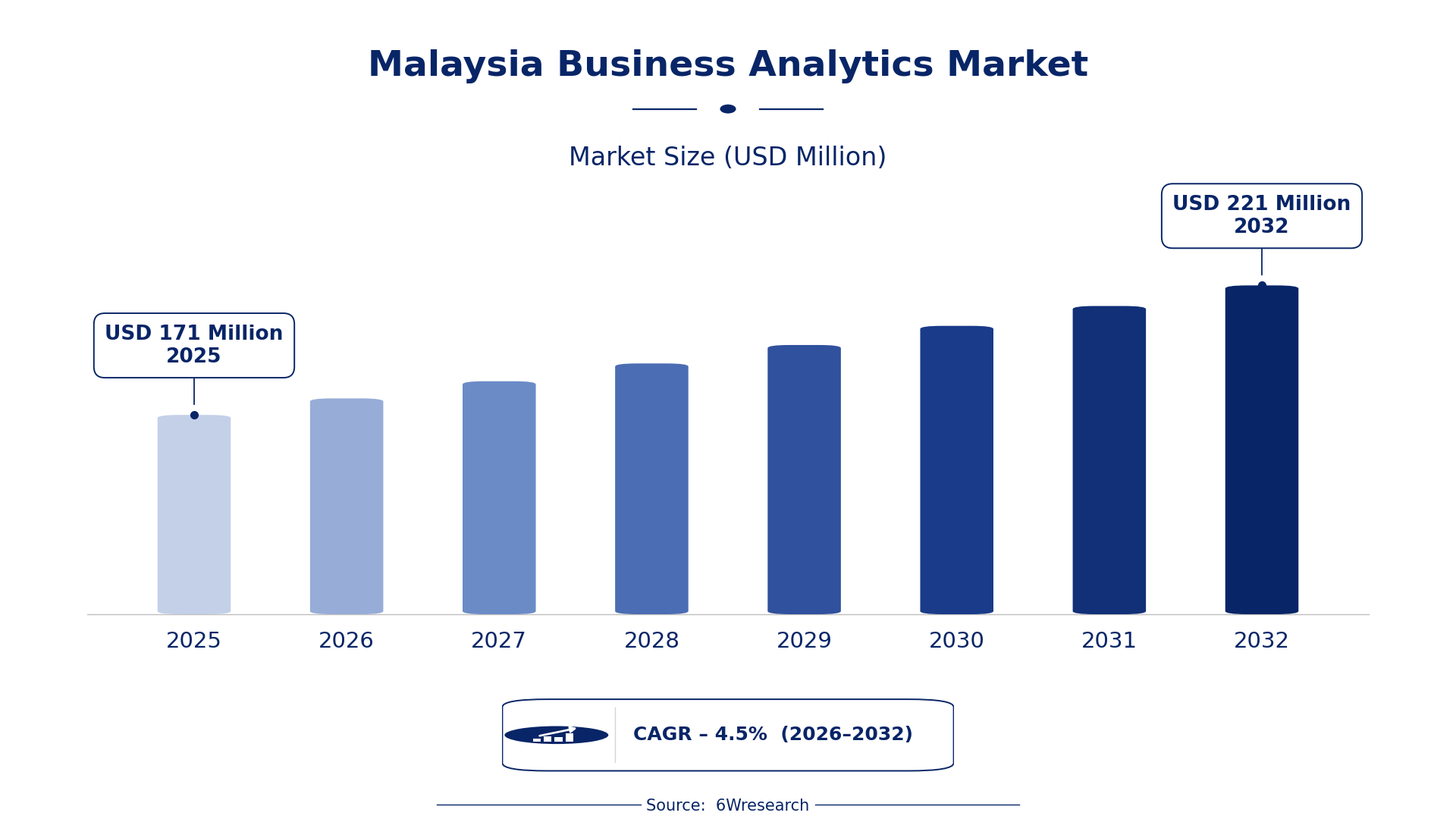
The Malaysia Business Analytics Market was estimated at USD 171 Million in 2025 and is projected to reach USD 221 Million by 2032, growing at a CAGR of 4.5% from 2026 to 2032.
Malaysia Business Analytics Market Synopsis
The Malaysia Business Analytics Market is witnessing a surge in demand as organizations increasingly recognize the value of data-driven decision-making. Companies across various sectors are adopting analytics tools to enhance their operational efficiency and better understand customer behavior, laying a strong foundation for market growth.
As businesses navigate an increasingly competitive environment, the focus on advanced analytics, including predictive modeling and big data techniques, has intensified. This shift not only reflects a growing acceptance of analytics but also highlights the strategic importance of leveraging insights for sustainable growth.
Malaysia Business Analytics Market Year-wise Growth Rate and Key Drivers
This graph illustrates the annual growth rates of the Malaysia Business Analytics Market from 2021 to 2032, highlighting a steady upward trajectory and projected expansion over the forecast period.
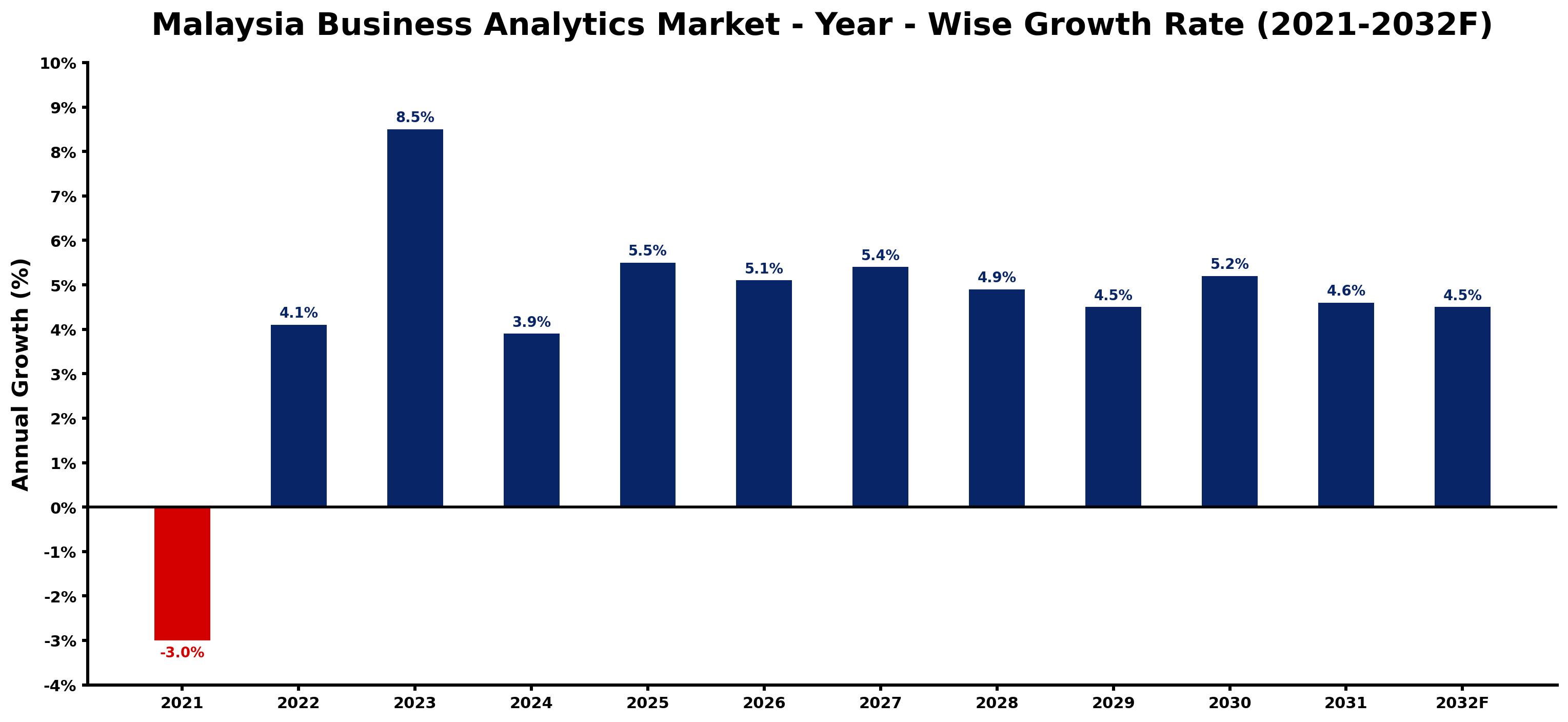
The table below presents the year‑wise growth rates along with the key drivers influencing the market
| Year | Growth Rate | Major Drivers |
| 2021 | -3.0% | Decline in spending from Malaysian government contracts |
| 2022 | 4.1% | Digital Economy Council supports data-driven decision making. |
| 2023 | 8.5% | Gaining traction from Malaysia's National AI Strategy 2021. |
| 2024 | 3.9% | Local businesses emphasizing data analytics for competitive edge. |
| 2025 | 5.5% | Government grants encourage local firms adopting analytics solutions. |
| 2026 | 5.1% | Increased demand for smart solutions in retail sector. |
| 2027 | 5.4% | Rising investment in industrial IoT boosting data analytics needs. |
| 2028 | 4.9% | Growing focus on sustainable business practices driving analytics use. |
| 2029 | 4.5% | Telecommunications sector evolving with enhanced data handling capabilities. |
| 2030 | 5.2% | Healthcare sector adoption of predictive analytics enhances efficiency. |
| 2031 | 4.6% | Education sector leveraging analytics for student performance insights. |
| 2032 | 4.5% | Financial services investing in analytics for risk management. |
Note: Market size estimations and growth projections presented in this report are based on 6Wresearch's proprietary forecasting methodology, utilizing the latest available industry data, government publications, and primary research inputs.
Malaysia Business Analytics Market Key Takeaways
Below are some of the specific key takeaways from the market, including:
- The market is driven by the rising necessity for data-driven decision-making among organizations.
- Integration of artificial intelligence and machine learning technologies is boosting the demand for analytics solutions.
- Data governance and security challenges present hurdles for organizations looking to implement analytics effectively.
- The COVID-19 pandemic has accelerated the adoption of analytics tools across various business functions.
- Government initiatives are playing a significant role in shaping the analytics ecosystem in Malaysia.
Evaluation of Restraints in Malaysia Business Analytics Market
The Malaysia Business Analytics Market faces several restraints that hinder its full potential. A major concern is the issue of data governance and security, where businesses struggle to protect sensitive information while ensuring accessibility for analysis. on top of that, inconsistent data quality and integration can skew insights, making organizations hesitant to fully embrace analytics. Compounding these issues, the need for skilled professionals in analytics remains a pressing challenge, as training and development can be resource-intensive. Lastly, the rapid pace of technological advancements demands constant updates to analytics strategies, which can overwhelm companies that are not prepared.
Malaysia Business Analytics Market Trends
Current trends in the Malaysia Business Analytics Market reflect a shift towards more sophisticated analytics techniques. Companies are increasingly investing in real-time analytics to enhance decision-making capabilities. Another significant trend is the growing adoption of cloud-based analytics solutions, offering flexibility and scalability to businesses of all sizes. on top of that, the integration of artificial intelligence in analytics tools is helping organizations uncover deeper insights and automate processes, ultimately driving efficiency.
Malaysia Business Analytics Market Opportunities
The future holds substantial growth opportunities for players in the Malaysia Business Analytics Market. As businesses seek to enhance their competitive advantage, there is a strong demand for customized analytics solutions tailored to specific industries. Additionally, the increasing focus on customer experience and personalization is driving organizations to invest in advanced analytics to better understand consumer behavior. on top of that, partnerships between technology providers and businesses can facilitate innovation and broaden the scope of analytics applications.
Government Initiatives in the Malaysia Business Analytics Market
The Malaysian government is actively fostering the development of the Business Analytics Market through various initiatives aimed at enhancing digital infrastructure and promoting data-driven strategies. With a focus on innovation, the government is prioritizing investments that bolster analytical capabilities across sectors. These efforts underscore the importance of public policy in creating an environment conducive to analytics adoption.
- A recently completed initiative focused on upgrading national digital infrastructure to enhance data accessibility for businesses.
- A current program promoting public-private partnerships to facilitate the adoption of analytics in the healthcare sector.
- Ongoing training programs designed to develop analytics skills among the workforce, aimed at addressing the talent gap.
- A planned initiative to establish a regulatory framework that supports data privacy while encouraging analytics innovation by 2026.
Future Insights of the Malaysia Business Analytics Market
Looking ahead to 2026-2032, the Malaysia Business Analytics Market is expected to continue its upward trajectory. As businesses increasingly prioritize data-driven strategies, the demand for advanced analytics tools will likely grow. Additionally, the integration of emerging technologies, such as AI and machine learning, will further enhance the capabilities of analytics solutions. Organizations that invest in these technologies will be better positioned to capitalize on market opportunities and drive sustainable growth.
Malaysia Business Analytics Market Latest Developments
In the past year, the Malaysia Business Analytics Market has seen notable developments as organizations strive to enhance their analytics capabilities. Companies are increasingly focusing on integrating advanced technologies to optimize their operations and decision-making processes. This trend reflects a broader commitment to leveraging data for strategic advantage.
- A major technology vendor launched a new analytics platform in early 2025, designed to provide real-time insights across various business functions.
- A leading regional operator initiated a partnership with local universities in mid-2025 to promote analytics education and research.
- An ongoing project aims to implement predictive analytics solutions in the retail sector, enhancing inventory management by mid-2026.
- Upcoming enhancements to existing analytics software are expected to be rolled out by late 2026, focusing on user experience and integration capabilities.
Malaysia Business Analytics Market - Key Attractiveness of the Report
- 10 Years of Market Numbers
- Historical Data Starting from 2022 to 2025
- Base Year: 2025
- Forecast Data until 2032
- Key Performance Indicators Impacting the Market
- Major Upcoming Developments and Projects
Key Highlights of the Report:
- Malaysia Business Analytics Market Outlook
- Market Size of Malaysia Business Analytics Market, 2025
- Forecast of Malaysia Business Analytics Market, 2032
- Historical Data and Forecast of Malaysia Business Analytics Revenues & Volume for the Period 2022-2032F
- Malaysia Business Analytics Market Trend Evolution
- Malaysia Business Analytics Market Drivers and Challenges
- Malaysia Business Analytics Price Trends
- Malaysia Business Analytics Porter's Five Forces
- Malaysia Business Analytics Industry Life Cycle
- Historical Data and Forecast of Malaysia Business Analytics Market Revenues & Volume By Software for the Period 2022-2032F
- Historical Data and Forecast of Malaysia Business Analytics Market Revenues & Volume By Query, Reporting and Analysis Tools for the Period 2022-2032F
- Historical Data and Forecast of Malaysia Business Analytics Market Revenues & Volume By Advanced and Predictive Analytics for the Period 2022-2032F
- Historical Data and Forecast of Malaysia Business Analytics Market Revenues & Volume By Location Intelligence for the Period 2022-2032F
- Historical Data and Forecast of Malaysia Business Analytics Market Revenues & Volume By Content Analytics for the Period 2022-2032F
- Historical Data and Forecast of Malaysia Business Analytics Market Revenues & Volume By Data Warehousing Platform for the Period 2022-2032F
- Historical Data and Forecast of Malaysia Business Analytics Market Revenues & Volume By Enterprise Performance Management for the Period 2022-2032F
- Historical Data and Forecast of Malaysia Business Analytics Market Revenues & Volume By Deployment Type for the Period 2022-2032F
- Historical Data and Forecast of Malaysia Business Analytics Market Revenues & Volume By Cloud for the Period 2022-2032F
- Historical Data and Forecast of Malaysia Business Analytics Market Revenues & Volume By On-Premises for the Period 2022-2032F
- Historical Data and Forecast of Malaysia Business Analytics Market Revenues & Volume By User Type for the Period 2022-2032F
- Historical Data and Forecast of Malaysia Business Analytics Market Revenues & Volume By Large Enterprises for the Period 2022-2032F
- Historical Data and Forecast of Malaysia Business Analytics Market Revenues & Volume By SMBs for the Period 2022-2032F
- Historical Data and Forecast of Malaysia Business Analytics Market Revenues & Volume By Vertical for the Period 2022-2032F
- Historical Data and Forecast of Malaysia Business Analytics Market Revenues & Volume By Banking, Financial Services, and Insurance (BFSI) for the Period 2022-2032F
- Historical Data and Forecast of Malaysia Business Analytics Market Revenues & Volume By Energy and power for the Period 2022-2032F
- Historical Data and Forecast of Malaysia Business Analytics Market Revenues & Volume By Education for the Period 2022-2032F
- Historical Data and Forecast of Malaysia Business Analytics Market Revenues & Volume By Government for the Period 2022-2032F
- Historical Data and Forecast of Malaysia Business Analytics Market Revenues & Volume By Retail for the Period 2022-2032F
- Historical Data and Forecast of Malaysia Business Analytics Market Revenues & Volume By Healthcare for the Period 2022-2032F
- Historical Data and Forecast of Malaysia Business Analytics Market Revenues & Volume By Media and Entertainment for the Period 2022-2032F
- Historical Data and Forecast of Malaysia Business Analytics Market Revenues & Volume By Manufacturing for the Period 2022-2032F
- Malaysia Business Analytics Import Export Trade Statistics
- Market Opportunity Assessment By Software
- Market Opportunity Assessment By Deployment Type
- Market Opportunity Assessment By User Type
- Market Opportunity Assessment By Vertical
- Malaysia Business Analytics Top Companies Market Share
- Malaysia Business Analytics Competitive Benchmarking By Technical and Operational Parameters
- Malaysia Business Analytics Company Profiles
- Malaysia Business Analytics Key Strategic Recommendations






































