Malaysia Computer-Aided Manufacturing Market Size & Growth Rate (2026-2032)
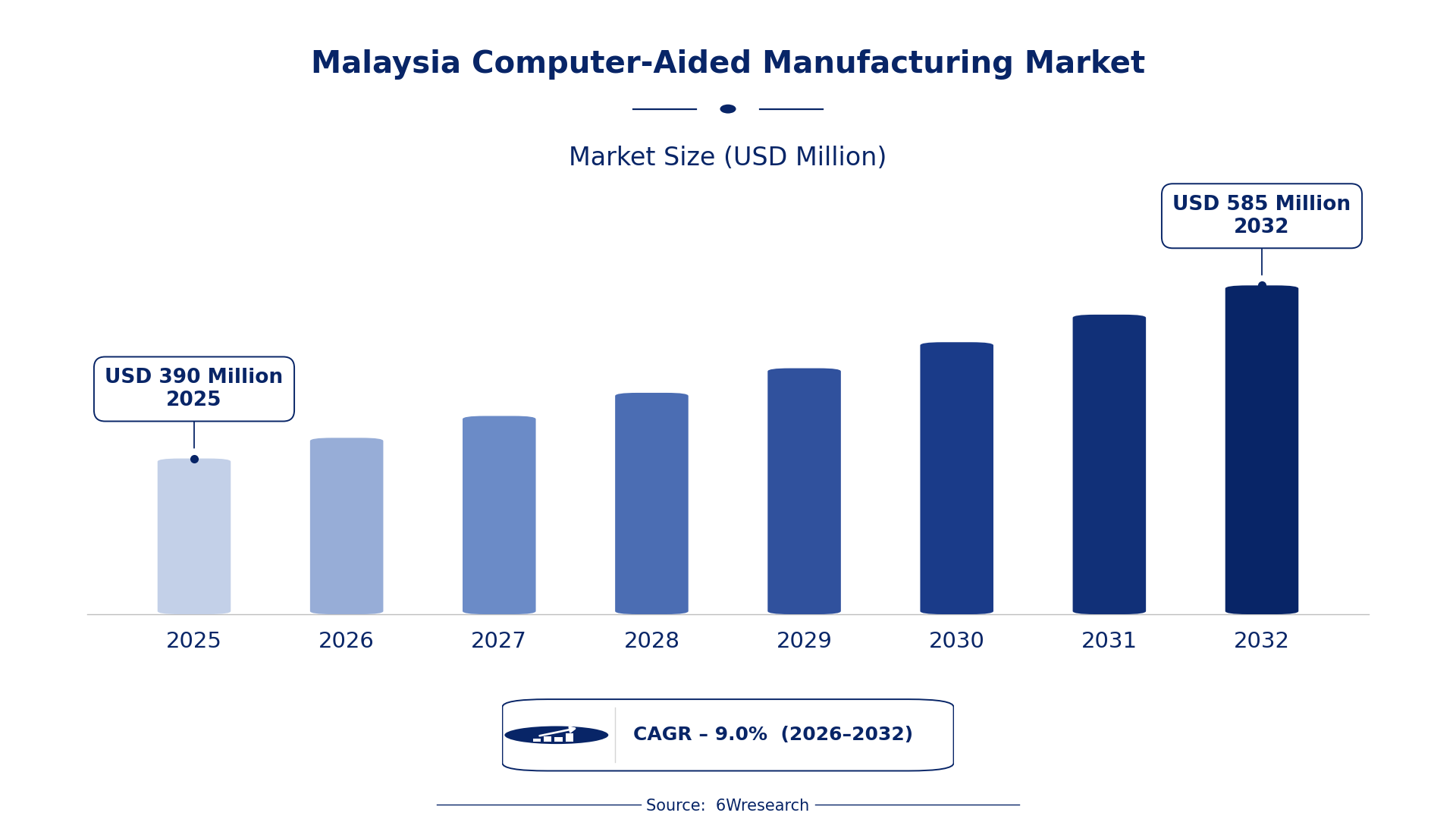
The Malaysia Computer-Aided Manufacturing Market was estimated at USD 390 Million in 2025 and is projected to reach USD 585 Million by 2032, growing at a CAGR of 9.0% from 2026 to 2032.
Malaysia Computer-Aided Manufacturing Market Synopsis
The demand for precision and efficiency in manufacturing processes is rising sharply in Malaysia, with various industries such as aerospace, automotive, and electronics leading the charge. Computer-Aided Manufacturing (CAM) solutions are increasingly recognized for their ability to automate processes and enhance product quality, driving the market forward.
The competitive landscape is diverse, featuring both global leaders and local firms that cater to unique manufacturing needs. This mix not only fosters innovation but also ensures that businesses have access to tailored solutions, setting the stage for continuous market expansion.
Malaysia Computer-Aided Manufacturing Market Year-wise Growth Rate and Key Drivers
This graph illustrates the annual growth rates of the Malaysia Computer-Aided Manufacturing Market from 2021 to 2032, highlighting a steady upward trajectory and projected expansion over the forecast period.
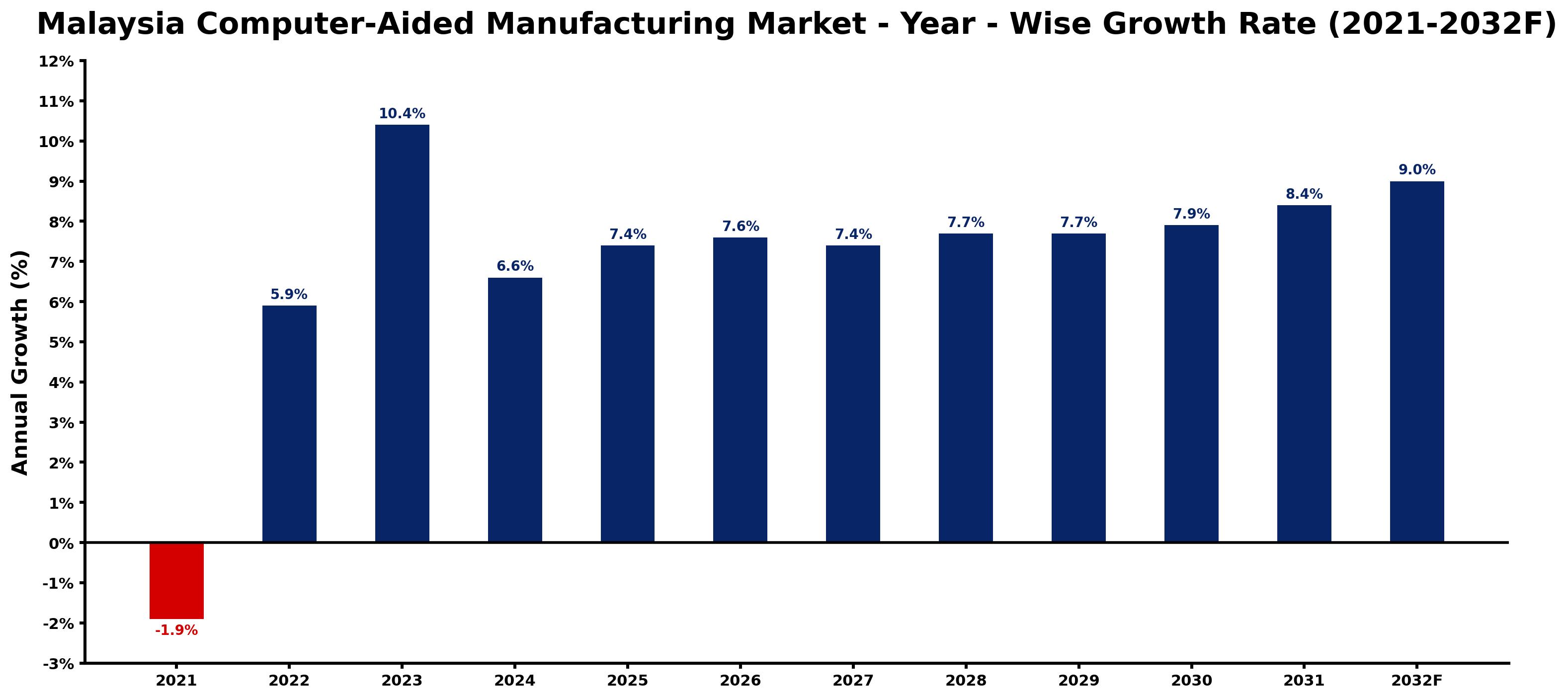
The table below presents the year‑wise growth rates along with the key drivers influencing the market
| Year | Growth Rate | Major Drivers |
| 2021 | -1.9% | Pandemic-related factory shutdowns limited production capabilities. |
| 2022 | 5.9% | Industry 4.0 initiatives driving investments in automation. |
| 2023 | 10.4% | SME digitalization grants boosting computer-aided manufacturing adoption. |
| 2024 | 6.6% | Government funding for advanced manufacturing technology projects. |
| 2025 | 7.4% | Increase in skilled workforce from technical training programs. |
| 2026 | 7.6% | Rising adoption of robotics in local manufacturing sectors. |
| 2027 | 7.4% | Export demand for locally manufactured precision components rising. |
| 2028 | 7.7% | Malaysian manufacturers seeking efficiency through smart technologies. |
| 2029 | 7.7% | Regional trade agreements enhancing competitive manufacturing landscape. |
| 2030 | 7.9% | Emergence of local startups innovating in CAD software. |
| 2031 | 8.4% | Government incentives for green manufacturing technology integration. |
| 2032 | 9.0% | Increased focus on digital transformation in local industries. |
Note: Market size estimations and growth projections presented in this report are based on 6Wresearch's proprietary forecasting methodology, utilizing the latest available industry data, government publications, and primary research inputs.
Malaysia Computer-Aided Manufacturing Market Key Takeaways
Below are some of the specific key takeaways from the market, including:
- Growing demand for CAM technologies is primarily driven by the need for enhanced manufacturing efficiency.
- Adoption of CAM systems is being accelerated by ongoing digital transformation efforts in the manufacturing sector.
- Local providers are increasingly tailoring CAM solutions to meet the specific challenges faced by Malaysian manufacturers.
- Investment in workforce training is crucial for maximizing the benefits of CAM technologies.
- COVID-19 has acted as a catalyst for the adoption of advanced manufacturing technologies in Malaysia.
Evaluation of Restraints in Malaysia Computer-Aided Manufacturing Market
The primary challenges facing the Malaysia Computer-Aided Manufacturing Market revolve around workforce development and skills training. Many manufacturers are struggling to find employees with the requisite expertise in CAD/CAM technology. This skills gap can hinder the effective implementation of CAM solutions, ultimately limiting productivity gains. Without a strong focus on education and training initiatives, the potential of CAM technologies may remain underutilized.
Malaysia Computer-Aided Manufacturing Market Trends
The trend toward automation and digitization is reshaping the manufacturing sector, with CAM technologies at the forefront. Increasingly, companies are integrating CAM with other advanced technologies like IoT and AI to further enhance production capabilities. The push for sustainable manufacturing practices is also influencing CAM solutions, as firms seek to optimize resource usage while minimizing waste.
Malaysia Computer-Aided Manufacturing Market Opportunities
Significant growth opportunities lie in the integration of CAM with emerging technologies such as additive manufacturing and smart factories. The Malaysian government’s push for Industry 4.0 is likely to create a conducive environment for CAM adoption. Additionally, sectors like aerospace and electronics are expected to invest heavily in CAM solutions, presenting avenues for companies offering innovative and efficient manufacturing solutions.
Government Initiatives in the Malaysia Computer-Aided Manufacturing Market
Government policy in Malaysia is actively shaping the Computer-Aided Manufacturing Market through various initiatives aimed at fostering technological adoption and workforce development. The regulatory framework emphasizes enhancing manufacturing capabilities while ensuring that businesses can access the necessary resources to modernize their operations.
- A recently completed initiative involved the launch of a national program to promote digital manufacturing technologies, enhancing competitiveness across sectors.
- A current initiative focuses on partnerships with educational institutions to develop specialized training programs for CAD/CAM skills.
- Upcoming plans include a regulatory framework aimed at incentivizing companies to adopt advanced manufacturing technologies by 2026.
- The government is also investing in infrastructure upgrades to support smart manufacturing environments, currently underway in key industrial regions.
- An initiative to establish innovation hubs across major manufacturing clusters is planned for 2027, aimed at fostering collaboration and R&D.
Future Insights of the Malaysia Computer-Aided Manufacturing Market
Looking ahead to 2026-2032, the Malaysia Computer-Aided Manufacturing Market is set to experience substantial growth driven by technological advancements and increased industry demand for efficiency. As manufacturers continue to adopt integrated CAM solutions, the focus will shift towards enhancing the agility of production processes. With government support and a growing emphasis on upskilling the workforce, the market is likely to evolve rapidly, offering new opportunities for innovation and competitive advantage.
Malaysia Computer-Aided Manufacturing Market Latest Developments
In the last year, the Malaysia Computer-Aided Manufacturing Market has witnessed a flurry of activity as firms accelerate their digital transformation efforts. The pandemic has prompted manufacturers to re-evaluate their production strategies, pushing them to integrate more sophisticated CAM technologies into their operations.
- A leading technology vendor launched a new suite of CAM software aimed at enhancing CNC machining capabilities in early 2023.
- An ongoing initiative aims to upgrade existing CAM systems across major automotive manufacturers, improving production efficiency and reducing lead times.
- A partnership between two regional firms was formed in Q1 2023 to co-develop innovative CAM solutions tailored for the electronics sector.
- Plans for a new training facility dedicated to CAD/CAM skills development were announced in late 2022 and are expected to open by mid-2023.
- A rollout of a comprehensive CAM integration program is set to begin in Q3 2023, targeting small and medium-sized enterprises (SMEs).
Malaysia Computer-Aided Manufacturing Market - Key Attractiveness of the Report
- 10 Years of Market Numbers
- Historical Data Starting from 2022 to 2025
- Base Year: 2025
- Forecast Data until 2032
- Key Performance Indicators Impacting the Market
- Major Upcoming Developments and Projects
Key Highlights of the Report:
- Malaysia Computer-Aided Manufacturing Market Outlook
- Market Size of Malaysia Computer-Aided Manufacturing Market, 2025
- Forecast of Malaysia Computer-Aided Manufacturing Market, 2032
- Historical Data and Forecast of Malaysia Computer-Aided Manufacturing Revenues & Volume for the Period 2022-2032F
- Malaysia Computer-Aided Manufacturing Market Trend Evolution
- Malaysia Computer-Aided Manufacturing Market Drivers and Challenges
- Malaysia Computer-Aided Manufacturing Price Trends
- Malaysia Computer-Aided Manufacturing Porter's Five Forces
- Malaysia Computer-Aided Manufacturing Industry Life Cycle
- Historical Data and Forecast of Malaysia Computer-Aided Manufacturing Market Revenues & Volume By Component for the Period 2022-2032F
- Historical Data and Forecast of Malaysia Computer-Aided Manufacturing Market Revenues & Volume By Solution for the Period 2022-2032F
- Historical Data and Forecast of Malaysia Computer-Aided Manufacturing Market Revenues & Volume By Services for the Period 2022-2032F
- Historical Data and Forecast of Malaysia Computer-Aided Manufacturing Market Revenues & Volume By Training and education for the Period 2022-2032F
- Historical Data and Forecast of Malaysia Computer-Aided Manufacturing Market Revenues & Volume By Support and maintenance for the Period 2022-2032F
- Historical Data and Forecast of Malaysia Computer-Aided Manufacturing Market Revenues & Volume By Industry Vertical for the Period 2022-2032F
- Historical Data and Forecast of Malaysia Computer-Aided Manufacturing Market Revenues & Volume By Automotive for the Period 2022-2032F
- Historical Data and Forecast of Malaysia Computer-Aided Manufacturing Market Revenues & Volume By Aerospace and Defense for the Period 2022-2032F
- Historical Data and Forecast of Malaysia Computer-Aided Manufacturing Market Revenues & Volume By Industrial Equipment for the Period 2022-2032F
- Historical Data and Forecast of Malaysia Computer-Aided Manufacturing Market Revenues & Volume By High Tech for the Period 2022-2032F
- Historical Data and Forecast of Malaysia Computer-Aided Manufacturing Market Revenues & Volume By Medical Devices and Component for the Period 2022-2032F
- Historical Data and Forecast of Malaysia Computer-Aided Manufacturing Market Revenues & Volume By Energy and Utilities for the Period 2022-2032F
- Historical Data and Forecast of Malaysia Computer-Aided Manufacturing Market Revenues & Volume By Others for the Period 2022-2032F
- Historical Data and Forecast of Malaysia Computer-Aided Manufacturing Market Revenues & Volume By Deployment Type for the Period 2022-2032F
- Historical Data and Forecast of Malaysia Computer-Aided Manufacturing Market Revenues & Volume By On-Premises for the Period 2022-2032F
- Historical Data and Forecast of Malaysia Computer-Aided Manufacturing Market Revenues & Volume By Cloud for the Period 2022-2032F
- Historical Data and Forecast of Malaysia Computer-Aided Manufacturing Market Revenues & Volume By Organization Size for the Period 2022-2032F
- Historical Data and Forecast of Malaysia Computer-Aided Manufacturing Market Revenues & Volume By Large enterprises for the Period 2022-2032F
- Historical Data and Forecast of Malaysia Computer-Aided Manufacturing Market Revenues & Volume By SMEs for the Period 2022-2032F
- Malaysia Computer-Aided Manufacturing Import Export Trade Statistics
- Market Opportunity Assessment By Component
- Market Opportunity Assessment By Industry Vertical
- Market Opportunity Assessment By Deployment Type
- Market Opportunity Assessment By Organization Size
- Malaysia Computer-Aided Manufacturing Top Companies Market Share
- Malaysia Computer-Aided Manufacturing Competitive Benchmarking By Technical and Operational Parameters
- Malaysia Computer-Aided Manufacturing Company Profiles
- Malaysia Computer-Aided Manufacturing Key Strategic Recommendations






































