Malaysia Data Center Market Size & Growth Rate (2026-2032)
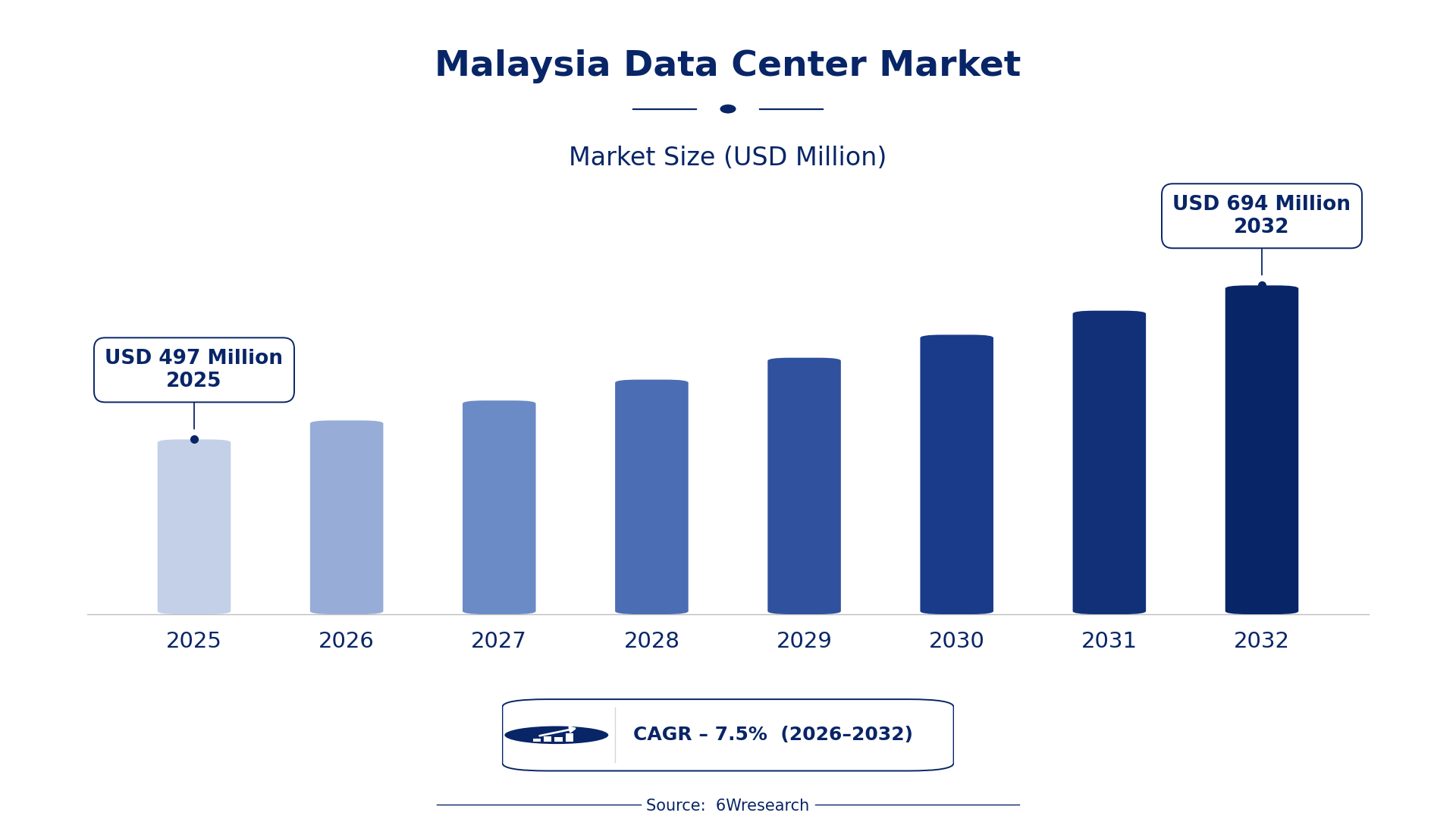
The Malaysia Data Center Market was estimated at USD 497 Million in 2025 and is projected to reach USD 694 Million by 2032, growing at a CAGR of 7.5% from 2026 to 2032.
Malaysia Data Center Market Synopsis
The Malaysia Data Center market has been on a growth trajectory, driven by rising data storage demands and an increase in cloud service adoption. This momentum indicates a vibrant sector adapting swiftly to the digital transformation needs of various industries.
Looking ahead, the market is expected to evolve further, with enterprises prioritizing enhanced security and energy efficiency. The strategic position of Malaysia as a digital hub in Southeast Asia will continue to attract investments and foster innovation in data center infrastructure.
Malaysia Data Center Market Year-wise Growth Rate and Key Drivers
This graph illustrates the annual growth rates of the Malaysia Data Center Market from 2021 to 2032, highlighting a steady upward trajectory and projected expansion over the forecast period.
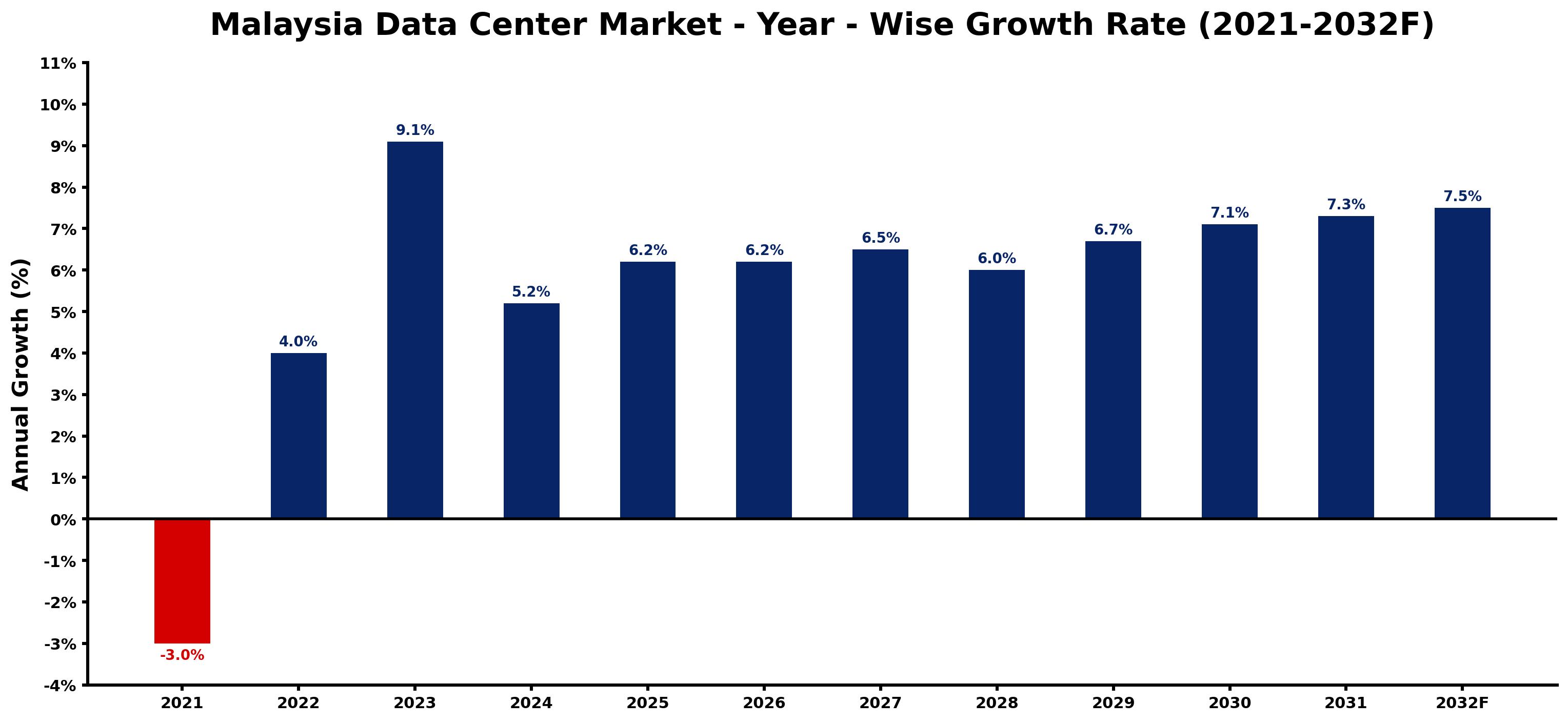
The table below presents the year‑wise growth rates along with the key drivers influencing the market
| Year | Growth Rate | Major Drivers |
| 2021 | -3.0% | Pandemic restrictions delayed data center construction projects. |
| 2022 | 4.0% | Government's JENDELA initiative enhancing digital connectivity access. |
| 2023 | 9.1% | Increased cloud adoption by SMEs driving infrastructure investment. |
| 2024 | 5.2% | Growth in e-commerce fueling server demands and capabilities. |
| 2025 | 6.2% | Emergence of cybersecurity regulations promoting data protection needs. |
| 2026 | 6.2% | Green data center initiatives attracting foreign investors. |
| 2027 | 6.5% | Rise in remote work boosting data storage requirements. |
| 2028 | 6.0% | Investment in AI technologies increasing computational demands. |
| 2029 | 6.7% | Local tech events showcasing innovations attracting investments. |
| 2030 | 7.1% | Government partnerships with tech firms enhancing data infrastructure. |
| 2031 | 7.3% | Growing gaming industry creating demand for latency-sensitive services. |
| 2032 | 7.5% | Emergence of fintech firms driving advanced data processing needs. |
Note: Market size estimations and growth projections presented in this report are based on 6Wresearch's proprietary forecasting methodology, utilizing the latest available industry data, government publications, and primary research inputs.
Malaysia Data Center Market Key Takeaways
Below are some of the specific key takeaways from the market, including:
- Digital transformation initiatives are significantly driving the demand for data centers in Malaysia.
- Cloud computing adoption is a major factor influencing growth across various sectors.
- Energy efficiency and sustainability are increasingly becoming focal points for data center operators.
- Government policies are playing a crucial role in shaping the regulatory environment for the market.
- Major players are investing heavily in advanced technologies and infrastructure to stay competitive.
Evaluation of Restraints in Malaysia Data Center Market
Several restraints are evident in the Malaysia Data Center market that could impede its growth. The rapid increase in data generation presents a challenge for data centers that must continuously scale their operations. With the rise of cloud computing and IoT applications, existing facilities often struggle to keep pace with demand. on top of that, energy consumption is a critical issue, as data centers must address both environmental concerns and operational costs. Ensuring compliance with stringent security regulations adds another layer of complexity for operators in this competitive space.
Malaysia Data Center Market Trends
Several trends are shaping the Malaysia Data Center market. The push towards hybrid cloud solutions is gaining traction, allowing organizations to balance on-premise and cloud environments effectively. Another trend is the increasing emphasis on data sovereignty, prompting companies to utilize local data centers to comply with regulations. Additionally, advancements in AI and machine learning are being integrated into data center operations to optimize performance and enhance resource management.
Malaysia Data Center Market Opportunities
Investment opportunities abound in the Malaysia Data Center market, particularly in the areas of infrastructure expansion and technological upgrades. The demand for edge computing solutions is expected to grow, driven by the need for low-latency processing closer to data sources. on top of that, partnerships between local and international firms are likely to create synergies that foster innovation and expand service offerings, paving the way for new market entrants and enhanced competition.
Government Initiatives in the Malaysia Data Center Market
The Malaysian government has been actively shaping the data center market through various initiatives aimed at enhancing digital infrastructure. Public policies are focused on fostering growth while ensuring compliance with international standards. These initiatives are critical for positioning Malaysia as a leading data center hub in Southeast Asia.
- A national digital infrastructure upgrade programme launched in early 2023 aims to enhance connectivity across urban and rural areas.
- A regulatory framework introduced in 2024 mandates enhanced energy efficiency measures for new data center constructions.
- Currently ongoing is a public-private partnership focused on developing eco-friendly data center solutions to reduce carbon emissions.
- Upcoming initiatives include a planned investment programme expected to attract foreign investments in data center projects by 2026.
- A recently completed initiative provided tax incentives for data center operators investing in renewable energy technologies.
Future Insights of the Malaysia Data Center Market
From 2026 to 2032, the Malaysia Data Center market is set for continued growth, driven by increasing data consumption and technological advancements. As businesses continue to digitize their operations, the demand for secure, efficient, and scalable data storage solutions will intensify. The government's supportive policies and strategic investments in infrastructure are expected to create a favorable environment for market players. Emerging technologies like AI and IoT will further influence the operational dynamics of data centers, leading to innovative service offerings and improved customer experiences.
Malaysia Data Center Market Latest Developments
Over the past year, the Malaysia Data Center market has witnessed several notable developments, reflecting an industry adapting to new challenges and opportunities. The focus on sustainability and innovation has driven many operators to enhance their offerings and expand their facilities.
- A major technology vendor announced a partnership in late 2023 to develop advanced cooling technologies for data centers, aiming to reduce energy consumption.
- In early 2024, a leading regional operator completed the construction of a new facility designed to incorporate renewable energy sources.
- An initiative launched in mid-2023 is currently underway, targeting the integration of AI-driven analytics in data center operations.
- By late 2024, a planned upgrade of existing infrastructure will enhance connectivity and speed across multiple data centers in Malaysia.
- A recent collaboration between multiple stakeholders initiated in Q1 2024 aims to create a regional data exchange platform to facilitate data sharing and interoperability.
Malaysia Data Center Market - Key Attractiveness of the Report
- 10 Years of Market Numbers
- Historical Data Starting from 2022 to 2025
- Base Year: 2025
- Forecast Data until 2032
- Key Performance Indicators Impacting the Market
- Major Upcoming Developments and Projects
Key Highlights of the Report:
- Malaysia Data Center Market Outlook
- Market Size of Malaysia Data Center Market, 2025
- Forecast of Malaysia Data Center Market, 2032
- Historical Data and Forecast of Malaysia Data Center Revenues & Volume for the Period 2022-2032F
- Malaysia Data Center Market Trend Evolution
- Malaysia Data Center Market Drivers and Challenges
- Malaysia Data Center Price Trends
- Malaysia Data Center Porter's Five Forces
- Malaysia Data Center Industry Life Cycle
- Historical Data and Forecast of Malaysia Data Center Market Revenues & Volume By Component for the Period 2022-2032F
- Historical Data and Forecast of Malaysia Data Center Market Revenues & Volume By Electrical for the Period 2022-2032F
- Historical Data and Forecast of Malaysia Data Center Market Revenues & Volume By Mechanical for the Period 2022-2032F
- Historical Data and Forecast of Malaysia Data Center Market Revenues & Volume By Networking for the Period 2022-2032F
- Historical Data and Forecast of Malaysia Data Center Market Revenues & Volume By Racks for the Period 2022-2032F
- Historical Data and Forecast of Malaysia Data Center Market Revenues & Volume By Security Systems for the Period 2022-2032F
- Historical Data and Forecast of Malaysia Data Center Market Revenues & Volume By Fire Systems for the Period 2022-2032F
- Historical Data and Forecast of Malaysia Data Center Market Revenues & Volume By Vertical for the Period 2022-2032F
- Historical Data and Forecast of Malaysia Data Center Market Revenues & Volume By Banking Financial Services & Insurance (BFSI) for the Period 2022-2032F
- Historical Data and Forecast of Malaysia Data Center Market Revenues & Volume By Government for the Period 2022-2032F
- Historical Data and Forecast of Malaysia Data Center Market Revenues & Volume By IT & Telecom for the Period 2022-2032F
- Historical Data and Forecast of Malaysia Data Center Market Revenues & Volume By Media for the Period 2022-2032F
- Historical Data and Forecast of Malaysia Data Center Market Revenues & Volume By Retail for the Period 2022-2032F
- Historical Data and Forecast of Malaysia Data Center Market Revenues & Volume By Manufacturing for the Period 2022-2032F
- Historical Data and Forecast of Malaysia Data Center Market Revenues & Volume By Others for the Period 2022-2032F
- Malaysia Data Center Import Export Trade Statistics
- Market Opportunity Assessment By Component
- Market Opportunity Assessment By Vertical
- Malaysia Data Center Top Companies Market Share
- Malaysia Data Center Competitive Benchmarking By Technical and Operational Parameters
- Malaysia Data Center Company Profiles
- Malaysia Data Center Key Strategic Recommendations






































