Malaysia Decorative Laminates Market Size, Share & Growth Rate
The Malaysia Decorative Laminates Market was estimated at USD 205 Million in 2025 and is projected to reach USD 265 Million by 2032, growing at a CAGR of 3.7% from 2026 to 2032. This growth trajectory is driven primarily by robust demand from the construction and interior design sectors, fueled by urbanization and a thriving real estate market. Homeowners and designers are increasingly seeking durable, aesthetically appealing laminate options, which is fostering innovation and expansion in this vibrant sector.
Malaysia Decorative Laminates Market Year-wise Growth Rate and Key Drivers
This graph highlights how the Malaysia Decorative Laminates Market has steadily grown over the years, supported by major growth factors.
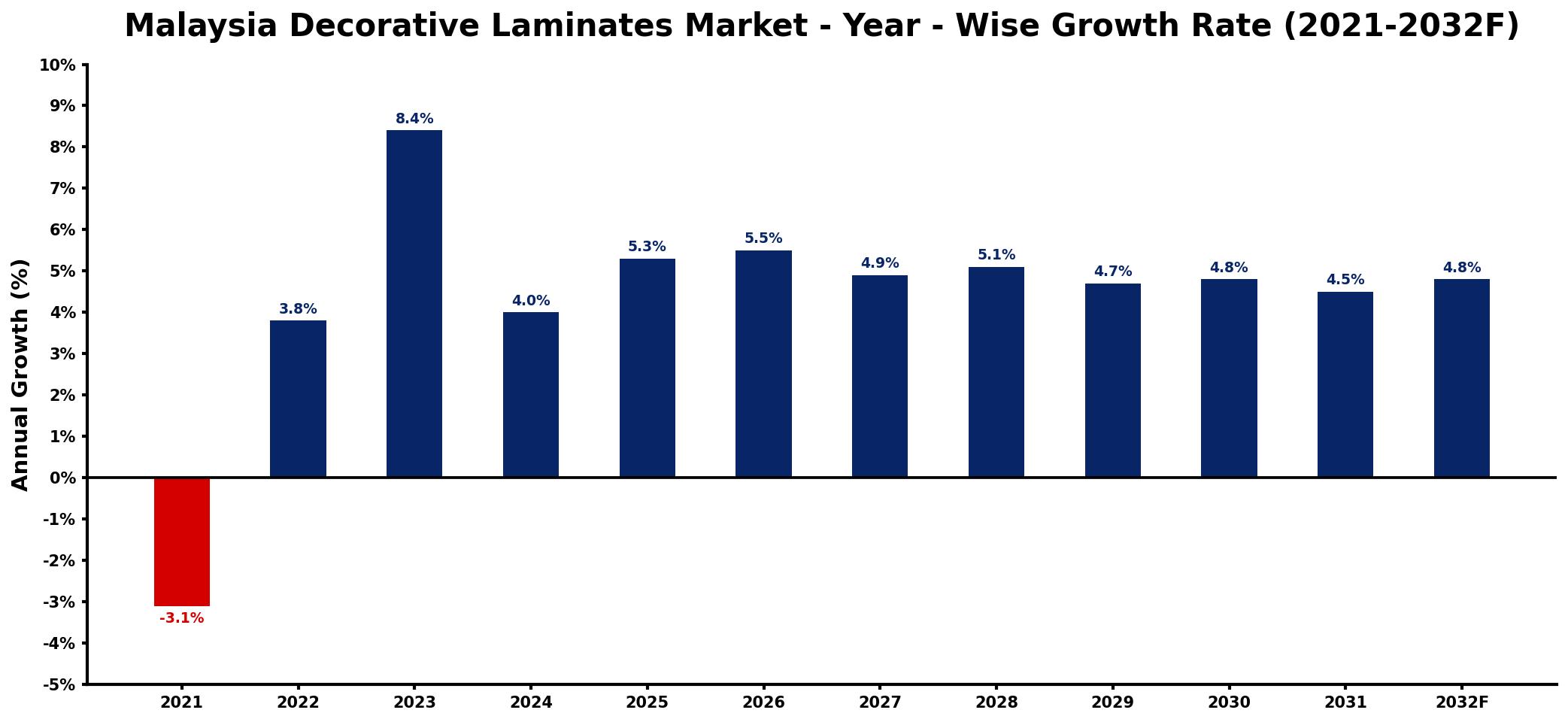
The table below presents the year‑wise growth rates along with the key drivers influencing the market
| Year | Growth Rate | Major Drivers |
| 2021 | -3.1% | Construction sector investments decline significantly |
| 2022 | 3.8% | Increased residential renovation projects |
| 2023 | 8.4% | Rising demand from interior design |
| 2024 | 4.0% | Expansion of commercial real estate |
| 2025 | 5.3% | Growth in furniture manufacturing sector |
| 2026 | 5.5% | Surge in eco-friendly building materials |
| 2027 | 4.9% | Technological advancements in production |
| 2028 | 5.1% | Increased exports to regional markets |
| 2029 | 4.7% | Growing popularity of DIY projects |
| 2030 | 4.8% | Enhanced marketing strategies adopted |
| 2031 | 4.5% | Emergence of new market entrants |
| 2032 | 4.8% | Strengthened partnerships with suppliers |
Note: Market size estimations and growth projections presented in this report are based on 6Wresearch's proprietary forecasting methodology, utilizing the latest available industry data, government publications, and primary research inputs.
Malaysia Decorative Laminates Market Synopsis
In recent years, the Malaysia decorative laminates market has witnessed a noticeable transformation, largely influenced by the rising demand for stylish and functional interior solutions. From furniture to wall applications, the versatility of decorative laminates is appealing to a wide array of consumers, including architects and interior designers.
As urban living spaces continue to evolve, the inclination towards interior renovations and innovative design solutions is escalating. This is resulting in a proactive shift towards sustainable and eco-friendly laminate products, aligning with growing consumer consciousness about environmental issues.
Malaysia Decorative Laminates Market Key Takeaways
- The market is poised for steady growth, bolstered by urbanization and a flourishing real estate sector.
- Rising disposable incomes are driving consumer interest in home renovation and interior decoration.
- There's a significant shift towards sustainability, with eco-friendly laminate options gaining traction.
- Manufacturers must navigate increasing competition and price sensitivity to maintain market presence.
- The resurgence in home improvement post-COVID-19 is positively impacting market dynamics.
Evaluation of Restraints in Malaysia Decorative Laminates Market
Despite its promising outlook, the Malaysia decorative laminates market faces notable restraints that could hinder growth. The fierce competition among manufacturers often leads to price wars, squeezing profit margins and forcing companies to differentiate themselves through innovation and quality. Additionally, economic fluctuations directly impact the construction and real estate sectors, influencing demand. With rapid shifts in consumer preferences and design trends, businesses must be agile and responsive, while also addressing stringent environmental regulations surrounding the production of laminates, particularly concerning adhesives and chemical use.
Malaysia Decorative Laminates Market Trends
Current trends indicate a growing preference for multi-functional and customizable decorative laminates that cater to both aesthetic appeal and practicality. As sustainability continues to be a priority, manufacturers are investing in developing eco-friendly products that use sustainable materials and low-impact production processes. The integration of technology in laminate design, including the use of digital printing for unique patterns, is also becoming increasingly popular, allowing consumers greater choice and personalization in their interior spaces.
Malaysia Decorative Laminates Market Opportunities
Significant growth opportunities lie in the development of innovative, sustainable laminate solutions that meet evolving consumer preferences. As urbanization drives more individuals to renovate or redesign their homes, there is a heightened demand for stylish yet durable materials. The advent of digital technology presents avenues for manufacturers to explore new designs and finishes, further enhancing market appeal. Additionally, collaboration with interior designers and architects can facilitate the introduction of tailored products that meet specific project requirements, broadening market reach.
Government Initiatives in the Malaysia Decorative Laminates Market
The Malaysian government is actively promoting sustainable construction and interior design practices through various initiatives. Investments in public infrastructure and housing projects are creating demand for decorative laminates. Policies aimed at environmental sustainability are encouraging manufacturers to adopt eco-friendly practices and products, aligning market growth with national goals of sustainability and innovation. Incentives for green building practices are fostering a supportive environment for laminate manufacturers to innovate and produce sustainable offerings.
Future Insights of the Malaysia Decorative Laminates Market
Looking ahead to the period between 2026 and 2032, the Malaysia decorative laminates market is expected to continue on its growth path, driven by sustained urbanization and increasing consumer awareness of design quality and sustainability. As the market adapts to evolving trends, manufacturers who prioritize innovation and eco-friendliness are likely to gain competitive advantages. The anticipated growth in both residential and commercial construction sectors will provide ample opportunities for the decorative laminates market to flourish in the coming years.
Malaysia Decorative Laminates Market Latest Developments (2025 - 2026)
Recent months have seen significant developments in the Malaysia decorative laminates market, with a noticeable shift toward incorporating sustainable materials in laminate production. Innovations in product design and manufacturing processes are making waves, as companies strive to meet the increasing demand for eco-friendly options. Industry players are also leveraging digital technologies for enhanced customization, allowing consumers to tailor designs according to personal preferences, thus setting new market standards.
Malaysia Decorative Laminates Market - Key Attractiveness of the Report
- 10 Years of Market Numbers
- Historical Data Starting from 2022 to 2025
- Base Year: 2025
- Forecast Data until 2032
- Key Performance Indicators Impacting the Market
- Major Upcoming Developments and Projects
Key Highlights of the Report:
- Malaysia Decorative Laminates Market Outlook
- Market Size of Malaysia Decorative Laminates Market, 2025
- Forecast of Malaysia Decorative Laminates Market, 2032
- Historical Data and Forecast of Malaysia Decorative Laminates Revenues & Volume for the Period 2022-2032F
- Malaysia Decorative Laminates Market Trend Evolution
- Malaysia Decorative Laminates Market Drivers and Challenges
- Malaysia Decorative Laminates Price Trends
- Malaysia Decorative Laminates Porter's Five Forces
- Malaysia Decorative Laminates Industry Life Cycle
- Historical Data and Forecast of Malaysia Decorative Laminates Market Revenues & Volume By Raw Material for the Period 2022-2032F
- Historical Data and Forecast of Malaysia Decorative Laminates Market Revenues & Volume By Plastic resins for the Period 2022-2032F
- Historical Data and Forecast of Malaysia Decorative Laminates Market Revenues & Volume By Overlays for the Period 2022-2032F
- Historical Data and Forecast of Malaysia Decorative Laminates Market Revenues & Volume By Adhesives for the Period 2022-2032F
- Historical Data and Forecast of Malaysia Decorative Laminates Market Revenues & Volume By Wood substrate for the Period 2022-2032F
- Historical Data and Forecast of Malaysia Decorative Laminates Market Revenues & Volume By Type for the Period 2022-2032F
- Historical Data and Forecast of Malaysia Decorative Laminates Market Revenues & Volume By General Purpose for the Period 2022-2032F
- Historical Data and Forecast of Malaysia Decorative Laminates Market Revenues & Volume By Postforming for the Period 2022-2032F
- Historical Data and Forecast of Malaysia Decorative Laminates Market Revenues & Volume By Special Products for the Period 2022-2032F
- Historical Data and Forecast of Malaysia Decorative Laminates Market Revenues & Volume By Backer for the Period 2022-2032F
- Historical Data and Forecast of Malaysia Decorative Laminates Market Revenues & Volume By Application for the Period 2022-2032F
- Historical Data and Forecast of Malaysia Decorative Laminates Market Revenues & Volume By Cabinets for the Period 2022-2032F
- Historical Data and Forecast of Malaysia Decorative Laminates Market Revenues & Volume By Furniture for the Period 2022-2032F
- Historical Data and Forecast of Malaysia Decorative Laminates Market Revenues & Volume By Flooring for the Period 2022-2032F
- Historical Data and Forecast of Malaysia Decorative Laminates Market Revenues & Volume By Table Top for the Period 2022-2032F
- Historical Data and Forecast of Malaysia Decorative Laminates Market Revenues & Volume By Counter Top for the Period 2022-2032F
- Historical Data and Forecast of Malaysia Decorative Laminates Market Revenues & Volume By Wall Panels for the Period 2022-2032F
- Historical Data and Forecast of Malaysia Decorative Laminates Market Revenues & Volume By End-Use for the Period 2022-2032F
- Historical Data and Forecast of Malaysia Decorative Laminates Market Revenues & Volume By Residential for the Period 2022-2032F
- Historical Data and Forecast of Malaysia Decorative Laminates Market Revenues & Volume By Non-residential for the Period 2022-2032F
- Historical Data and Forecast of Malaysia Decorative Laminates Market Revenues & Volume By Transportation for the Period 2022-2032F
- Malaysia Decorative Laminates Import Export Trade Statistics
- Market Opportunity Assessment By Raw Material
- Market Opportunity Assessment By Type
- Market Opportunity Assessment By Application
- Market Opportunity Assessment By End-Use
- Malaysia Decorative Laminates Top Companies Market Share
- Malaysia Decorative Laminates Competitive Benchmarking By Technical and Operational Parameters
- Malaysia Decorative Laminates Company Profiles
- Malaysia Decorative Laminates Key Strategic Recommendations






































