Malaysia Functional Apparel Market Size, Share & Growth Rate
The Malaysia Functional Apparel Market was estimated at USD 307 Million in 2025 and is projected to reach USD 401 Million by 2032, growing at a CAGR of 3.9% from 2026 to 2032. This growth trajectory is primarily fueled by the increasing health consciousness among Malaysians, prompting a demand for innovative clothing that combines performance and style. Additionally, the rise of outdoor activities and home workouts has further amplified interest in functional apparel, making it an integral part of the modern lifestyle.
Malaysia Functional Apparel Market Year-wise Growth Rate and Key Drivers
This graph highlights how the Malaysia Functional Apparel Market has steadily grown over the years, supported by major growth factors.
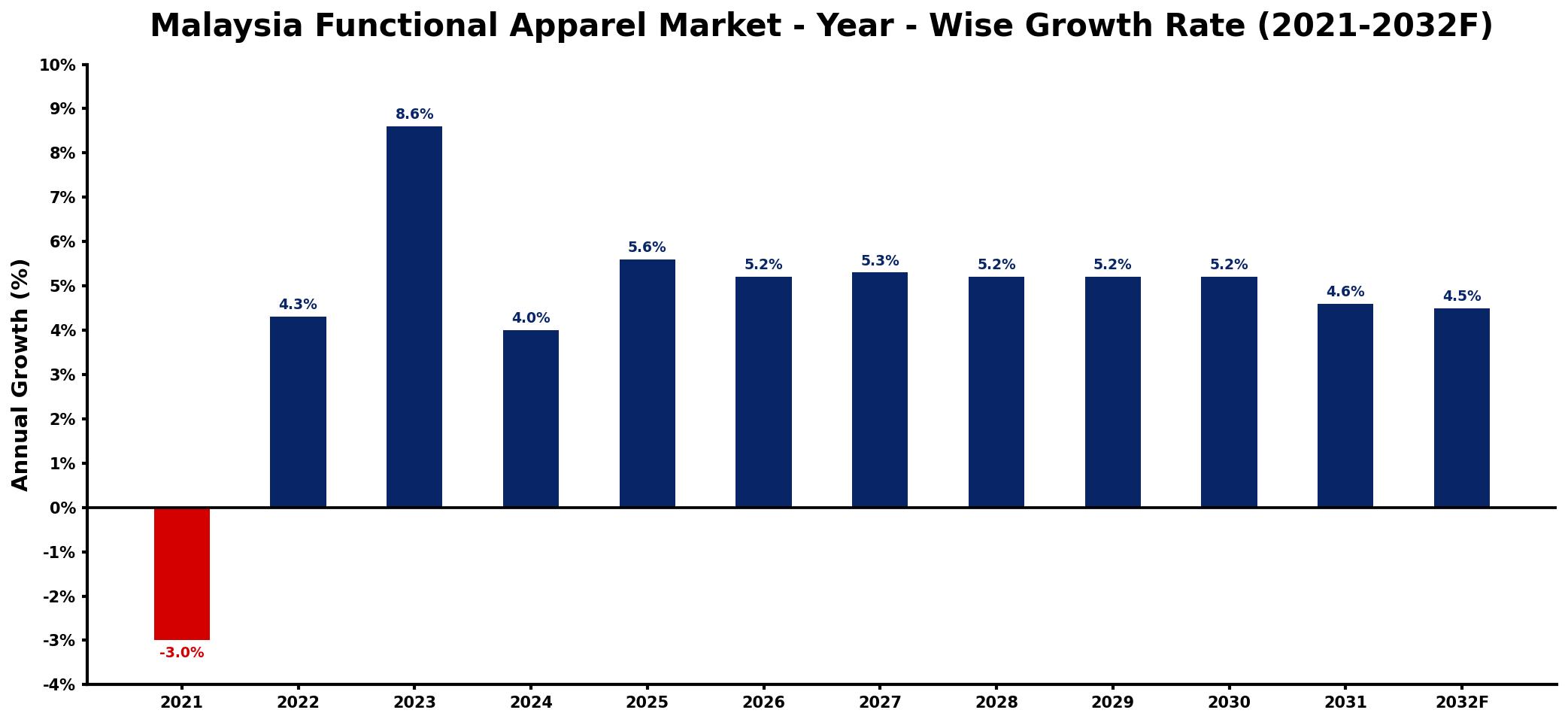
The table below presents the year‑wise growth rates along with the key drivers influencing the market
| Year | Growth Rate | Major Drivers |
| 2021 | -3.0% | decreased consumer spending habits |
| 2022 | 4.3% | rising health and fitness trends |
| 2023 | 8.6% | growing online shopping platforms |
| 2024 | 4.0% | increased focus on sustainability |
| 2025 | 5.6% | expanding athleisure market segment |
| 2026 | 5.2% | growing downstream application demand |
| 2027 | 5.3% | surge in fitness awareness campaigns |
| 2028 | 5.2% | growing demand for customization |
| 2029 | 5.2% | increased corporate wellness programs |
| 2030 | 5.2% | expansion of e-commerce channels |
| 2031 | 4.6% | growing influence of social media |
| 2032 | 4.5% | rising interest in outdoor activities |
Note: Market size estimations and growth projections presented in this report are based on 6Wresearch's proprietary forecasting methodology, utilizing the latest available industry data, government publications, and primary research inputs.
Malaysia Functional Apparel Market Synopsis
The strongest force shaping the Malaysia Functional Apparel Market today is the growing focus on health and fitness. This trend is evident in a surge of interest in sportswear, athleisure, and outdoor clothing as consumers seek attire that supports their active lifestyles. As fabric technology evolves, innovations such as moisture-wicking properties and UV protection are gaining traction, further enhancing consumer appeal.
Moreover, the recent pandemic has acted as a catalyst for change, making functional clothing, including face masks and antimicrobial garments, a necessity. As individuals prioritize both health and aesthetics, the market witnesses a blending of performance and style, creating a vibrant landscape for local and international brands to explore.
Malaysia Functional Apparel Market Key Takeaways
- The market is experiencing significant growth fueled by increased health awareness.
- Consumer preferences are shifting towards comfortable and stylish functional apparel.
- Innovations in fabric technology are becoming key differentiators in the market.
- The pandemic has highlighted the demand for functional clothing across various categories.
- There is a strong competitive landscape with both local and international brands striving for market share.
Evaluation of Restraints in Malaysia Functional Apparel Market
Despite the positive outlook, the Malaysia Functional Apparel Market grapples with challenges that could hinder its potential. The need for continuous product innovation is paramount, as businesses must differentiate themselves in a saturated market. Investments in research and development to create unique offerings can lead to increased production costs. This, combined with the challenge of convincing consumers to invest in premium functional apparel, adds a layer of complexity to pricing strategies and overall profitability.
Malaysia Functional Apparel Market Trends
Several trends are currently shaping demand and technology within the Malaysia Functional Apparel Market. The athleisure trend continues to gain momentum, with consumers embracing versatile clothing that transitions seamlessly from workouts to daily wear. Sustainable fashion is also becoming increasingly important, as brands strive to align with eco-friendly practices. Moreover, advancements in smart textiles and fabric technologies are paving the way for new innovations, enhancing functionality and user experience.
Malaysia Functional Apparel Market Opportunities
The Malaysia Functional Apparel Market presents ample growth and investment opportunities. Brands can explore niche segments like eco-conscious apparel or specialized sportswear tailored for specific activities, such as running or yoga. Additionally, partnerships with fitness influencers and health-oriented campaigns can effectively tap into the growing market of health enthusiasts. As consumers continue to prioritize comfort and functionality, investment in innovative materials and technology will further propel growth.
Government Initiatives in the Malaysia Functional Apparel Market
The Malaysian government has been proactive in promoting health and wellness, which indirectly supports the functional apparel market. Initiatives aimed at encouraging physical activity among the populace include funding for sports programs and the development of public facilities. Furthermore, policies that support local manufacturing can foster a competitive landscape for homegrown brands, enhancing their ability to innovate and meet consumer demands effectively.
Future Insights of the Malaysia Functional Apparel Market
Looking ahead to 2026-2032, the Malaysia Functional Apparel Market is poised for robust growth. As urban lifestyles continue to evolve, the demand for versatile and performance-driven clothing will intensify. Anticipated advancements in textile technologies and a shift towards sustainable practices will redefine consumer expectations, making it imperative for brands to adapt. The integration of health and lifestyle trends into apparel design will be crucial in capturing the attention of the increasingly discerning Malaysian consumer.
Malaysia Functional Apparel Market Latest Developments (2025 - 2026)
Recent developments in the Malaysia Functional Apparel Market indicate a shift towards sustainability and innovation. Brands are increasingly focusing on eco-friendly materials and production processes, which resonate with the growing environmentally conscious consumer base. Collaborations between tech companies and apparel manufacturers are also on the rise, leading to the introduction of smart textiles that enhance the functionality of clothing. These trends point towards a dynamic market adapting to both consumer needs and technological advancements.
Malaysia Functional Apparel Market - Key Attractiveness of the Report
- 10 Years of Market Numbers
- Historical Data Starting from 2022 to 2025
- Base Year: 2025
- Forecast Data until 2032
- Key Performance Indicators Impacting the Market
- Major Upcoming Developments and Projects
Key Highlights of the Report:
- Malaysia Functional Apparel Market Outlook
- Market Size of Malaysia Functional Apparel Market, 2025
- Forecast of Malaysia Functional Apparel Market, 2032
- Historical Data and Forecast of Malaysia Functional Apparel Revenues & Volume for the Period 2022-2032F
- Malaysia Functional Apparel Market Trend Evolution
- Malaysia Functional Apparel Market Drivers and Challenges
- Malaysia Functional Apparel Price Trends
- Malaysia Functional Apparel Porter's Five Forces
- Malaysia Functional Apparel Industry Life Cycle
- Historical Data and Forecast of Malaysia Functional Apparel Market Revenues & Volume By Product Type for the Period 2022-2032F
- Historical Data and Forecast of Malaysia Functional Apparel Market Revenues & Volume By Sportswear for the Period 2022-2032F
- Historical Data and Forecast of Malaysia Functional Apparel Market Revenues & Volume By Activewear for the Period 2022-2032F
- Historical Data and Forecast of Malaysia Functional Apparel Market Revenues & Volume By Protective Clothing for the Period 2022-2032F
- Historical Data and Forecast of Malaysia Functional Apparel Market Revenues & Volume By Others for the Period 2022-2032F
- Historical Data and Forecast of Malaysia Functional Apparel Market Revenues & Volume By Application for the Period 2022-2032F
- Historical Data and Forecast of Malaysia Functional Apparel Market Revenues & Volume By Sports Industry for the Period 2022-2032F
- Historical Data and Forecast of Malaysia Functional Apparel Market Revenues & Volume By Outdoor Clothing for the Period 2022-2032F
- Historical Data and Forecast of Malaysia Functional Apparel Market Revenues & Volume By Healthcare sector for the Period 2022-2032F
- Historical Data and Forecast of Malaysia Functional Apparel Market Revenues & Volume By Distribution Channel for the Period 2022-2032F
- Historical Data and Forecast of Malaysia Functional Apparel Market Revenues & Volume By Offline Store for the Period 2022-2032F
- Historical Data and Forecast of Malaysia Functional Apparel Market Revenues & Volume By Online Store for the Period 2022-2032F
- Malaysia Functional Apparel Import Export Trade Statistics
- Market Opportunity Assessment By Product Type
- Market Opportunity Assessment By Application
- Market Opportunity Assessment By Distribution Channel
- Malaysia Functional Apparel Top Companies Market Share
- Malaysia Functional Apparel Competitive Benchmarking By Technical and Operational Parameters
- Malaysia Functional Apparel Company Profiles
- Malaysia Functional Apparel Key Strategic Recommendations






































