Malaysia Gamification in Education Market Size & Growth Rate (2026-2032)
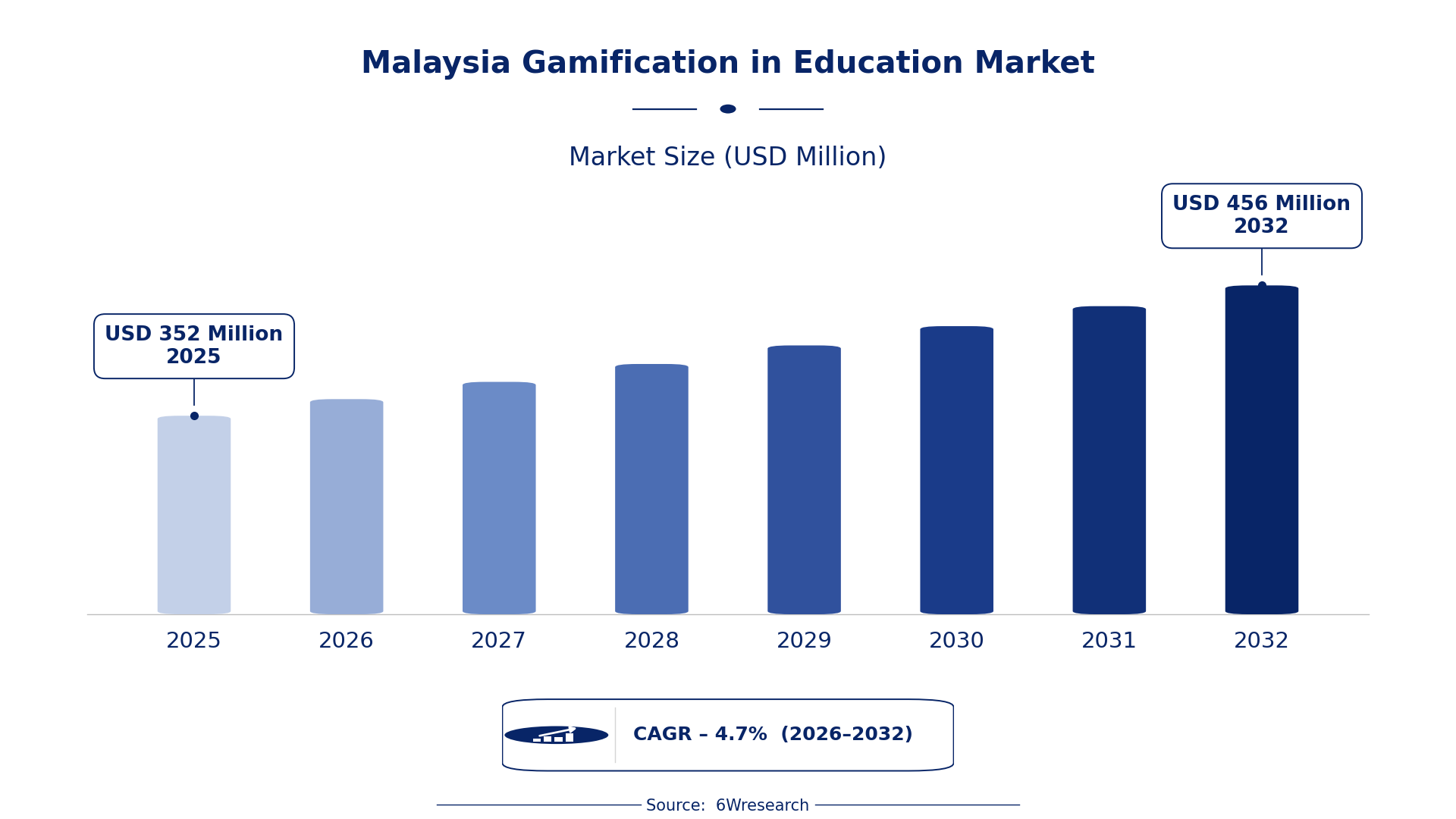
The Malaysia Gamification in Education Market was estimated at USD 352 Million in 2025 and is projected to reach USD 456 Million by 2032, growing at a CAGR of 4.7% from 2026 to 2032.
Malaysia Gamification in Education Market Synopsis
The Malaysia gamification in education market has gained momentum as schools and institutions increasingly adopt engaging learning techniques. This shift reflects a broader trend towards interactive education, where gamified experiences are seen as vital for enhancing student engagement and retention.
As the market evolves, the focus is shifting towards integrating advanced digital tools and methodologies. This evolution positions gamification not just as a supplementary tool, but as a core component of educational strategies moving forward.
Malaysia Gamification in Education Market Year-wise Growth Rate and Key Drivers
This graph illustrates the annual growth rates of the Malaysia Gamification in Education Market from 2021 to 2032, highlighting a steady upward trajectory and projected expansion over the forecast period.
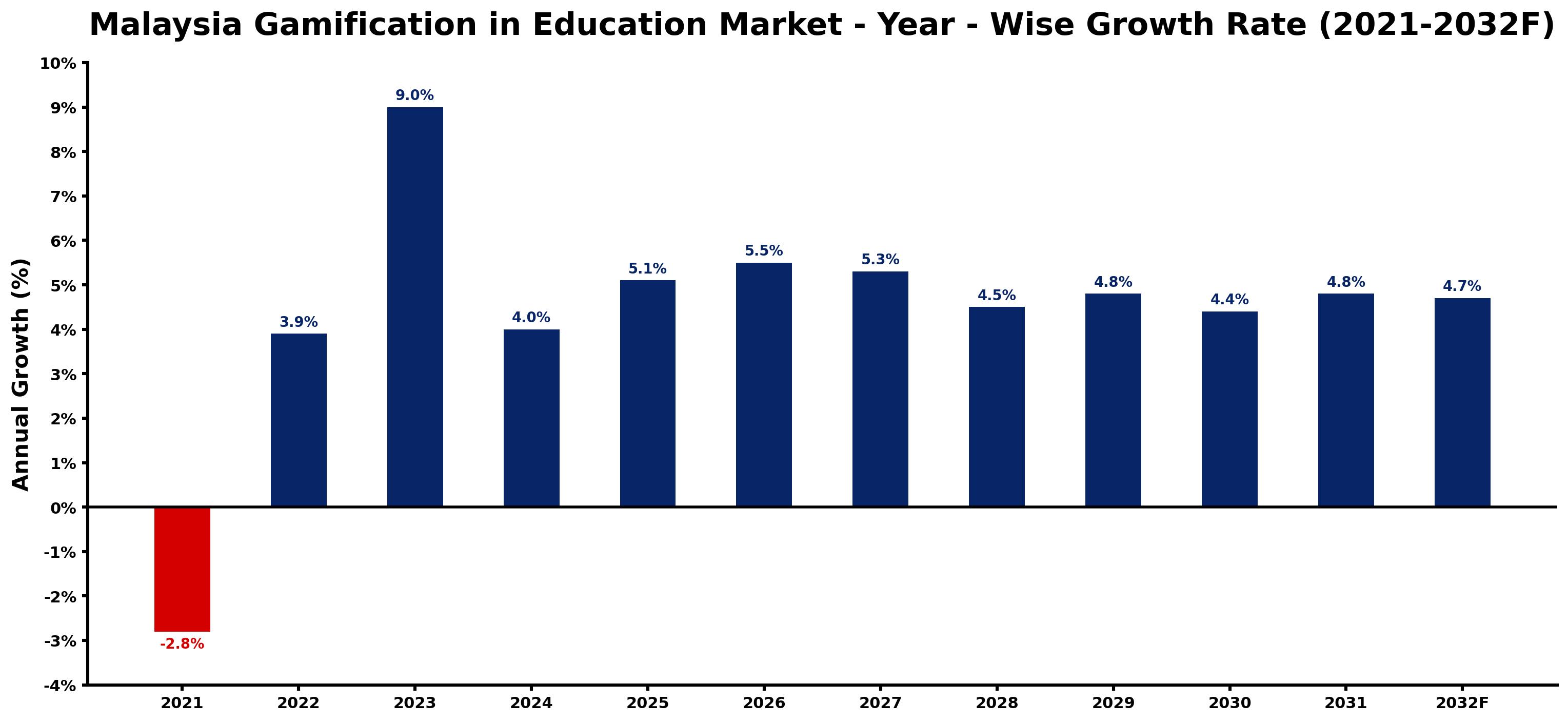
The table below presents the year‑wise growth rates along with the key drivers influencing the market
| Year | Growth Rate | Major Drivers |
| 2021 | -2.8% | Delayed digital transformation due to Malaysian pandemic restrictions. |
| 2022 | 3.9% | Increased student engagement through interactive learning platforms. |
| 2023 | 9.0% | Government grants support gamified curriculum development programs. |
| 2024 | 4.0% | Rise of EdTech startups focusing on gamified learning tools. |
| 2025 | 5.1% | Adoption of mobile learning apps enhances educational accessibility. |
| 2026 | 5.5% | Local schools leverage gamification for proficiency test preparation. |
| 2027 | 5.3% | Teachers receive training on integrating gamification in classrooms. |
| 2028 | 4.5% | Corporate sponsorship for gamified educational workshops increases. |
| 2029 | 4.8% | Demand for personalized learning experiences drives gamification uptake. |
| 2030 | 4.4% | Incorporation of local culture into educational game design. |
| 2031 | 4.8% | Collaboration between universities and game developers grows. |
| 2032 | 4.7% | Advancements in AR technology enrich gamified learning experiences. |
Note: Market size estimations and growth projections presented in this report are based on 6Wresearch's proprietary forecasting methodology, utilizing the latest available industry data, government publications, and primary research inputs.
Malaysia Gamification in Education Market Key Takeaways
Below are some of the specific key takeaways from the market, including:
- The market is increasingly driven by digitalization and the widespread use of smartphones.
- Teachers require extensive training to effectively integrate gamified elements into curricula.
- COVID-19 has accelerated the adoption of gamification as a response to remote learning challenges.
- Balancing entertainment and educational value remains a critical focus for developers.
- Leading educational platforms are enhancing their offerings to include gamified content.
Evaluation of Restraints in Malaysia Gamification in Education Market
Despite the growth, the market faces considerable restraints. A significant barrier is the difficulty in integrating gamified learning into traditional educational frameworks. Many educators are accustomed to conventional teaching methods, which can hinder the adoption of new, interactive techniques. The need for extensive teacher training is also a challenge, as resources for such professional development are often limited. on top of that, ensuring that gamified content aligns with national educational standards and curricula is critical, making the transition complex and multifaceted.
Malaysia Gamification in Education Market Trends
A growing trend is the emphasis on personalized learning experiences, where gamified elements are tailored to meet individual student needs. This shift is encouraging educators to explore adaptive learning technologies. Another noteworthy trend is the collaboration between educational institutions and technology providers, fostering innovation in gamified solutions. The use of analytics to track student progress and engagement is also on the rise, allowing for real-time adjustments to educational strategies.
Malaysia Gamification in Education Market Opportunities
Opportunities abound for companies willing to innovate within this sector. The demand for engaging educational content presents a fertile ground for startups and established players to develop gamified platforms that resonate with students. Additionally, partnerships with governmental educational initiatives can provide a significant boost. The emphasis on STEM education further encourages the integration of gamification, opening up new avenues for investment and growth.
Government Initiatives in the Malaysia Gamification in Education Market
The Malaysian government is actively promoting the incorporation of technology in education, which significantly impacts the gamification market. Recent public policy initiatives focus on enhancing digital literacy and encouraging innovative teaching methods. This regulatory support is crucial as it drives the adoption of gamified learning solutions, ensuring they align with national educational objectives.
- A national digital infrastructure upgrade programme was launched in early 2025 to enhance connectivity in educational institutions.
- The Ministry of Education initiated an ongoing professional development programme aimed at training teachers in gamification techniques, starting in late 2025.
- A planned public-private initiative expected to expand access to gamified learning tools is set to begin in 2026.
- A regulatory framework introduced in 2025 mandates the integration of technology in school curricula to enhance student engagement.
Future Insights of the Malaysia Gamification in Education Market
Looking ahead, the Malaysia gamification in education market is likely to see sustained growth as more institutions embrace technology-driven learning. The ongoing digital transformation in education will further bolster the demand for gamified solutions. By 2032, we expect that gamification will be a standard practice in educational settings, fundamentally reshaping how students interact with learning materials and concepts.
Malaysia Gamification in Education Market Latest Developments
In the past year, the Malaysia gamification in education market has witnessed a surge in activity, particularly in response to the challenges posed by remote learning. Institutions are increasingly seeking innovative solutions to engage students effectively. This urgency has driven several key developments in the sector.
- A major technology vendor launched a new gamified learning platform in Q2 2025, aimed at primary and secondary education.
- An initiative that began in early 2025 focuses on integrating augmented reality (AR) into gamified learning experiences and remains underway.
- A collaboration between educational institutions and software developers, established in mid-2025, is working to create tailored gamified content for diverse learning needs.
- A rollout of a new mobile application designed to facilitate gamified learning is expected to begin in early 2026.
Malaysia Gamification in Education Market - Key Attractiveness of the Report
- 10 Years of Market Numbers
- Historical Data Starting from 2022 to 2025
- Base Year: 2025
- Forecast Data until 2032
- Key Performance Indicators Impacting the Market
- Major Upcoming Developments and Projects
What are the government’s priorities regarding gamification in education?
Key Highlights of the Report:
- Malaysia Gamification in Education Market Outlook
- Market Size of Malaysia Gamification in Education Market, 2025
- Forecast of Malaysia Gamification in Education Market, 2032
- Historical Data and Forecast of Malaysia Gamification in Education Revenues & Volume for the Period 2022-2032F
- Malaysia Gamification in Education Market Trend Evolution
- Malaysia Gamification in Education Market Drivers and Challenges
- Malaysia Gamification in Education Price Trends
- Malaysia Gamification in Education Porter's Five Forces
- Malaysia Gamification in Education Industry Life Cycle
- Historical Data and Forecast of Malaysia Gamification in Education Market Revenues & Volume By Offering for the Period 2022-2032F
- Historical Data and Forecast of Malaysia Gamification in Education Market Revenues & Volume By Software for the Period 2022-2032F
- Historical Data and Forecast of Malaysia Gamification in Education Market Revenues & Volume By Services for the Period 2022-2032F
- Historical Data and Forecast of Malaysia Gamification in Education Market Revenues & Volume By End User for the Period 2022-2032F
- Historical Data and Forecast of Malaysia Gamification in Education Market Revenues & Volume By Academic for the Period 2022-2032F
- Historical Data and Forecast of Malaysia Gamification in Education Market Revenues & Volume By Corporate Training for the Period 2022-2032F
- Historical Data and Forecast of Malaysia Gamification in Education Market Revenues & Volume By Deployment Mode for the Period 2022-2032F
- Historical Data and Forecast of Malaysia Gamification in Education Market Revenues & Volume By Cloud for the Period 2022-2032F
- Historical Data and Forecast of Malaysia Gamification in Education Market Revenues & Volume By On-Premises for the Period 2022-2032F
- Malaysia Gamification in Education Import Export Trade Statistics
- Market Opportunity Assessment By Offering
- Market Opportunity Assessment By End User
- Market Opportunity Assessment By Deployment Mode
- Malaysia Gamification in Education Top Companies Market Share
- Malaysia Gamification in Education Competitive Benchmarking By Technical and Operational Parameters
- Malaysia Gamification in Education Company Profiles
- Malaysia Gamification in Education Key Strategic Recommendations






































