Malaysia Insurance Telematics Market Size & Growth Rate (2026-2032)
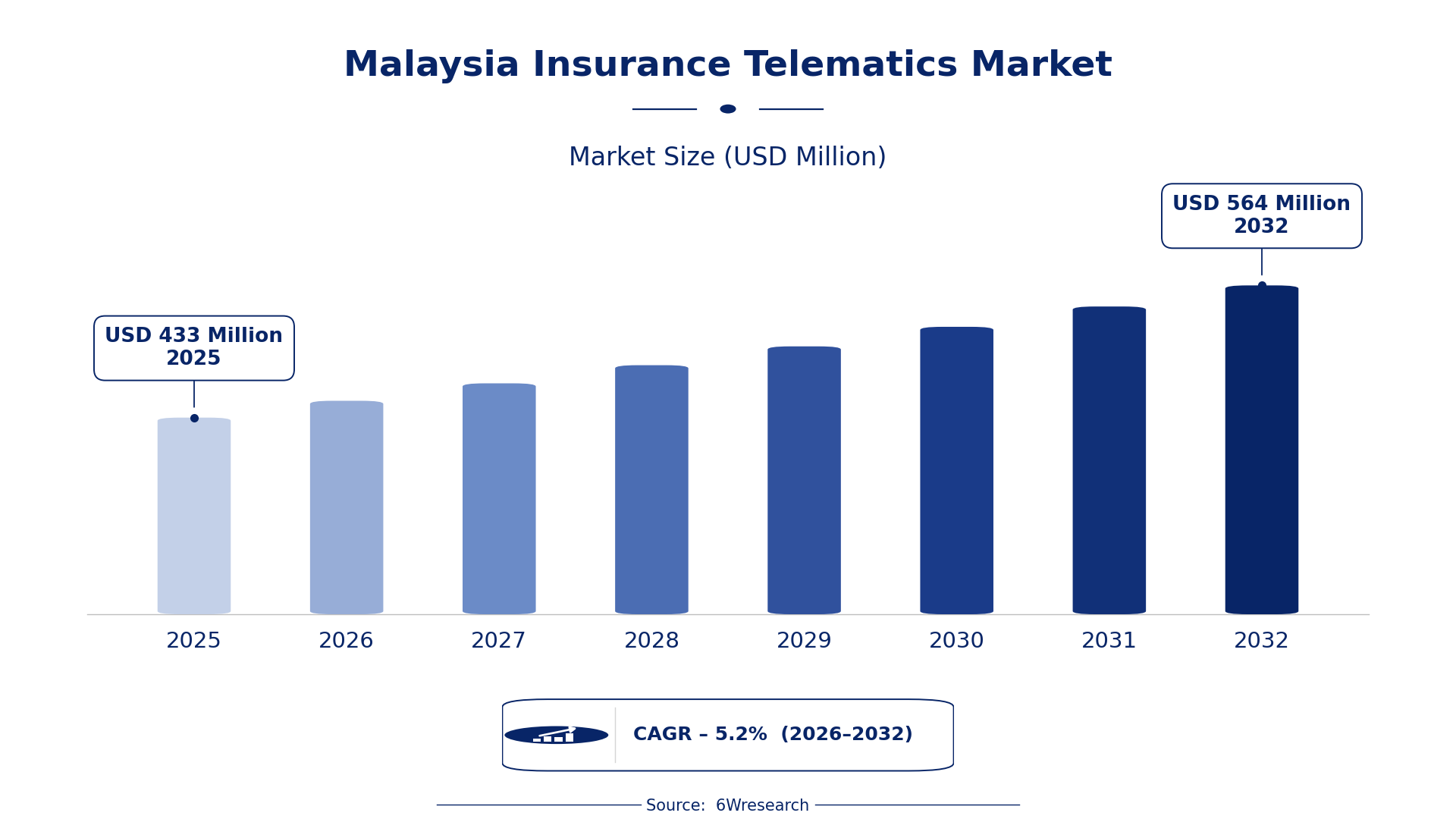
The Malaysia Insurance Telematics Market was estimated at USD 433 Million in 2025 and is projected to reach USD 564 Million by 2032, growing at a CAGR of 5.2% from 2026 to 2032.
Malaysia Insurance Telematics Market Synopsis
In Malaysia, the rising trend of connected car technologies is significantly influencing the insurance telematics market. As insurers increasingly adopt data-driven approaches to risk assessment, telematics solutions are becoming central to their offerings, enabling precise monitoring of driving behavior and facilitating personalized insurance policies.
The shift towards usage-based insurance is gaining traction, allowing policyholders to benefit from lower premiums by demonstrating safe driving habits. This paradigm shift not only rewards responsible drivers but also enhances overall road safety, showcasing the potential of telematics in transforming the insurance sector in Malaysia.
Malaysia Insurance Telematics Market Year-wise Growth Rate and Key Drivers
This graph illustrates the annual growth rates of the Malaysia Insurance Telematics Market from 2021 to 2032, highlighting a steady upward trajectory and projected expansion over the forecast period.
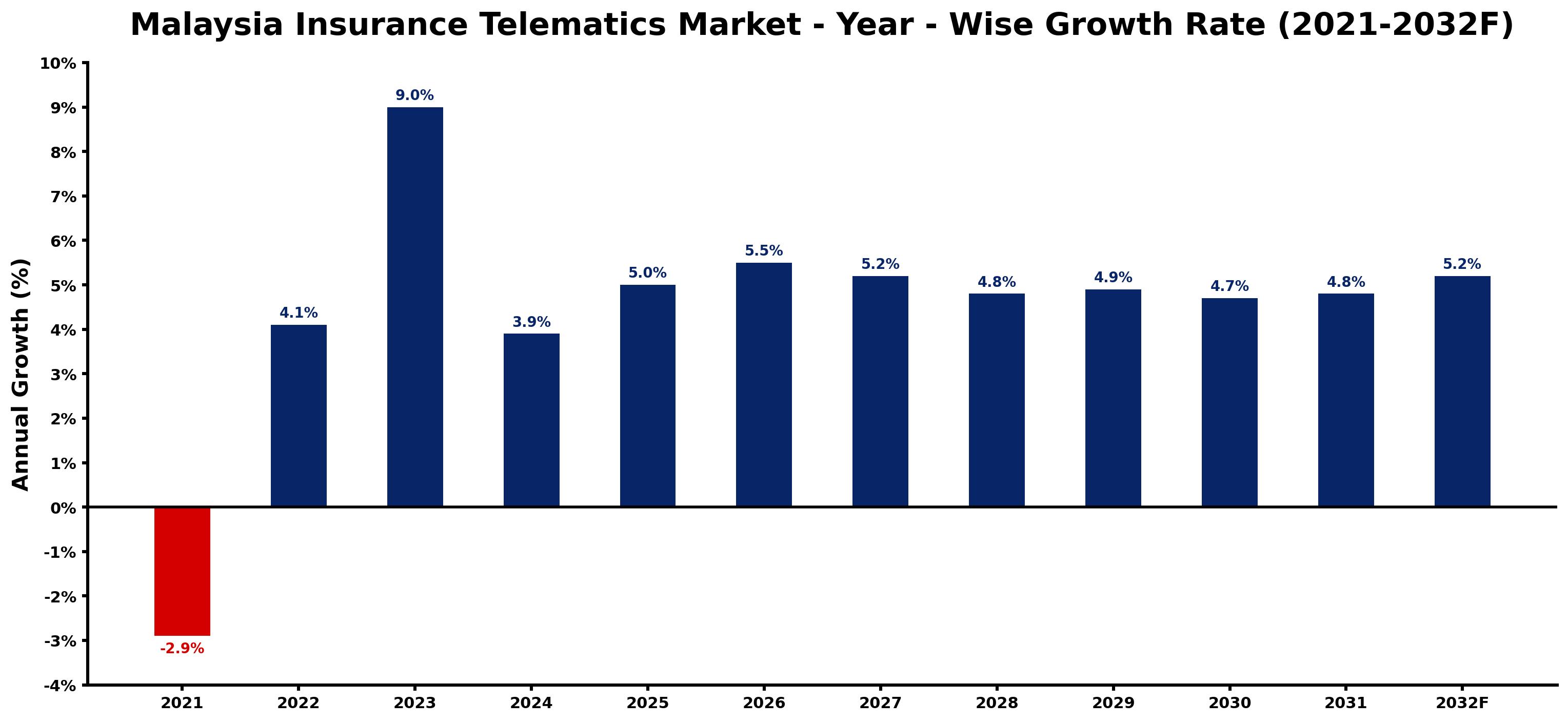
The table below presents the year‑wise growth rates along with the key drivers influencing the market
| Year | Growth Rate | Major Drivers |
| 2021 | -2.9% | Lower demand for telematics from Malaysian insurance providers. |
| 2022 | 4.1% | Implementation of MyTeksi's real-time driving data analytics. |
| 2023 | 9.0% | Government incentives for telematics in vehicle insurance policies. |
| 2024 | 3.9% | Rising smartphone penetration spurring telematics app adoption. |
| 2025 | 5.0% | Increased consumer awareness about insurance premium discounts. |
| 2026 | 5.5% | Bank Negara Malaysia promoting innovative digital insurance solutions. |
| 2027 | 5.2% | Growth in Malaysian ride-hailing services enhancing telematics demand. |
| 2028 | 4.8% | Launch of new telematics-based insurance products by startups. |
| 2029 | 4.9% | Integration of AI for risk assessment in insurance policies. |
| 2030 | 4.7% | Surge in government-backed smart city vehicle initiatives. |
| 2031 | 4.8% | Collaboration between insurers and automotive firms for telematics. |
| 2032 | 5.2% | Enhanced data privacy regulations boosting consumer trust in telematics. |
Note: Market size estimations and growth projections presented in this report are based on 6Wresearch's proprietary forecasting methodology, utilizing the latest available industry data, government publications, and primary research inputs.
Malaysia Insurance Telematics Market Key Takeaways
Below are some of the specific key takeaways from the market, including:
- The integration of IoT technology is reshaping risk assessment practices in the insurance industry.
- Telematics enables the customization of insurance policies based on individual driving behaviors.
- Privacy and data security concerns are major factors influencing telematics adoption among consumers.
- Policyholders are increasingly interested in usage-based insurance as a cost-saving measure.
- Investment in analytics capabilities is crucial for insurers to capitalize on the data generated by telematics.
Evaluation of Restraints in Malaysia Insurance Telematics Market
Despite the promising growth, the Malaysia Insurance Telematics Market grapples with considerable restraints. Privacy concerns loom large as consumers are often hesitant to share driving data due to fears of misuse. The cost associated with telematics devices can deter both insurers and policyholders from fully embracing the technology. on top of that, the challenge of interpreting vast data sets requires advanced analytical skills, which are not universally available in the industry. Regulatory hurdles further complicate the adoption process, as insurers must ensure compliance with a complex framework governing data protection and telematics usage.
Malaysia Insurance Telematics Market Trends
A few trends are currently shaping the Malaysia Insurance Telematics Market. The increasing adoption of smart vehicles is driving demand for telematics solutions, allowing insurers to gather real-time data on driving habits. There’s also a notable shift towards mobile applications that provide users with insights into their driving behaviors, further enhancing customer engagement. on top of that, partnerships between insurers and technology firms are becoming common, aiming to improve data analytics capabilities and develop innovative insurance products.
Malaysia Insurance Telematics Market Opportunities
The market presents numerous opportunities for growth, particularly in the development of tailored insurance products that cater to specific consumer needs. There's a growing demand for fleet telematics solutions, which can improve risk management for businesses. Additionally, the rise of electric vehicles opens new avenues for telematics applications, as insurers can leverage data to develop policies that reflect the unique risks associated with these vehicles. Investing in data security technologies will also enhance consumer trust and drive wider adoption.
Government Initiatives in the Malaysia Insurance Telematics Market
Government policies in Malaysia are crucial in shaping the Insurance Telematics Market. The regulatory landscape is evolving to accommodate the integration of telematics into insurance, focusing on consumer protection while encouraging innovation. Recent initiatives aim to enhance digital infrastructure, making telematics solutions more accessible and reliable for insurers and consumers alike.
- A national digital infrastructure upgrade programme was completed in early 2025, improving connectivity for telematics applications.
- A regulatory framework introduced in 2025 mandates transparency in data handling practices, addressing privacy concerns.
- Currently, a public-private initiative is underway to promote the adoption of smart vehicle technologies, enhancing data collection methods.
- Plans for a comprehensive insurance reform package are expected to roll out by 2026, which will focus on telematics integration in insurance products.
Future Insights of the Malaysia Insurance Telematics Market
Looking ahead to 2026-2032, the Malaysia Insurance Telematics Market is set to evolve significantly. The emphasis on personalized insurance products will likely intensify, driven by consumer demand for tailored solutions. As data analytics capabilities improve, insurers will be better equipped to harness telematics data for risk assessment, leading to more competitive pricing. The ongoing development of regulatory frameworks will also play a critical role in shaping the market, ensuring that innovation occurs alongside robust consumer protections.
Malaysia Insurance Telematics Market Latest Developments
In the past year, the Malaysia Insurance Telematics Market has seen a surge in activity as insurers adapt to changing consumer expectations and technological advancements. The focus has been on enhancing telematics offerings and ensuring data security, which is vital for building consumer trust.
- A major technology vendor launched an advanced telematics platform in Q1 2025, enabling insurers to offer real-time driving feedback.
- Currently, an initiative is underway where leading insurers are collaborating to develop standardized telematics data-sharing protocols.
- A new telematics-based insurance product was introduced in mid-2025, aimed at young drivers with incentives for safe driving.
- Plans for a regional telematics conference scheduled for late 2026 are being finalized, focusing on industry advancements and regulatory updates.
Malaysia Insurance Telematics Market - Key Attractiveness of the Report
- 10 Years of Market Numbers
- Historical Data Starting from 2022 to 2025
- Base Year: 2025
- Forecast Data until 2032
- Key Performance Indicators Impacting the Market
- Major Upcoming Developments and Projects
Key Highlights of the Report:
- Malaysia Insurance Telematics Market Outlook
- Market Size of Malaysia Insurance Telematics Market, 2025
- Forecast of Malaysia Insurance Telematics Market, 2032
- Historical Data and Forecast of Malaysia Insurance Telematics Revenues & Volume for the Period 2022-2032F
- Malaysia Insurance Telematics Market Trend Evolution
- Malaysia Insurance Telematics Market Drivers and Challenges
- Malaysia Insurance Telematics Price Trends
- Malaysia Insurance Telematics Porter's Five Forces
- Malaysia Insurance Telematics Industry Life Cycle
- Historical Data and Forecast of Malaysia Insurance Telematics Market Revenues & Volume By End User for the Period 2022-2032F
- Historical Data and Forecast of Malaysia Insurance Telematics Market Revenues & Volume By Small for the Period 2022-2032F
- Historical Data and Forecast of Malaysia Insurance Telematics Market Revenues & Volume By Medium Enterprises for the Period 2022-2032F
- Historical Data and Forecast of Malaysia Insurance Telematics Market Revenues & Volume By Large Enterprises for the Period 2022-2032F
- Historical Data and Forecast of Malaysia Insurance Telematics Market Revenues & Volume By Deployment Type for the Period 2022-2032F
- Historical Data and Forecast of Malaysia Insurance Telematics Market Revenues & Volume By Cloud for the Period 2022-2032F
- Historical Data and Forecast of Malaysia Insurance Telematics Market Revenues & Volume By On-Premises for the Period 2022-2032F
- Historical Data and Forecast of Malaysia Insurance Telematics Market Revenues & Volume By Organization Size for the Period 2022-2032F
- Historical Data and Forecast of Malaysia Insurance Telematics Market Revenues & Volume By Small and Medium Enterprises (SMEs) for the Period 2022-2032F
- Historical Data and Forecast of Malaysia Insurance Telematics Market Revenues & Volume By Large Enterprises for the Period 2022-2032F
- Malaysia Insurance Telematics Import Export Trade Statistics
- Market Opportunity Assessment By End User
- Market Opportunity Assessment By Deployment Type
- Market Opportunity Assessment By Organization Size
- Malaysia Insurance Telematics Top Companies Market Share
- Malaysia Insurance Telematics Competitive Benchmarking By Technical and Operational Parameters
- Malaysia Insurance Telematics Company Profiles
- Malaysia Insurance Telematics Key Strategic Recommendations






































