Malaysia IPTV Market Size, Share & Growth Rate
The Malaysia IPTV Market was estimated at USD 272 Million in 2025 and is projected to reach USD 353 Million by 2032, growing at a CAGR of 3.8% from 2026 to 2032. This upward trajectory is fueled by the increasing consumer preference for flexible and personalized viewing experiences, alongside the expansion of high-speed internet access across urban and rural areas. Additionally, the integration of advanced technologies into IPTV services is enhancing user engagement, driving further adoption in a competitive landscape.
Malaysia IPTV Market Year-wise Growth Rate and Key Drivers
This graph highlights how the Malaysia IPTV Market has steadily grown over the years, supported by major growth factors.
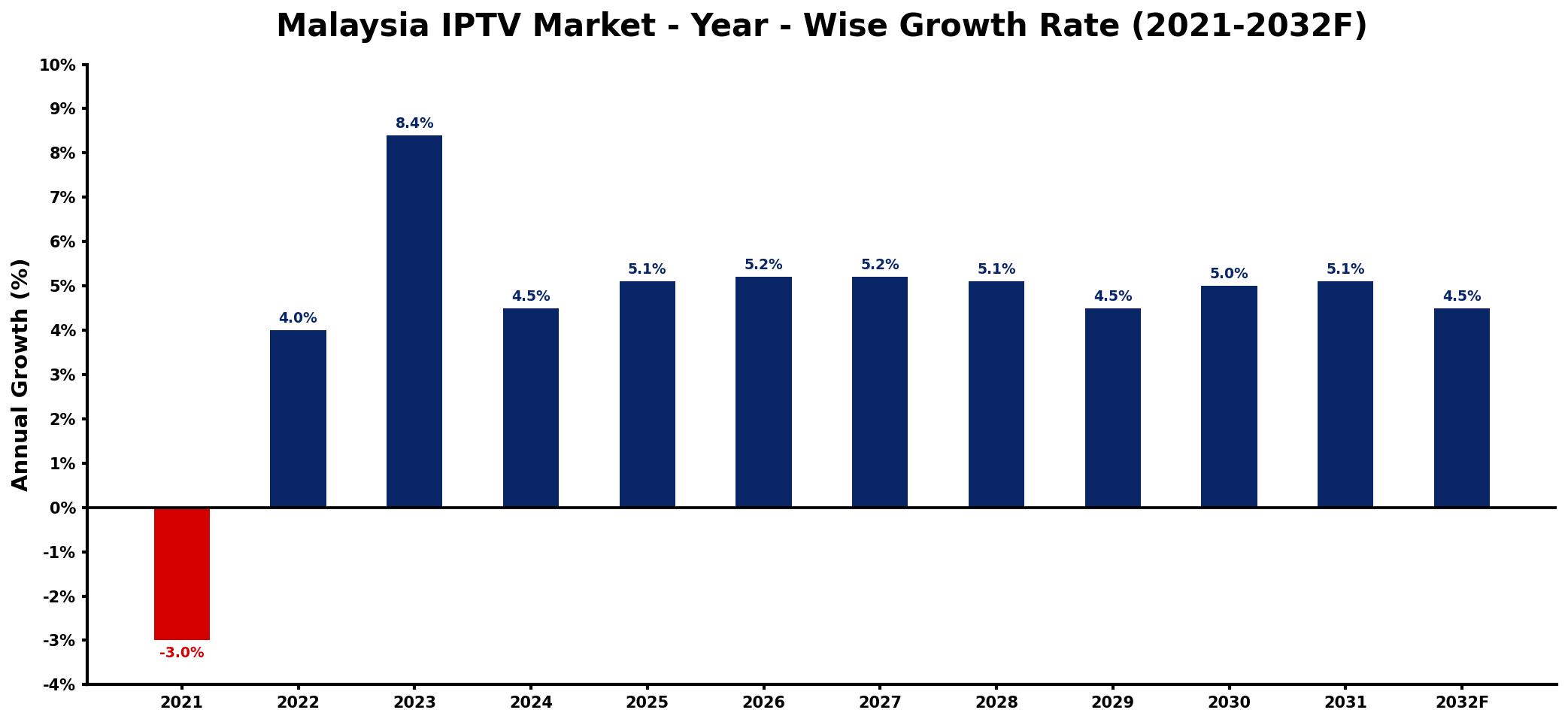
The table below presents the year‑wise growth rates along with the key drivers influencing the market
| Year | Growth Rate | Major Drivers |
| 2021 | -3.0% | shifts in consumer viewing habits |
| 2022 | 4.0% | rise in digital content consumption |
| 2023 | 8.4% | expansion of broadband infrastructure |
| 2024 | 4.5% | increased investment in technology |
| 2025 | 5.1% | growing demand for personalized content |
| 2026 | 5.2% | enhanced user experience innovations |
| 2027 | 5.2% | diversification of content offerings |
| 2028 | 5.1% | collaboration with telecom providers |
| 2029 | 4.5% | emergence of connected devices |
| 2030 | 5.0% | growth in subscription-based models |
| 2031 | 5.1% | development of original programming |
| 2032 | 4.5% | increased focus on regional content |
Note: Market size estimations and growth projections presented in this report are based on 6Wresearch's proprietary forecasting methodology, utilizing the latest available industry data, government publications, and primary research inputs.
Malaysia IPTV Market Synopsis
In Malaysia, the demand for IPTV services is surging, thanks in part to the growing availability of affordable, high-speed broadband connections. Consumers are increasingly drawn to the myriad content options available, ranging from international movies to local programming, facilitating a shift from traditional cable television to internet-based solutions.
Additionally, businesses are leveraging IPTV for internal communications and advertising, recognizing the potential for a more engaged audience through interactive features. This trend is reshaping how entertainment and information are consumed in the region.
Malaysia IPTV Market Key Takeaways
- The market is experiencing notable growth due to rising demand for on-demand content and interactive viewing experiences.
- High-speed internet penetration is critical in facilitating the transition from traditional television to IPTV platforms.
- Government initiatives are aimed at enhancing connectivity, which in turn supports IPTV adoption among consumers.
- Content diversity remains a key driver, as providers compete to attract subscribers with unique offerings.
- Emerging players are disrupting the market landscape, fostering innovation and consumer engagement.
Evaluation of Restraints in Malaysia IPTV Market
Despite the promising growth trajectory, the Malaysia IPTV market faces several significant restraints. A primary concern lies in the quality of broadband infrastructure; many regions still require improvements to support high-definition streaming without interruptions. Moreover, the persistent issues surrounding content piracy demand robust regulatory measures, which complicate the market landscape. Service providers also grapple with the challenge of differentiating themselves in an increasingly saturated market, necessitating the development of exclusive, high-quality content to retain subscribers.
Malaysia IPTV Market Trends
The IPTV market in Malaysia is currently witnessing several trends that are reshaping the industry. Firstly, the integration of artificial intelligence and machine learning into content delivery systems is enabling more personalized viewing experiences. Consumers are now able to receive tailored recommendations based on their viewing habits. Secondly, the growing popularity of mobile IPTV services reflects the shift toward on-the-go entertainment, as more users seek to watch their favorite shows on smartphones and tablets. Additionally, partnerships between content producers and IPTV providers are increasing, allowing for exclusive content availability that appeals to niche audiences.
Malaysia IPTV Market Opportunities
There are significant opportunities for growth within the Malaysia IPTV market, particularly in the areas of technological innovation and content creation. As consumers continue to demand higher quality and more engaging content, there is an opening for providers to invest in original programming and unique content partnerships. Moreover, expanding into underserved regions presents a lucrative opportunity for market entrants seeking to capture new subscribers. Furthermore, advancements in streaming technology, such as 5G deployment, will likely facilitate even greater growth by enhancing service reliability and speed.
Government Initiatives in the Malaysia IPTV Market
The Malaysian government is actively promoting initiatives aimed at enhancing digital infrastructure and expanding internet access across the country. Programs focused on improving broadband connectivity are critical in driving the adoption of IPTV services, particularly in rural areas. Additionally, policies encouraging digital content creation and the protection of intellectual property are crucial for establishing a sustainable environment for IPTV providers. These government efforts are designed to foster a vibrant digital economy, which directly benefits the IPTV sector.
Future Insights of the Malaysia IPTV Market
Looking ahead, the Malaysia IPTV market is expected to continue its growth trajectory from 2026 to 2032, driven by an increasing shift towards digital consumption. As user expectations evolve, service providers will need to innovate and adapt their offerings to stay relevant. The expansion of 5G networks will significantly enhance the user experience by offering faster and more reliable streaming options. Ultimately, a focus on customer satisfaction and the delivery of diverse, high-quality content will be pivotal in navigating the competitive landscape of the future.
Malaysia IPTV Market Latest Developments (2025 - 2026)
Recent developments within the Malaysia IPTV market indicate a heightened focus on collaborative content initiatives, as providers seek to differentiate their services amid growing competition. Additionally, advancements in streaming technology are being explored to enhance user experience and reduce service disruptions. The ongoing interest in interactive and personalized content continues to drive strategic partnerships between content creators and service providers, positioning the industry for a robust future.
Malaysia IPTV Market - Key Attractiveness of the Report
- 10 Years of Market Numbers
- Historical Data Starting from 2022 to 2025
- Base Year: 2025
- Forecast Data until 2032
- Key Performance Indicators Impacting the Market
- Major Upcoming Developments and Projects
Key Highlights of the Report:
- Malaysia IPTV Market Outlook
- Market Size of Malaysia IPTV Market, 2025
- Forecast of Malaysia IPTV Market, 2032
- Historical Data and Forecast of Malaysia IPTV Revenues & Volume for the Period 2022-2032F
- Malaysia IPTV Market Trend Evolution
- Malaysia IPTV Market Drivers and Challenges
- Malaysia IPTV Price Trends
- Malaysia IPTV Porter's Five Forces
- Malaysia IPTV Industry Life Cycle
- Historical Data and Forecast of Malaysia IPTV Market Revenues & Volume By Component for the Period 2022-2032F
- Historical Data and Forecast of Malaysia IPTV Market Revenues & Volume By Hardware (Router, Set-top Box, Receiver, Encoder) for the Period 2022-2032F
- Historical Data and Forecast of Malaysia IPTV Market Revenues & Volume By Services (In-house services, Managed services) for the Period 2022-2032F
- Historical Data and Forecast of Malaysia IPTV Market Revenues & Volume By Software for the Period 2022-2032F
- Historical Data and Forecast of Malaysia IPTV Market Revenues & Volume By Transmission Type for the Period 2022-2032F
- Historical Data and Forecast of Malaysia IPTV Market Revenues & Volume By Wired for the Period 2022-2032F
- Historical Data and Forecast of Malaysia IPTV Market Revenues & Volume By Wireless for the Period 2022-2032F
- Historical Data and Forecast of Malaysia IPTV Market Revenues & Volume By Streaming Type for the Period 2022-2032F
- Historical Data and Forecast of Malaysia IPTV Market Revenues & Volume By Non-Video Television for the Period 2022-2032F
- Historical Data and Forecast of Malaysia IPTV Market Revenues & Volume By Video Television for the Period 2022-2032F
- Historical Data and Forecast of Malaysia IPTV Market Revenues & Volume By Subscription Type for the Period 2022-2032F
- Historical Data and Forecast of Malaysia IPTV Market Revenues & Volume By Subscription-based IPTV for the Period 2022-2032F
- Historical Data and Forecast of Malaysia IPTV Market Revenues & Volume By Subscription free IPTV for the Period 2022-2032F
- Historical Data and Forecast of Malaysia IPTV Market Revenues & Volume By Device Type for the Period 2022-2032F
- Historical Data and Forecast of Malaysia IPTV Market Revenues & Volume By Smartphones and tablets for the Period 2022-2032F
- Historical Data and Forecast of Malaysia IPTV Market Revenues & Volume By Smart TVs for the Period 2022-2032F
- Historical Data and Forecast of Malaysia IPTV Market Revenues & Volume By Desktops and laptops for the Period 2022-2032F
- Historical Data and Forecast of Malaysia IPTV Market Revenues & Volume By Application for the Period 2022-2032F
- Historical Data and Forecast of Malaysia IPTV Market Revenues & Volume By Linear Television for the Period 2022-2032F
- Historical Data and Forecast of Malaysia IPTV Market Revenues & Volume By Non-linear Television for the Period 2022-2032F
- Historical Data and Forecast of Malaysia IPTV Market Revenues & Volume By End User for the Period 2022-2032F
- Historical Data and Forecast of Malaysia IPTV Market Revenues & Volume By SMEs for the Period 2022-2032F
- Historical Data and Forecast of Malaysia IPTV Market Revenues & Volume By Large Enterprises for the Period 2022-2032F
- Historical Data and Forecast of Malaysia IPTV Market Revenues & Volume By Residential customers for the Period 2022-2032F
- Historical Data and Forecast of Malaysia IPTV Market Revenues & Volume By Vertical for the Period 2022-2032F
- Historical Data and Forecast of Malaysia IPTV Market Revenues & Volume By Advertising and marketing for the Period 2022-2032F
- Historical Data and Forecast of Malaysia IPTV Market Revenues & Volume By Media and entertainment for the Period 2022-2032F
- Historical Data and Forecast of Malaysia IPTV Market Revenues & Volume By Gaming for the Period 2022-2032F
- Historical Data and Forecast of Malaysia IPTV Market Revenues & Volume By Online stores for the Period 2022-2032F
- Historical Data and Forecast of Malaysia IPTV Market Revenues & Volume By Telecom and IT for the Period 2022-2032F
- Historical Data and Forecast of Malaysia IPTV Market Revenues & Volume By Healthcare and medical for the Period 2022-2032F
- Historical Data and Forecast of Malaysia IPTV Market Revenues & Volume By Other Verticals (education and manufacturing). for the Period 2022-2032F
- Malaysia IPTV Import Export Trade Statistics
- Market Opportunity Assessment By Component
- Market Opportunity Assessment By Transmission Type
- Market Opportunity Assessment By Streaming Type
- Market Opportunity Assessment By Subscription Type
- Market Opportunity Assessment By Device Type
- Market Opportunity Assessment By Application
- Market Opportunity Assessment By End User
- Market Opportunity Assessment By Vertical
- Malaysia IPTV Top Companies Market Share
- Malaysia IPTV Competitive Benchmarking By Technical and Operational Parameters
- Malaysia IPTV Company Profiles
- Malaysia IPTV Key Strategic Recommendations






































