Malaysia Marketing Cloud Platform Market Size & Growth Rate (2026-2032)
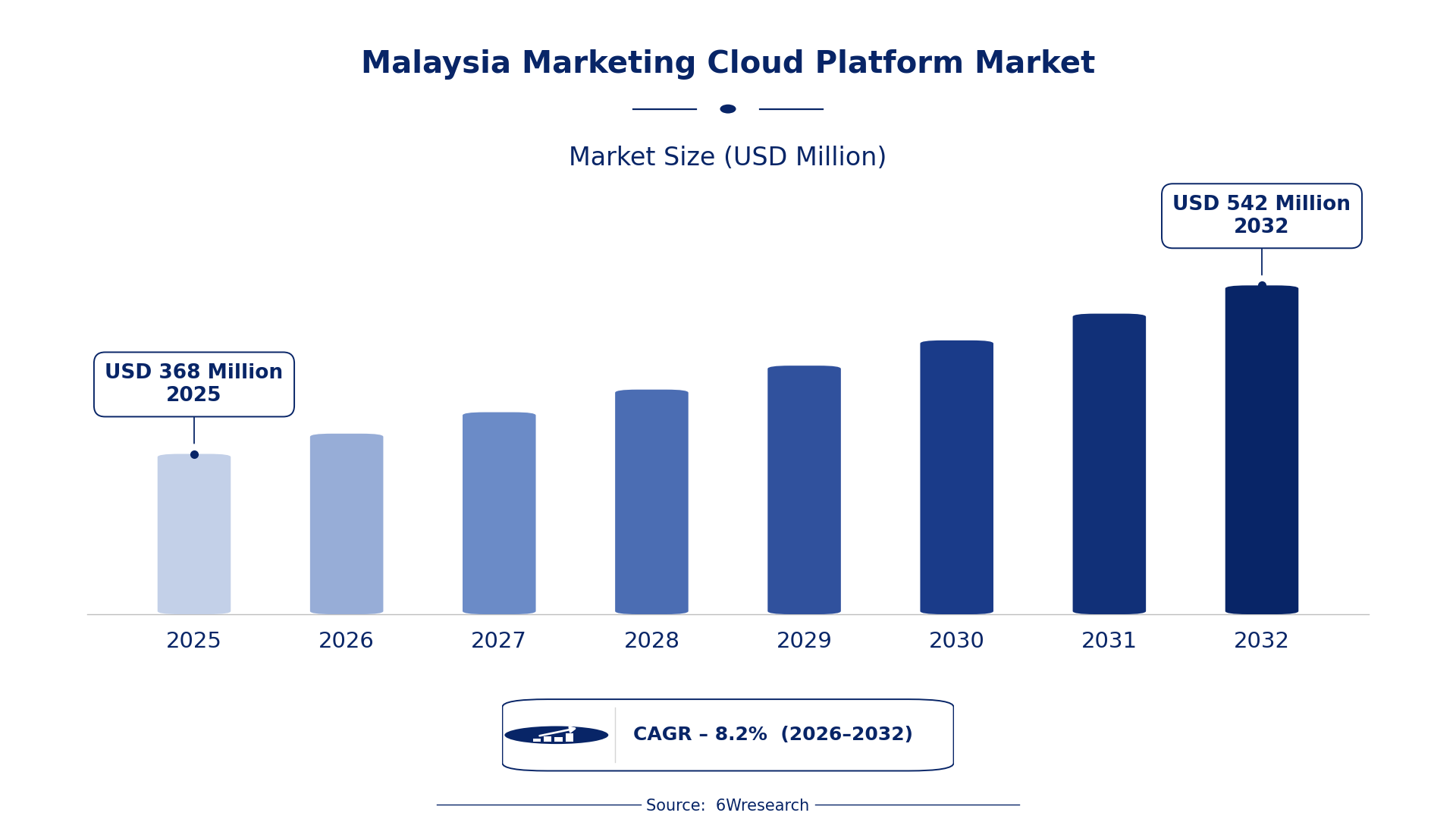
The Malaysia Marketing Cloud Platform Market was estimated at USD 368 Million in 2025 and is projected to reach USD 542 Million by 2032, growing at a CAGR of 8.2% from 2026 to 2032.
Malaysia Marketing Cloud Platform Market Synopsis
In Malaysia, the Marketing Cloud Platform market is witnessing a surge as businesses increasingly prioritize integrated, data-centric marketing strategies. Companies are turning to these platforms for enhanced campaign management and customer analytics, recognizing the necessity of staying competitive in a digitally-driven environment.
The demand for personalized and omnichannel marketing solutions is becoming a key driver of growth. Businesses are focusing on customer engagement and return on investment (ROI), compelling them to adopt comprehensive marketing cloud platforms that offer automation and analytics capabilities tailored to their unique needs.
Malaysia Marketing Cloud Platform Market Year-wise Growth Rate and Key Drivers
This graph illustrates the annual growth rates of the Malaysia Marketing Cloud Platform Market from 2021 to 2032, highlighting a steady upward trajectory and projected expansion over the forecast period.
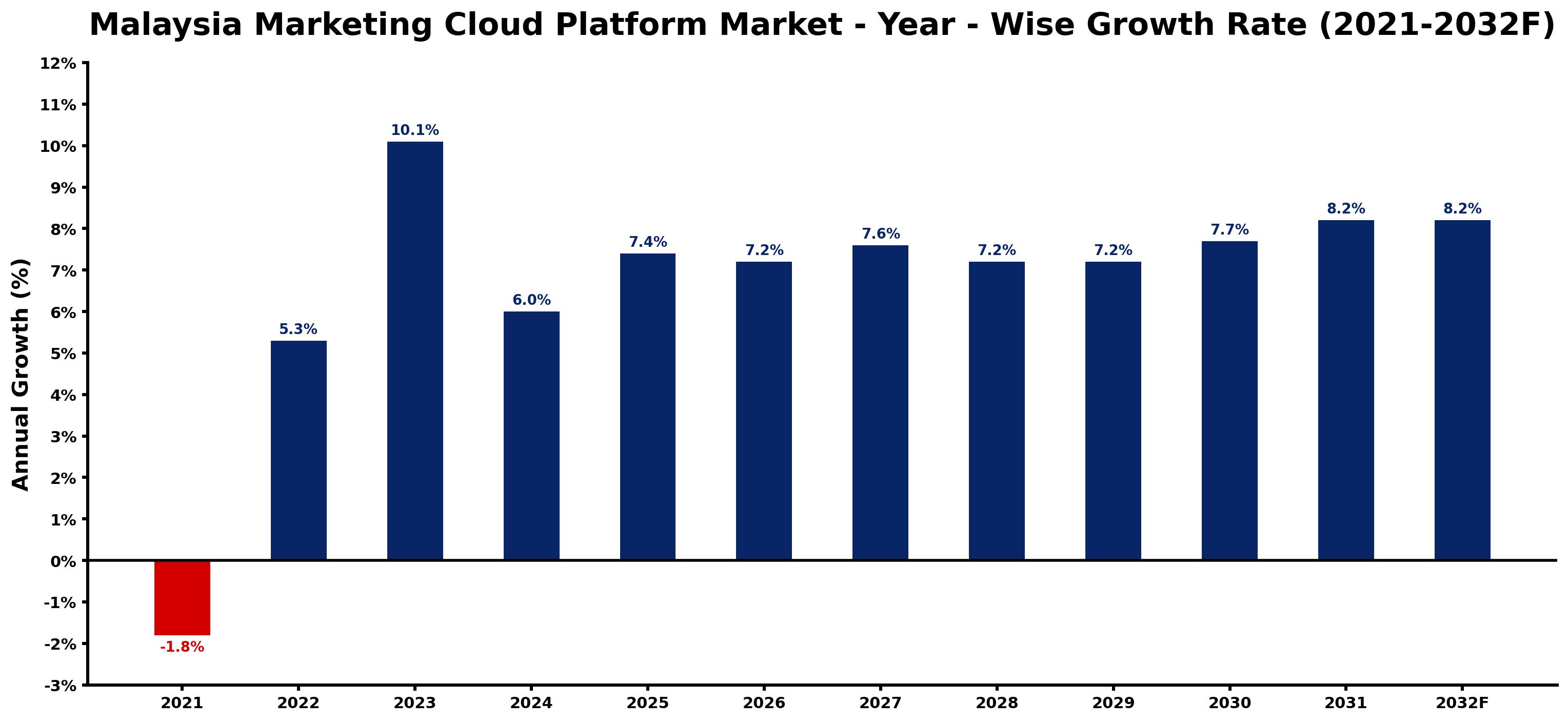
The table below presents the year‑wise growth rates along with the key drivers influencing the market
| Year | Growth Rate | Major Drivers |
| 2021 | -1.8% | MCMC's stricter regulations on digital advertising practices. |
| 2022 | 5.3% | Adoption of Multimedia Super Corridor digital incentives. |
| 2023 | 10.1% | Increasing smartphone penetration driving mobile marketing growth. |
| 2024 | 6.0% | Focus on Malaysian Digital Economy Blueprint strategies. |
| 2025 | 7.4% | Growing integration of artificial intelligence in marketing tools. |
| 2026 | 7.2% | Shift to data-driven marketing analytics among businesses. |
| 2027 | 7.6% | Boost from Digital Economy Council initiatives for startups. |
| 2028 | 7.2% | Emerging social media trends enhancing targeted advertising. |
| 2029 | 7.2% | Collaboration between local universities and marketing platforms. |
| 2030 | 7.7% | Increased investments in customer experience optimization technologies. |
| 2031 | 8.2% | Government support for tech innovation in advertising sectors. |
| 2032 | 8.2% | Higher consumer spending on personalized digital experiences. |
Note: Market size estimations and growth projections presented in this report are based on 6Wresearch's proprietary forecasting methodology, utilizing the latest available industry data, government publications, and primary research inputs.
Malaysia Marketing Cloud Platform Market Key Takeaways
Below are some of the specific key takeaways from the market, including:
- The shift towards data-driven marketing strategies is accelerating adoption among Malaysian businesses.
- Regulatory challenges around data privacy are creating complexities for marketers.
- COVID-19 has acted as a catalyst for digital marketing transformation.
- Integration with existing marketing systems remains a challenge for many organizations.
- Companies are increasingly focusing on customer segmentation to enhance targeted marketing efforts.
Evaluation of Restraints in Malaysia Marketing Cloud Platform Market
Data privacy regulations in Malaysia pose a significant challenge for the Marketing Cloud Platform market. As laws governing personal data usage tighten, businesses must find ways to comply while still delivering personalized marketing experiences. This balancing act is not just a regulatory hurdle but also a fundamental concern for maintaining customer trust. on top of that, the technical intricacies involved in integrating various marketing tools can deter companies from fully embracing comprehensive cloud solutions, limiting their ability to maximize the benefits these platforms offer.
Malaysia Marketing Cloud Platform Market Trends
Several trends are shaping the demand for marketing cloud platforms in Malaysia. The push for personalized customer experiences is leading organizations to invest heavily in analytics and automation tools. Companies are also moving towards omnichannel strategies, ensuring their marketing efforts are cohesive across various digital touchpoints.
on top of that, there is a growing inclination towards AI-driven marketing solutions. Businesses are increasingly looking at artificial intelligence to gain insights from data, automate processes, and predict customer behavior, which ultimately enhances engagement and conversion rates.
Malaysia Marketing Cloud Platform Market Opportunities
The Malaysia Marketing Cloud Platform market offers substantial growth opportunities, particularly for companies willing to innovate. The increasing digital adoption among consumers presents a ripe environment for businesses to expand their marketing capabilities. There’s a notable gap in the market for solutions that provide seamless integration with existing tools while adhering to data privacy regulations.
on top of that, the rising interest in AI and machine learning technologies can lead to the development of advanced marketing solutions that provide deeper insights into customer preferences. Companies that can harness these technologies effectively will have a competitive edge.
Government Initiatives in the Malaysia Marketing Cloud Platform Market
The Malaysian government is actively shaping the Marketing Cloud Platform market through various initiatives aimed at enhancing digital infrastructure and regulatory frameworks. With a focus on promoting digital transformation, public policies are increasingly aligned with the needs of businesses seeking to adopt comprehensive marketing solutions. The government's support for technology adoption is crucial for market growth and innovation.
- A national digital infrastructure upgrade programme currently in its rollout phase aims to enhance connectivity and data accessibility for businesses.
- A regulatory framework introduced in 2025 mandates greater transparency in data usage, ensuring consumer privacy while allowing for targeted marketing.
- A planned public-private initiative expected to expand digital marketing capabilities by 2028 aims to foster collaboration between technology providers and businesses.
- The establishment of a Digital Economy Council in 2023, which focuses on driving digital innovation across various sectors.
- Ongoing initiatives to provide training and resources for marketers to better understand data privacy regulations and their implications.
Future Insights of the Malaysia Marketing Cloud Platform Market
Looking ahead to 2026-2032, the Malaysia Marketing Cloud Platform market is expected to continue its growth trajectory. The increasing emphasis on personalized marketing and the integration of AI technologies will redefine how businesses engage with customers. Companies that prioritize data analytics and customer insights will likely see the highest returns on their marketing investments.
As regulatory frameworks evolve, businesses will need to adapt swiftly to ensure compliance while still leveraging data for marketing purposes. This dynamic environment will require companies to stay agile and forward-thinking in their marketing strategies.
Malaysia Marketing Cloud Platform Market Latest Developments
In the last 12-14 months, the Malaysia Marketing Cloud Platform market has seen notable advancements as organizations strive to enhance their digital marketing capabilities. Companies are increasingly investing in technology solutions that facilitate better customer engagement and data analytics, leading to a more competitive environment.
- A leading regional operator launched a new marketing automation tool in early 2025, designed to streamline campaign management and improve customer targeting.
- In mid-2025, a major technology vendor unveiled an advanced analytics platform that integrates seamlessly with existing marketing cloud solutions.
- A partnership between a digital marketing agency and a cloud service provider began in late 2025, focusing on delivering tailored marketing solutions to SMEs.
- A rollout expected to begin in the second half of 2026 will introduce a suite of AI-driven marketing tools aimed at enhancing personalization for businesses.
- An initiative that started in early 2025 to educate companies on data privacy regulations and their impact on marketing strategies is currently underway.
Malaysia Marketing Cloud Platform Market - Key Attractiveness of the Report
- 10 Years of Market Numbers
- Historical Data Starting from 2022 to 2025
- Base Year: 2025
- Forecast Data until 2032
- Key Performance Indicators Impacting the Market
- Major Upcoming Developments and Projects
Key Highlights of the Report:
- Malaysia Marketing Cloud Platform Market Outlook
- Market Size of Malaysia Marketing Cloud Platform Market, 2025
- Forecast of Malaysia Marketing Cloud Platform Market, 2032
- Historical Data and Forecast of Malaysia Marketing Cloud Platform Revenues & Volume for the Period 2022-2032F
- Malaysia Marketing Cloud Platform Market Trend Evolution
- Malaysia Marketing Cloud Platform Market Drivers and Challenges
- Malaysia Marketing Cloud Platform Price Trends
- Malaysia Marketing Cloud Platform Porter's Five Forces
- Malaysia Marketing Cloud Platform Industry Life Cycle
- Historical Data and Forecast of Malaysia Marketing Cloud Platform Market Revenues & Volume By Component for the Period 2022-2032F
- Historical Data and Forecast of Malaysia Marketing Cloud Platform Market Revenues & Volume By Platforms for the Period 2022-2032F
- Historical Data and Forecast of Malaysia Marketing Cloud Platform Market Revenues & Volume By Services for the Period 2022-2032F
- Historical Data and Forecast of Malaysia Marketing Cloud Platform Market Revenues & Volume By Organization Size for the Period 2022-2032F
- Historical Data and Forecast of Malaysia Marketing Cloud Platform Market Revenues & Volume By Large Enterprises for the Period 2022-2032F
- Historical Data and Forecast of Malaysia Marketing Cloud Platform Market Revenues & Volume By SMEs for the Period 2022-2032F
- Historical Data and Forecast of Malaysia Marketing Cloud Platform Market Revenues & Volume By Deployment Mode for the Period 2022-2032F
- Historical Data and Forecast of Malaysia Marketing Cloud Platform Market Revenues & Volume By Public Cloud for the Period 2022-2032F
- Historical Data and Forecast of Malaysia Marketing Cloud Platform Market Revenues & Volume By Private Cloud for the Period 2022-2032F
- Historical Data and Forecast of Malaysia Marketing Cloud Platform Market Revenues & Volume By Marketing Functions for the Period 2022-2032F
- Historical Data and Forecast of Malaysia Marketing Cloud Platform Market Revenues & Volume By Advertising for the Period 2022-2032F
- Historical Data and Forecast of Malaysia Marketing Cloud Platform Market Revenues & Volume By Designing for the Period 2022-2032F
- Historical Data and Forecast of Malaysia Marketing Cloud Platform Market Revenues & Volume By Sales Channel for the Period 2022-2032F
- Historical Data and Forecast of Malaysia Marketing Cloud Platform Market Revenues & Volume By Branding for the Period 2022-2032F
- Historical Data and Forecast of Malaysia Marketing Cloud Platform Market Revenues & Volume By Communications for the Period 2022-2032F
- Historical Data and Forecast of Malaysia Marketing Cloud Platform Market Revenues & Volume By Customer Support for the Period 2022-2032F
- Historical Data and Forecast of Malaysia Marketing Cloud Platform Market Revenues & Volume By Vertical for the Period 2022-2032F
- Historical Data and Forecast of Malaysia Marketing Cloud Platform Market Revenues & Volume By Retail & eCommerce for the Period 2022-2032F
- Historical Data and Forecast of Malaysia Marketing Cloud Platform Market Revenues & Volume By Banking, Financial Services, & Insurance (BFSI) for the Period 2022-2032F
- Historical Data and Forecast of Malaysia Marketing Cloud Platform Market Revenues & Volume By IT & Telecom for the Period 2022-2032F
- Historical Data and Forecast of Malaysia Marketing Cloud Platform Market Revenues & Volume By Education for the Period 2022-2032F
- Historical Data and Forecast of Malaysia Marketing Cloud Platform Market Revenues & Volume By Travel & Hospitality for the Period 2022-2032F
- Historical Data and Forecast of Malaysia Marketing Cloud Platform Market Revenues & Volume By Media, Entertainment, & Gaming for the Period 2022-2032F
- Historical Data and Forecast of Malaysia Marketing Cloud Platform Market Revenues & Volume By Healthcare & Life Sciences for the Period 2022-2032F
- Historical Data and Forecast of Malaysia Marketing Cloud Platform Market Revenues & Volume By Other Verticals for the Period 2022-2032F
- Malaysia Marketing Cloud Platform Import Export Trade Statistics
- Market Opportunity Assessment By Component
- Market Opportunity Assessment By Organization Size
- Market Opportunity Assessment By Deployment Mode
- Market Opportunity Assessment By Marketing Functions
- Market Opportunity Assessment By Vertical
- Malaysia Marketing Cloud Platform Top Companies Market Share
- Malaysia Marketing Cloud Platform Competitive Benchmarking By Technical and Operational Parameters
- Malaysia Marketing Cloud Platform Company Profiles
- Malaysia Marketing Cloud Platform Key Strategic Recommendations






































