Malaysia Mechanical Springs Market Size, Share & Growth Rate
The Malaysia Mechanical Springs Market was estimated at USD 387 Million in 2025 and is projected to reach USD 509 Million by 2032, growing at a CAGR of 4.0% from 2026 to 2032. This growth trajectory is being supported by a burgeoning manufacturing sector and an increasing demand for high-performance springs in industries such as automotive and aerospace. As Malaysia continues to expand its role in the global supply chain, the need for reliable mechanical springs that enhance the performance and durability of equipment will only grow.
Malaysia Mechanical Springs Market Year-wise Growth Rate and Key Drivers
This graph highlights how the Malaysia Mechanical Springs Market has steadily grown over the years, supported by major growth factors.
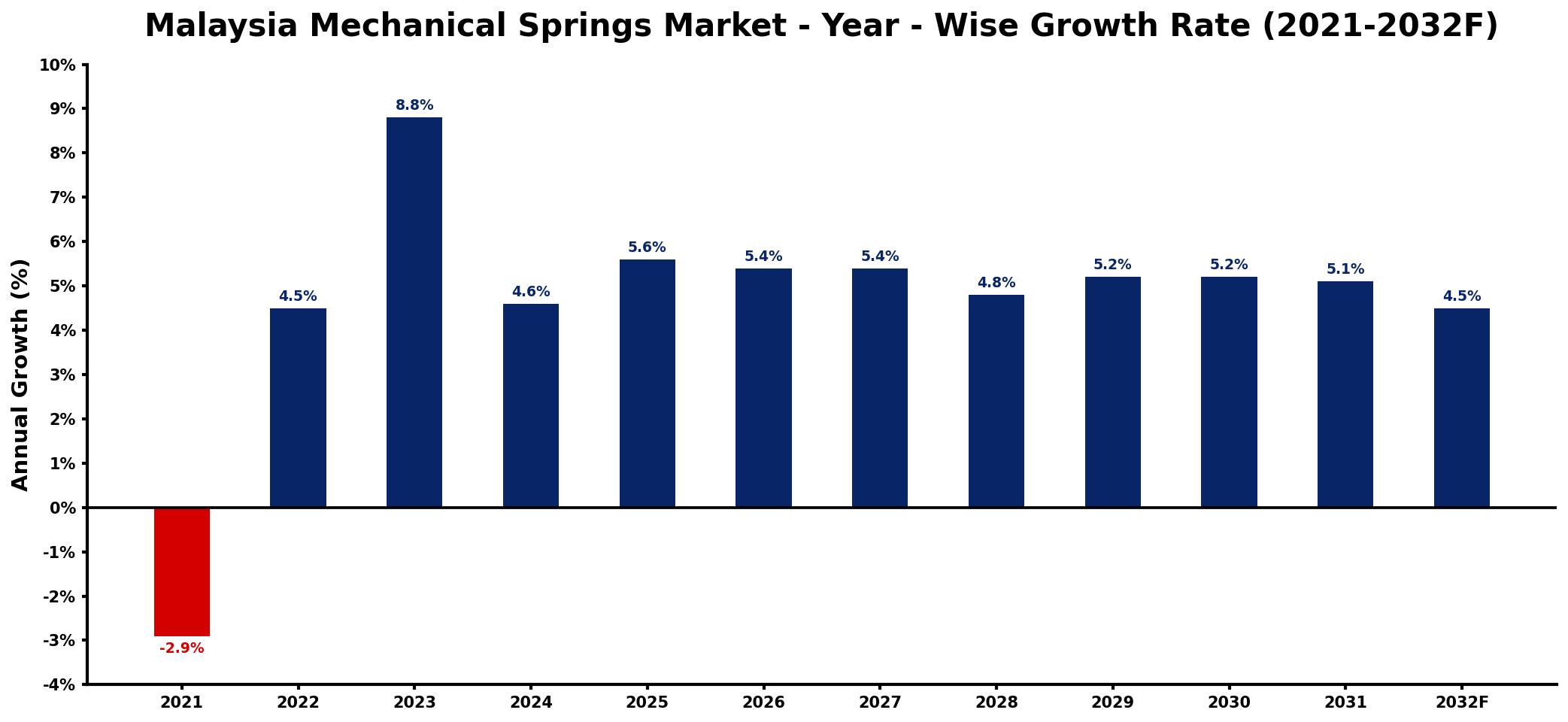
The table below presents the year‑wise growth rates along with the key drivers influencing the market
| Year | Growth Rate | Major Drivers |
| 2021 | -2.9% | Reduced investment in manufacturing sector |
| 2022 | 4.5% | Increased demand from automotive industry |
| 2023 | 8.8% | Expansion in construction activities |
| 2024 | 4.6% | Growth in renewable energy projects |
| 2025 | 5.6% | Rise in consumer electronics production |
| 2026 | 5.4% | Boost in industrial automation investments |
| 2027 | 5.4% | Surge in aerospace manufacturing activities |
| 2028 | 4.8% | increased overall sector activity |
| 2029 | 5.2% | Increase in home appliance demand |
| 2030 | 5.2% | Expansion of transportation infrastructure projects |
| 2031 | 5.1% | stronger distribution network expansion |
| 2032 | 4.5% | growing downstream application demand |
Note: Market size estimations and growth projections presented in this report are based on 6Wresearch's proprietary forecasting methodology, utilizing the latest available industry data, government publications, and primary research inputs.
Malaysia Mechanical Springs Market Synopsis
Recent momentum in the Malaysia mechanical springs market reflects a recovery from the disruptions caused by the COVID-19 pandemic. As manufacturing resumes its upward trajectory, driven by robust vehicle production and machinery needs, the market is positioned for a steady ascent. In the coming years, this demand is expected to accelerate, particularly as local manufacturers innovate and adapt to the evolving market landscape.
The mechanical springs market in Malaysia serves a diverse range of sectors, signaling its integral role in the countrys industrial framework. As industries strive for enhanced performance through advanced engineering solutions, the focus will increasingly shift towards sourcing high-quality springs that comply with stringent international standards.
Malaysia Mechanical Springs Market Key Takeaways
- The market is poised for growth, driven primarily by the automotive and manufacturing sectors.
- Increased vehicle production in Malaysia is a significant driver of mechanical spring demand.
- Local manufacturers are focusing on innovation and quality to compete against imports.
- Adoption of advanced materials and technologies is reshaping the competitive landscape.
- Despite challenges, there are emerging opportunities in renewable energy and healthcare equipment.
Evaluation of Restraints in Malaysia Mechanical Springs Market
While the Malaysia mechanical springs market shows promise, several constraints can impede its growth. A significant challenge lies in the increasing competition from lower-cost imports, which may hinder local manufacturers' pricing strategies. Furthermore, the need for advanced materials poses a hurdle for some firms that may lack the resources or expertise to innovate. Quality control remains a critical issue as manufacturers strive to meet the rigorous demands of their diverse clientele, necessitating ongoing investments in both technology and skill development.
Malaysia Mechanical Springs Market Trends
A notable trend shaping the Malaysia mechanical springs market is the increasing focus on sustainability and the adoption of environmentally friendly practices. Manufacturers are exploring innovative materials and processes that reduce waste and enhance the recyclability of their products. Additionally, the rise of Industry 4.0 is prompting the incorporation of smart technologies in manufacturing processes, improving efficiency and product customization. The push for high-performance and specialty springs is also becoming prominent, as industries seek to optimize machinery and equipment operations.
Malaysia Mechanical Springs Market Opportunities
Significant growth opportunities exist for manufacturers venturing into niche markets, such as renewable energy and healthcare equipment, which have seen increased demand in recent years. Additionally, investments in research and development can lead to the creation of advanced, high-quality springs that cater to specialized applications. As Malaysian manufacturers enhance their capabilities and product offerings, there is potential for lucrative partnerships and collaborations, both domestically and internationally, to further expand market reach.
Government Initiatives in the Malaysia Mechanical Springs Market
The Malaysian government has been actively supporting the growth of its manufacturing sector through various initiatives aimed at enhancing competitiveness. Policies promoting the adoption of advanced manufacturing technologies and investment incentives are key components of these efforts. Public funding for research and development projects is also being allocated, encouraging innovation in sectors reliant on mechanical springs, thereby facilitating a more sustainable and technologically adept industry.
Future Insights of the Malaysia Mechanical Springs Market
Looking ahead to 2026-2032, the Malaysia mechanical springs market is anticipated to continue its upward trajectory, driven by ongoing industrial expansion and increasing demand for high-performance components. As Malaysian manufacturers adapt to global trends and embrace technological advancements, their ability to deliver quality products will be paramount. The market will likely see further diversification of applications and a stronger emphasis on sustainability, paving the way for innovative solutions that meet the evolving needs of various industries.
Malaysia Mechanical Springs Market Latest Developments (2025 - 2026)
In recent months, the industry has witnessed a surge in technological advancements aimed at improving production efficiency and product quality. Companies have been enhancing their capabilities through collaborations with technology providers and investing in smart manufacturing solutions. There has also been a notable shift towards sustainable practices, with several manufacturers implementing eco-friendly materials and processes, aligning with global sustainability trends and consumer demand for greener products.
Malaysia Mechanical Springs Market - Key Attractiveness of the Report
- 10 Years of Market Numbers
- Historical Data Starting from 2022 to 2025
- Base Year: 2025
- Forecast Data until 2032
- Key Performance Indicators Impacting the Market
- Major Upcoming Developments and Projects
Key Highlights of the Report:
- Malaysia Mechanical Springs Market Outlook
- Market Size of Malaysia Mechanical Springs Market, 2025
- Forecast of Malaysia Mechanical Springs Market, 2032
- Historical Data and Forecast of Malaysia Mechanical Springs Revenues & Volume for the Period 2022-2032F
- Malaysia Mechanical Springs Market Trend Evolution
- Malaysia Mechanical Springs Market Drivers and Challenges
- Malaysia Mechanical Springs Price Trends
- Malaysia Mechanical Springs Porter's Five Forces
- Malaysia Mechanical Springs Industry Life Cycle
- Historical Data and Forecast of Malaysia Mechanical Springs Market Revenues & Volume By Shape for the Period 2022-2032F
- Historical Data and Forecast of Malaysia Mechanical Springs Market Revenues & Volume By Helical Springs or Coil Springs for the Period 2022-2032F
- Historical Data and Forecast of Malaysia Mechanical Springs Market Revenues & Volume By Conical and Volute Springs for the Period 2022-2032F
- Historical Data and Forecast of Malaysia Mechanical Springs Market Revenues & Volume By Laminated or Leaf Springs for the Period 2022-2032F
- Historical Data and Forecast of Malaysia Mechanical Springs Market Revenues & Volume By Disc or Belleville Springs for the Period 2022-2032F
- Historical Data and Forecast of Malaysia Mechanical Springs Market Revenues & Volume By Material for the Period 2022-2032F
- Historical Data and Forecast of Malaysia Mechanical Springs Market Revenues & Volume By Alloy Steel for the Period 2022-2032F
- Historical Data and Forecast of Malaysia Mechanical Springs Market Revenues & Volume By Beryllium Copper for the Period 2022-2032F
- Historical Data and Forecast of Malaysia Mechanical Springs Market Revenues & Volume By Brass for the Period 2022-2032F
- Historical Data and Forecast of Malaysia Mechanical Springs Market Revenues & Volume By Bronze for the Period 2022-2032F
- Historical Data and Forecast of Malaysia Mechanical Springs Market Revenues & Volume By Carbon Steel for the Period 2022-2032F
- Historical Data and Forecast of Malaysia Mechanical Springs Market Revenues & Volume By Chrome Silicone for the Period 2022-2032F
- Historical Data and Forecast of Malaysia Mechanical Springs Market Revenues & Volume By Copper for the Period 2022-2032F
- Historical Data and Forecast of Malaysia Mechanical Springs Market Revenues & Volume By Application for the Period 2022-2032F
- Historical Data and Forecast of Malaysia Mechanical Springs Market Revenues & Volume By Dock Levels for the Period 2022-2032F
- Historical Data and Forecast of Malaysia Mechanical Springs Market Revenues & Volume By Farming Equipment for the Period 2022-2032F
- Historical Data and Forecast of Malaysia Mechanical Springs Market Revenues & Volume By Furniture for the Period 2022-2032F
- Historical Data and Forecast of Malaysia Mechanical Springs Market Revenues & Volume By Power & Energy for the Period 2022-2032F
- Historical Data and Forecast of Malaysia Mechanical Springs Market Revenues & Volume By Transportation for the Period 2022-2032F
- Historical Data and Forecast of Malaysia Mechanical Springs Market Revenues & Volume By Agriculture for the Period 2022-2032F
- Historical Data and Forecast of Malaysia Mechanical Springs Market Revenues & Volume By Electrical & Electronics for the Period 2022-2032F
- Historical Data and Forecast of Malaysia Mechanical Springs Market Revenues & Volume By Others for the Period 2022-2032F
- Malaysia Mechanical Springs Import Export Trade Statistics
- Market Opportunity Assessment By Shape
- Market Opportunity Assessment By Material
- Market Opportunity Assessment By Application
- Malaysia Mechanical Springs Top Companies Market Share
- Malaysia Mechanical Springs Competitive Benchmarking By Technical and Operational Parameters
- Malaysia Mechanical Springs Company Profiles
- Malaysia Mechanical Springs Key Strategic Recommendations






































