Malaysia Middleware Market Size & Growth Rate (2026-2032)
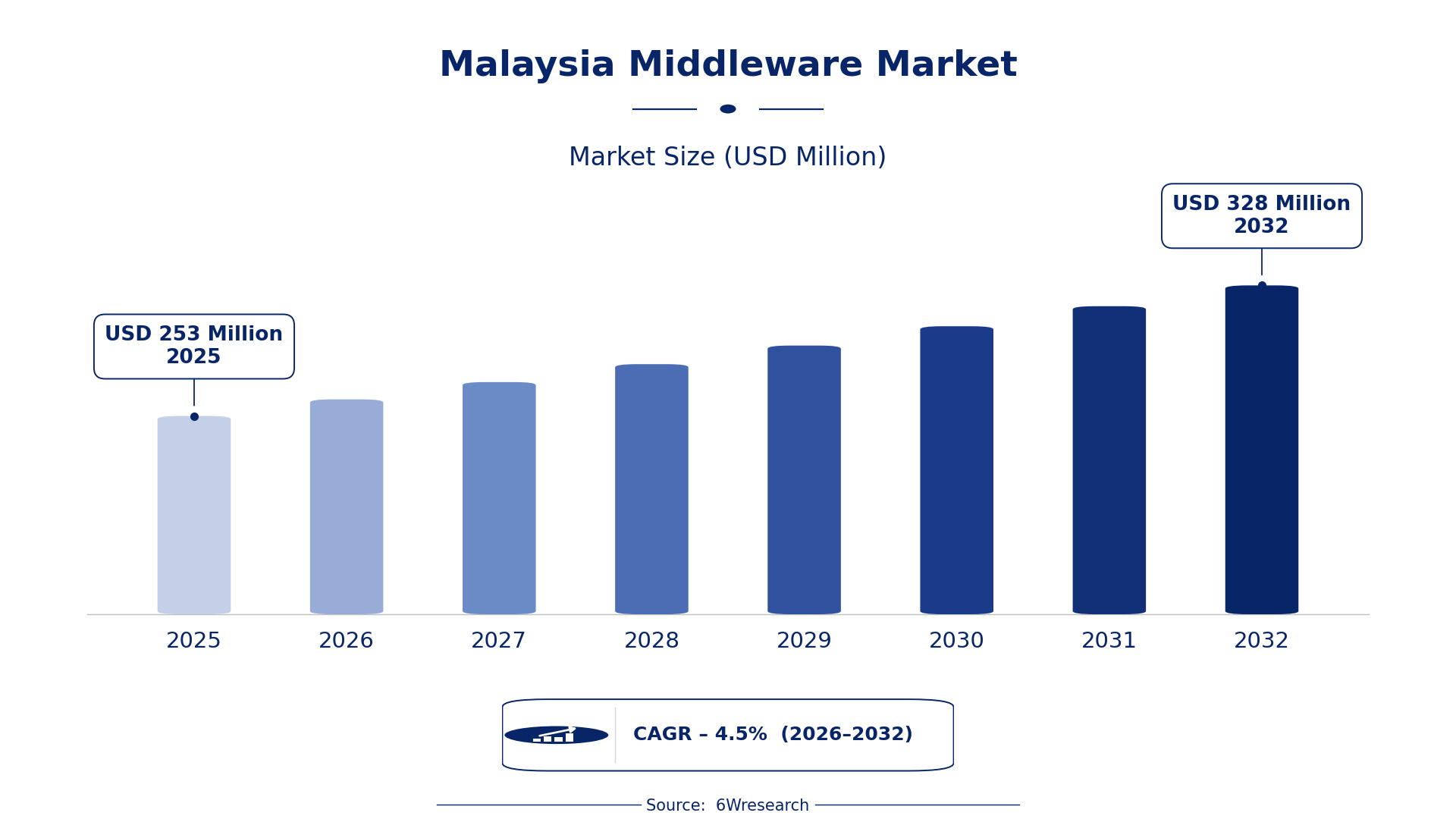
The Malaysia Middleware Market was estimated at USD 253 Million in 2025 and is projected to reach USD 328 Million by 2032, growing at a CAGR of 4.5% from 2026 to 2032.
Malaysia Middleware Market Synopsis
In Malaysia, the middleware market is rapidly evolving to address the intricate integration needs of various software applications across diverse industries. Organizations are increasingly adopting middleware solutions to enable real-time communication, improve operational efficiency, and enhance customer experiences.
This market encompasses a variety of technologies, including application servers and enterprise service buses. As businesses continue to embrace digital transformation, middleware becomes essential in facilitating the seamless flow of data and processes across disparate systems.
Malaysia Middleware Market Year-wise Growth Rate and Key Drivers
This graph illustrates the annual growth rates of the Malaysia Middleware Market from 2021 to 2032, highlighting a steady upward trajectory and projected expansion over the forecast period.
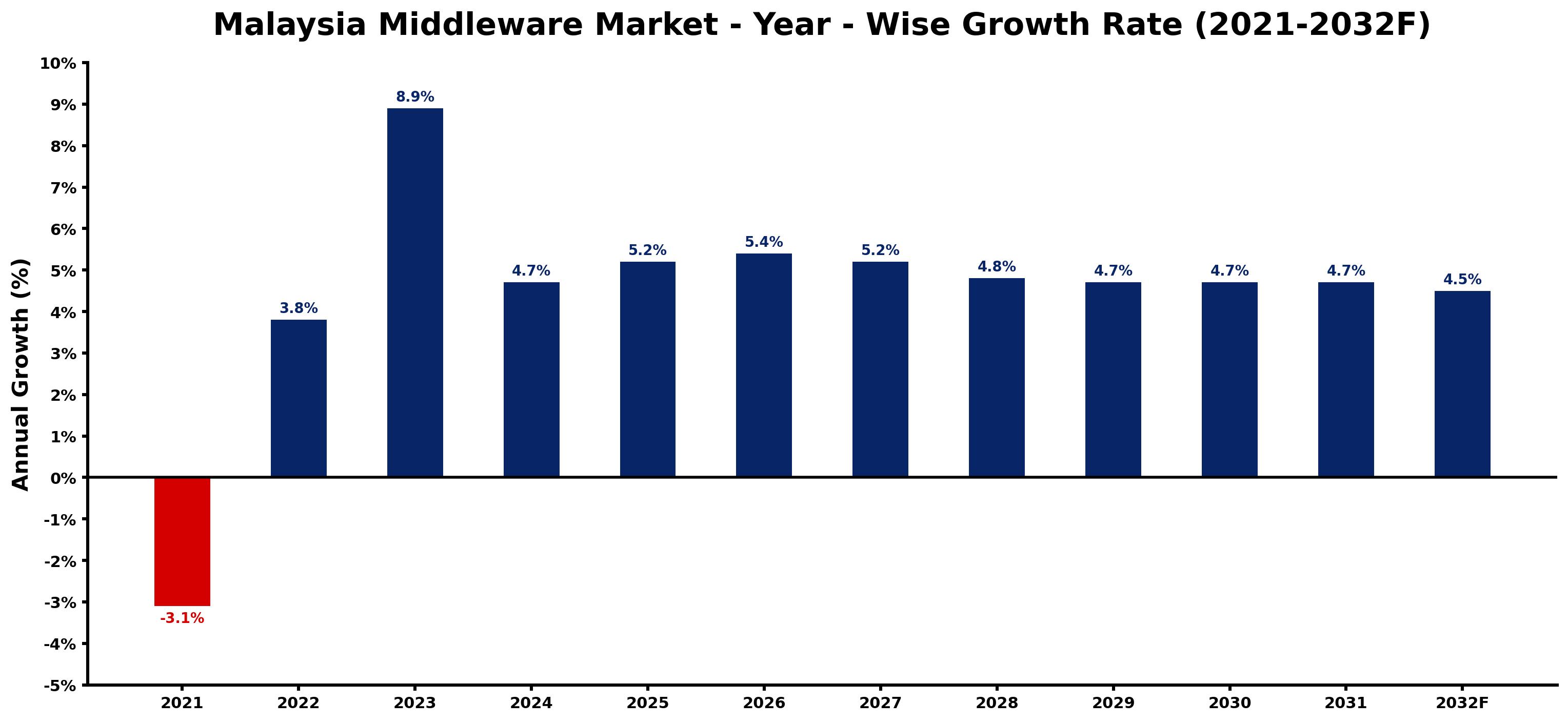
The table below presents the year‑wise growth rates along with the key drivers influencing the market
| Year | Growth Rate | Major Drivers |
| 2021 | -3.1% | Malaysian government delays digital economy initiatives implementation. |
| 2022 | 3.8% | MCMC promoting digital transformation initiatives in enterprises. |
| 2023 | 8.9% | Increase in cloud adoption among Malaysian SMEs. |
| 2024 | 4.7% | Government funding for tech startups enhancing middleware development. |
| 2025 | 5.2% | Rise in e-commerce driving integration of payment systems. |
| 2026 | 5.4% | Digital banking regulations boosting API usage in finance. |
| 2027 | 5.2% | Growing IoT ecosystem necessitating robust middleware solutions. |
| 2028 | 4.8% | Local demand for real-time data analytics in retail. |
| 2029 | 4.7% | Healthcare sector digitization requires seamless systems integration. |
| 2030 | 4.7% | Regulatory push for data interoperability in government services. |
| 2031 | 4.7% | Increased cybersecurity threats driving middleware security solutions. |
| 2032 | 4.5% | Education sector integration fosters demand for collaborative platforms. |
Note: Market size estimations and growth projections presented in this report are based on 6Wresearch's proprietary forecasting methodology, utilizing the latest available industry data, government publications, and primary research inputs.
Malaysia Middleware Market Key Takeaways
Below are some of the specific key takeaways from the market, including:
- The demand for middleware is fueled by the need for efficient integration of applications and systems.
- Cybersecurity and data protection remain significant concerns, necessitating advanced middleware solutions.
- Businesses are increasingly prioritizing agility, driving a surge in middleware adoption post-COVID-19.
- The market is characterized by a diverse range of technologies catering to varying integration needs.
- Government policies are shaping the middleware landscape, promoting digital transformation initiatives.
Evaluation of Restraints in Malaysia Middleware Market
Several challenges hinder the growth of the Malaysia middleware market. Compatibility issues between legacy systems and modern applications complicate integration efforts. Additionally, organizations grapple with the need to adopt new technologies while ensuring robust cybersecurity measures. The rapid pace of technological change also puts pressure on middleware providers to stay relevant and deliver solutions that meet evolving business demands. These factors collectively create a complex environment that can slow down middleware adoption.
Malaysia Middleware Market Trends
One notable trend is the increasing focus on cloud-based middleware solutions. As more organizations migrate to cloud environments, the demand for middleware that can operate across hybrid infrastructures is growing. on top of that, the rise of microservices architecture is pushing businesses to adopt middleware that supports distributed application environments. This shift facilitates faster development cycles and enhances operational flexibility.
Malaysia Middleware Market Opportunities
The growing emphasis on digital transformation presents significant opportunities for middleware providers. As Malaysian businesses seek to enhance operational efficiency and customer engagement, they are turning to innovative middleware solutions. Additionally, the increasing investment in smart technologies, such as IoT and AI, is expected to drive demand for middleware that can integrate and manage these advanced systems effectively.
Government Initiatives in the Malaysia Middleware Market
The Malaysian government is actively promoting digital transformation through various initiatives, which directly impact the middleware market. By prioritizing regulatory frameworks and public-private partnerships, the government aims to enhance the overall IT infrastructure and support middleware adoption. These efforts are crucial for fostering innovation and ensuring businesses can effectively integrate emerging technologies.
- A national digital infrastructure upgrade programme launched in 2024 aims to improve connectivity and access to middleware solutions.
- Currently ongoing initiatives focus on developing training and certification programs for middleware professionals to build local expertise.
- A regulatory framework introduced in early 2025 mandates enhanced data protection measures for middleware solutions.
- Future plans include a public-private partnership to foster innovation in middleware technologies, expected to be initiated by 2026.
Future Insights of the Malaysia Middleware Market
From 2026 to 2032, the Malaysia middleware market is set to experience notable growth driven by the continuous digitalization of businesses. As organizations increasingly rely on integrated systems, middleware will be at the forefront of enabling connectivity and efficiency. The emphasis on cybersecurity and data protection will also guide product development, pushing providers to innovate and adapt to new challenges.
Malaysia Middleware Market Latest Developments
Recent activity in the Malaysia middleware market indicates a strong trend toward innovation and expansion. Companies are focusing on enhancing their middleware offerings to meet the growing demands for integration and security. This dynamic environment suggests that the market is gearing up for significant advancements in technology and service delivery.
- A major technology vendor announced a new middleware platform in Q1 2025 designed to facilitate seamless integration across cloud environments.
- A partnership between two leading regional operators to develop a middleware solution for IoT applications is currently ongoing, expected to complete by mid-2025.
- In late 2024, a prominent software provider completed a rollout of its upgraded middleware capabilities, enhancing support for enterprise applications.
- Upcoming initiatives include a middleware solution aimed at small and medium-sized enterprises, set to launch in early 2026.
Malaysia Middleware Market - Key Attractiveness of the Report
- 10 Years of Market Numbers
- Historical Data Starting from 2022 to 2025
- Base Year: 2025
- Forecast Data until 2032
- Key Performance Indicators Impacting the Market
- Major Upcoming Developments and Projects
Key Highlights of the Report:
- Malaysia Middleware Market Outlook
- Market Size of Malaysia Middleware Market, 2025
- Forecast of Malaysia Middleware Market, 2032
- Historical Data and Forecast of Malaysia Middleware Revenues & Volume for the Period 2022-2032F
- Malaysia Middleware Market Trend Evolution
- Malaysia Middleware Market Drivers and Challenges
- Malaysia Middleware Price Trends
- Malaysia Middleware Porter's Five Forces
- Malaysia Middleware Industry Life Cycle
- Historical Data and Forecast of Malaysia Middleware Market Revenues & Volume By Product Type for the Period 2022-2032F
- Historical Data and Forecast of Malaysia Middleware Market Revenues & Volume By Communication Middleware for the Period 2022-2032F
- Historical Data and Forecast of Malaysia Middleware Market Revenues & Volume By Platform Middleware for the Period 2022-2032F
- Historical Data and Forecast of Malaysia Middleware Market Revenues & Volume By Integration Middleware for the Period 2022-2032F
- Historical Data and Forecast of Malaysia Middleware Market Revenues & Volume By Others for the Period 2022-2032F
- Historical Data and Forecast of Malaysia Middleware Market Revenues & Volume By Deployment Types for the Period 2022-2032F
- Historical Data and Forecast of Malaysia Middleware Market Revenues & Volume By On-Premise for the Period 2022-2032F
- Historical Data and Forecast of Malaysia Middleware Market Revenues & Volume By Hosted for the Period 2022-2032F
- Historical Data and Forecast of Malaysia Middleware Market Revenues & Volume By Hybrid for the Period 2022-2032F
- Historical Data and Forecast of Malaysia Middleware Market Revenues & Volume By Organization Size for the Period 2022-2032F
- Historical Data and Forecast of Malaysia Middleware Market Revenues & Volume By Small businesses for the Period 2022-2032F
- Historical Data and Forecast of Malaysia Middleware Market Revenues & Volume By Medium businesses for the Period 2022-2032F
- Historical Data and Forecast of Malaysia Middleware Market Revenues & Volume By Enterprises for the Period 2022-2032F
- Historical Data and Forecast of Malaysia Middleware Market Revenues & Volume By Large enterprises for the Period 2022-2032F
- Historical Data and Forecast of Malaysia Middleware Market Revenues & Volume By Verticals for the Period 2022-2032F
- Historical Data and Forecast of Malaysia Middleware Market Revenues & Volume By Banking, financial services and insurance (BFSI) for the Period 2022-2032F
- Historical Data and Forecast of Malaysia Middleware Market Revenues & Volume By Consumer Goods and Retail for the Period 2022-2032F
- Historical Data and Forecast of Malaysia Middleware Market Revenues & Volume By IT and telecom for the Period 2022-2032F
- Historical Data and Forecast of Malaysia Middleware Market Revenues & Volume By Manufacturing for the Period 2022-2032F
- Historical Data and Forecast of Malaysia Middleware Market Revenues & Volume By Oil and Gas for the Period 2022-2032F
- Historical Data and Forecast of Malaysia Middleware Market Revenues & Volume By Healthcare for the Period 2022-2032F
- Historical Data and Forecast of Malaysia Middleware Market Revenues & Volume By Government for the Period 2022-2032F
- Malaysia Middleware Import Export Trade Statistics
- Market Opportunity Assessment By Product Type
- Market Opportunity Assessment By Deployment Types
- Market Opportunity Assessment By Organization Size
- Market Opportunity Assessment By Verticals
- Malaysia Middleware Top Companies Market Share
- Malaysia Middleware Competitive Benchmarking By Technical and Operational Parameters
- Malaysia Middleware Company Profiles
- Malaysia Middleware Key Strategic Recommendations






































