Malaysia Pest Control Market Size Growth Rate
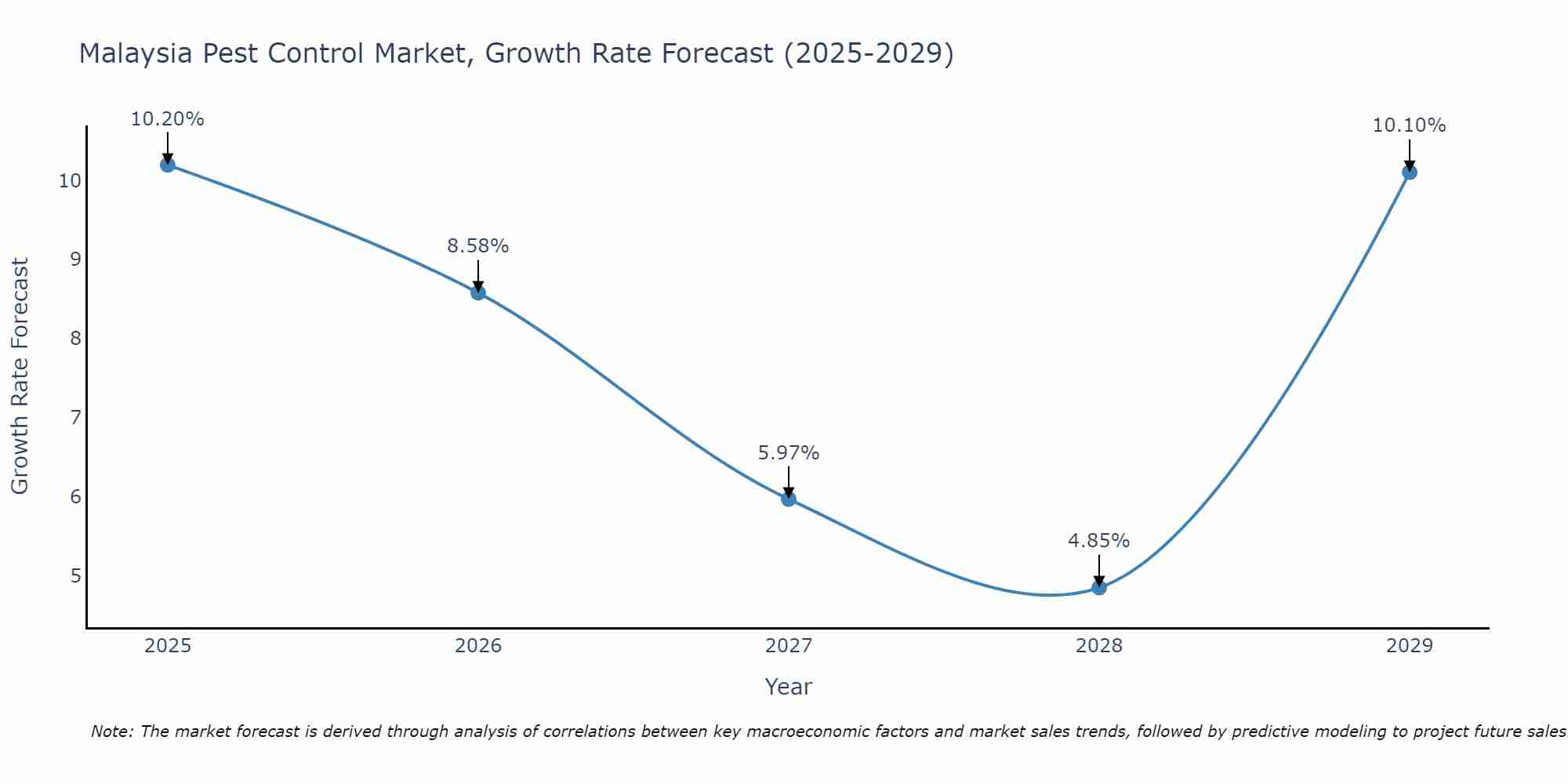
The Malaysia Pest Control Market is projected to witness mixed growth rate patterns during 2025 to 2029. Beginning strongly at 10.20% in 2025, growth softens to 10.10% in 2029.
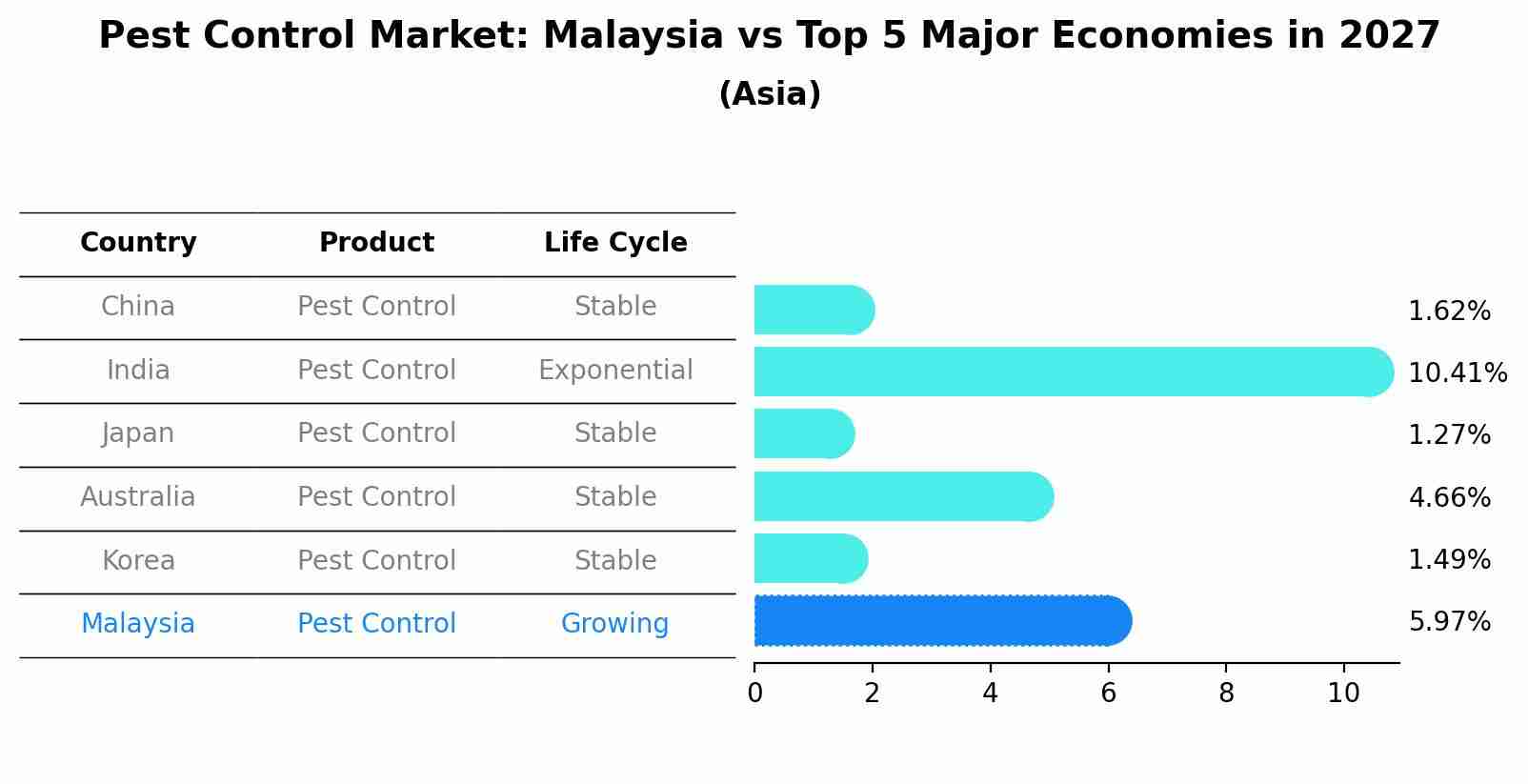
Pest Control Market: Malaysia vs Top 5 Major Economies in 2027 (Asia)
By 2027, the Pest Control market in Malaysia is anticipated to reach a growth rate of 5.97%, as part of an increasingly competitive Asia region, where China remains at the forefront, supported by India, Japan, Australia and South Korea, driving innovations and market adoption across sectors.
Malaysia Pest Control Market Growth Rate
According to 6Wresearch internal database and industry insights,
Five-Year Growth Trajectory of the Malaysia Pest Control Market
Below mentioned are the evaluation of year-wise growth rate along with key drivers:
| Year | Est. Annual Growth (%) | Growth Drivers |
| 2021 | 4.3% | Increased demand for termite protection in the burgeoning high-end residential sector in the Klang Valley. |
| 2022 | 4.9% | Rapid expansion of the Halal food processing industry requiring stringent international hygiene compliance. |
| 2023 | 5.2% | Rise in Smart City developments in Johor and Penang, driving the adoption of IoT-based pest monitoring. |
| 2024 | 5.6% | Government-led intensification of the National Dengue Prevention Program and vector control in urban centers. |
| 2025 | 5.7% | Strategic shift toward Integrated Pest Management (IPM) in large-scale agricultural plantations and logistics hubs. |
Topics Covered in the Malaysia Pest Control Market Report
The report thoroughly covers the market by pest type, control method, mode of application, and application. It provides an unbiased and detailed analysis of ongoing market trends, opportunities, challenges, and market drivers.
India Grow Light Market Highlights
| Report Name | Malaysia Pest Control Market |
| Forecast Period | 2026–2032 |
| CAGR | 5.8% |
| Growing Sector | Commercial |
Malaysia Pest Control Market Synopsis
The Malaysia Pest Control Market is undergoing a transition from reactive "spray-and-pray" methods to data-driven Integrated Pest Management (IPM). As of early 2026, the market is proliferated by Malaysia's tropical climate. This gives year-round breeding grounds for termites and mosquitoes and the government's concentration on Food Safety (HACCP/GMP) and the Malaysian Sustainable Palm Oil (MSPO) scheme has created higher standards for pest control in food supply chains and plantations. The market is also transforming with the incorporation of AI-enabled thermal imaging for termite detection and the utilisation of eco-friendly biological baits.
Evaluation of Growth Drivers in the Malaysia Pest Control Market
Below mentioned are some prominent drivers and their influence on Malaysia Pest Control Market dynamics:
| Drivers | Primary Segment Affected | Why It Matters (Evidence) |
| Tropical Climate Surges | Insects / Termites | High humidity levels in Malaysia drive nearly $150 million in annual property damage from termites. |
| Smart IoT Monitoring | Commercial | Real-time rodent tracking reduces inspection labor costs by up to 30% for warehouse managers. |
| Dengue Control Programs | Sprays / Public | The Ministry of Health's intensified anti-Aedes campaigns drive recurring fogging contracts. |
| E-commerce & Logistics | Storage & Transport | The boom in logistics hubs (e.g., Sepang) requires strict rodent and insect exclusion to protect goods. |
| Residential Awareness | Residential | Homeowners are increasingly opting for "pet-safe" and non-toxic gel baits over traditional sprays. |
The Malaysia Pest Control Market Size is projected to grow at a compound annual growth rate (CAGR) of 5.8% from 2026 to 2032. The market is proliferated by the growth of the high-end residential real estate sector. They are also accelerated by strict hygiene requirements for Malaysia's high-quality electronics and food export industries. As of 2026, Insects persist the largest segment by pest type. While the Chemical control method continues to hold the majority share owing to its instant efficacy. Biological and Mechanical methods are the fastest-growing segments, showcasing a trend toward sustainable pest management.
Evaluation of Restraints in the Malaysia Pest Control Market
Below mentioned are some major restraints and their influence on Malaysia Pest Control Market dynamics:
| Restraints | Primary Segment Affected | What This Means (Evidence) |
| Stringent Pesticide Laws | Chemical | The Pesticides Act 1974 (updated 2024/25) limits the use of certain high-toxicity neurotoxic chemicals. |
| Manpower Shortages | All Segments | A shortage of licensed technicians and skilled field workers often delays service execution in rural areas. |
| Price Undercutting | Residential | Unlicensed "cowboy" operators provide low-cost, ineffective treatments that erode market trust. |
| Pest Resistance | Insects | Mosquito and cockroach resistance in urban centres are there owing to over-exposure to specific pyrethroids. |
| Environmental Concerns | Wildlife | Restrictions on the relocation of protected wildlife species makes issues for the management for urban wildlife. |
Malaysia Pest Control Market Challenges
The Malaysia Pest Control Industry faces challenges such as the high operational costs associated with maintaining specialized equipment and the complexity of managing pests in large-scale Oil Palm and Rubber estates. Furthermore, the monsoon season often leads to "pest surges" that overwhelm the capacity of smaller service providers.
To overcome these, companies are doing fund allocation in predictive analytics to anticipate infestation spikes and deploy drone-based spraying for hard-to-reach industrial rooftops and plantations. The industry is highly contending with the increasing price of regulatory compliance, as new Pesticides Board mandates require high-cost training for licensed applicators to certain the safe handling of next-generation.
Malaysia Pest Control Market Trends
There are numerous trends that will shape the future of the pest control market in Malaysia, including the developing shift towards sustainable and non-toxic pest control solutions. Companies are making investments in biological control solutions and organic products. As many companies have switched to digital transformation, pest control services are not far behind and most companies are using software and apps to schedule, monitor, and create reports. There has also been a concentration on educating the public about integrated pest management (IPM) solutions, which combine multiple methods of controlling pests, give long-term sustainable solutions.
Investment Opportunities in the Malaysia Pest Control Industry
Malaysia Pest Control Industry provides various lucrative investment opportunities, especially for companies emphasizing on R&D on environmentally friendly pesticides and biological control solutions. Similarly, pest control solutions that focus on the Internet of Things (IoT), such as sensor-based real-time monitoring of pest activity, is a growing opportunity that can create new products as the market continues to expand. Another area for development in Malaysia pest control market is providing specialized pest control services which meet government regulations for industrial applications and are becoming increasingly popular for agricultural applications since it meets the rising demand for safe and effective pest management solutions.
Top 5 Leading Players in the Malaysia Pest Control Market
Below is the list of prominent companies operating in the Malaysia Pest Control Market:
1. Rentokil Initial Malaysia
| Company Name | Rentokil Initial Malaysia |
|---|---|
| Established Year | 1967 (Malaysia operations) |
| Headquarters | Petaling Jaya, Malaysia |
| Official Website | Click Here |
Rentokil Initial Malaysia is one of the dominant pest control service providers in the country, offering integrated pest management solutions for residential and commercial clients.
2. Terminix
| Company Name | Terminix |
|---|---|
| Established Year | 1927 |
| Headquarters | Memphis, United States |
| Official Website | Click Here |
Terminix is a worldwide recognized pest control company providing services for termite control, rodent management, and other pest solutions.
3. Ecolab
| Company Name | Ecolab |
|---|---|
| Established Year | 1923 |
| Headquarters | St. Paul, Minnesota, United States |
| Official Website | Click Here |
Ecolab gives pest elimination services along with hygiene and sanitation solutions for industries such as food processing, hospitality, and healthcare.
4. Arrow Exterminators
| Company Name | Arrow Exterminators |
|---|---|
| Established Year | 1964 |
| Headquarters | Atlanta, Georgia, United States |
| Official Website | Click Here |
Arrow Exterminators provides a broad range of pest control services including termite control, wildlife management, and eco-friendly pest solutions.
5. BASF SE
| Company Name | BASF SE |
|---|---|
| Established Year | 1865 |
| Headquarters | Ludwigshafen, Germany |
| Official Website | Click Here |
BASF SE is a worldwide chemical company that develops pest control solutions and insecticides used by professional pest management companies.
Government Regulations Introduced in the Malaysia Pest Control Market
According to Malaysian government data, Government regulation is significant for the pest control industry in Malaysia. Government organizations (i.e., Malaysian Pesticide Board) have stringent guidelines for industry members regarding the manufacture, importation, and use of pesticides to ensure the health of people and the environment. For example, the government introduced new regulations for pest control in 2022, which sought to reduce the use of dangerous pesticides and promote Integrated Pest Management (IPM) practices.
Furthermore, environmental laws like the Environmental Quality Act mandate that pest control companies adopt eco-friendly and biodegradable solutions while minimizing chemical runoffs.
Future Insights of the Malaysia Pest Control Market
The Malaysia Pest Control Market Growth is expected to increase as the energy transition toward "Green Buildings" and sustainable hygiene continues. Market development will persist to rise owing to the concentration on AI-driven prevention and bio-insecticides. The advancement of "Smart Cities" is anticipated to become a major industrial growth driver and this will become the major driver for digital pest services by 2032. This will become the major driver for digital pest services by 2032.
The growing incorporation of ESG (Environmental, Social, and Governance) compliance in the corporate sector, which is encouraged by the MyDigital initiative is predicted to mandate the use of non-toxic, data-traceable pest management systems to align international sustainability auditing standards by the end of the forecast period.
Market Segmentation Analysis
The report offers a comprehensive study of the following market segments and their leading categories:
By Pest Type – Insects to dominate the market
According to Lakshita, Senior Research Analyst, 6Wresearch, The Insects segment will lead the Malaysia Pest Control Market Share and this dominance is proliferated by the country's tropical climate, which facilitates year-round breeding of mosquitoes (Aedes), cockroaches, and ants.
By Control Method – Chemical to dominate the market
The Chemical segment showcases the majority of the market by value, favoured for its immediate efficacy and lower initial service cost. Despite the dominance of chemical sprays and fogs, the Software & Services (Digital Monitoring) and Biological segments are anticipated to be the fastest-growing categories.
By Mode of Application – Sprays to dominate the market
Sprays persist to be the most widely used mode of application, particularly for mosquito fogging and large-scale industrial surface treatments. However, Baits & Traps are getting rapid traction in the residential and hospitality sectors.
By Application – Commercial to dominate the market
The Commercial application segment is the leading contributor to the market, driven by strict hygiene compliance standards in Malaysia’s hospitality, retail, and office sectors. Establishments are required to maintain regular pest control records to comply with HACCP and local municipal health regulations.
Key Attractiveness of the Report
- 10 Years of Market Numbers.
- Historical Data Starting from 2022 to 2025.
- Base Year: 2025.
- Forecast Data until 2032.
- Key Performance Indicators Impacting the Market.
- Major Upcoming Developments and Projects.
Key Highlights of the Report:
- Malaysia Pest Control Market Outlook
- Market Size of Malaysia Pest Control Market, 2025
- Forecast of Malaysia Pest Control Market, 2032
- Historical Data and Forecast of Malaysia Pest Control Revenues & Volume for the Period 2022-2032F
- Malaysia Pest Control Market Trend Evolution
- Malaysia Pest Control Market Drivers and Challenges
- Malaysia Pest Control Price Trends
- Malaysia Pest Control Porter's Five Forces
- Malaysia Pest Control Industry Life Cycle
- Historical Data and Forecast of Malaysia Pest Control Market Revenues & Volume By Pest Type for the Period 2022-2032F
- Historical Data and Forecast of Malaysia Pest Control Market Revenues & Volume By Insects for the Period 2022-2032F
- Historical Data and Forecast of Malaysia Pest Control Market Revenues & Volume By Termites for the Period 2022-2032F
- Historical Data and Forecast of Malaysia Pest Control Market Revenues & Volume By Rodents for the Period 2022-2032F
- Historical Data and Forecast of Malaysia Pest Control Market Revenues & Volume By Wildlife for the Period 2022-2032F
- Historical Data and Forecast of Malaysia Pest Control Market Revenues & Volume By Other pest types (birds, reptiles, and mollusks) for the Period 2022-2032F
- Historical Data and Forecast of Malaysia Pest Control Market Revenues & Volume By Control Method for the Period 2022-2032F
- Historical Data and Forecast of Malaysia Pest Control Market Revenues & Volume By Chemical for the Period 2022-2032F
- Historical Data and Forecast of Malaysia Pest Control Market Revenues & Volume By Biological for the Period 2022-2032F
- Historical Data and Forecast of Malaysia Pest Control Market Revenues & Volume By Mechanical for the Period 2022-2032F
- Historical Data and Forecast of Malaysia Pest Control Market Revenues & Volume By Software & services for the Period 2022-2032F
- Historical Data and Forecast of Malaysia Pest Control Market Revenues & Volume By Mode of Application for the Period 2022-2032F
- Historical Data and Forecast of Malaysia Pest Control Market Revenues & Volume By Powder for the Period 2022-2032F
- Historical Data and Forecast of Malaysia Pest Control Market Revenues & Volume By Sprays for the Period 2022-2032F
- Historical Data and Forecast of Malaysia Pest Control Market Revenues & Volume By Pellets for the Period 2022-2032F
- Historical Data and Forecast of Malaysia Pest Control Market Revenues & Volume By Traps for the Period 2022-2032F
- Historical Data and Forecast of Malaysia Pest Control Market Revenues & Volume By Baits for the Period 2022-2032F
- Historical Data and Forecast of Malaysia Pest Control Market Revenues & Volume By Application: for the Period 2022-2032F
- Historical Data and Forecast of Malaysia Pest Control Market Revenues & Volume By Residential for the Period 2022-2032F
- Historical Data and Forecast of Malaysia Pest Control Market Revenues & Volume By Commercial for the Period 2022-2032F
- Historical Data and Forecast of Malaysia Pest Control Market Revenues & Volume By Livestock for the Period 2022-2032F
- Historical Data and Forecast of Malaysia Pest Control Market Revenues & Volume By Industrial for the Period 2022-2032F
- Historical Data and Forecast of Malaysia Pest Control Market Revenues & Volume By Other applications (non-commercial institutions, storage & transport facilities, and public landscapes) for the Period 2022-2032F
- Malaysia Pest Control Import Export Trade Statistics
- Market Opportunity Assessment By Pest Type
- Market Opportunity Assessment By Control Method
- Market Opportunity Assessment By Mode of Application
- Market Opportunity Assessment By Application:
- Malaysia Pest Control Top Companies Market Share
- Malaysia Pest Control Competitive Benchmarking By Technical and Operational Parameters
- Malaysia Pest Control Company Profiles
- Malaysia Pest Control Key Strategic Recommendations
Market Segmentation
The Market report covers a detailed analysis of the following market segments:
By Pest Type
- Insects
- Termites
- Rodents
- Wildlife
- Other pest types (birds, reptiles, and mollusks)
By Control Method
- Chemical
- Biological
- Mechanical
- Software & Services
By Mode of Application
- Powder
- Sprays
- Pellets
- Traps
- Baits
By Application
- Residential
- Commercial
- Livestock
- Industrial
- Other applications (non-commercial institutions, storage & transport facilities, and public landscapes)






































