Malaysia POS Security Market Size & Growth Rate (2026-2032)
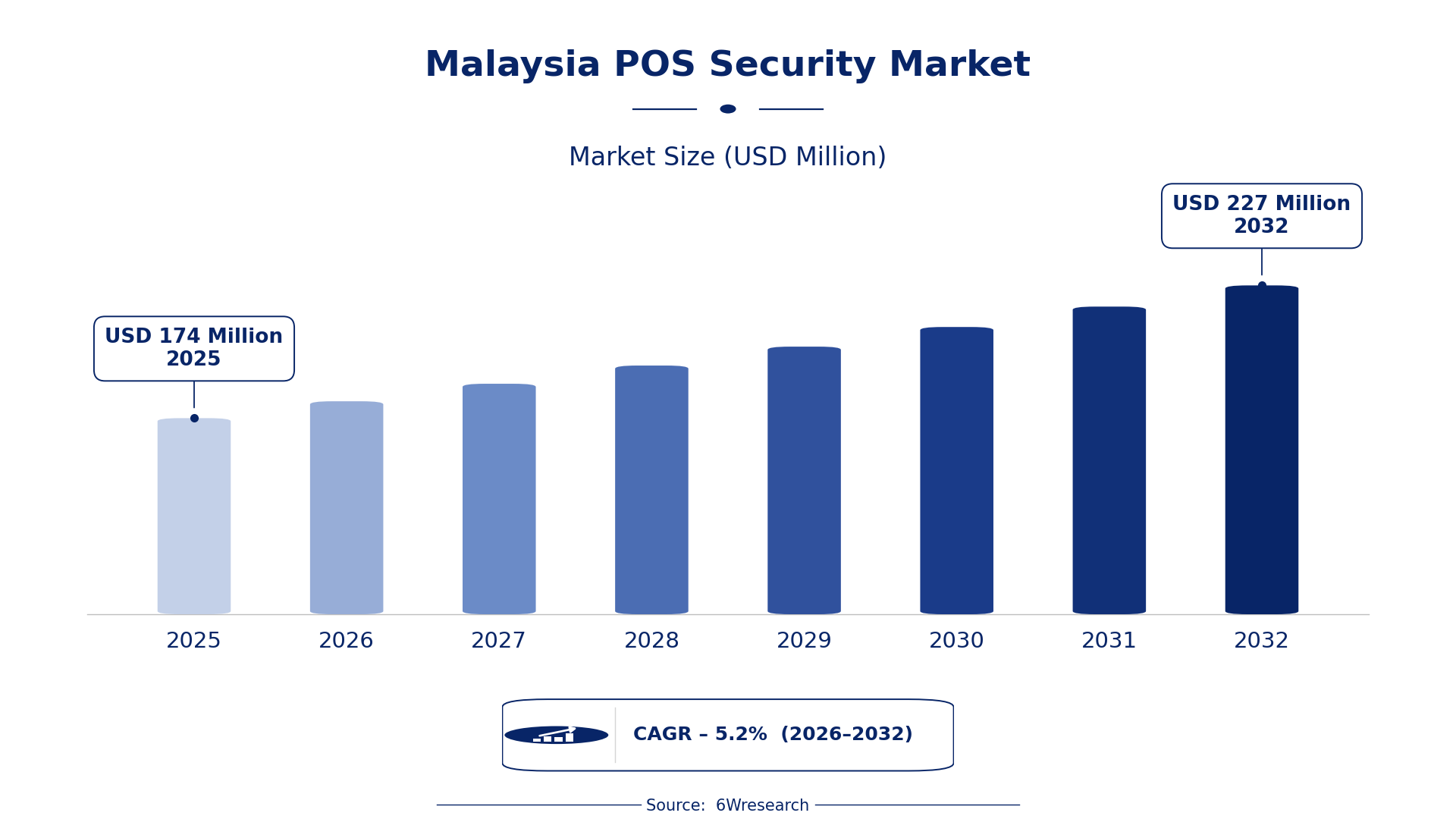
The Malaysia POS Security Market was estimated at USD 174 Million in 2025 and is projected to reach USD 227 Million by 2032, growing at a CAGR of 5.2% from 2026 to 2032.
Malaysia POS Security Market Synopsis
The surge in e-commerce is the strongest force currently shaping the Malaysia POS Security Market. As consumers increasingly opt for digital transactions, the need for secure payment environments has never been more critical, driving demand for advanced POS security solutions.
With rising concerns over payment fraud and data breaches, businesses recognize that safeguarding sensitive financial data is imperative. This mounting urgency has positioned the market as a key player in ensuring the integrity of financial transactions across the country.
Malaysia POS Security Market Year-wise Growth Rate and Key Drivers
This graph illustrates the annual growth rates of the Malaysia POS Security Market from 2021 to 2032, highlighting a steady upward trajectory and projected expansion over the forecast period.
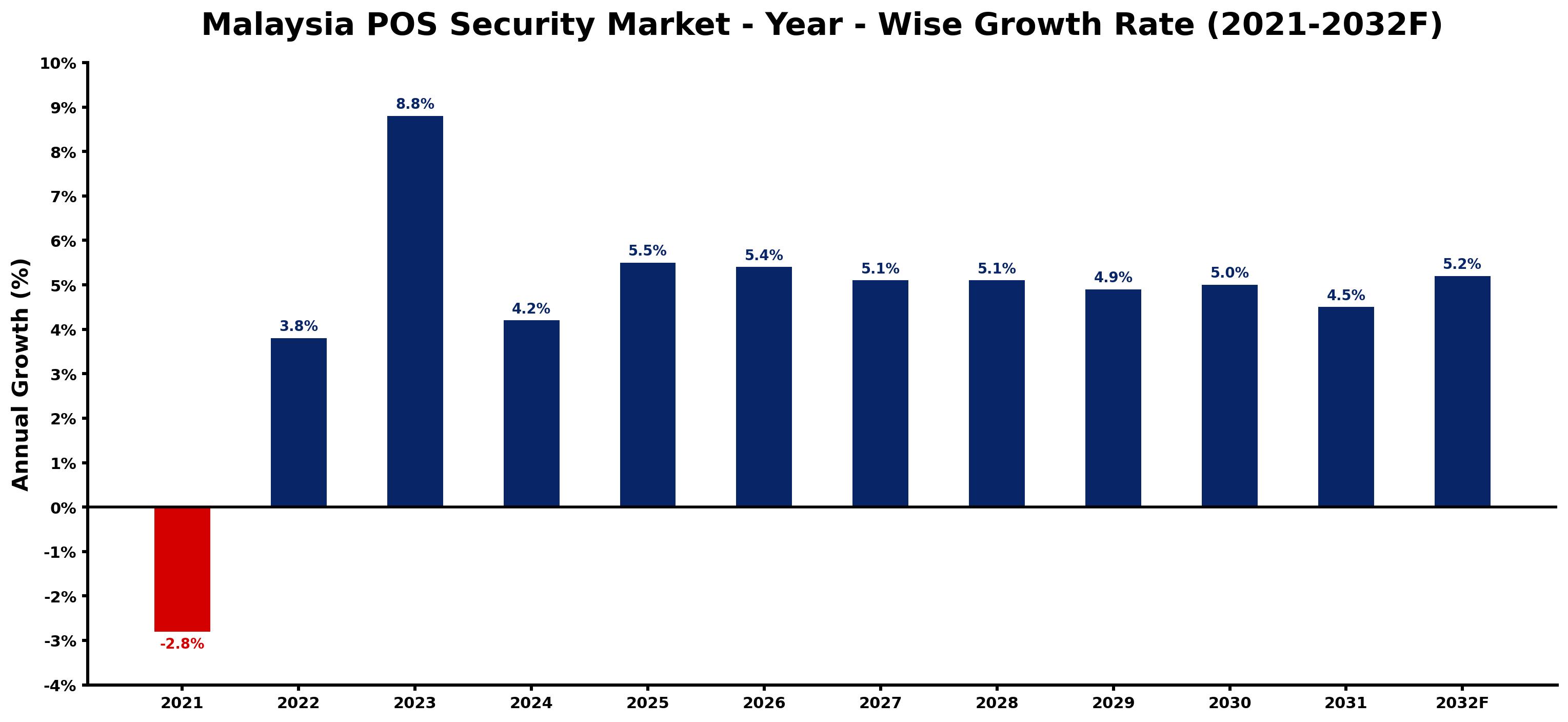
The table below presents the year‑wise growth rates along with the key drivers influencing the market
| Year | Growth Rate | Major Drivers |
| 2021 | -2.8% | Malaysian government delayed biometric data regulations implementation. |
| 2022 | 3.8% | Increased retail cybersecurity regulations from Bank Negara Malaysia |
| 2023 | 8.8% | Growing online shopping trend post-pandemic in Malaysia |
| 2024 | 4.2% | Implementation of new data protection laws by MCMC |
| 2025 | 5.5% | Rising consumer awareness of digital payment security |
| 2026 | 5.4% | Boost in e-commerce platforms enhancing security infrastructure |
| 2027 | 5.1% | Government incentives for adopting secure payment technologies |
| 2028 | 5.1% | Matured local market for advanced POS security solutions |
| 2029 | 4.9% | Accelerated digital transformation in Malaysian retail sector |
| 2030 | 5.0% | Integration of AI-driven security measures in transactions |
| 2031 | 4.5% | Increased investment in cybersecurity training for retail staff |
| 2032 | 5.2% | Enhanced government support for secure payment startups |
Note: Market size estimations and growth projections presented in this report are based on 6Wresearch's proprietary forecasting methodology, utilizing the latest available industry data, government publications, and primary research inputs.
Malaysia POS Security Market Key Takeaways
Below are some of the specific key takeaways from the market, including:
- The market is witnessing accelerated growth fueled by rising electronic payment usage.
- Regulatory standards are influencing the adoption of advanced POS security measures.
- The prevalence of cyber threats necessitates continual innovation in security technology.
- The COVID-19 pandemic has heightened the focus on data security in financial transactions.
- Leading players are enhancing their offerings to provide comprehensive solutions against fraud.
Evaluation of Restraints in Malaysia POS Security Market
The Malaysia POS Security Market faces notable constraints that may limit its growth trajectory. Evolving cyber threats present an ongoing challenge, as malicious actors become more sophisticated in their attacks on point-of-sale systems. Businesses often struggle to keep pace with these developments, which can lead to vulnerabilities. Furthermore, the costs associated with implementing and maintaining robust security measures can deter some companies from investing adequately in necessary technologies, creating a gap in overall market security readiness.
Malaysia POS Security Market Trends
Several trends are shaping demand and technology within the Malaysia POS Security Market. The integration of artificial intelligence and machine learning into security solutions is gaining traction, allowing for real-time fraud detection and prevention. Additionally, the shift towards contactless payments has accelerated the need for enhanced security protocols. There is also a noticeable increase in collaboration among stakeholders, as businesses seek to share information and resources to combat cyber threats effectively.
Malaysia POS Security Market Opportunities
Opportunities for growth in the Malaysia POS Security Market are emerging as businesses adapt to changing consumer behaviors. The rise of mobile payments and digital wallets is prompting investments in secure solutions tailored to these platforms. Furthermore, public awareness regarding data protection is increasing, pushing companies to prioritize security. As regulatory frameworks evolve, there will be more room for compliance-driven innovations, making it a ripe landscape for new technologies and service models.
Government Initiatives in the Malaysia POS Security Market
The Malaysian government is actively shaping the POS security environment through various initiatives aimed at enhancing financial transaction safety. Regulatory bodies are prioritizing the establishment of standards and guidelines to strengthen data protection across the market. These efforts are crucial to address the growing concerns surrounding cyber threats and to foster a secure digital economy.
- A regulatory framework introduced in 2025 mandating security compliance for payment systems.
- Currently ongoing initiatives focus on enhancing cybersecurity training for businesses and employees.
- A planned public-private partnership expected to bolster the cybersecurity infrastructure by 2028.
- Recent pilot programs aimed at integrating advanced security technologies into local POS systems.
Future Insights of the Malaysia POS Security Market
Looking ahead to 2026-2032, the Malaysia POS Security Market is expected to continue expanding as digital payment methods gain popularity. The increasing integration of security features within payment platforms will drive demand for innovative solutions. Additionally, collaboration among technology providers and regulatory bodies will be vital in addressing emerging threats, ensuring that businesses can confidently embrace digital transactions. As the market evolves, staying ahead of technological advancements will be critical for maintaining a secure payment environment.
Malaysia POS Security Market Latest Developments
The past year has seen considerable activity in the Malaysia POS Security Market, with a focus on enhancing the security of payment systems. Companies are actively upgrading their technologies and exploring partnerships to address the evolving landscape of cyber threats.
- A major technology vendor launched a new AI-driven security solution aimed at detecting fraud in real-time in late 2023.
- Currently ongoing collaborations between financial institutions and tech startups to develop robust security frameworks.
- An initiative to integrate biometric authentication into POS systems is expected to start in early 2024.
- New training programs for merchants on cybersecurity best practices were rolled out in Q4 2023.
Malaysia POS Security Market - Key Attractiveness of the Report
- 10 Years of Market Numbers
- Historical Data Starting from 2022 to 2025
- Base Year: 2025
- Forecast Data until 2032
- Key Performance Indicators Impacting the Market
- Major Upcoming Developments and Projects
Key Highlights of the Report:
- Malaysia POS Security Market Outlook
- Market Size of Malaysia POS Security Market, 2025
- Forecast of Malaysia POS Security Market, 2032
- Historical Data and Forecast of Malaysia POS Security Revenues & Volume for the Period 2022-2032F
- Malaysia POS Security Market Trend Evolution
- Malaysia POS Security Market Drivers and Challenges
- Malaysia POS Security Price Trends
- Malaysia POS Security Porter's Five Forces
- Malaysia POS Security Industry Life Cycle
- Historical Data and Forecast of Malaysia POS Security Market Revenues & Volume By Offering for the Period 2022-2032F
- Historical Data and Forecast of Malaysia POS Security Market Revenues & Volume By Solutions for the Period 2022-2032F
- Historical Data and Forecast of Malaysia POS Security Market Revenues & Volume By Services for the Period 2022-2032F
- Historical Data and Forecast of Malaysia POS Security Market Revenues & Volume By Organization Size for the Period 2022-2032F
- Historical Data and Forecast of Malaysia POS Security Market Revenues & Volume By SMEs for the Period 2022-2032F
- Historical Data and Forecast of Malaysia POS Security Market Revenues & Volume By Large Enterprises for the Period 2022-2032F
- Historical Data and Forecast of Malaysia POS Security Market Revenues & Volume By Vertical for the Period 2022-2032F
- Historical Data and Forecast of Malaysia POS Security Market Revenues & Volume By Retail for the Period 2022-2032F
- Historical Data and Forecast of Malaysia POS Security Market Revenues & Volume By Restaurants for the Period 2022-2032F
- Historical Data and Forecast of Malaysia POS Security Market Revenues & Volume By Hospitality for the Period 2022-2032F
- Malaysia POS Security Import Export Trade Statistics
- Market Opportunity Assessment By Offering
- Market Opportunity Assessment By Organization Size
- Market Opportunity Assessment By Vertical
- Malaysia POS Security Top Companies Market Share
- Malaysia POS Security Competitive Benchmarking By Technical and Operational Parameters
- Malaysia POS Security Company Profiles
- Malaysia POS Security Key Strategic Recommendations






































