Malaysia Secondhand Apparel Market Size, Share & Growth Rate
The Malaysia Secondhand Apparel Market was estimated at USD 240 Million in 2025 and is projected to reach USD 312 Million by 2032, growing at a CAGR of 3.8% from 2026 to 2032. This growth trajectory is fueled by an increasing shift towards sustainable fashion, as consumers seek alternatives to fast fashion. A burgeoning interest in vintage clothing and the unique appeal of pre-owned items further bolster market demand, driving retailers to innovate in sourcing and marketing secondhand apparel.
Malaysia Secondhand Apparel Market Growth Rate Analysis (2021-2032)
The Malaysian secondhand apparel market has witnessed a remarkable rebound, transitioning from a decline of 3.3% in 2021 to an impressive growth of 9.0% in 2023. This surge is largely attributable to shifting consumer preferences towards sustainability and cost-effectiveness, coupled with the increasing penetration of e-commerce platforms facilitating access to secondhand goods. Following a robust growth of 4.2% in 2022, projections indicate sustained positive momentum with anticipated increases of 4.4% in 2024 and 5.7% by 2025. This upward trend underscores the evolving consumer demand for eco-friendly options, bolstered by Malaysia’s growing digital infrastructure and a heightened awareness of environmental issues. As investments in this sector continue, the industry is poised for consistent expansion through 2032.
Malaysia Secondhand Apparel Market Year-wise Growth Rate and Key Drivers
This graph highlights how the Malaysia Secondhand Apparel Market has steadily grown over the past five years, supported by major growth factors.
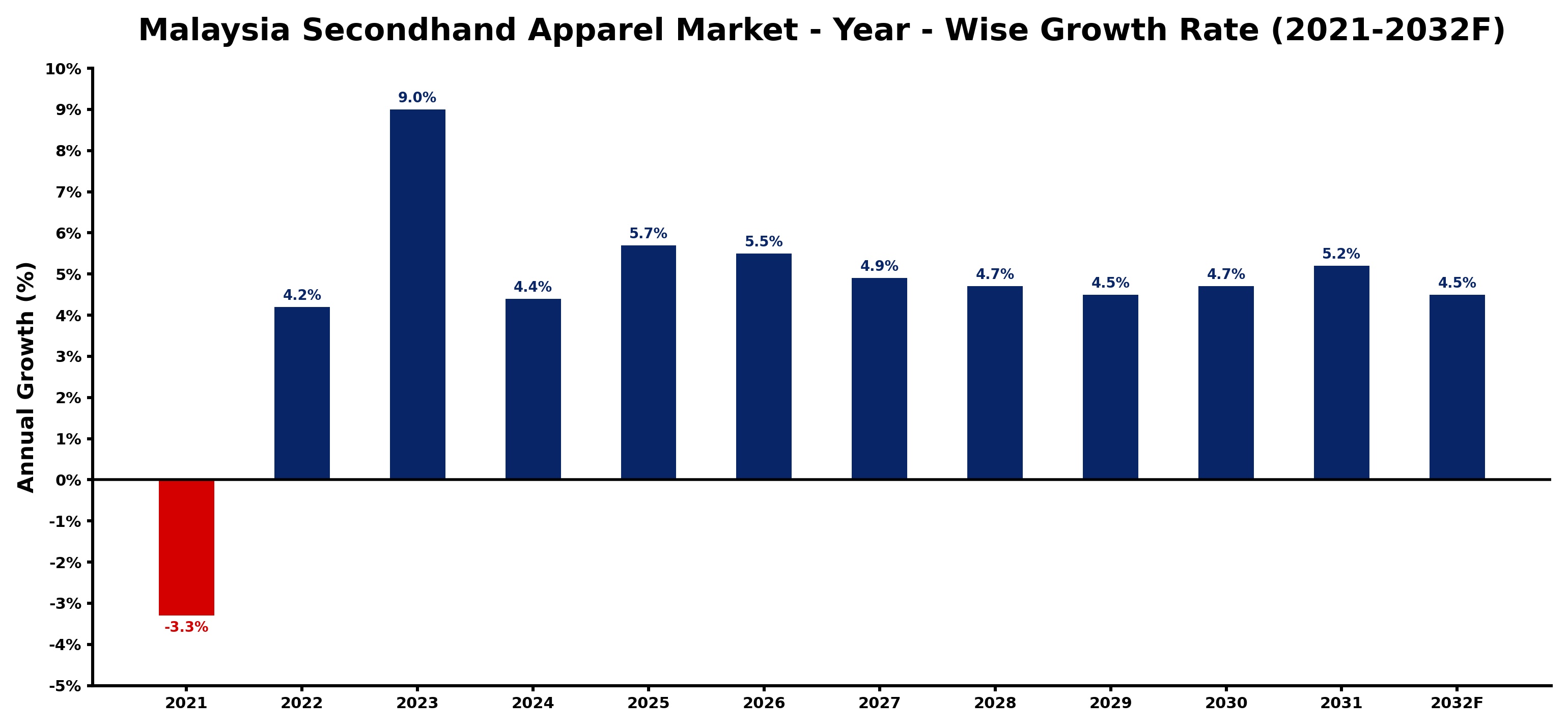
The table below presents the year‑wise growth rates along with the key drivers influencing the market
| Year | Growth Rate | Major Drivers |
| 2021 | -3.3% | Increasing adoption of advanced technologies |
| 2022 | 4.2% | Growing renewable energy integration projects |
| 2023 | 9.0% | Growing renewable energy integration projects |
| 2024 | 4.4% | Increasing industrial automation investments |
| 2025 | 5.7% | Government infrastructure modernization initiatives |
| 2026 | 5.5% | Expansion of commercial construction activities |
| 2027 | 4.9% | Rising electricity demand across industries |
| 2028 | 4.7% | Increasing adoption of advanced technologies |
| 2029 | 4.5% | Increasing adoption of advanced technologies |
| 2030 | 4.7% | Growing renewable energy integration projects |
| 2031 | 5.2% | Growing renewable energy integration projects |
| 2032 | 4.5% | Increasing industrial automation investments |
Note - Market size estimations and growth projections presented in this report are based on 6Wresearch’s advanced forecasting approach, validated with industry datasets as of June 2026.
Malaysia Secondhand Apparel Market Synopsis
A notable characteristic of the Malaysia secondhand apparel market is its diverse retail landscape, where physical thrift stores coexist with dynamic online platforms and vibrant pop-up markets. This multi-channel approach caters to a growing demographic that values both affordability and sustainability in fashion choices.
Additionally, the market reflects a shift in consumer perception, moving away from the stigma previously associated with pre-owned clothing. As awareness of the environmental impact of fashion grows, many Malaysians are actively choosing secondhand options, making this market ripe with potential for both new and established retailers.
Malaysia Secondhand Apparel Market Key Takeaways
- Growing consumer awareness of sustainability drives demand for secondhand apparel.
- A diverse range of retail channels enhances accessibility for consumers.
- Increased interest in luxury secondhand items contributes to market growth.
- Online shopping platforms have gained significant traction, especially post-pandemic.
- Quality assurance is crucial in maintaining consumer trust in the secondhand market.
Evaluation of Restraints in Malaysia Secondhand Apparel Market
While the Malaysia secondhand apparel market is thriving, it faces several restraints that can impede its growth. One major concern is the lingering perception of quality issues associated with pre-owned clothing. Although many consumers are shifting their attitudes, overcoming the stigma of secondhand apparel requires consistent educational efforts and marketing strategies that emphasize quality and value. Additionally, the online marketplace presents challenges in ensuring the authenticity and condition of items sold, which can affect consumer trust. Retailers must develop robust quality assurance protocols and transparent communication practices to effectively address these concerns and build lasting relationships with their customers.
Malaysia Secondhand Apparel Market Trends
Emerging trends within the Malaysia secondhand apparel market showcase an increasing alignment with global sustainability movements. Consumers are prioritizing circular fashion, leading to a heightened appreciation for vintage and unique items. Moreover, social media has become a vital tool in shaping consumer preferences and promoting secondhand shopping culture, particularly among younger generations. As thrift shopping gains popularity, businesses are innovating with curated selections that highlight sustainability and individuality, making pre-owned clothing an attractive option.
Malaysia Secondhand Apparel Market Opportunities
The secondhand apparel market in Malaysia presents numerous opportunities for growth and investment. Retailers that emphasize quality, sustainability, and customer engagement can tap into the expanding demographic of environmentally conscious consumers. Innovative online platforms and mobile apps focused on secondhand apparel can facilitate convenient shopping experiences and community building among buyers and sellers. Additionally, collaborating with fashion influencers can further promote the benefits of secondhand clothing, appealing to a broader audience.
Government Initiatives in the Malaysia Secondhand Apparel Market
The Malaysian government has been increasingly supportive of initiatives that promote sustainability and circular economy practices. Various programs aim to raise awareness of environmental issues related to waste and fashion consumption, encouraging citizens to consider secondhand clothing as a viable alternative. Furthermore, public policies that support sustainable entrepreneurship can provide resources and incentives for businesses operating within the secondhand market, helping to cultivate a more eco-friendly retail landscape.
Future Insights of the Malaysia Secondhand Apparel Market
Looking ahead to 2026-2032, the Malaysia secondhand apparel market is expected to continue its upward trend, driven by evolving consumer preferences and a deeper commitment to sustainable fashion. As education and awareness campaigns proliferate, more consumers will embrace secondhand shopping as a legitimate and fashionable choice. Online platforms are likely to expand further, offering innovative features that enhance user experience. Collaborations across fashion sectors may also emerge, as businesses explore the intersections of secondhand and new apparel markets. The future of this market is characterized by a blend of creativity, sustainability, and consumer engagement.
Malaysia Secondhand Apparel Market Latest Developments (May 2025 - June 2026)
Recent industry developments within the Malaysia secondhand apparel market indicate a notable shift towards online shopping solutions, largely driven by the increasing demand for convenience. Several new platforms are launching, targeting tech-savvy consumers looking for curated secondhand selections. Moreover, collaborative efforts between non-profit organizations and retailers aim to promote sustainability in fashion, enhancing community engagement. Retailers are also focusing on transparency and authenticity to build trust, further propelling market dynamics.
Malaysia Secondhand Apparel Market - Key Attractiveness of the Report
- 10 Years of Market Numbers
- Historical Data Starting from 2022 to 2025
- Base Year: 2025
- Forecast Data until 2032
- Key Performance Indicators Impacting the Market
- Major Upcoming Developments and Projects
Key Highlights of the Report:
- Malaysia Secondhand Apparel Market Outlook
- Market Size of Malaysia Secondhand Apparel Market, 2025
- Forecast of Malaysia Secondhand Apparel Market, 2032F
- Historical Data and Forecast of Malaysia Secondhand Apparel Revenues & Volume for the Period 2022-2032F
- Malaysia Secondhand Apparel Market Trend Evolution
- Malaysia Secondhand Apparel Market Drivers and Challenges
- Malaysia Secondhand Apparel Price Trends
- Malaysia Secondhand Apparel Porter's Five Forces
- Malaysia Secondhand Apparel Industry Life Cycle
- Historical Data and Forecast of Malaysia Secondhand Apparel Market Revenues & Volume By Sector for the Period 2022-2032F
- Historical Data and Forecast of Malaysia Secondhand Apparel Market Revenues & Volume By Resale for the Period 2022-2032F
- Historical Data and Forecast of Malaysia Secondhand Apparel Market Revenues & Volume By Traditional Thrift Stores and Donations for the Period 2022-2032F
- Historical Data and Forecast of Malaysia Secondhand Apparel Market Revenues & Volume By Product Type for the Period 2022-2032F
- Historical Data and Forecast of Malaysia Secondhand Apparel Market Revenues & Volume By Dresses & Tops for the Period 2022-2032F
- Historical Data and Forecast of Malaysia Secondhand Apparel Market Revenues & Volume By Shirts & T-shirts for the Period 2022-2032F
- Historical Data and Forecast of Malaysia Secondhand Apparel Market Revenues & Volume By Sweaters, Coats & Jackets for the Period 2022-2032F
- Historical Data and Forecast of Malaysia Secondhand Apparel Market Revenues & Volume By Jeans & Pants for the Period 2022-2032F
- Historical Data and Forecast of Malaysia Secondhand Apparel Market Revenues & Volume By Others for the Period 2022-2032F
- Historical Data and Forecast of Malaysia Secondhand Apparel Market Revenues & Volume By Target Population for the Period 2022-2032F
- Historical Data and Forecast of Malaysia Secondhand Apparel Market Revenues & Volume By Men for the Period 2022-2032F
- Historical Data and Forecast of Malaysia Secondhand Apparel Market Revenues & Volume By Women for the Period 2022-2032F
- Historical Data and Forecast of Malaysia Secondhand Apparel Market Revenues & Volume By Kids for the Period 2022-2032F
- Historical Data and Forecast of Malaysia Secondhand Apparel Market Revenues & Volume By Sales Channel for the Period 2022-2032F
- Historical Data and Forecast of Malaysia Secondhand Apparel Market Revenues & Volume By Wholesalers/Distributors for the Period 2022-2032F
- Historical Data and Forecast of Malaysia Secondhand Apparel Market Revenues & Volume By Hypermarkets/Supermarkets for the Period 2022-2032F
- Historical Data and Forecast of Malaysia Secondhand Apparel Market Revenues & Volume By Multi-brand Stores for the Period 2022-2032F
- Historical Data and Forecast of Malaysia Secondhand Apparel Market Revenues & Volume By Independent Small Stores for the Period 2022-2032F
- Historical Data and Forecast of Malaysia Secondhand Apparel Market Revenues & Volume By Departmental Stores for the Period 2022-2032F
- Historical Data and Forecast of Malaysia Secondhand Apparel Market Revenues & Volume By Online Retailers for the Period 2022-2032F
- Historical Data and Forecast of Malaysia Secondhand Apparel Market Revenues & Volume By Others for the Period 2022-2032F
- Malaysia Secondhand Apparel Import Export Trade Statistics
- Market Opportunity Assessment By Sector
- Market Opportunity Assessment By Product Type
- Market Opportunity Assessment By Target Population
- Market Opportunity Assessment By Sales Channel
- Malaysia Secondhand Apparel Top Companies Market Share
- Malaysia Secondhand Apparel Competitive Benchmarking By Technical and Operational Parameters
- Malaysia Secondhand Apparel Company Profiles
- Malaysia Secondhand Apparel Key Strategic Recommendations






































