Malaysia Smart Learning Market Size & Growth Rate (2026-2032)
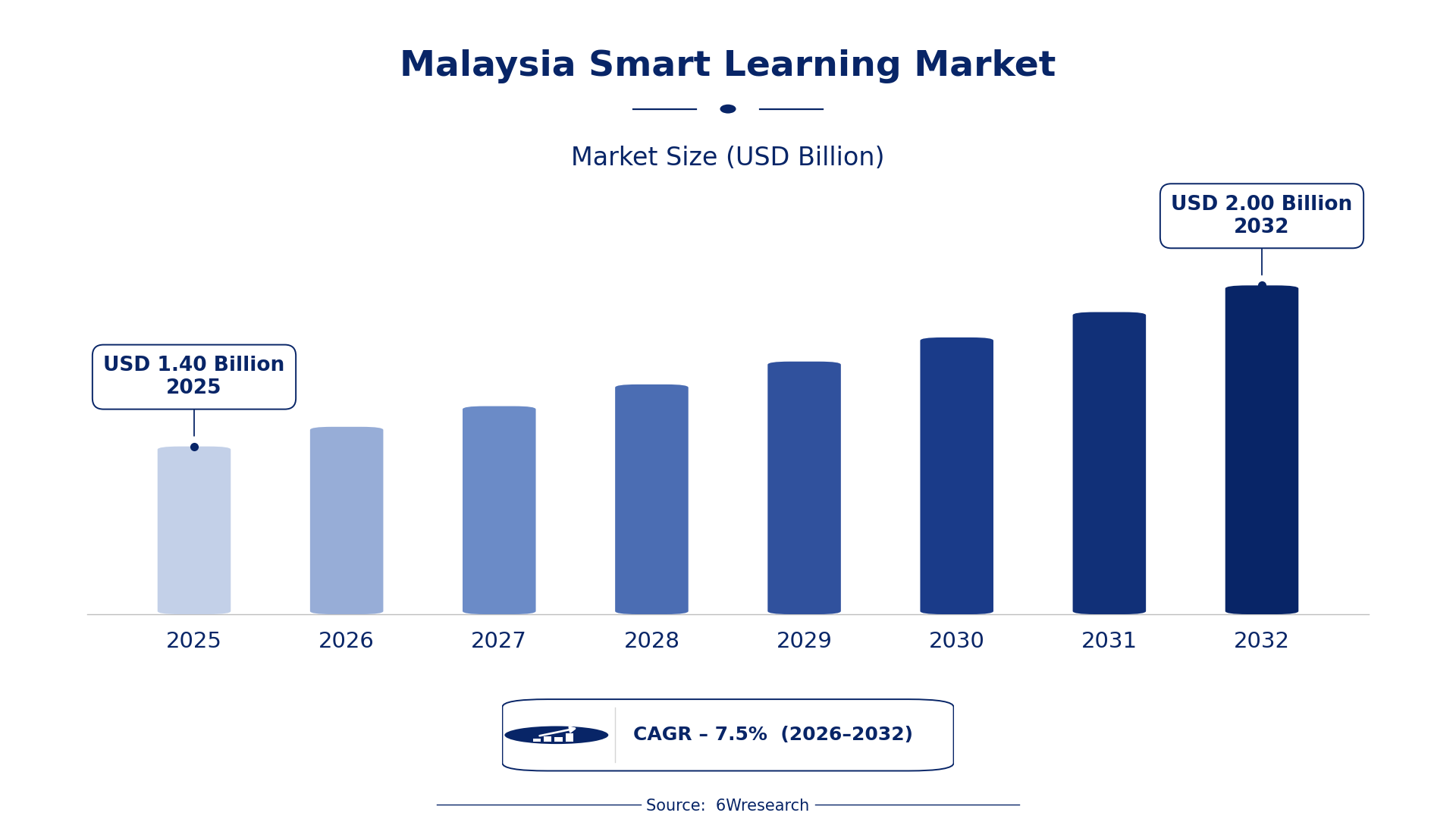
The Malaysia Smart Learning Market was estimated at USD 1399 Million in 2025 and is projected to reach USD 2003 Million by 2032, growing at a CAGR of 7.5% from 2026 to 2032.
Malaysia Smart Learning Market Synopsis
The push for advanced educational technologies in Malaysia is reshaping the traditional classroom experience. With an increasing emphasis on digital learning tools, schools and universities are adopting smart learning platforms that enhance interactivity and personalized instruction.
Government initiatives to modernize education are further accelerating this trend. As internet penetration continues to rise, educational institutions are increasingly investing in smart learning solutions to better prepare students for the demands of the digital economy.
Malaysia Smart Learning Market Year-wise Growth Rate and Key Drivers
This graph illustrates the annual growth rates of the Malaysia Smart Learning Market from 2021 to 2032, highlighting a steady upward trajectory and projected expansion over the forecast period.
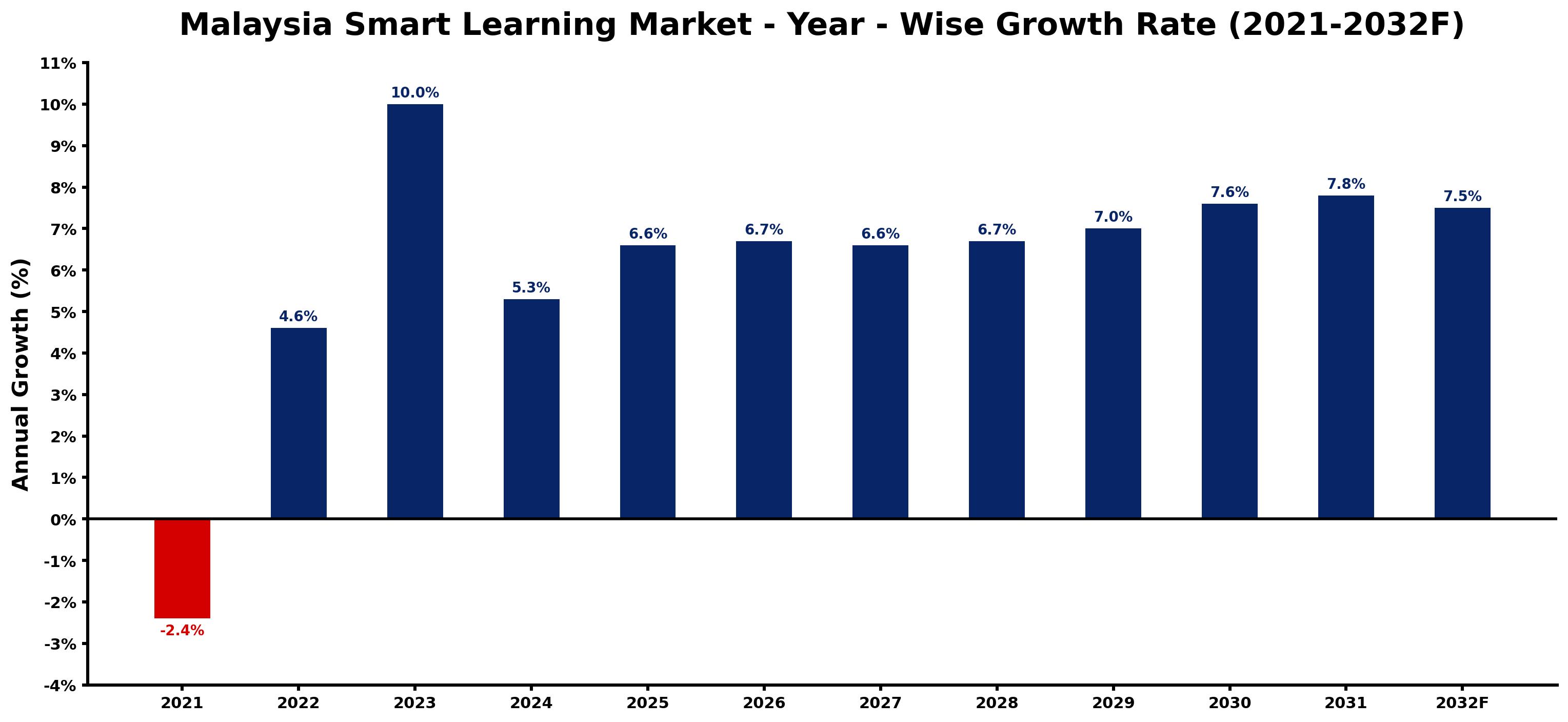
The table below presents the year‑wise growth rates along with the key drivers influencing the market
| Year | Growth Rate | Major Drivers |
| 2021 | -2.4% | Implementation delays of Malaysia’s Digital Educational Transformation Plan |
| 2022 | 4.6% | Implementation of Malaysia's National Digital Educational Policy |
| 2023 | 10.0% | Increased investment in EdTech startups by local venture capital |
| 2024 | 5.3% | Growing adoption of AI-driven personalized learning tools |
| 2025 | 6.6% | Government funding for rural digital education initiatives |
| 2026 | 6.7% | Rising interest in gamified learning platforms among students |
| 2027 | 6.6% | Partnerships between universities and tech companies for skills |
| 2028 | 6.7% | Focus on STEM education driving smart learning adoption |
| 2029 | 7.0% | Rise in mobile device penetration among students |
| 2030 | 7.6% | Integration of immersive technologies in classroom settings |
| 2031 | 7.8% | Demand for continuous professional development online courses |
| 2032 | 7.5% | Supportive policies encouraging hybrid learning environments |
Note: Market size estimations and growth projections presented in this report are based on 6Wresearch's proprietary forecasting methodology, utilizing the latest available industry data, government publications, and primary research inputs.
Malaysia Smart Learning Market Key Takeaways
Below are some of the specific key takeaways from the market, including:
- The integration of technology in education is becoming a priority for Malaysian institutions.
- Demand for e-learning platforms and digital classrooms is on the rise, driven by both government policy and consumer preferences.
- Challenges such as the digital divide and content localization need addressing for widespread adoption.
- The COVID-19 pandemic has accelerated the transition to remote learning, highlighting the need for effective smart learning solutions.
- Investments in teacher training and infrastructure are crucial for maximizing the potential of smart learning technologies.
Evaluation of Restraints in Malaysia Smart Learning Market
Despite the promising outlook for smart learning in Malaysia, several restraints are holding back its full potential. The digital divide remains a pressing issue, with disparities in access to technology among various demographic groups. This inequality complicates efforts to ensure that all students benefit from smart learning solutions. on top of that, the requirement for educators to be adequately trained in these new technologies cannot be overlooked; without proficient instructors, the effectiveness of smart learning tools diminishes. Lastly, creating high-quality, localized educational content that aligns with Malaysia's unique curriculum poses a challenge that needs to be tackled for broader acceptance.
Malaysia Smart Learning Market Trends
A notable trend in the Malaysia Smart Learning Market is the growing reliance on blended learning approaches, combining traditional classroom instruction with digital resources. This hybrid model is favored for its flexibility and effectiveness. Additionally, gamification is gaining traction, making learning more engaging for students. As the demand for personalized education increases, adaptive learning technologies are also emerging, tailoring content to meet individual student needs. on top of that, the focus on cybersecurity in educational technology is intensifying, as institutions strive to protect sensitive student data.
Malaysia Smart Learning Market Opportunities
The smart learning market in Malaysia is ripe with opportunities for growth and investment. One area of significant potential lies in partnerships between educational institutions and technology providers to develop localized content and platforms tailored to Malaysian students. Additionally, expanding internet access in rural areas presents a chance to tap into an underserved market. As corporations increasingly recognize the importance of continuous employee training, corporate learning solutions represent another avenue for growth. Finally, leveraging emerging technologies such as artificial intelligence and virtual reality can enhance the learning experience and stimulate further innovation.
Government Initiatives in the Malaysia Smart Learning Market
The Malaysian government plays a critical role in shaping the Smart Learning Market through various initiatives aimed at enhancing educational access and quality. With a clear focus on integrating technology into the education system, these policies reflect a commitment to closing the digital divide and fostering an inclusive learning environment.
- A national digital infrastructure upgrade programme launched in early 2025 aims to improve internet access across urban and rural schools.
- The Ministry of Education is currently implementing a comprehensive teacher training initiative focused on digital literacy and the effective use of smart learning tools.
- Plans are underway for a public-private partnership expected to develop a suite of interactive learning resources aligned with the national curriculum by 2027.
- A recent regulatory framework introduced in 2024 mandates that educational institutions prioritize cybersecurity measures in their digital platforms.
- The government has initiated a pilot programme in select schools to test adaptive learning technologies, with an evaluation phase set for late 2025.
Future Insights of the Malaysia Smart Learning Market
Looking ahead to 2026-2032, the Malaysia Smart Learning Market is set for continued expansion. As educational institutions embrace more innovative solutions, the shift towards personalized and engaging learning experiences will likely accelerate. The increasing adoption of AI and machine learning will facilitate adaptive learning pathways, catering to diverse student needs. Coupled with ongoing government support and investment in infrastructure, the market is positioned to thrive. The integration of immersive technologies like augmented and virtual reality will further redefine educational experiences, paving the way for new pedagogical approaches.
Malaysia Smart Learning Market Latest Developments
Over the past 12-14 months, the Malaysia Smart Learning Market has seen a flurry of activity, driven largely by the ongoing recovery from the pandemic and a renewed focus on enhancing educational delivery methods. Institutions are increasingly adopting innovative technologies to meet the changing needs of students and educators alike.
- A leading educational technology firm launched a comprehensive smart learning platform in Q1 2025, integrating tools for remote and in-person learning.
- An initiative that began in mid-2025 focuses on equipping schools with advanced digital infrastructure, enhancing connectivity and access to online resources.
- A major partnership between several universities and tech providers is currently underway, aimed at developing localized e-learning content tailored to Malaysian cultural contexts.
- A new regulatory compliance framework was rolled out in early 2025 to enforce cybersecurity measures in educational institutions, enhancing the safety of online learning environments.
- Plans for a nationwide rollout of adaptive learning technologies are expected to begin by late 2026, aiming to provide personalized learning experiences across various educational levels.
Malaysia Smart Learning Market - Key Attractiveness of the Report
- 10 Years of Market Numbers
- Historical Data Starting from 2022 to 2025
- Base Year: 2025
- Forecast Data until 2032
- Key Performance Indicators Impacting the Market
- Major Upcoming Developments and Projects
Key Highlights of the Report:
- Malaysia Smart Learning Market Outlook
- Market Size of Malaysia Smart Learning Market, 2025
- Forecast of Malaysia Smart Learning Market, 2032
- Historical Data and Forecast of Malaysia Smart Learning Revenues & Volume for the Period 2022-2032F
- Malaysia Smart Learning Market Trend Evolution
- Malaysia Smart Learning Market Drivers and Challenges
- Malaysia Smart Learning Price Trends
- Malaysia Smart Learning Porter's Five Forces
- Malaysia Smart Learning Industry Life Cycle
- Historical Data and Forecast of Malaysia Smart Learning Market Revenues & Volume By Component for the Period 2022-2032F
- Historical Data and Forecast of Malaysia Smart Learning Market Revenues & Volume By Hardware for the Period 2022-2032F
- Historical Data and Forecast of Malaysia Smart Learning Market Revenues & Volume By Software for the Period 2022-2032F
- Historical Data and Forecast of Malaysia Smart Learning Market Revenues & Volume By Services for the Period 2022-2032F
- Historical Data and Forecast of Malaysia Smart Learning Market Revenues & Volume By End User for the Period 2022-2032F
- Historical Data and Forecast of Malaysia Smart Learning Market Revenues & Volume By Academic for the Period 2022-2032F
- Historical Data and Forecast of Malaysia Smart Learning Market Revenues & Volume By Enterprises for the Period 2022-2032F
- Historical Data and Forecast of Malaysia Smart Learning Market Revenues & Volume By Government for the Period 2022-2032F
- Historical Data and Forecast of Malaysia Smart Learning Market Revenues & Volume By Learning type for the Period 2022-2032F
- Historical Data and Forecast of Malaysia Smart Learning Market Revenues & Volume By Synchronous learning for the Period 2022-2032F
- Historical Data and Forecast of Malaysia Smart Learning Market Revenues & Volume By Asynchronous learning for the Period 2022-2032F
- Historical Data and Forecast of Malaysia Smart Learning Market Revenues & Volume By Services for the Period 2022-2032F
- Historical Data and Forecast of Malaysia Smart Learning Market Revenues & Volume By Consulting for the Period 2022-2032F
- Historical Data and Forecast of Malaysia Smart Learning Market Revenues & Volume By Implementation for the Period 2022-2032F
- Historical Data and Forecast of Malaysia Smart Learning Market Revenues & Volume By Support and maintenance for the Period 2022-2032F
- Malaysia Smart Learning Import Export Trade Statistics
- Market Opportunity Assessment By Component
- Market Opportunity Assessment By End User
- Market Opportunity Assessment By Learning type
- Market Opportunity Assessment By Services
- Malaysia Smart Learning Top Companies Market Share
- Malaysia Smart Learning Competitive Benchmarking By Technical and Operational Parameters
- Malaysia Smart Learning Company Profiles
- Malaysia Smart Learning Key Strategic Recommendations






































