Malaysia Spend Analytics Market Size & Growth Rate (2026-2032)
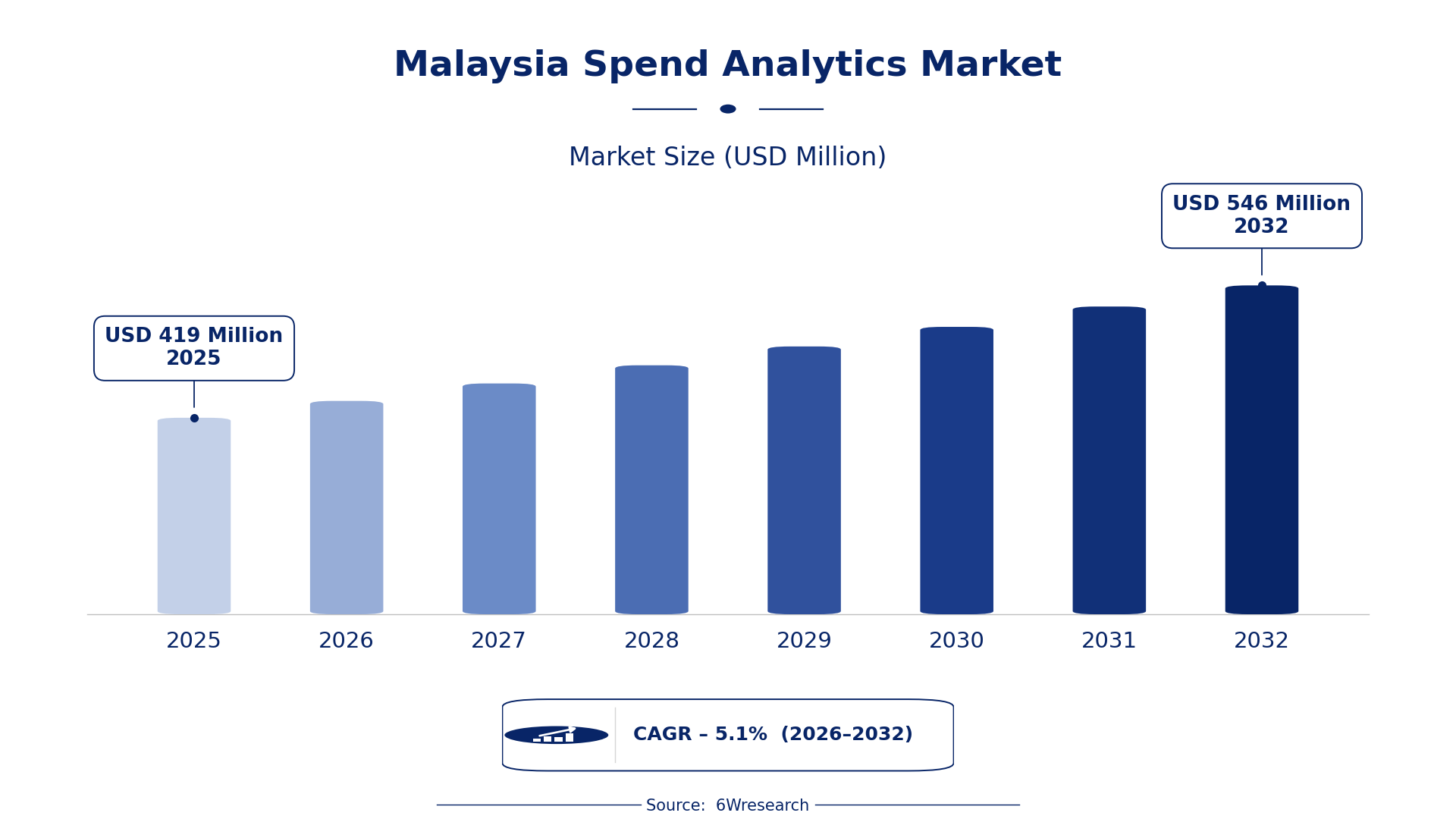
The Malaysia Spend Analytics Market was estimated at USD 419 Million in 2025 and is projected to reach USD 546 Million by 2032, growing at a CAGR of 5.1% from 2026 to 2032.
Malaysia Spend Analytics Market Synopsis
The demand for spend analytics in Malaysia is being propelled by businesses striving for enhanced cost efficiency and procurement optimization. As organizations increasingly recognize the value of data-driven decision-making, the uptake of spend analytics solutions has accelerated, allowing firms to scrutinize their spending patterns and uncover avenues for cost savings.
Companies are now prioritizing investment in advanced analytics capabilities that can illuminate their procurement processes. The insights derived from these tools empower businesses to negotiate better supplier contracts and manage vendor relationships more effectively, thus directly impacting their bottom lines.
Malaysia Spend Analytics Market Year-wise Growth Rate and Key Drivers
This graph illustrates the annual growth rates of the Malaysia Spend Analytics Market from 2021 to 2032, highlighting a steady upward trajectory and projected expansion over the forecast period.
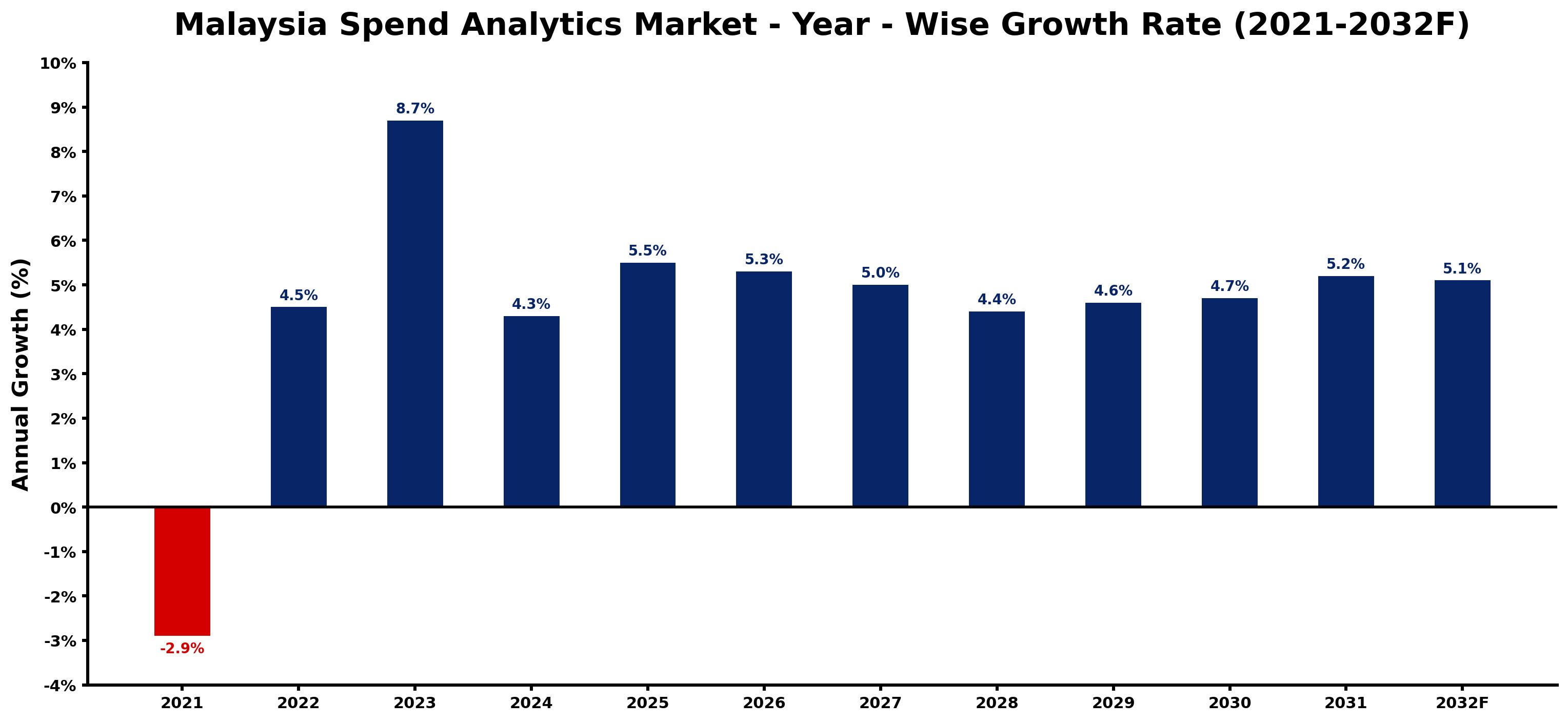
The table below presents the year‑wise growth rates along with the key drivers influencing the market
| Year | Growth Rate | Major Drivers |
| 2021 | -2.9% | Delayed adoption of automated analytics solutions in Malaysia |
| 2022 | 4.5% | Increased adoption of e-procurement solutions by businesses |
| 2023 | 8.7% | Government push for transparency in public sector spending |
| 2024 | 4.3% | Rise in local startups focused on data analytics services |
| 2025 | 5.5% | Corporate focus on cost optimization drives analytics demand |
| 2026 | 5.3% | Malaysia's digital economy initiative boosting data-driven decisions |
| 2027 | 5.0% | Growing awareness of compliance regulations in procurement |
| 2028 | 4.4% | Investment in AI tools for enhanced spend visibility |
| 2029 | 4.6% | Surge in demand for supplier risk management solutions |
| 2030 | 4.7% | Transition to cloud services enhancing analytic capabilities |
| 2031 | 5.2% | Massive growth in mobile and online retail transactions |
| 2032 | 5.1% | Focus on sustainable procurement practices among corporations |
Note: Market size estimations and growth projections presented in this report are based on 6Wresearch's proprietary forecasting methodology, utilizing the latest available industry data, government publications, and primary research inputs.
Malaysia Spend Analytics Market Key Takeaways
Below are some of the specific key takeaways from the market, including:
- The market is driven by the increasing need for cost optimization and improved procurement strategies.
- Data quality and accessibility remain critical challenges for effective spend analytics implementation.
- Recent shifts due to COVID-19 have heightened the importance of spend visibility and financial resilience.
- Local players are making headway alongside global vendors, offering tailored solutions to meet market needs.
- Government initiatives are supporting technological advancements and the digital transformation of procurement processes.
Evaluation of Restraints in Malaysia Spend Analytics Market
Despite the promising outlook, the Malaysia Spend Analytics market faces several hurdles that impede its growth. A major constraint lies in the fragmented nature of data across different departments and systems within organizations. This dispersion complicates the aggregation and analysis processes, making it challenging for companies to derive actionable insights. on top of that, the customization of spend analytics solutions presents another significant barrier. As businesses span diverse industries, a one-size-fits-all approach often falls short, necessitating providers to possess a nuanced understanding of specific industry needs to tailor their offerings effectively.
Malaysia Spend Analytics Market Trends
The trend towards digital transformation is reshaping the Malaysia Spend Analytics market, with businesses increasingly adopting cloud-based solutions for enhanced flexibility and accessibility. Artificial intelligence and machine learning are becoming integral components, facilitating predictive analytics that help organizations anticipate spending trends. Additionally, there is a growing emphasis on real-time analytics, enabling firms to make timely decisions based on current data rather than historical trends.
Malaysia Spend Analytics Market Opportunities
Opportunities for growth in the Malaysia Spend Analytics market lie primarily in the increasing adoption of advanced analytics technologies. Businesses are eager to invest in tools that provide deeper insights into their procurement processes. The rise of data-driven decision-making culture is creating a fertile ground for innovative solutions that can cater to diverse industry requirements. on top of that, as government initiatives continue to promote digitalization, companies that align their strategies with these policies stand to gain competitive advantages.
Government Initiatives in the Malaysia Spend Analytics Market
The Malaysian government has recognized the critical importance of data analytics in enhancing business efficiency and competitiveness. Recently, the government launched a digital procurement framework aimed at standardizing data practices across public sector agencies, promoting transparency and efficiency. Currently, initiatives are underway to facilitate training programs for procurement professionals to better utilize spend analytics tools effectively. Looking ahead, plans are in motion to establish a national data governance policy, which will provide guidelines for data management practices, ensuring organizations have access to high-quality data for effective analytics.
Future Insights of the Malaysia Spend Analytics Market
From 2026 to 2032, the Malaysia Spend Analytics market is expected to continue its upward trajectory as more businesses embrace data-driven strategies. With advancements in technology enabling deeper insights and improved decision-making capabilities, organizations are likely to prioritize investment in analytics solutions. The growing importance of supplier collaboration and risk management will also shape the direction of spend analytics, pushing companies to seek innovative ways to enhance their procurement strategies.
Malaysia Spend Analytics Market Latest Developments
In the past year, the Malaysia Spend Analytics market has seen notable activity. A major technology vendor launched an upgraded spend analytics platform that focuses on real-time data processing and enhanced visualization capabilities, completed in late 2025. Meanwhile, a partnership between a leading analytics firm and a regional enterprise resource planning provider began in early 2025, enhancing service offerings and expanding market reach. Looking forward, a local startup plans to introduce a new AI-powered spend analytics tool aimed at small to medium enterprises, expected to begin beta testing in the second half of 2026.
Malaysia Spend Analytics Market - Key Attractiveness of the Report
- 10 Years of Market Numbers
- Historical Data Starting from 2022 to 2025
- Base Year: 2025
- Forecast Data until 2032
- Key Performance Indicators Impacting the Market
- Major Upcoming Developments and Projects
Key Highlights of the Report:
- Malaysia Spend Analytics Market Outlook
- Market Size of Malaysia Spend Analytics Market, 2025
- Forecast of Malaysia Spend Analytics Market, 2032
- Historical Data and Forecast of Malaysia Spend Analytics Revenues & Volume for the Period 2022-2032F
- Malaysia Spend Analytics Market Trend Evolution
- Malaysia Spend Analytics Market Drivers and Challenges
- Malaysia Spend Analytics Price Trends
- Malaysia Spend Analytics Porter's Five Forces
- Malaysia Spend Analytics Industry Life Cycle
- Historical Data and Forecast of Malaysia Spend Analytics Market Revenues & Volume By Application for the Period 2022-2032F
- Historical Data and Forecast of Malaysia Spend Analytics Market Revenues & Volume By Financial management for the Period 2022-2032F
- Historical Data and Forecast of Malaysia Spend Analytics Market Revenues & Volume By Risk management for the Period 2022-2032F
- Historical Data and Forecast of Malaysia Spend Analytics Market Revenues & Volume By Governance and compliance management for the Period 2022-2032F
- Historical Data and Forecast of Malaysia Spend Analytics Market Revenues & Volume By Supplier sourcing and performance management for the Period 2022-2032F
- Historical Data and Forecast of Malaysia Spend Analytics Market Revenues & Volume By Demand and supply forecasting for the Period 2022-2032F
- Historical Data and Forecast of Malaysia Spend Analytics Market Revenues & Volume By Others for the Period 2022-2032F
- Historical Data and Forecast of Malaysia Spend Analytics Market Revenues & Volume By Component for the Period 2022-2032F
- Historical Data and Forecast of Malaysia Spend Analytics Market Revenues & Volume By Software for the Period 2022-2032F
- Historical Data and Forecast of Malaysia Spend Analytics Market Revenues & Volume By Services for the Period 2022-2032F
- Historical Data and Forecast of Malaysia Spend Analytics Market Revenues & Volume By Analytics Type for the Period 2022-2032F
- Historical Data and Forecast of Malaysia Spend Analytics Market Revenues & Volume By Predictive for the Period 2022-2032F
- Historical Data and Forecast of Malaysia Spend Analytics Market Revenues & Volume By Prescriptive for the Period 2022-2032F
- Historical Data and Forecast of Malaysia Spend Analytics Market Revenues & Volume By Descriptive for the Period 2022-2032F
- Historical Data and Forecast of Malaysia Spend Analytics Market Revenues & Volume By Business Function for the Period 2022-2032F
- Historical Data and Forecast of Malaysia Spend Analytics Market Revenues & Volume By Finance for the Period 2022-2032F
- Historical Data and Forecast of Malaysia Spend Analytics Market Revenues & Volume By Information Technology (IT) for the Period 2022-2032F
- Historical Data and Forecast of Malaysia Spend Analytics Market Revenues & Volume By Marketing for the Period 2022-2032F
- Historical Data and Forecast of Malaysia Spend Analytics Market Revenues & Volume By Procurement for the Period 2022-2032F
- Historical Data and Forecast of Malaysia Spend Analytics Market Revenues & Volume By Deployment Model for the Period 2022-2032F
- Historical Data and Forecast of Malaysia Spend Analytics Market Revenues & Volume By On-premises for the Period 2022-2032F
- Historical Data and Forecast of Malaysia Spend Analytics Market Revenues & Volume By Cloud for the Period 2022-2032F
- Historical Data and Forecast of Malaysia Spend Analytics Market Revenues & Volume By Organization Size for the Period 2022-2032F
- Historical Data and Forecast of Malaysia Spend Analytics Market Revenues & Volume By Small and Medium Enterprises (SMEs) for the Period 2022-2032F
- Historical Data and Forecast of Malaysia Spend Analytics Market Revenues & Volume By Large enterprises for the Period 2022-2032F
- Historical Data and Forecast of Malaysia Spend Analytics Market Revenues & Volume By Industry Vertical for the Period 2022-2032F
- Historical Data and Forecast of Malaysia Spend Analytics Market Revenues & Volume By Manufacturing for the Period 2022-2032F
- Historical Data and Forecast of Malaysia Spend Analytics Market Revenues & Volume By Retail and eCommerce for the Period 2022-2032F
- Historical Data and Forecast of Malaysia Spend Analytics Market Revenues & Volume By Government and defense for the Period 2022-2032F
- Historical Data and Forecast of Malaysia Spend Analytics Market Revenues & Volume By Healthcare and life sciences for the Period 2022-2032F
- Historical Data and Forecast of Malaysia Spend Analytics Market Revenues & Volume By Telecommunications and IT for the Period 2022-2032F
- Historical Data and Forecast of Malaysia Spend Analytics Market Revenues & Volume By Energy and utilities for the Period 2022-2032F
- Historical Data and Forecast of Malaysia Spend Analytics Market Revenues & Volume By Banking, Financial Services, and Insurance (BFSI) for the Period 2022-2032F
- Malaysia Spend Analytics Import Export Trade Statistics
- Market Opportunity Assessment By Application
- Market Opportunity Assessment By Component
- Market Opportunity Assessment By Analytics Type
- Market Opportunity Assessment By Business Function
- Market Opportunity Assessment By Deployment Model
- Market Opportunity Assessment By Organization Size
- Market Opportunity Assessment By Industry Vertical
- Malaysia Spend Analytics Top Companies Market Share
- Malaysia Spend Analytics Competitive Benchmarking By Technical and Operational Parameters
- Malaysia Spend Analytics Company Profiles
- Malaysia Spend Analytics Key Strategic Recommendations






































